Why Synchronizing Evaluation Accounts Helps Prop Traders

Synchronizing evaluation and funded accounts helps because it removes manual execution errors, forces consistent risk settings across every account, and turns a single trading edge into scalable, asymmetric ROI. A trader with one profitable strategy can run it across ten evaluations instead of one, and the math tilts in their favor: a handful of payouts can cover dozens of evaluation fees. The master/follower model used by platforms like Trading Floor mirrors net positions instead of just signals, which matters more than it sounds.
Before scaling to a dozen accounts, though, run a small test:
- Sync two follower accounts to a demo master and watch fill timing.
- Check latency between the master’s order and the follower’s confirmation.
- Confirm stop-loss and profit-target replication actually holds under fast markets.
Key Takeaways
Synchronizing evaluation and funded accounts works because it replaces manual, error-prone copying with automated, risk-controlled replication that scales a proven edge safely.
| Point | Details |
|---|---|
| Accuracy improves first | Automated copying removes fat-finger errors and missed fills that manual re-entry causes. |
| Batch to limit blast radius | Group 2 to 3 followers per master instead of copying everything to one master. |
| Verify before scaling | Run a demo sync, latency test, stop-loss test, and panic test before adding accounts. |
| Compliance gets easier | Consistent multiplier math and logged fills give a clean audit trail during firm reviews. |
| Trading Floor handles the mechanics | Cloud-based mirroring with per-account risk limits and alerts across Tradovate and TopstepX. |
Table of Contents
- The Real Benefits of Synchronizing Accounts
- How Does Master/Follower Synchronization Actually Work?
- What Risks Come with Synchronizing Multiple Accounts?
- How Do You Set Up and Test Synchronized Accounts Safely?
- Who Actually Benefits from Synchronizing Accounts?
- How Does Synchronization Affect Compliance and Auditing?
- Real Examples of Synchronization Paying Off, and Failing
- Comparing Ways to Synchronize Trading Accounts
- What Makes Cross-Platform Synchronization Difficult?
- An Honest Take on Synchronization from the Trenches
- Get Synchronized Accounts Running the Right Way
- Sources
The Real Benefits of Synchronizing Accounts
The case for account synchronization advantages rests on four measurable improvements, not vague convenience.
Execution accuracy improves first. Manually re-entering the same trade across five or ten platforms invites fat-finger errors: wrong contract size, missed fill, a stop placed on the wrong side of the market. Trade copying automates replication of trades, stop-losses, and profit targets across accounts, which removes the most common source of human error in multi-account trading.
Consistent risk rules come next. Every follower account inherits the same stop-loss and profit-target logic from the master, scaled proportionally, so a trader never accidentally runs looser risk on one account than another during a stressful session.
Scaling and asymmetric ROI is where synchronization pays for itself. One funded payout can offset the evaluation fees of many other accounts, and running the same verified strategy across a batch of evaluations multiplies the number of independent shots at that payout without multiplying the trader’s screen time.
Operational efficiency rounds it out:
- Fewer manual entries means fewer decisions during volatile moves.
- One dashboard replaces ten browser tabs.
- Cognitive load during fast markets drops because the trader manages one position, not ten copies of it.
Pro Tip: Track your evaluation-to-funded conversion rate before and after synchronizing. If accuracy genuinely improves, that ratio should climb within the first month.
How Does Master/Follower Synchronization Actually Work?
The master/follower model is straightforward in concept: one master account generates the trade, and follower accounts mirror its net position rather than just copying a buy or sell signal. That distinction matters because net-position mirroring adjusts automatically if the master scales in or out, while signal-only copying can drift out of sync after a few partial fills.
Multipliers do the heavy lifting. A follower’s contract size is calculated as follower account size divided by master account size, then applied to the master’s position. A follower trades a contract size proportionally scaled to their account relative to the master’s size, automatically, every time.
Verification matters as much as setup:
- Confirm stop-loss and profit-target orders replicate on the follower, not just the entry.
- Measure latency between master execution and follower confirmation. Execution latency is a real technical risk that has to be measured, not assumed.
- Watch for slippage gaps between master fills and follower fills during fast candles.
- Check system health indicators: disconnects, failed order retries, and delayed confirmations all signal a sync problem before it costs money.
Pro Tip: Run your latency check during a high-volatility open, not a quiet afternoon. A copier that looks flawless at 2 PM can lag badly at the 9:30 AM bell.
What Risks Come with Synchronizing Multiple Accounts?
Synchronization cuts both ways. The same mechanism that replicates a winning trade across ten accounts also replicates a losing one, and that’s the blast radius problem: copy too many followers to a single master and one bad trade doesn’t cost you one evaluation, it costs you all of them at once.
Practitioners who run large account portfolios routinely warn against copying every account to a single master, because correlated losses can wipe out a week of gains in one trade. Batching followers into groups of two or three per master, with independent masters running separate strategies or timeframes, caps that exposure without sacrificing scale.
| Control | What it does |
|---|---|
| Batch size limits | Cap correlated losses by grouping only 2 to 3 followers per master |
| Per-account daily loss limits | Stop copying to an account once it hits its daily drawdown ceiling |
| Slippage caps | Reject or flag follower fills that deviate too far from the master’s price |
| Reconciliation checks | Compare master and follower fills daily to catch silent sync failures |
| Panic/flatten controls | Close every position across every account instantly during a runaway trade |
Automated per-account limits matter more than most traders assume going in. A daily loss cap on each follower stops a single bad session from cascading into every account tied to that master, and a slippage cap prevents a thin market from filling followers at prices that would never have triggered on the master alone.
- Set independent daily loss limits on every follower, not just the master.
- Test the panic button monthly, not just once at setup.
- Reconcile fills across all accounts at the end of each trading day.
- Review each prop firm’s copy trading policy before enabling automated replication, since rules vary by firm.
How Do You Set Up and Test Synchronized Accounts Safely?
A working checklist beats a theory every time. Here’s the sequence that catches problems before they become expensive ones.
- Start small. Sync a demo master to one or two follower accounts before touching live capital.
- Verify multiplier math. Confirm follower size divided by master size matches the contract count actually executed, and recalculate monthly as account balances shift.
- Run a latency and fill-difference test. Place several trades during normal market hours and log the gap between master and follower execution times.
- Test stop-loss replication. Confirm the follower’s protective order fires at the same trigger, not an approximate one.
- Test the panic/flatten function. Trigger it in a demo environment and confirm every account closes simultaneously.
- Document and reconcile. Keep a trade journal that logs master trades against follower fills for at least a week before scaling further.
- Adjust batch sizes if slippage appears. If fills consistently lag or drift, reduce the number of followers per master rather than tolerating the gap.
This sequence mirrors a practical verification workflow: demo sync, latency test, stop-loss test, panic test, then a week of reconciliation before adding more accounts. Skipping steps to scale faster is the single most common mistake traders make with copy trading, and it’s usually the one that costs them an entire batch of evaluations at once.
Pro Tip: Recalculate your multiplier the moment any account’s balance changes meaningfully, especially after a payout or a drawdown. A stale multiplier is how a $50,000 account ends up trading like a $30,000 one without anyone noticing.
For traders managing sizing across accounts of different balances, a consistent trade sizing framework keeps the multiplier math honest month over month.
Who Actually Benefits from Synchronizing Accounts?
Synchronization rewards traders who already have a proven, repeatable edge and a real multi-account plan. It does very little for a trader still working out whether their strategy wins over time. Copying a losing pattern across ten accounts just fails ten evaluations faster instead of one.
- Run the demo sync and latency check from the checklist above before committing real accounts.
- Test the panic/flatten button under simulated conditions, not just in theory.
- Review your prop firm’s copy trading policy before enabling anything live.
- Hold off entirely if your edge isn’t consistent yet, or if tilt after a losing trade tends to affect your judgment. Synchronization amplifies discipline problems just as fast as it amplifies gains.
How Does Synchronization Affect Compliance and Auditing?
Prop firms audit trading behavior more closely than most retail traders expect, and synchronized accounts leave a cleaner trail than manual copying ever could, provided the setup is transparent from the start. When a master trade executes and every follower mirrors that exact net position, timestamps and fill data create an automatic record showing the strategy was applied consistently rather than tweaked account by account after the fact.

That consistency actually helps during a compliance review. Firms increasingly scrutinize whether a trader manages multiple accounts within the rules of each individual agreement, and a synchronized setup with logged multiplier math, fill reconciliation, and per-account risk limits gives a trader something to point to. Manual copying, by contrast, produces exactly the kind of inconsistent timing and sizing that raises flags during an audit, because no two manually placed trades ever look quite identical.
The account-linking model used by major platforms offers a useful parallel here. Google’s account linking framework relies on consented data sharing and clear security controls between linked accounts and apps, the same principle that should govern how a trader links funded and evaluation accounts to a copier. Consent, visibility, and a clear audit trail aren’t compliance overhead. They’re what let a trader prove, after the fact, exactly what happened and when.
Not every prop firm treats multi-account copying the same way, either. Some explicitly permit it, others restrict it to certain account types, and a few require disclosure. Checking which prop firms allow copy trading before enabling any automated replication avoids a compliance problem nobody wants to discover after a payout is already pending.
Real Examples of Synchronization Paying Off, and Failing
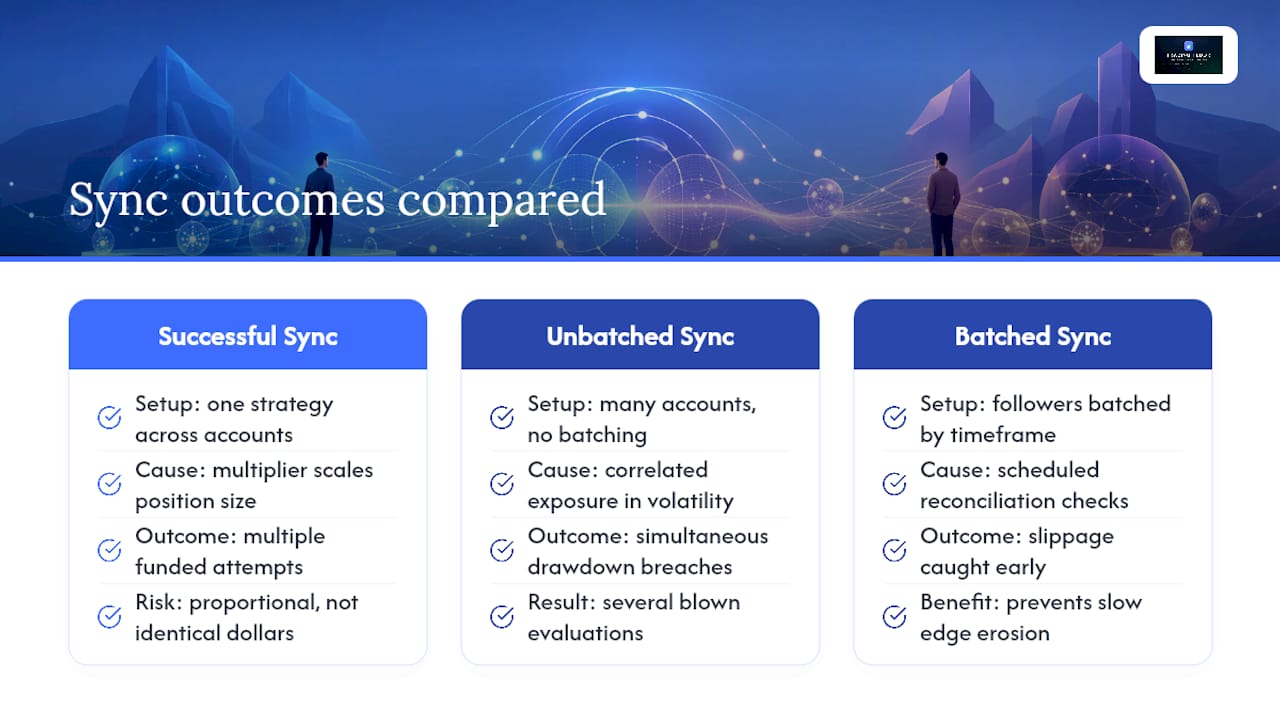
The clearest illustration of synchronization done right shows up in how traders pass multiple evaluations at once using one verified strategy instead of testing separate approaches on each account. Running one strategy across several evaluations simultaneously turns a single edge into several independent attempts at funding, and because the multiplier scales position size to each account, the risk profile stays proportional rather than identical in dollar terms.
The failure mode looks different but follows a predictable pattern. A trader syncs eight or ten evaluation accounts to a single master without batching, hits a losing streak during a volatile session, and watches every account breach its daily drawdown limit in the same few minutes. What would have been one blown evaluation under manual trading becomes eight blown evaluations under unbatched synchronization, because the correlated exposure that batching is designed to prevent never got addressed.
A middle-ground example is more common and more instructive: a trader runs three followers per master, batches them by strategy timeframe, and catches a slippage problem during a reconciliation check before it compounds. The follower fills were consistently landing two ticks worse than the master’s during the market open, a gap small enough to miss casually but large enough to erode an edge over dozens of trades. Catching it during a scheduled fill comparison, rather than after a month of quiet underperformance, is the entire point of building reconciliation into the routine rather than treating it as optional.
Comparing Ways to Synchronize Trading Accounts
Traders generally choose between three approaches, and each carries a different cost in time, risk, and reliability.
Manual copying means placing the same trade by hand on every account. It costs nothing beyond the trader’s own time, but it’s the slowest option and the most error-prone, especially past three or four accounts running simultaneously.
Broker-native or platform-specific copiers exist on some individual platforms, but they typically only mirror trades within that same broker’s accounts, which does little for a trader spread across Tradovate, TopstepX, and other futures platforms at once.
Cross-platform cloud copiers mirror net positions across different brokers and account types from a single dashboard, with per-account multipliers, risk limits, and alerts built in. This is the category that actually solves the multi-broker, multi-evaluation problem most active prop traders face, since it doesn’t require every account to live on the same platform to stay synchronized.
The tradeoff is setup time versus ongoing reliability. Manual copying takes minutes to start and hours to maintain badly. A cross-platform copier takes longer to configure correctly the first time, with multiplier math, risk caps, and a verification pass, but it removes the daily manual burden entirely once it’s running clean.
What Makes Cross-Platform Synchronization Difficult?
Every futures platform handles contracts, margin, and order types slightly differently, and that’s where cross-platform synchronization gets genuinely hard rather than just tedious.
Contract multipliers don’t map cleanly between brokers in every case. A position sized correctly on one platform can translate into an oversized or undersized follower trade on another if the copier doesn’t account for each platform’s specific contract specifications. Trading the same strategy across multiple brokers requires mapping those specifications broker by broker, not assuming they’re interchangeable.
Latency varies by platform too, and not evenly. A copier syncing to Rithmic-connected accounts may see different fill speeds than one syncing to a different order routing system, which means a latency test run on one broker doesn’t necessarily validate performance on another.
Order type support is the quieter problem. Not every platform supports the same bracket order or trailing stop logic, so a stop-loss that replicates perfectly on one follower account might need a different implementation on another to achieve the same protective effect. Testing each platform pairing individually, rather than assuming uniform behavior across the board, is what separates a copier setup that holds up under pressure from one that quietly drifts out of sync until a losing trade exposes the gap.
An Honest Take on Synchronization from the Trenches
The first time I ran three evaluation accounts through the same master without testing latency first, one follower filled four ticks worse than the master during a fast open. It wasn’t catastrophic, but it was a preview of what happens when you skip the demo phase to save a weekend.
Batching accounts and testing panic controls before scaling isn’t caution for its own sake. It’s the difference between synchronization that compounds an edge and synchronization that compounds a mistake. Done with real controls, it’s one of the more disciplined ways to scale a strategy you already trust.
Get Synchronized Accounts Running the Right Way
Setting up synchronization by hand across ten broker tabs is exactly the manual bottleneck this article just walked through. Trading Floor mirrors net positions in real time across funded and evaluation accounts, with per-account risk controls, contract multipliers, slippage caps, and push notifications so a disconnect or failed order gets flagged the moment it happens, not after the damage is done.
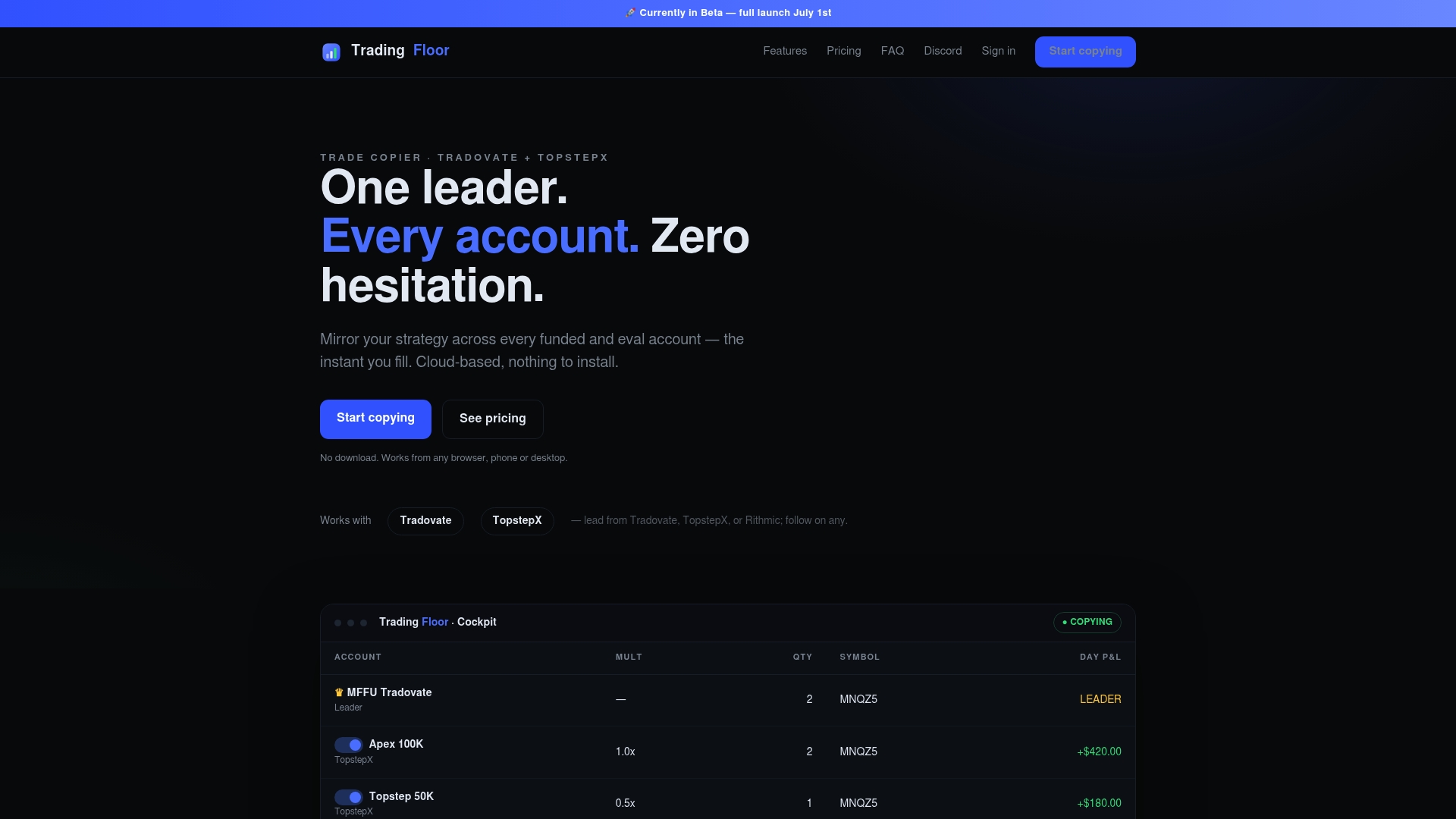
It’s cloud-based, works across platforms including Tradovate and TopstepX, and needs no installation on any device. If you’re managing multiple evaluations right now, the practical next step is running the checklist from this article inside a 30-day trial: sync a demo master to one follower, check latency, test the panic button, then scale from there. Start with the TopstepX Trade Copier if that’s your platform, or check the system status page before your first live sync to confirm everything’s running clean.
Sources
- Ultimate Guide to Trade Copying for Funded Accounts | Damn Prop Firms
- Running Multiple Prop Firm Accounts: My 20-Account Strategy | ThePropFirmGuide
- How Google helps you share data safely using Google Account Linking - Google Account Help
Recommended
- Account Evaluation Strategy Examples for Prop Traders in 2026 — Trading Floor
- Sync Evaluation and Funded Accounts: 2026 Guide — Trading Floor
- Evaluation Account Management Best Practices for Prop Traders — Trading Floor
- Pass Multiple Prop Firm Evals at Once With One Strategy — Trading Floor
Trading Floor mirrors every trade across your Tradovate, TopstepX & Rithmic accounts in real time, from $25/mo.
Start copying →