Account Evaluation Strategy Examples for Prop Traders in 2026

The most effective examples of account evaluation strategies for multi-account traders combine three things: centralized management with hard environment isolation, weighted scoring models built on auditable decision trees, and daily rule reviews that adapt to funded account constraints. Traders managing simultaneous evaluation and funded accounts need more than a checklist. They need a system where every account is scored, monitored, and governed in real time.
Key approaches used by professional prop traders and firms include:
- Centralized account structures that separate production from test environments using organizational units
- Weighted scoring rubrics combining firmographic fit, technographic signals, intent data, and engagement metrics
- Branching decision trees that make scoring defensible and auditable at every quarterly review
- Daily rule reviews before each session, especially after transitioning to trailing drawdown on funded accounts
- Real-time synchronization tools that mirror positions across multiple accounts with per-account risk controls
- Automation that handles position replication, breach alerts, and consistency tracking without manual intervention
Table of Contents
- 1. Centralized account management keeps environments from bleeding into each other
- 2. Professional scoring models use weighted rubrics, not gut calls
- 3. Transitioning to funded accounts requires a complete risk reset
- 4. Auditable decision trees outperform flat scoring rubrics
- 5. Tradingfloor’s platform handles real-time synchronization across all your accounts
- 6. How to sync evaluation and funded accounts using Tradingfloor
- 7. Risk controls for simultaneous account operations
- 8. Account evaluation in practice: what it looks like on a real trading day
- 9. KPIs that actually tell you how your accounts are performing
- Key Takeaways
1. Centralized account management keeps environments from bleeding into each other
The single biggest structural mistake in multi-account trading is running everything through one undifferentiated account. Isolating environments from the start provides a scalable, secure foundation that prevents systemic failures when one account hits a drawdown limit or triggers a risk breach.
The model that works: organize accounts into organizational units (OUs) that separate live funded accounts from evaluation accounts and test environments. Production workloads stay isolated from development and staging by default, with no cross-account access unless explicitly granted. This mirrors multi-account best practices used in cloud infrastructure governance, where account-level separation is the primary security boundary.
Consolidated billing across grouped accounts gives firms aggregated usage visibility and volume discounts, while each account retains its own performance record. Layered guardrails applied at the OU level enforce consistent risk controls across every member account without requiring manual policy updates per account.
2. Professional scoring models use weighted rubrics, not gut calls
Account scoring models that actually hold up under review combine firmographic data, technographic fit, intent signals, and engagement metrics into a single weighted score, recalculated frequently as market conditions shift. The score is not a static label. It reflects current behavior.

A practical structure weights fit highest because it is structural. Intent and engagement are amplifiers, not substitutes for fit. An account with strong engagement but poor fit rarely closes or performs as expected. Fit gates the conversation; intent and engagement confirm timing.
Pro Tip: Recalculate scores at least every two weeks. Signal data moves faster than firmographic data, and a score that is three months old is a liability in fast-moving markets.
Scoring thresholds should map directly to actions: top-tier accounts get immediate attention and multi-thread management, mid-tier accounts enter nurture sequences, and low-scoring accounts get parked until a qualifying signal appears.
3. Transitioning to funded accounts requires a complete risk reset
The shift from evaluation to funded trading is where most prop traders fail. Trailing drawdown replaces static drawdown on funded accounts, and that single change eliminates more funded traders than any other factor. Under static drawdown, profits give you a larger cushion. Under trailing drawdown, your margin of safety stays fixed regardless of how much profit you make.
Reduce position sizes during the first weeks on a funded account. This buffer period lets you adapt to the new risk math without hitting your drawdown ceiling while you are still recalibrating. Print your funded account rules and read them before every session. The differences from evaluation rules are subtle but consequential.
Consistency rules require that no single trading day contribute a disproportionate share of total profits. Many firms cap that at a defined maximum percentage per day. Violating this rule while profitable is one of the most common and avoidable disqualification triggers. Track daily profits in a separate spreadsheet to catch the problem before it happens. For a full breakdown of funded account risk rules, the specifics vary by firm and deserve their own dedicated review.
4. Auditable decision trees outperform flat scoring rubrics
A flat scoring rubric produces a single number with no visible structure. Nobody can tell whether that score came from fit or from engagement, which makes it impossible to defend in a review or recalibrate against historical data. Branching decision trees solve this by keeping the structure visible and every threshold testable.
The four-branch model works like this: Branch one covers fit (firmographic plus technographic). Branch two covers engagement (first-party signals). Branch three covers intent (third-party signals). Branch four is a strategic override for accounts that the standard fit branch underweights. The combination rule is multiplicative for fit and additive for engagement and intent, which means weak fit cannot be rescued by strong intent.
Governance runs on a quarterly calibration cycle. The team pulls the prior twelve months of outcomes, computes what score the tree would have produced at the moment each opportunity was created, and adjusts thresholds before weights, and weights before criteria. An annual full rebuild retires criteria that have lost predictive signal. This cadence is what makes the model auditable and compliant across business reviews.
5. Tradingfloor’s platform handles real-time synchronization across all your accounts
Tradingfloor is built specifically for prop traders running multiple funded and evaluation accounts simultaneously. The platform copies real-time positions across all accounts by mirroring the leader’s net position, not just signals. Every entry and exit replicates instantly, with individual risk controls configured per account.
The application runs in the cloud with no installation required, accessible from any device. It supports broker platforms including Tradovate and TopstepX, and minimizes execution errors that typically occur when traders manage accounts manually across different interfaces. Trade limits and real-time breach notifications give firms the control layer they need without building custom infrastructure.
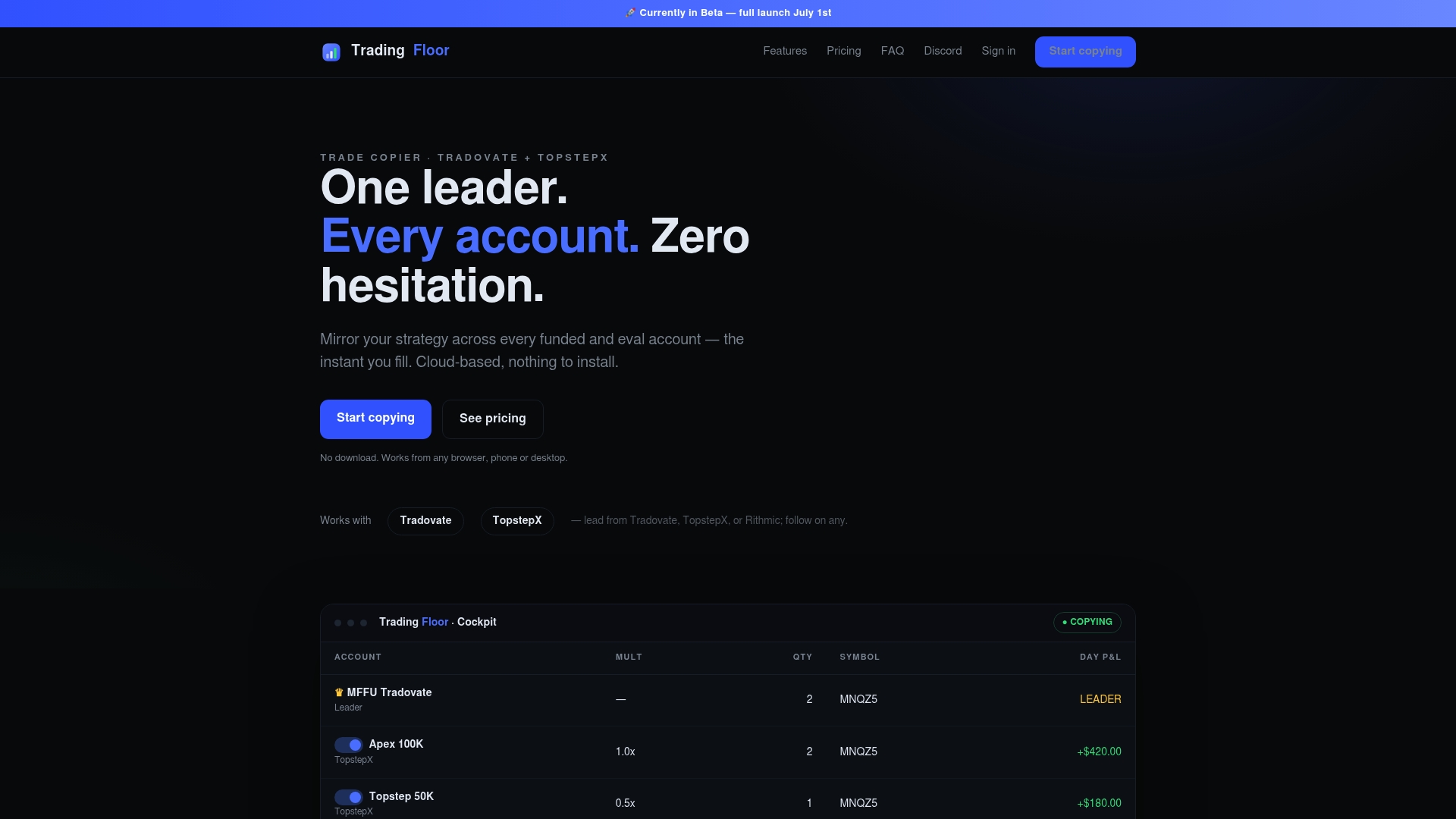
For traders who want to pass multiple evaluations simultaneously without running separate strategies per account, Tradingfloor’s synchronization model is the most direct path. Explore the full platform at Tradingfloor or review current pricing to match a plan to your account count.
6. How to sync evaluation and funded accounts using Tradingfloor
Start by designating one account as the leader. Tradingfloor mirrors that account’s net position across every connected account in real time. Set individual risk parameters per account before the session opens, not after a position is already running.
Adjust trade sizes within the platform to reflect each account’s specific drawdown constraints. A funded account with trailing drawdown needs tighter sizing than an evaluation account with static drawdown, even when the underlying strategy is identical. Tradingfloor’s dashboard surfaces per-account performance metrics so you can monitor consistency ratios and daily profit distribution without switching between broker interfaces. For a deeper look at multi-account execution, the mechanics of simultaneous order routing are worth understanding before you scale.
Build a pre-session checklist: review each account’s current drawdown level, check consistency metrics against the prior day’s profit distribution, and confirm risk parameters are set correctly. Automation handles the position replication. Your job is to verify the inputs are right before the session starts.
7. Risk controls for simultaneous account operations
Running multiple accounts at once multiplies both opportunity and exposure. A position that is correctly sized for one account may breach the daily loss limit on another if the risk parameters are not isolated per account. The core technique is per-account position sizing, calculated independently based on each account’s current equity, not a shared baseline.
Set hard daily loss limits per account and configure automated alerts to fire before the limit is reached, not at it. A 1.5% warning threshold on a 2% daily limit gives you time to flatten positions before a breach. Correlation risk is the other factor most traders underestimate: running the same directional trade across multiple accounts amplifies drawdown when the market moves against you. Cross-account trade management strategies address this by staggering entries or capping total exposure across the account group.
8. Account evaluation in practice: what it looks like on a real trading day
A prop trader running three accounts simultaneously, two in evaluation and one funded, opens the session by pulling up each account’s current drawdown level and checking the prior day’s consistency ratio. The funded account is at 60% of its trailing drawdown limit after a strong week, so position size drops by 20% for the session. The evaluation accounts are at 30% of their static drawdown limits, so sizing stays standard.
A signal fires. The leader account enters a long position. Tradingfloor replicates the entry across all three accounts within milliseconds, applying each account’s pre-set size modifier. The funded account gets the reduced size automatically. Mid-session, one evaluation account approaches its daily loss limit. An alert fires. The trader flattens that account’s position while leaving the others running. End of session: all three accounts are reviewed against their consistency metrics before the trader logs off. This kind of automated evaluation workflow is what separates disciplined multi-account operators from traders who manage everything manually.
9. KPIs that actually tell you how your accounts are performing
The metrics that matter for real-time account performance are not the same as end-of-month P&L. Daily drawdown utilization (how much of your daily limit you consumed) tells you whether your sizing is calibrated correctly. Consistency ratio (the percentage of total profit attributable to your single best day) flags whether you are building toward a consistency rule violation before it happens.
Win rate by session and average risk-to-reward per trade give you the signal-to-noise ratio on your strategy. A high win rate with a poor risk-to-reward ratio often means you are taking profits too early and letting losses run, which compounds quickly under trailing drawdown. Track these metrics per account, not in aggregate. An aggregate view hides the account that is quietly drifting toward a breach. Forensic-level behavioral and transactional analysis applied to account performance data can surface these patterns before they become disqualifying events.
Key Takeaways
The most effective account evaluation strategies combine environment isolation, auditable scoring models, and per-account risk controls reviewed daily before each trading session.
| Point | Details |
|---|---|
| Isolate account environments | Separate production, evaluation, and test accounts using organizational units to prevent cross-account risk leakage. |
| Use auditable scoring models | Branching decision trees with quarterly calibration outperform flat rubrics because every threshold is visible and testable. |
| Reset risk on funded accounts | Trailing drawdown replaces static drawdown on funded accounts, requiring recalculated position sizing from day one. |
| Track consistency ratios daily | No single trading day should contribute a disproportionate share of total profits; a spreadsheet catches violations before they happen. |
| Tradingfloor syncs positions in real time | The platform mirrors the leader’s net position across all connected accounts with individual risk controls per account. |
Recommended
- Pass Multiple Prop Firm Evals at Once With One Strategy — Trading Floor
- Automate Trades During Account Evaluation: A Prop Trader’s Guide — Trading Floor
- Why Prop Evaluators Monitor Trading Patterns — Trading Floor
- Prop Trader Performance Optimization Explained — Trading Floor
Trading Floor mirrors every trade across your Tradovate, TopstepX & Rithmic accounts in real time, from $25/mo.
Start copying →