Consistent Trade Sizing Across Accounts: A Prop Trader's Guide

Why consistent trade sizing across accounts determines your payout eligibility
Prop firms don’t just check whether you hit a profit target. They audit how you got there. Consistent position sizing means keeping your position sizes proportional to each account’s capital base and risk tolerance, trade after trade, without sudden jumps. Firms like Apex Trader Funding enforce this through hard rules: their 30% Consistency Rule requires that no single trading day account for more than 30% of total profit at payout time, and their Contract Scaling Rule restricts traders to half their maximum contracts until a trailing threshold is cleared.
- Proportional sizing preserves your risk structure across accounts of different sizes
- Erratic contract changes, especially right before a payout request, trigger automatic flags
- Sizing consistency is what separates a documented trading strategy from a lucky gamble in a firm’s eyes
Common challenges in maintaining uniform trade sizing
Managing sizing trades across accounts with different balances, leverage ratios, and broker margin rules is harder than it sounds. A 1-lot position on a $10,000 account carries ten times the proportional exposure of the same lot on a $100,000 account. Without automated scaling, traders routinely apply the wrong size to the wrong account.
The behavioral trap is just as dangerous. Traders tend to size up after winning trades and down after losses, a pattern that increases variance exactly when it hurts most. Automated audits flag positions exceeding roughly twice the account’s average lot size, and sudden jumps immediately before a payout request are among the most-detected patterns firms watch for.
- Different account sizes and leverage levels make manual proportional calculation error-prone
- Profit cap rules (some firms use 30% per day) interact directly with sizing spikes
- Firms monitor trade duration and volume together, flagging sudden scalping bursts or lot-size spikes as inconsistencies
Statistic: Prop firms use statistical distribution analysis to flag inconsistency, specifically when the largest position is significantly greater than the median size or when a spike occurs right before a payout request.
Best practices for achieving trade size consistency across funded accounts
The most reliable approach is risk-based sizing: fix your risk percentage per trade (commonly 1%), then let the stop-loss distance determine the lot size. When risk is constant, lot sizes stay naturally within the deviation ranges most firms allow.
- Use balance-based lot scaling so each account’s position size adjusts to its own capital base automatically
- Scale contracts gradually as balances grow (1 contract at $50K, 2 at $55K, 3 at $60K) rather than jumping sizes
- Document every sizing adjustment with a strategy reason; logical changes for volatility or account growth are allowed, undocumented jumps are not
- Audit your lot size distribution regularly: calculate your average, then check whether any trade exceeds twice that figure
- Never use tiny filler trades (0.01 lots) to pad trade counts; modern audit systems exclude these from average calculations and flag the behavior separately
Pro Tip: Keep a trade log that records the account balance, stop-loss distance, and calculated lot size for every trade. If a firm ever questions your sizing, a clean log showing consistent risk percentage is your strongest defense.
How sizing variance affects your chances of passing evaluations
Trading analyst Avi Roshkovan puts it plainly:
“Sizing variance eats survivability. Not the mean. Not the expectancy. The variance of the bet itself. The survivors weren’t the traders with the best edge. They were the traders who had the most boring sizing.” — Avi Roshkovan, Sizing Variance Is Eating Your Edge
Inconsistent sizing creates asymmetric risk: you tend to be fully exposed during losing streaks (because the previous trade was a win, so you sized up) and under-exposed during winning ones. That timing mismatch compounds against you. A flat sizing rule on every trade keeps drawdown predictable and survivable. Variable sizing, even with the same average, can push drawdown well beyond funded account limits.
A stable sizing strategy also keeps you inside the 2x deviation range most firms enforce. If your average is 2 lots and one trade hits 10 lots, the firm may disqualify that trade’s profit entirely, regardless of whether you cleared the profit target.
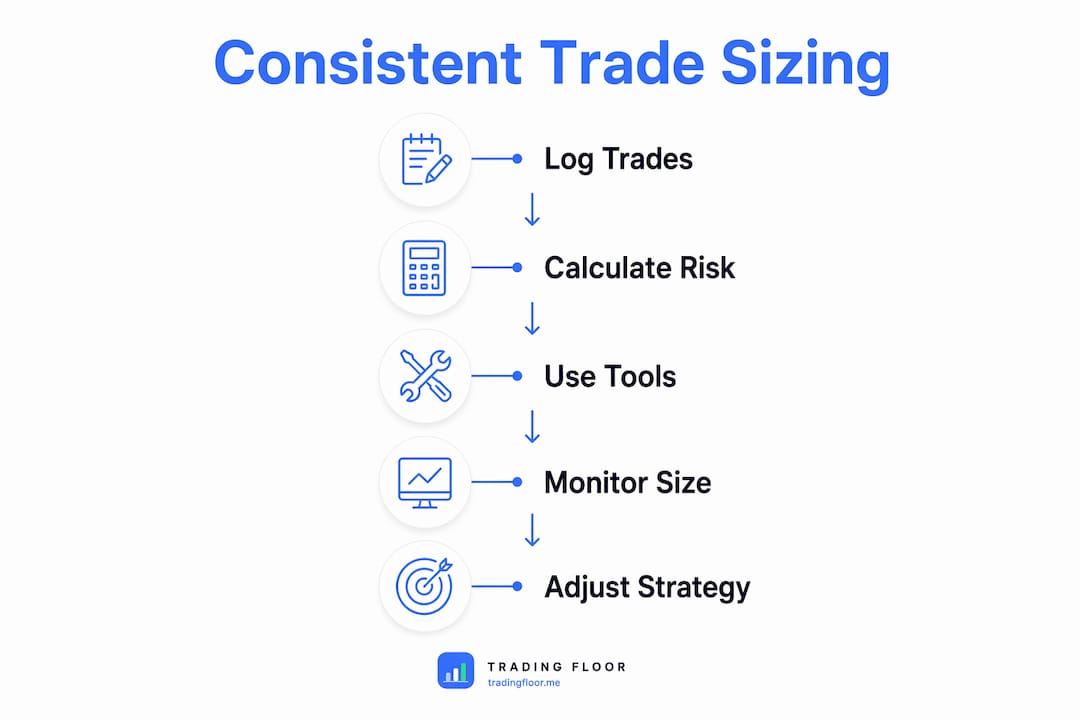
Tools and technology that synchronize sizing across multiple accounts
Balance-based lot scaling is the technical foundation: the system calculates each account’s position size from the ratio of its balance to the master account, then recalculates dynamically at execution time so stale settings never cause a mismatch.

Tradingfloor is built specifically for this problem. The cloud-based platform mirrors the leader’s net position across funded and evaluation accounts on Tradovate and TopstepX in real time, with individual risk controls per account. No installation required, accessible from any device.
| Feature | What it does |
|---|---|
| Balance-based lot scaling | Sizes each follower account proportionally to its own capital |
| Dynamic recalculation | Recalculates lot size at execution, not at setup |
| Per-account risk controls | Lets each account hold its own max contract or risk limit |
| Real-time notifications | Alerts you to sizing anomalies before they become violations |
| Trade limit controls | Caps position size per account to prevent accidental oversizing |
Additional tools worth knowing: position size calculators that take stop-loss distance and account balance as inputs, and prop trader performance tools that help you track sizing discipline alongside other execution metrics.
Why prop trading accounts demand sizing discipline above all else
Prop firms provide capital to traders who demonstrate a repeatable edge, not a lucky streak. When 80% of your profit comes from one outsized position on a news event, the firm reads that as a Martingale approach, not professional trading. Consistent sizing is the evidence that your results are reproducible.
The contract size consistency rule at Apex Trader Funding makes this explicit: traders must use contract sizes that reflect a consistent approach throughout the account’s lifecycle, from inception to payout. Adjustments tied to account growth or documented strategy changes are fine. Drastic changes to manipulate a payout are grounds for forfeiture.
How to calculate trade size uniformly across different account sizes and instruments
Use this procedure for every account, every trade:
- Set your risk percentage. Fix it at 1% of account balance (or whatever your firm allows). Never adjust it trade by trade.
- Measure your stop-loss distance in ticks or pips for the specific instrument.
- Calculate dollar risk per contract. For ES futures, one tick equals $12.50; for MES, $1.25. Multiply tick distance by dollar-per-tick.
- Divide account risk by dollar risk per contract. That gives your contract count for that account.
- Apply the same formula to every account, substituting each account’s balance. A $100K account gets twice the contracts of a $50K account at the same risk percentage.
- Check against firm maximums before sending the order.
This formula keeps sizing proportional across instruments with very different notional values, whether you trade ES, NQ, or MES.
How to manage sizing when accounts have different leverage or margin requirements
Leverage differences mean the same lot size can consume very different percentages of margin across brokers. The fix is to anchor sizing to dollar risk, not to contract count. When you calculate position size from a fixed risk percentage and a stop-loss distance, the resulting lot size automatically adjusts for the instrument’s notional value and the account’s available margin.
For accounts with strict maximum contract rules, use a fixed-mode cap as a hard ceiling. If the balance-based calculation produces 8 contracts but the firm caps you at 5, the cap wins. Platforms like Tradingfloor enforce per-account maximums automatically, so a calculation error on one account never bleeds into another.
How to monitor and audit trade size consistency in real-time
Real-time monitoring catches sizing drift before it becomes a flag. After every session, calculate your average lot size across all trades and identify any position that exceeded twice that figure. If one exists, document the reason before your next trade.
Firms monitor trade duration and volume together, so a sudden shift from swing trades to rapid scalping also triggers review. Keep a running spreadsheet or use your platform’s trade history export to track lot size distribution weekly. The goal is a tight cluster around your target size, with no outliers that a statistical audit would flag. Tradingfloor’s real-time notifications alert you the moment a copied position approaches a configured limit, giving you time to act before a violation is recorded.
Key Takeaways
Consistent trade sizing across accounts is the single most audited behavior in prop trading, and fixing it requires a systematic, documented approach applied to every account simultaneously.
| Point | Details |
|---|---|
| Risk-based sizing is the anchor | Fix your risk percentage per trade so lot sizes stay within firm deviation limits automatically. |
| Gradual scaling only | Step up contracts as balances grow; sudden jumps trigger statistical flags regardless of profitability. |
| Variance kills survivability | Variable sizing increases drawdown risk asymmetrically, even when the average size looks fine. |
| Automate across accounts | Balance-based lot scaling tools recalculate each account’s position size at execution, removing manual error. |
| Document every adjustment | Logical sizing changes tied to account growth or volatility are allowed; undocumented ones are not. |
Tradingfloor keeps every account in sync
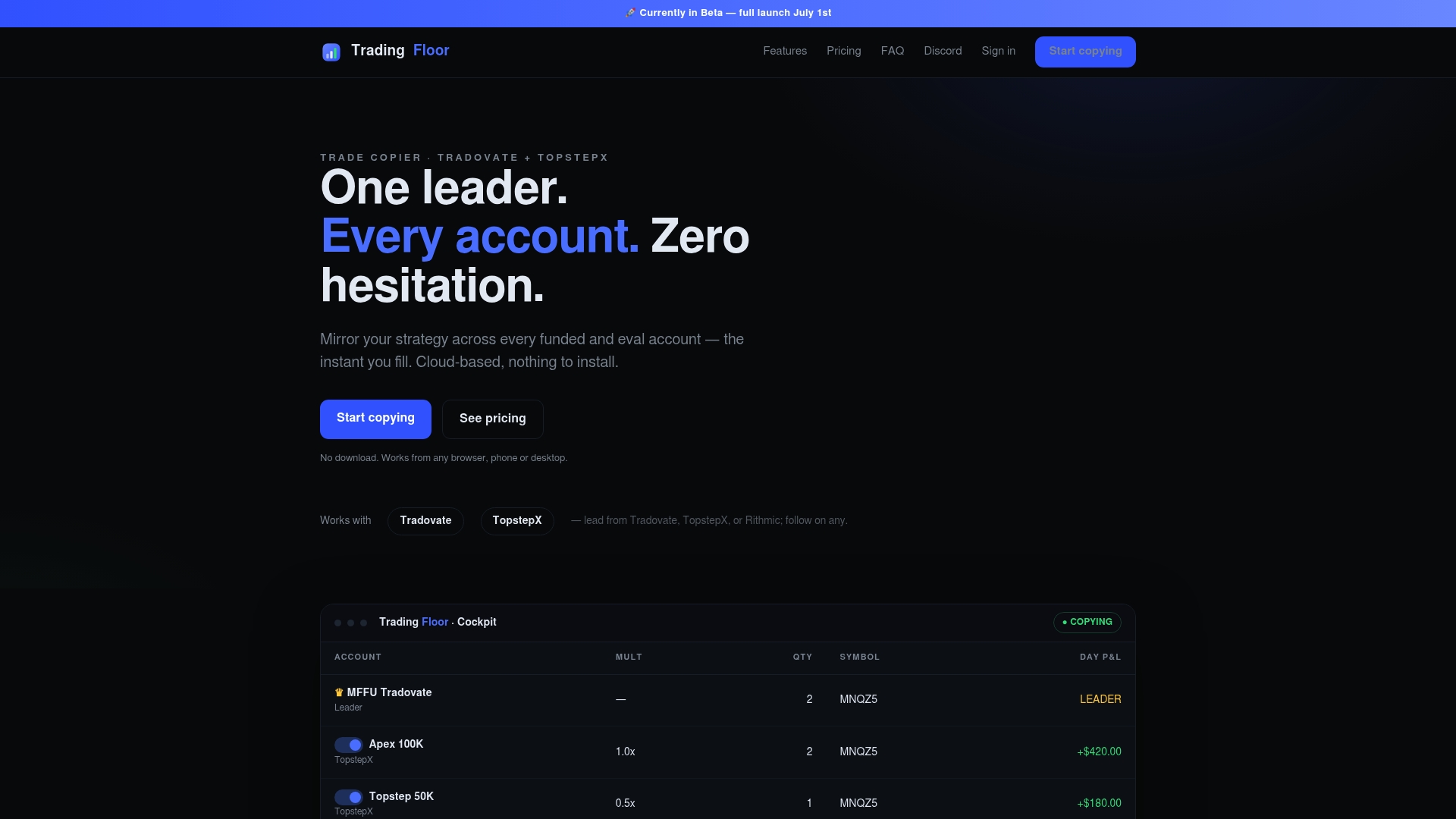
Tradingfloor mirrors your leader account’s net position across all your funded and evaluation accounts in real time, with per-account risk controls, trade limit caps, and instant notifications. No installation, no manual recalculation, no sizing errors. Start managing every account from one place and keep your sizing exactly where prop firms expect it.
Recommended
- Trade the Same Strategy Across Multiple Brokers — Trading Floor
- Prop Account Trade Limit Setup: Your 2026 Guide — Trading Floor
- Avoid Consistency Rule Violations When Copying Trades — Trading Floor
- Multi-Account Trade Execution Explained for Prop Traders — Trading Floor
Trading Floor mirrors every trade across your Tradovate, TopstepX & Rithmic accounts in real time, from $25/mo.
Start copying →