How to Mirror Trades Across Prop Accounts Precisely

Mirror trading across prop accounts is the process of automatically copying trades from one lead account to multiple follower accounts you own, replicating every entry, exit, stop-loss, and profit target without manual re-entry. The efficiency gain is dramatic. Manual execution on 10 accounts takes nearly 60 seconds per trade, while automation replicates the same trade in milliseconds. That gap is the difference between consistent execution and compounding errors across every funded account you hold. Tradingfloor is built specifically for this workflow, mirroring net positions across Tradovate and TopstepX accounts with per-account risk controls applied in real time.
What tools do you need to mirror trades across prop accounts?
The right infrastructure separates traders who scale cleanly from those who blow accounts through preventable errors. You need three things before placing a single mirrored trade: compliant software, reliable connectivity, and properly configured accounts.
Native vs. third-party copier software
Native platform copiers are built into a broker’s interface and work only within that ecosystem. Third-party trade copiers offer superior risk controls, synchronization, and compatibility across multiple prop firms. That cross-firm flexibility is what makes them the standard choice for traders managing funded accounts at more than one firm simultaneously.
Connectivity and hardware requirements
A Virtual Private Server (VPS) is not optional for serious multi-account trading. Your home internet connection introduces latency and downtime risk that a VPS eliminates. Choose a VPS located in the same data center region as your broker’s servers. Latency under 10 milliseconds between your copier and the broker’s execution engine keeps synchronization tight.
Prop firm compliance rules
Trade copying is allowed only between accounts owned by the same individual trader. Copying from another trader’s account or using third-party signals violates prop firm rules and results in immediate account termination. Read each firm’s terms before configuring any copier software.
Account setup checklist
Before going live, verify these items across every follower account:
- Contract multipliers: Confirm that one lot on the master account maps correctly to the intended size on each follower. A mismatch here causes disproportionate trade sizes that trigger margin violations.
- Position sizing framework: Align each follower’s sizing to its available drawdown room, not its nominal balance.
- Risk limits: Set per-account daily loss caps inside your copier software before activation.
- Platform credentials: Confirm API keys or login credentials are active and authenticated for every account.
| Feature category | What to look for |
|---|---|
| Synchronization speed | Sub-100ms order replication |
| Risk controls | Per-account drawdown and lot limits |
| Multi-firm support | Works across different broker platforms |
| Monitoring and alerts | Real-time notifications for failed orders |
| Cloud access | No local installation required |
Pro Tip: Run a paper-trade test on all follower accounts for at least one full session before going live. Confirm that every order, stop-loss, and profit target appears correctly on each account before risking real capital.
How to mirror trades step by step
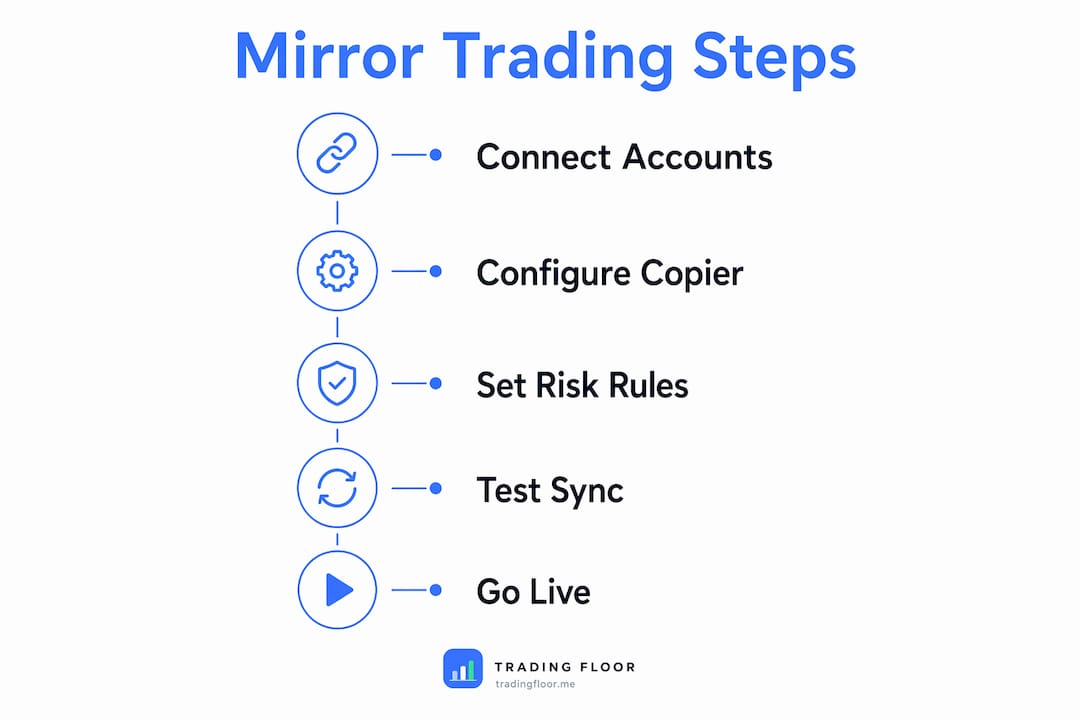
A clean workflow removes ambiguity at every stage. Follow these steps in order, and do not skip verification steps to save time.
-
Select your lead account. Choose the account with the most headroom and the cleanest track record as your master. This is the account whose positions all followers will replicate.
-
Install and configure your copier software. Set the master account as the signal source. Input each follower account’s credentials. Configure synchronization settings to minimize latency, targeting sub-100ms replication.
-
Set contract multipliers for each follower. Manually verify that the lot-size ratio between master and each follower reflects your intended position sizing. Do not rely on default settings.
-
Apply per-account risk limits. Set a daily loss budget for each follower account based on its available drawdown room, targeting 25–30% of that room as the daily cap. This keeps a bad day on one account from cascading into others.
-
Activate stop-loss and take-profit synchronization. Confirm that your copier software replicates these parameters automatically. Stop-loss and profit-target sync should occur in under 100 milliseconds on average.
-
Place a test trade on the master account. Verify that every follower account reflects the position within seconds. Check order size, direction, stop-loss level, and profit target on each account individually.
-
Monitor execution logs in real time. Review the copier’s log after every session. Flag any failed orders, partial fills, or disconnection events immediately.
-
Establish a daily review routine. Check connectivity, account balances, and open positions each morning before the session starts. Catching a disconnected follower account before the market opens prevents missed exits.
Pro Tip: Set up real-time push notifications or email alerts for failed orders on any follower account. A missed stop-loss on one account during a fast-moving market can wipe a day’s gains across your entire portfolio.
Common execution risks and how to avoid them
Scaling across multiple prop accounts multiplies execution risk exponentially. A single synchronization failure can trigger violations on every follower account simultaneously. Knowing the specific failure modes lets you build defenses before they cost you.
Latency and slippage
Latency above 50 milliseconds between your copier and a broker’s server causes slippage on follower accounts. The master account fills at one price, but followers fill later at a worse price. Over dozens of trades, that slippage compounds into a measurable drag on performance. A VPS in the same region as your broker’s servers is the most direct fix.
Contract multiplier mistakes
A “1 lot” position on the master account does not automatically translate correctly to every follower. If the multiplier is misconfigured, a follower account could open a position five times larger than intended. That single error can breach a daily drawdown limit before you notice. Verify multipliers manually before every new account goes live.
Missed stop-loss or take-profit sync
Some copier configurations replicate the initial order but fail to carry over subsequent stop-loss adjustments. If you move a stop to breakeven on the master, every follower must reflect that change. Confirm your software handles dynamic order modifications, not just initial placement.
Platform disconnects and flattening failures
A follower account that disconnects mid-session will not receive close orders. The position stays open while the master exits. This is the most dangerous failure mode because it can leave a follower account exposed through a news event or overnight session.
Execution risks multiply as follower accounts disconnect or fail to synchronize. Third-party copiers with automatic reconnection and position reconciliation are the only reliable defense for traders managing multiple funded accounts at scale.
- Use automatic reconnection settings in your copier software so disconnected accounts rejoin and reconcile open positions.
- Set maximum position limits per follower account to cap exposure if a close order fails to transmit.
- Review open positions on every account at session end, not just the master.
- Keep a manual flattening procedure ready so you can close all positions across accounts quickly if the copier fails entirely.
How to optimize your mirror trading strategy for scaling
Position sizing and strategy selection determine whether scaling adds profit or multiplies losses. The mechanics of copying are only as good as the underlying prop trading strategy you replicate.
Choosing compatible prop trading strategies
Supply and demand zone trading is one of the most compatible approaches for mirror trading techniques in prop firm environments. Successful traders using supply and demand strategies target risk-reward ratios between 2:1 and 5:1, reaching 10% profit targets over approximately 20 trades across two to three weeks. That trade frequency is low enough to keep execution manageable across multiple accounts without overwhelming your monitoring capacity.
Calibrating position sizing to drawdown room
Daily loss budgets should be based on drawdown room, not total account balance. A $100,000 account with a $3,000 maximum drawdown has a very different risk capacity than a $100,000 account with a $6,000 drawdown. Size positions to the available drawdown room on each follower account individually. This prevents a single losing streak from eliminating an account that had more room to absorb losses.
Staggered entries to reduce correlated risk
Entering every follower account at the exact same moment creates fully correlated risk. If the trade goes against you, every account loses simultaneously. Staggered entries, where followers enter at slightly different price levels or after confirmation signals, reduce that correlation. The tradeoff is slightly different fill prices, but the reduction in simultaneous drawdown is worth it when managing four or more accounts.
Pro Tip: Apply a fixed risk percentage per trade across all accounts, but calculate that percentage against each account’s remaining drawdown room rather than its starting balance. This keeps your total exposure proportional as accounts grow or shrink.
| Strategy element | Target range |
|---|---|
| Risk-reward ratio | 2:1 to 5:1 per trade |
| Trades to reach 10% profit target | ~20 trades |
| Daily loss budget (drawdown-based) | 25–30% of available drawdown room |
| Recommended trade frequency | Low to moderate (avoids monitoring overload) |
For a deeper look at multi-account execution frameworks, the mechanics of position sizing and risk-reward calibration across funded accounts are worth studying before you scale beyond two or three accounts.
Key Takeaways
Mirroring trades across multiple prop accounts requires automated synchronization, per-account risk controls, and verified contract multipliers before any live trading begins.
| Point | Details |
|---|---|
| Automation speed advantage | Automated copiers replicate trades in milliseconds versus 60 seconds for manual entry across 10 accounts. |
| Compliance is non-negotiable | Copy only between accounts you own. Copying another trader’s account causes immediate termination. |
| Contract multipliers need manual checks | Verify lot-size ratios on every follower account before going live to avoid margin violations. |
| Size to drawdown room, not balance | Base daily loss budgets on 25–30% of available drawdown, not nominal account balance. |
| Third-party copiers outperform native tools | They offer better synchronization, cross-firm support, and per-account risk controls for scaling safely. |
Why I think most traders underestimate the operational side of mirror trading
Most traders focus entirely on strategy when they think about copy trading in prop firms. They spend weeks perfecting a supply and demand setup, then wire it into a copier and assume the hard work is done. The operational side is where accounts actually get blown.
I have watched traders lose funded accounts not because their strategy failed, but because a follower account disconnected during a news spike and held a position open for three hours after the master exited. The strategy was fine. The infrastructure was not. That distinction matters enormously when your capital is spread across four or five accounts.
The other mistake I see constantly is aggressive scaling before the system is proven. Running two accounts for a full month before adding a third is not slow. It is the only way to know whether your copier handles reconnections, dynamic stop-loss adjustments, and partial fills correctly under real market conditions. Incremental scaling is not caution. It is how you protect the accounts you already have.
Prop firm compliance also deserves more attention than it gets. The rule that copying is restricted to your own accounts is enforced, and violations are not reversed. Read the terms of every firm you trade with, and re-read them when firms update their policies. One compliance error can eliminate months of funded account progress in a single day.
The traders who scale mirror trading successfully treat it like running a small operation, not just pressing a button. Daily log reviews, weekly infrastructure checks, and conservative position sizing are not optional extras. They are the system.
— KennyTrades
Tradingfloor keeps your mirror trading infrastructure visible
Knowing your copy trading infrastructure is running before you place a trade is not a luxury. It is a requirement. Tradingfloor gives prop traders a cloud-based position mirroring system that works across Tradovate and TopstepX accounts with no local installation needed.
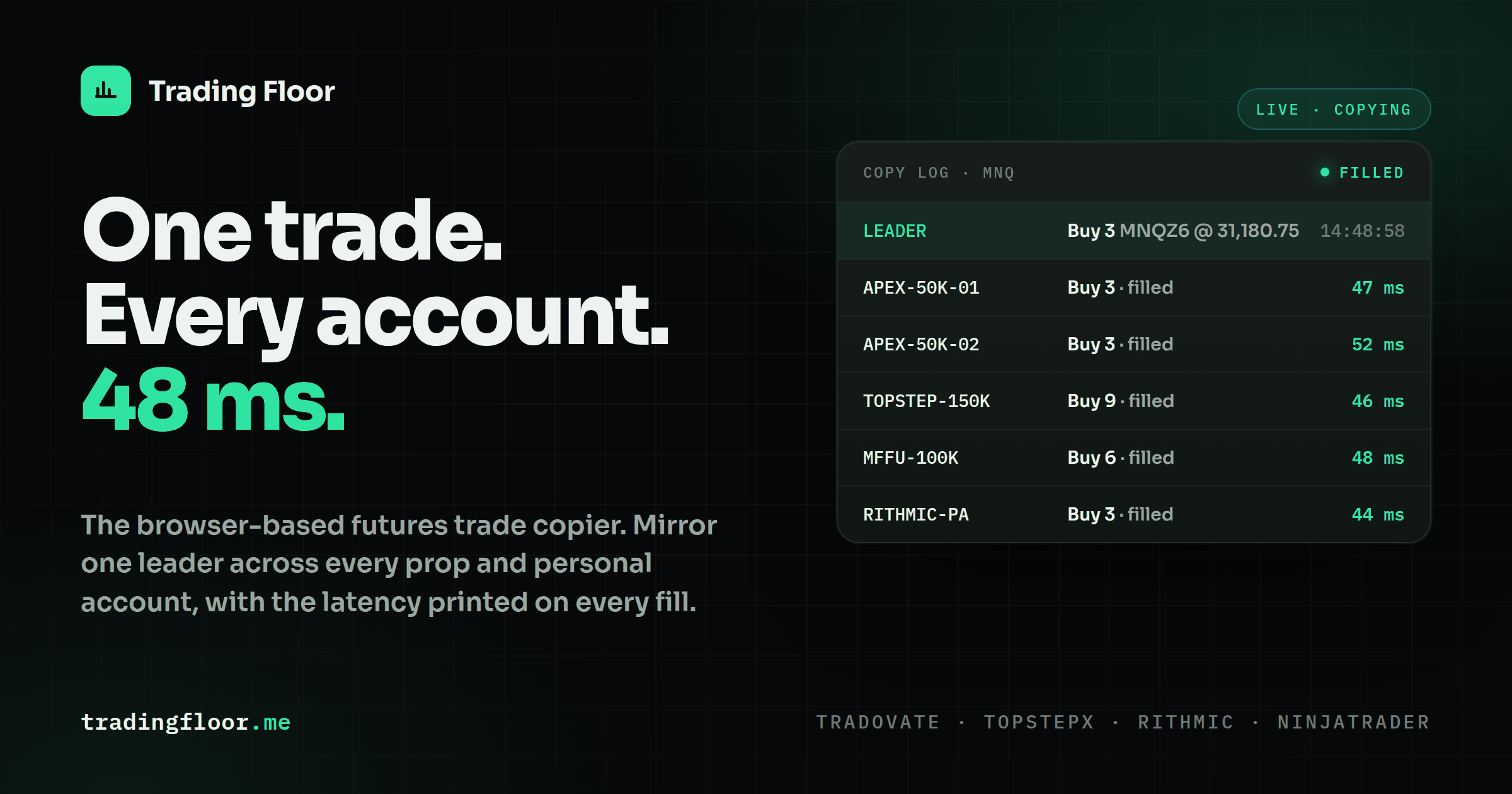
Check the live system status at any time to confirm service uptime before your session starts. Tradingfloor mirrors the leader’s net position across funded and evaluation accounts in real time, with per-account trade limits and instant notifications when something needs your attention. For traders who want to automate position copying without building a custom infrastructure from scratch, Tradingfloor is the direct path from strategy to execution.
FAQ
What does it mean to mirror trades across prop accounts?
Mirroring trades across prop accounts means automatically copying every position from a lead account to multiple follower accounts you own, including entries, exits, stop-losses, and profit targets, without manual re-entry on each account.
Can I copy trades from another trader’s prop account?
No. Prop firms restrict copying to accounts owned by the same individual. Copying from another trader’s account or using third-party signals violates firm rules and results in account termination.
How fast do trade copiers replicate orders?
Quality trade copiers replicate orders, stop-losses, and profit targets in under 100 milliseconds on average. Manual execution across 10 accounts takes close to 60 seconds, making automation the only practical option at scale.
How should I size positions when mirroring across multiple accounts?
Base each account’s position size on its available drawdown room, targeting a daily loss budget of 25–30% of that room. Sizing to nominal balance rather than drawdown room leads to overexposure on accounts with tighter limits.
What is the biggest risk when mirror trading multiple prop accounts?
Platform disconnects are the highest-risk failure mode. A follower account that loses connection mid-session will not receive close orders, leaving positions open after the master exits. Use copier software with automatic reconnection and reconcile open positions manually at session end.
Recommended
- How to Copy Trades Across Multiple Prop Firm Accounts Like TopstepX — Trading Floor
- Why Traders Use Account Mirroring to Scale Fast — Trading Floor
- What Tools Let You Mirror Trades from One Tradovate Account to Several Others? — Trading Floor
- Types of Trade Copying Strategies: 2026 Guide — Trading Floor
Trading Floor mirrors every trade across your Tradovate, TopstepX & Rithmic accounts in real time, from $25/mo.
Start copying →