Evaluation Account Management Best Practices for Prop Traders

Running multiple evaluation and funded accounts in real time without blowing one comes down to five non-negotiable controls: scale risk down when you go funded, cap session exposure at 60% of your daily limit, monitor Distance to Limit and Drawdown Buffer independently (not from the firm’s dashboard), enforce every decision through a written rulebook, and never deploy live without staged testing. Tools like Tradingfloor, PropJournal, and NexusFi each address pieces of this system, but the system itself has to be yours before any platform can enforce it.
Five controls to apply before your next session:
- Cut risk-per-trade by 30–50% when you go funded
- Set a session stop at 60% of your daily loss limit, hard stop at 80%
- Run an independent local tracker for Distance to Limit, not just the firm’s dashboard
- Pre-write your rulebook and automate enforcement before placing a single funded trade
- Paper-trade your sync setup for at least 10 sessions before going live
Pro Tip: Pre-calculate your position sizes before the setup appears on the chart. If you are doing the math while the candle is forming, you are already making an emotional decision.
Table of Contents
- How does risk management change when you move to a funded account?
- How do you build a checklist-driven rulebook that removes emotion?
- What real-time metrics should every multi-account trader track?
- How does account synchronization and trade mirroring actually work?
- What operational controls protect funded accounts day to day?
- What does a staged deployment plan look like for multi-account sync?
- What are the most common pitfalls managing multiple evaluation and funded accounts?
- Key Takeaways
- The part most guides skip entirely
- Tradingfloor gives you real-time mirroring with the controls built in
- Useful sources and further reading
How does risk management change when you move to a funded account?
The short answer: reduce evaluation risk by 30–50% when on funded capital. Losing a funded account means paying for another challenge and starting over. The cost of failure is categorically higher, and your position sizing needs to reflect that.
PropJournal’s tiered guidance maps it out clearly:
| Account size | Daily loss limit | 60% session cap | Per-trade cap (ultra-conservative) |
|---|---|---|---|
| — | $500 | — | 0.25% per trade risk |
| — | $1,000 | — | 0.25% per trade risk |
| — | — | — | 0.25% per trade risk |
| — | — | — | 0.25% per trade risk |
Three practical tiers to work from:
- Ultra-conservative (first 30 days funded): very low per trade risk, with a strict limit on consecutive losses before stopping
- Standard funded: moderate per trade risk with a daily stop after multiple losses
- Aggressive (only after a $1,000+ buffer above the drawdown floor): higher per trade risk levels
The 60% session rule is the single most underused control. Limit session aggregate risk well below your daily loss limit so a buffer remains for unexpected market events, with tiered soft and hard stops.
Pro Tip: Consistent small risk beats chasing scale increases. A trader who hits 0.25% per trade every day for three months earns payout eligibility. A trader who swings between 0.25% and 1.5% usually doesn’t.
How do you build a checklist-driven rulebook that removes emotion?
Write the rulebook before you trade funded capital, then automate enforcement so edge decisions are never made in the moment. The NexusFi funded trader operations manual describes a 4-band risk escalation system that works well as a template.
Four-band escalation:
- Green (0–50% daily limit used): Trade normally at your standard tier
- Yellow (50–60% used): Scale down to half your normal position size
- Orange (60–80% used): Stop trading new positions; manage open trades only
- Red (80%+ used): Flatten everything; session is over
Operationalizing this means more than knowing the bands. Before each session, run a pre-session checklist. Before each trade, timestamp a rule-check confirming which band you are in. Mid-session, log any override attempt and the reason. Every override gets captured, not ignored.
A short numbered checklist to adapt:
- Check current drawdown and daily loss used before market open
- Confirm which risk band you are in and set position size accordingly
- Log the band and size in your trade ledger with a timestamp
- After each trade, recheck the band before the next entry
- At session close, log final P&L, band reached, and any overrides
Pro Tip: Store time-stamped rule-checks in a dedicated folder and attach them to your trade ledger. If a payout dispute arises, that folder is your evidence.
The Jalen Trades funded-account checklist framework adds a session-grade sizing layer: assign each session a quality grade (A/B/C) based on market conditions and trade only at full size on A-grade sessions. That one filter alone cuts impulsive entries on low-conviction days. You can automate trades during evaluation and carry those same automation rules into funded trading.

What real-time metrics should every multi-account trader track?
Track Distance to Limit and Drawdown Buffer as your primary metrics, not plain balance or P&L. Balance tells you where you are; these two metrics tell you how close you are to losing the account.
| Metric | Why it matters | How to compute |
|---|---|---|
| Distance to Limit | Shows exactly how much room remains before account termination | Current equity minus drawdown floor (static) or peak equity minus drawdown floor (trailing) |
| Drawdown Buffer | Percentage of max drawdown still available | (Distance to Limit ÷ Max drawdown) × 100 |
| Session exposure | Aggregate risk across all open mirrored positions | Sum of per-account open risk in dollars |
| Daily loss used | Tracks progress toward the daily cap | Starting balance minus current equity |
For trailing drawdown firms, track peak intraday equity as the high-water mark. The Distance to Limit calculation changes every time equity makes a new high, which means your risk band can shift mid-session without a single losing trade.
Firm dashboards often update in intervals, sometimes only end-of-day. Run an independent local tracker for real-time distance-to-breach calculations. A spreadsheet refreshed on every fill is better than a firm portal that lags by 15 minutes.
Dashboard elements to surface and alert thresholds to preset:
- Distance to Limit: warn at 75% consumed, hard action at 80%
- Drawdown Buffer: warn when below 25% remaining
- Session exposure: alert when aggregate open risk exceeds 40% of daily limit
- Correlation flag: alert when two or more accounts hold the same instrument in the same direction
How does account synchronization and trade mirroring actually work?
Mirror net positions, but always apply per-account scaling and independent risk caps. A 1:1 mirror across accounts of different sizes is a sizing error waiting to happen.
Three common mirroring models:
- 1:1 mirror: Same lot size on every account. Works only when all accounts are identical in size and drawdown buffer.
- Scaled mirror: Lot size proportional to account size. A $100K account gets twice the lots of a $50K account.
- Ratio-based sizing: Lot size tied to each account’s remaining Drawdown Buffer. Accounts with less buffer get smaller size automatically.
Latency and slippage matter more than most traders expect. A 200ms delay between the leader fill and the follower fill can mean a different average price on fast-moving instruments. Test acceptable tolerances in a paper or sandbox environment before deploying live. Tradovate and TopstepX both support API connectivity, but order rejection handling and partial fill behavior differ by broker. Check both before syncing.
Pre-sync test checklist:
- Confirm API connectivity and authentication on all accounts
- Test order rejection handling (what happens when one account rejects and others fill)
- Verify partial fill behavior and how the system reconciles mismatched sizes
- Run a slippage stress-test on a volatile session in paper mode
- Confirm kill-switch functionality flattens all accounts simultaneously
Pro Tip: Log both the leader trade ID and the follower trade ID for every mirrored fill. Dual-logging makes reconciliation after a partial fill or rejection a five-minute task instead of a two-hour one. For multi-platform trading, this is non-negotiable.
What operational controls protect funded accounts day to day?
Automate every control you can and log every action. The minimum automation set for a funded trader running multiple accounts:
- Hard daily cap block: platform prevents new orders once daily loss limit is hit
- Near-floor warn alerts at 75% and 80% of daily limit consumed
- Manual-flatten procedure documented and rehearsed before live trading
- Optional auto-flatten condition tested in paper mode before enabling live
For record-keeping, complete documentation resolves payout disputes in roughly 2 business days versus 10–14 when records are incomplete. Build this folder structure from day one:
- Trade ledger with timestamps, instrument, size, entry/exit, P&L, and risk band at entry
- Session snapshots (risk panel screenshot at open and close)
- Rule-check log with timestamps
- Communications archive (any firm correspondence)
- Payout request records
Retain trade ledgers for 5–7 years and payout records for 7 years. The Audacity funded trader journal guide recommends logging distance to daily loss limit, drawdown floor, evaluation phase, and an emotional-state tag for each trade. That emotional-state tag is the field most traders skip and the one that reveals behavioral drift fastest.
Alert types and recommended recipients:
- Phone push: Distance to Limit at 75% and 80%
- Email: daily session summary with P&L and band reached
- Platform webhook: auto-flatten trigger confirmation
What does a staged deployment plan look like for multi-account sync?
Always run staged deployment: paper first, then sandbox or low-risk live, then gradual scale. Skipping stages is how traders discover slippage problems with real funded capital on the line.
| Stage | Duration | Success gate before advancing |
|---|---|---|
| Paper / simulation | 10 sessions minimum | Zero rule violations, alerts fire correctly, kill-switch tested |
| Low-risk live (1 account, minimum size) | 2 weeks | Consistent compliance, slippage within tolerance, reconciliation clean |
| Add second account | 2 weeks | Both accounts compliant, no sync errors, drawdown buffers healthy |
| Full scale | Ongoing | All accounts profitable, buffers above 50%, monitoring overhead manageable |
Expect evaluation or challenge fees during the testing period. Most firms charge $100–$500 per evaluation account depending on size, so budget for at least one or two test passes before scaling to multiple funded accounts simultaneously.
What are the most common pitfalls managing multiple evaluation and funded accounts?
The most frequent failures are tracking the wrong metrics, relying on willpower instead of rules, and mis-scaling correlated exposure across accounts.
- Tracking balance instead of Distance to Limit: Fix: replace your primary dashboard widget with Distance to Limit and Drawdown Buffer.
- Stale dashboard reliance: Firm portals lag. Fix: run a local spreadsheet that updates on every fill.
- Volume drift: Lot sizes creep up over winning streaks. Fix: cap max lot at 2× your average lot size and automate the cap.
- Mixing account ledgers: Entries from different accounts in one spreadsheet create reconciliation errors. Fix: one ledger file per account, one combined summary file.
- Manual overrides without logging: Overrides that go unlogged become habits. Fix: every override gets a timestamp and a written reason before execution.
- Correlated exposure across accounts: Same instrument, same direction on four accounts means a bad 30 minutes hits all four simultaneously. Fix: stagger entry times by at least 5 minutes or assign different sessions per account.
- Skipping the Friday review: A 45-minute weekly review across five modules (trade quality, session exposure, drawdown progression, rule compliance, payout eligibility) catches behavioral drift before it becomes a blown account.
For deeper guidance on risk management rules that apply across evaluation and funded phases, the fundamentals do not change, but the stakes do.
Key Takeaways
Running multiple funded accounts safely requires five controls applied consistently: risk scaling, session caps, independent real-time monitoring, rulebook automation, and staged deployment before going live.
| Point | Details |
|---|---|
| Scale risk down immediately | Cut risk-per-trade by 30–50% when moving from evaluation to funded capital. |
| Use the 60% session rule | Stop adding new positions once 60% of your daily loss limit is consumed; hard stop at 80%. |
| Track Distance to Limit, not balance | Monitor how close you are to account termination, not just your current P&L. |
| Stage every deployment | Paper-trade sync setups for 10 sessions before going live on any funded account. |
| Tradingfloor for real-time sync | Tradingfloor mirrors net positions with per-account risk caps and audit logs across Tradovate and TopstepX. |
The part most guides skip entirely
The checklist approach works. What most guides miss is why it works: it removes the moment of choice. When you are in a losing trade and the market is moving fast, you do not want to be deciding whether to add size or cut. That decision should already be made, written down, and automated.
The 45-minute Friday review is the other underrated habit. Five modules, 45 minutes, every week: trade quality, session exposure, drawdown progression, rule compliance, payout eligibility. Traders who run this review catch behavioral drift early, before it becomes a pattern that costs them an account. Those who skip it usually discover the pattern in a payout dispute.
One more thing worth saying plainly: re-read your funded contract before placing the first funded trade. Funded rules often differ from evaluation rules in ways that matter, and “I didn’t know the trailing drawdown worked differently” is not a dispute you will win. Treat every rule change as binding from the moment you receive it.
Tradingfloor gives you real-time mirroring with the controls built in
Every control in this guide, from per-account risk caps to audit logs, is something you can build manually. Tradingfloor builds it for you and keeps it running in real time.
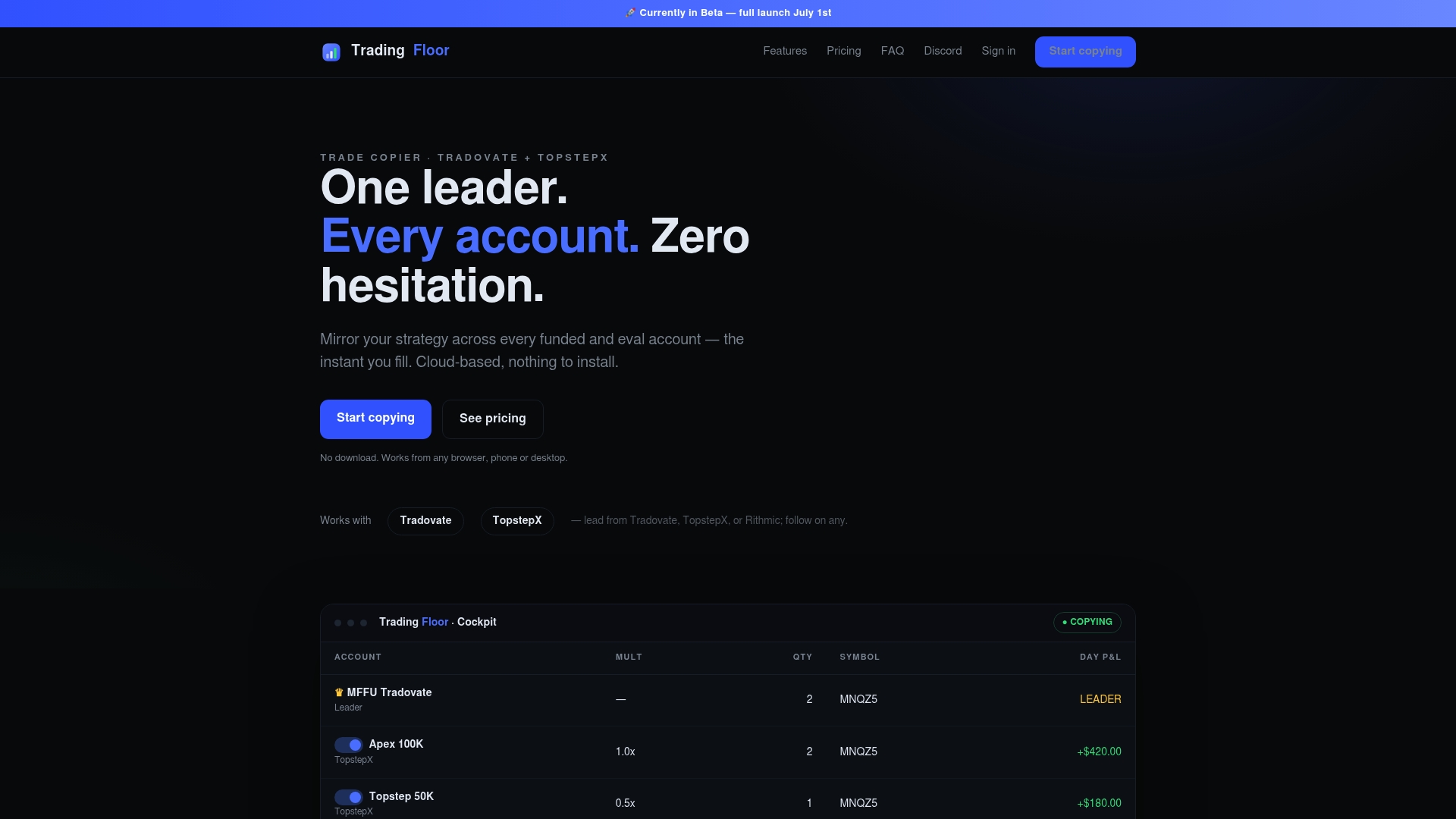
The platform mirrors the leader’s net position across any combination of funded and evaluation accounts, applying independent risk caps per account so one bad session does not cascade. Per-account scaling, real-time Distance to Limit monitoring, reconciliation logs, and automated alerts are all included. It connects with Tradovate and TopstepX, which covers the two most common broker setups for US-based prop traders. No installation required; it runs from any device, so your kill-switch is always one tap away.
If you are managing more than one account and still doing this manually, check what Tradingfloor does and see whether the setup time pays for itself in the first week. You can also verify platform uptime before your next live session.
Useful sources and further reading
- PropJournal risk management guide: Tiered funded-account risk ranges and the rationale for the 30–50% reduction rule.
- NexusFi funded trader operations manual: 4-band risk escalation, payout workflows, and the case for independent tracking systems.
- Jalen Trades funded-account checklists: Pre-session, pre-trade, and post-session checklist frameworks with session-grade sizing.
- PropFirmScan trade analytics guide: MAE/MFE, Sortino Ratio, and trailing drawdown tracking for performance audits.
- Audacity funded trader journal guide: Funded-specific journal fields including emotional-state tags and drawdown floor logging.
- Tradingfloor account-level risk management guide: In-depth frameworks and calculators for multi-account risk.
- Tradingfloor funded account risk rules: Practical rule adjustments for the evaluation-to-funded transition.
Before deploying any automation, read your prop firm’s rules document and your broker’s API documentation. Rules change; what was permitted last quarter may not be permitted now.
Recommended
- Account Evaluation Strategy Examples for Prop Traders in 2026 — Trading Floor
- Automate Trades During Account Evaluation: A Prop Trader’s Guide — Trading Floor
- Pass Multiple Prop Firm Evals at Once With One Strategy — Trading Floor
- Multi-Account Trade Execution Explained for Prop Traders — Trading Floor
Trading Floor mirrors every trade across your Tradovate, TopstepX & Rithmic accounts in real time, from $25/mo.
Start copying →