Trade Audit Trails for Prop Traders: A Practical Guide

A trade-copier audit trail is the chronological, per-account log of every copy command, fill, slippage event, risk-control action, and reconciliation result generated when your copier mirrors positions across accounts. It is not a regulatory filing or an exchange-facing compliance record. Its job is operational: verify that what the master account did actually landed correctly in each destination account, and give you a precise starting point when it did not.
Three things the trail must prove:
- Verification: every copied fill matches the source command within your defined tolerance
- Scope: records are per-account and per-venue, not aggregated across accounts
- Immediate value: when a payout query or a mis-copy surfaces, the trail tells you which account, which fill, and which timestamp to examine first
Key Takeaways
A trade-copier audit trail is only as reliable as the fields it captures, the controls that protect it, and the cadence at which you actually run reconciliation.
| Point | Details |
|---|---|
| BLUF definition | The trail is a per-account, chronological log of copy commands, fills, slippage, risk actions, and reconciliation events. |
| Minimum viable fields | Eight fields cover most exceptions: copy_id, fill_id, timestamp_utc, price, qty, fee, venue, account_id. |
| Reconciliation cadence | Run intraday alerts, end-of-day full reconciliation, weekly permission audits, and monthly WORM verification. |
| Tamper evidence | Apply a SHA-256 checksum to every raw export and store it in write-once storage alongside the file. |
| Tradingfloor | Generates a per-account receipt on every copy command with auto-reconciliation exports and slippage-cap alerts built in. |
Table of Contents
- What does a trade audit trail need to record?
- Why per-account audit trails matter for prop traders
- How to build a complete trade population from every source
- Step-by-step reconciliation for copied trades
- Controls and governance that keep the trail trustworthy
- Common discrepancies in multi-account copying and how to fix them
- Timestamp rules, storage, and retention
- A repeatable daily and weekly audit playbook
- What a real audit trail journal entry looks like
- How Tradingfloor implements audit trails and per-account journaling
- The misconfiguration most teams miss
- Tradingfloor gives you receipts on every copy, starting with a free trial
- Sources
What does a trade audit trail need to record?
The trail is only as useful as the fields it captures. Missing one identifier forces manual reconstruction later, which native exchange sync prevents when journaling is automated. Every event should carry at minimum:
copy_id(unique ID for the copy command)order_idandfill_id(exchange-assigned)timestamp_utc(millisecond or microsecond resolution)trader_id,source_account,destination_accountvenue,instrument,side,order_type,order_statusprice,qty,avg_price,fee_asset,fee_amount,slippagestrategy_tag,reconciliation_flag,notes
Field format examples:
| Field | Type | Example |
|---|---|---|
copy_id |
string | CPY-20260503-00142 |
fill_id |
string | EXCH12345-20260503-0001 |
timestamp_utc |
ISO 8601 | 2026-05-03T14:22:31.847Z |
slippage |
decimal | 0.75 |
reconciliation_flag |
enum | MATCHED / EXCEPTION / PENDING |
Pro Tip: For immediate troubleshooting, the minimum viable set is: copy_id, fill_id, timestamp_utc, price, qty, fee, venue, account_id. If those eight fields are present and consistent, you can resolve most exceptions without touching anything else.
Why per-account audit trails matter for prop traders
Prop-firm payout audits expect a compliance-ready journal with execution evidence, strategy disclosure, and consistency reports. A per-account trail delivers these without scrambling at review time.
The business outcomes are concrete:
- Faster payout approvals: reviewers see fill-level evidence, not just a P&L summary
- Dispute defense: when a trader claims slippage was excessive, the trail shows master fill vs. destination fill side by side
- Accurate P&L attribution: each account’s fees and slippage are isolated, not blended
- Reduced loss from mis-copies: exceptions surface within minutes, not days
- Demonstrable controls: funded-account programs can see that risk limits fired correctly
Consider a simple scenario: the master fills ES at 5,280.00; one destination account fills at 5,280.75. Without a trail, that 0.75-point gap is invisible until month-end P&L attribution. With the trail, it appears as a slippage event at the fill level, flagged automatically, and resolved before the next session. Funded-account risk rules often hinge on exactly this kind of per-fill evidence.
How to build a complete trade population from every source
Audit playbooks treat completeness as the foundation: orders, fills, cancellations, amendments, fees, deposits, withdrawals, and wallet transfers must all be collected before reconciliation begins.
- OMS/EMS or internal blotter — export: order lifecycle report; required fields:
order_id,instrument,side,qty,status,timestamps - Exchange API fills endpoint — required fields:
fill_id,order_id,price,qty,fee_asset,fee_amt,timestamp_utc - Broker confirmation reports — required fields:
trade_ref,account_id,net_price,commission - Copier command logs — required fields:
copy_id,source_account,destination_account,trigger_time,status - On-chain transactions (where applicable) — required fields:
tx_hash,network,from_address,to_address,amount,block_timestamp - OTC confirmations — required fields:
confirmation_id,counterparty,agreed_price,settlement_date - Custody/custodian statements — required fields:
asset,opening_balance,closing_balance,movements
Pro Tip: Save every raw export as the original CSV or JSON before any transformation. Apply a SHA-256 checksum to each file immediately after download and store both the file and its checksum in write-once storage. That checksum is your tamper evidence if a fill record is ever questioned.
Data mapping example: exchange fill_id → blotter trade_ref; exchange fill_qty → blotter recorded_qty; exchange fee_asset → GL posting account code. The evaluation phase checklist covers this mapping in detail for prop account setups.
Step-by-step reconciliation for copied trades
Effective reconciliation requires granular timestamps, unique identifiers, and a defined matching tolerance before you touch a single exception.
- Ingest all source exports into a single normalized schema (UTC timestamps, consistent instrument symbols, decimal quantities)
- Normalize fee assets to a common denomination; convert partial fills to aggregated average price
- Match records using primary key:
copy_id+fill_id; fallback:order_id+qty+venue+ UTC minute window (±30 seconds) - Flag exceptions automatically: any record without a confirmed match within tolerance
- Investigate flagged records by severity (see below)
- Close each exception with a resolution note and updated
reconciliation_flag
Partial fills require aggregating all child fills before comparing to the blotter entry.
Exception severity:
- Critical: missing fill, wrong destination account, wrong wallet address — acknowledge within 15 minutes
- Medium: fee mismatch, symbol mapping error — resolve within 4 hours
- Low: rounding difference below 1 cent, timestamp skew under 1 second — batch-resolve daily
Cross-account reconciliation across multiple venues adds symbol normalization as a prerequisite step.
Controls and governance that keep the trail trustworthy
A trail that can be altered is not evidence. Futures audit trail guidance recommends immutable storage and microsecond timestamps as baseline requirements.
Controls to test regularly:
- Role-based permissions: read-only access to audit logs for anyone not in the ops team; write access requires two-person approval
- API key scope and rotation: each key scoped to minimum required permissions; rotate on a defined schedule and verify that a disabled key produces zero fills in the log
- Two-person approval for critical actions: withdrawals, account additions, and copier rule changes require a second approver on record
- Address whitelists: withdrawal destinations locked to pre-approved addresses; any change triggers an alert and a 24-hour hold
- Immutable logging: audit log writes go to WORM storage or an append-only ledger; no delete or overwrite permissions exist at any role level
- Retention and searchable access: account-level risk management recommends keeping operational logs searchable for at least 90 days and archiving to WORM for the duration required by your funded program
Sample test: disable an API key, attempt a fill, confirm the log shows the attempt and the rejection. That log entry is your evidence of control effectiveness.
Common discrepancies in multi-account copying and how to fix them
Multi-account copiers need explicit instrument mapping and per-account sizing rules because margin, leverage, and contract specifications differ across accounts and cause drift.
| Exception | Probable cause | Immediate fix | Prevention |
|---|---|---|---|
| Partial fill not captured | Multi-fill aggregation missing | Rebuild avg price from all child fills | Implement fill consolidation before blotter write |
| Symbol mapping mismatch | Instrument IDs differ by venue | Manually remap and re-run reconciliation | Maintain a canonical symbol map per venue |
| Contract multiplier drift | Multiplier not set per account | Recalculate position size using correct multiplier | Define multiplier in copier rule per account |
| Missing fill (destination) | API rate limit hit during copy | Pull fill from exchange API directly | Add retry logic and rate-limit monitoring |
| Timezone misalignment | Source and destination clocks differ | Normalize all timestamps to UTC before matching | Enforce UTC at ingestion; store source timezone as metadata |
| Asynchronous reconnection | Copier reconnected mid-session | Audit the reconnection window for missed commands | Alert on reconnection events; replay missed commands |
Triage playbook snapshot: at T+0, the ops lead acknowledges the exception and pulls the raw fill from the exchange API. At T+1 hour, root cause is documented and a fix is applied or escalated. Escalation threshold: any critical exception unresolved after 4 hours goes to the firm principal. Notify the affected trader with account ID, fill ID, and the discrepancy amount.
Unique multi-account issues worth flagging separately: symbol mapping mismatches, contract multiplier differences, margin/leverage differences across accounts, asynchronous reconnections, API rate limits, and timezone misalignment. Error log guidance covers structuring these incident records.
Timestamp rules, storage, and retention
Always store timestamp_utc in ISO 8601 format with millisecond resolution at minimum; microsecond if the exchange provides it. Capture both event_time (when the exchange recorded the fill) and ingest_time (when your system received it). Preserve the original timezone metadata from the source even after normalizing to UTC.
- Operational access SLA: logs searchable within seconds for the most recent 90 days
- Archival: WORM or equivalent storage should be maintained for the full retention window as required by your funded program
- Tamper evidence: SHA-256 checksum on every export file, stored separately from the file itself
Pro Tip: When two accounts show a timestamp gap that looks like a missed copy, check ingest_time vs. event_time first. A large gap there usually means network latency or a reconnection event, not a genuine missed trade.
Time skew across exchanges: normalize all fills to UTC at ingestion. If two venues show the same trade 800 milliseconds apart, that is clock skew, not a duplicate. Use a ±1 second matching window as the default and tighten it only after you have confirmed clock synchronization across your venues.
A repeatable daily and weekly audit playbook
- Intraday (real-time): monitor copy-command receipts and fill confirmations as they arrive; alert on any copy command with no matching fill within 60 seconds
- End of day: run full reconciliation across all accounts; triage exception queue; close low-severity items; escalate critical items per severity SLA
- Weekly: review exception trends (are the same accounts or instruments generating repeat exceptions?); audit role permissions and API key status; confirm WORM write integrity
- Monthly: verify retention compliance; run a checksum audit on archived exports; review copier rules for any accounts that changed margin or leverage
SLA definitions:
- Critical exception: acknowledge in 15 minutes, resolve or escalate in 4 hours
- Medium exception: resolve within next business day
- Low exception: batch-resolve in weekly review
Sample escalation notification (ops to trader):
Exception Alert — Account ACCT-0042 Fill ID: EXCH12345-20260503-0001 | Copy ID: CPY-20260503-00142 Discrepancy: destination fill 0.75 pts above master fill Status: Under investigation. No action required from you yet. ETA for resolution: 4 hours.
Monitoring trading patterns at this cadence also surfaces policy-breach signals before they become funded-account violations.
What a real audit trail journal entry looks like
{
  "copy_id": "CPY-20260503-00142",
  "order_id": "ORD-20260503-88821",
  "fill_id": "EXCH12345-20260503-0001",
  "timestamp_utc": "2026-05-03T14:22:31.847Z",
  "venue": "Tradovate",
  "account_id": "ACCT-0042",
  "instrument": "ESM6",
  "side": "BUY",
  "price": 5280.75,
  "qty": 1,
  "avg_price": 5280.75,
  "fee_asset": "USD",
  "fee_amount": 2.10,
  "slippage": 0.75,
  "reconciliation_flag": "EXCEPTION",
  "notes": "Destination fill 0.75 pts above master; under investigation"
}
Field annotations:
copy_id: ties this fill back to the exact copy command; if missing, the fill cannot be attributed to a master tradefill_id: the exchange’s own identifier; cross-reference this against the exchange API to confirm the fill is realslippage: the gap between master fill price and destination fill price; anything above your cap triggers an exceptionreconciliation_flag: set to EXCEPTION here because slippage exceeded the defined tolerancenotes: the working investigation note; update this field as the exception is resolved
Resolution narrative: The EXCEPTION flag on CPY-20260503-00142 was detected at end-of-day reconciliation. The ops lead pulled the raw fill from the Tradovate API, confirmed the fill was genuine (not a duplicate), and traced the slippage to a brief liquidity gap at 14:22 UTC. The master account filled on a limit order; the destination account filled on a market order due to a copier order-type misconfiguration. The copier rule was corrected, the exception was closed with a resolution note, and the
reconciliation_flagwas updated to RESOLVED.
How Tradingfloor implements audit trails and per-account journaling
Tradingfloor maps directly to the checklist above. Per-account journaling is built in: every copy command generates a receipt that captures copy_id, fill details, slippage, and reconciliation status for each destination account individually.
Key features that support the audit trail:
- Per-account receipts on every copy: each mirrored position produces a timestamped record per destination account
- Auto-reconciliation exports: pull a CSV at any cadence with all fields needed for the reconciliation workflow above
- Slippage caps: set a maximum slippage per account; breaches flag automatically as exceptions
- Contract multipliers: define per-account multipliers so sizing is correct regardless of account differences
- Push notifications: real-time alerts on exceptions, reconnections, and risk-control events
- Cloud-based, no installation: accessible from any device; no local log files to lose
Example flow: copier fires a copy command → Tradingfloor generates a receipt with copy_id and fill details → auto-reconciliation compares master and destination fills → slippage cap breach triggers a push notification → ops lead investigates using the receipt → exception closed with a resolution note in the journal.
Pro Tip: Configure Tradingfloor’s push notifications to fire on every exception, not just critical ones. Medium-severity items (fee mismatches, symbol mapping warnings) accumulate into patterns that are far easier to fix early than after a week of drift.
The misconfiguration most teams miss
Most audit trail failures are not missing fields. They are propagation failures: the copy_id exists in the copier log but never makes it into the blotter or the exchange fill record. When that happens, reconciliation falls back to the weaker matching key (order ID plus timestamp window), and any fill that arrives slightly outside the window becomes an unmatched exception with no clear owner.
The fix is straightforward: enforce copy_id propagation as a required field at every system boundary. If your OMS or blotter does not accept a custom tag field, use the order’s client-order-ID field to carry the copy_id through to the exchange. Verify propagation daily by spot-checking five random fills and confirming the copy_id appears in all three records: copier log, blotter, and exchange fill.
Tradingfloor gives you receipts on every copy, starting with a free trial
Per-account receipts, auto-reconciliation exports, slippage caps, and push notifications are live from day one of your Tradingfloor subscription. You get a 30-day free trial with full access to the journaling and reconciliation features described in this guide.
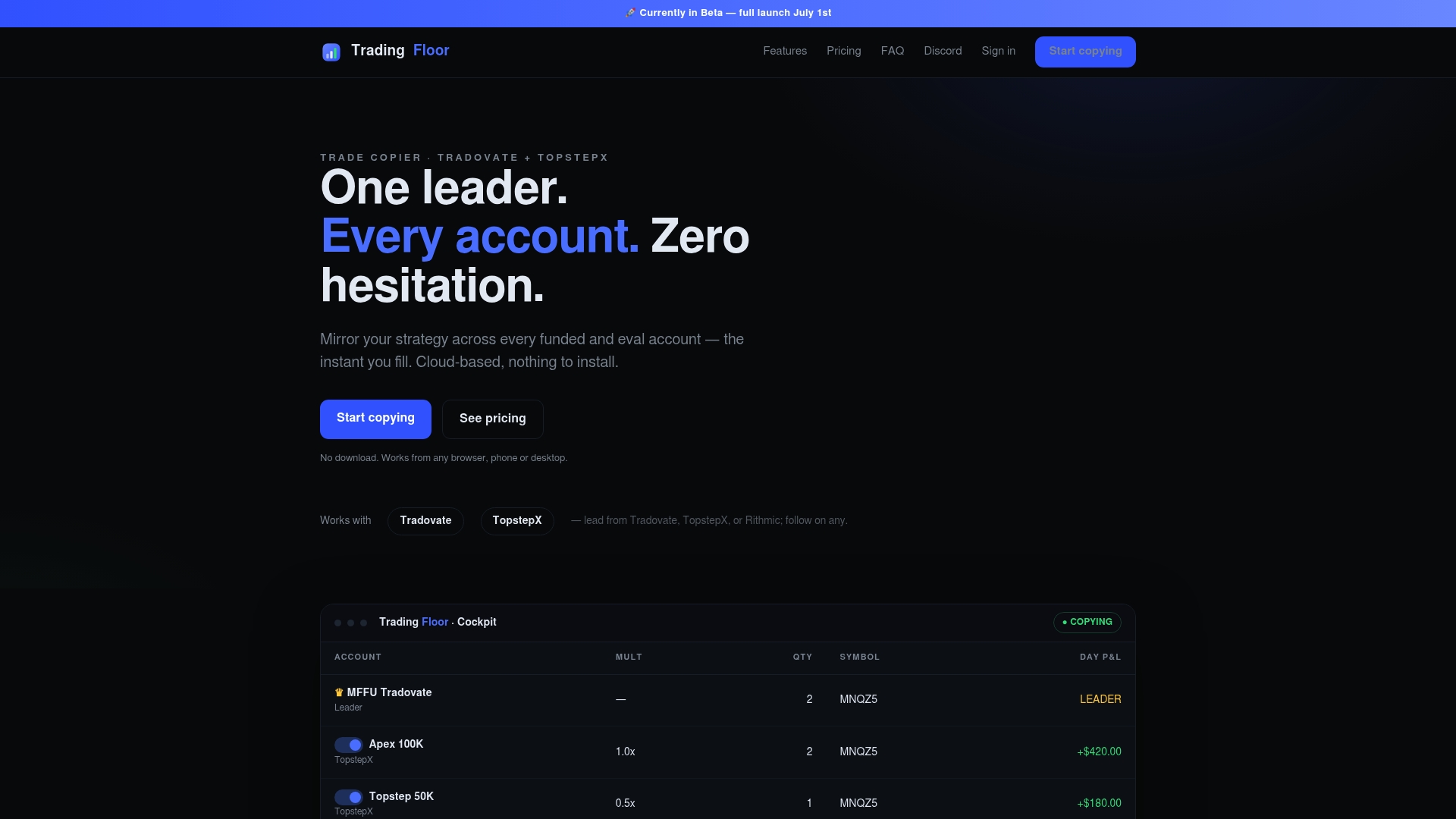
The per-account copier starts at $25/month and includes the audit receipt on every copy command, the reconciliation export, and real-time notifications. If you run Earn2Trade or TopstepX accounts, dedicated integrations handle the instrument mapping and per-account sizing rules that cause the most common exceptions. Start your 30-day trial at Tradingfloor and run your first end-of-day reconciliation using the sample record above.
Sources
- Crypto Trading Audits Explained: A Practical Guide
- Realtime trade copier issues in multi account setups explained
- The Complete Guide to Keeping a Trading Journal (2026)
- Quantstrategy
- How to Pass Prop Firm Payout Audits Every Time
Recommended
- Evaluation Phase Trading Checklist for Prop Traders — Trading Floor
- Trading Error Logs for Prop Traders: A Complete Guide — Trading Floor
- Prop Trader Performance Optimization Explained — Trading Floor
- Best prop.tradovate.com Alternatives for Multi-Account Prop Traders — Trading Floor
Trading Floor mirrors every trade across your Tradovate, TopstepX & Rithmic accounts in real time, from $25/mo.
Start copying →