Evaluation Phase Trading Checklist for Prop Traders

Pass your prop-firm evaluation by treating every session like a job audition: enforce written, binary checks before each session and each trade, set per-account risk overrides in your copier, and place server-side stops before any order goes live. That single discipline separates traders who pass consistently from those who blow accounts chasing profit targets.
Do these three things before your next session:
- Sync your trade copier and confirm all follower accounts show green status
- Set per-account risk overrides in the copier (not just at the master level)
- Place server-side stops on every account before the first order
Daily constraints to enforce without exception:
- Personal daily stop: set 20–25% below the firm’s daily loss limit
- Per-trade risk: 0.5–1% of account equity per position
- Correlated exposure cap: no more than 2% total notional across correlated instruments simultaneously
Most prop-firm evaluations require 8–10% profit targets for Phase 1 and 4–5% targets in Phase 2, with daily loss limits typically set at 3–5% and max drawdowns often at 8–10%. Many evaluations enforce a minimum of 5–10 trading days before submission. Plan your session cadence around those constraints from day one.
Pre-session psychological check: Rate your state (calm / neutral / elevated). If elevated, log the reason and abort the session. One impulsive session can erase a week of disciplined work.

Pro Tip: Set your personal daily stop as a hard order in the copier, not a mental note. Mental stops fail under pressure every time.
Table of Contents
- How to run your pre-trade and execution checks
- Risk rules and position sizing that hold up across accounts
- Multi-account copier checks that prevent evaluation breaches
- How to build an audit trail prop firms can actually verify
- End-of-day and weekly review that catches drift early
- Step-by-step copier setup for the evaluation workflow
- Printable binary checklist for every session
- Key Takeaways
- The checklist is the strategy, not a supplement to it
- Tradingfloor handles the operational layer so you can focus on execution
- Useful sources and further reading
How to run your pre-trade and execution checks
Every trade needs a binary gate. If any item fails, the trade does not happen. A written, externalized checklist converts impulsive System 1 decisions into deliberate System 2 checks, and that shift alone eliminates most rule violations.
Pre-trade binary gates (all must pass):
- Setup matches your defined criteria — no exceptions
- Higher-timeframe confirmation present
- Stop level defined structurally before entry
- Position size calculated from (risk $ ÷ stop distance), not chosen arbitrarily
- R:R at or above your minimum threshold (1.5:1 minimum; 2:1 preferred)
- No high-impact news within 15 minutes
- Psychological state: neutral or calm only
Execution rules during trade life-cycle:
- Server-side stops placed before entry, not after — manual stops create execution lag that can breach a single account while others are still open
- Slippage cap enforced; if fill exceeds your threshold, reduce size on the next trade
- No overnight holds if the firm prohibits them; confirm each session
- If the copier reports a partial fill, cancel new entries immediately and reconcile before continuing
Trade journal fields to capture for every trade:
| Field | What to Record |
|---|---|
| Timestamp | Entry and exit (NTP-synced) |
| Instrument | Exact contract |
| Master order ID | From broker confirmation |
| Follower order IDs | One per account |
| Entry / stop / target | Exact prices |
| Position size per account | Contracts or lots |
| Equity at entry | Per account snapshot |
| Rule exception flag | Yes / No + notes |
Pro Tip: If you cannot fill out the journal fields before clicking, the trade is not ready. The friction is the point.
Risk rules and position sizing that hold up across accounts
Position sizing should follow a percent-of-equity model: 0.5–1% risk per trade, recalculated after each session using the updated account equity. For multi-account setups, apply per-account scaling in the copier so a 1-contract master trade mirrors correctly to a smaller follower account.
Daily and trailing drawdown controls:
- Calculate trailing drawdown from peak equity, not starting balance
- Set a copier alert when trailing drawdown reaches 70% of the firm’s max
- Reduce position size by 50% once drawdown exceeds 50% of the firm’s limit
Why Sortino beats Sharpe during evaluation: Backtested Sharpe ratios are frequently inflated by data snooping and multiple testing. A strategy that looks like a Sharpe of 0.92 can require a t-statistic of 3.66 to confirm genuine edge when 200 strategy variants have been tested. Sortino focuses on downside deviation only, which is what prop firms actually care about. Use it as your primary consistency metric.
Risk rules to embed in the copier:
- Per-account max position size (hard limit, not advisory)
- Per-account notional cap
- Correlated exposure cap across instruments
- Per-instrument open positions limit
Pro Tip: Keep a rule-violation log. After two weeks, sort by time-of-day and instrument. The patterns will tell you exactly where to add restrictions.
Multi-account copier checks that prevent evaluation breaches
Technical failures in a multi-account setup are silent. A contract multiplier mismatch or a stale API key does not announce itself until a position is wrong-sized and the drawdown is already moving.
Pre-session health checklist:
- Cloud copier status confirmed (check the live system status page before each session)
- API keys valid for Tradovate, TopstepX, and Rithmic follower accounts
- Per-account risk settings verified as overriding master execution
- Push notifications tested with a dummy alert
Failure modes to watch actively:
- Contract multiplier mismatch between master and follower
- Different margin models causing unexpected position sizing
- Partial fills desynced across accounts after a fast move
- Master stop not propagated within your latency threshold
Latency and reconciliation protocol:
- Define an acceptable round-trip time threshold before the evaluation starts
- Enable automated reconciliation on fill mismatches; never rely on a single manual check mid-session
- Server-side stops must be active on every account simultaneously
Emergency procedure (predefine before day one):
- Pause copier immediately
- Cancel all outstanding orders across every account
- Archive session logs before any changes
- Notify compliance or support with timestamps
Pro Tip: Test the emergency pause procedure in a simulated session before your evaluation starts. Knowing the exact steps under pressure is different from reading them.
How to build an audit trail prop firms can actually verify
Prop evaluators monitor trading patterns and can request evidence of rule compliance. A clean, timestamped record is your proof.
Audit-trail checklist:
- Session start and end equity snapshots (timestamped)
- Trade logs with master and follower order IDs
- Screenshots of firm rule pages at evaluation start
- Daily equity curve exports
- Copies of all firm communications (email, portal messages)
- Copier health logs and server-side stop logs
- Rule-violation register with immediate remediation notes
Document packaging when requested:
| File | Naming Convention |
|---|---|
| Session snapshots | YYYY-MM-DD_session_start/end.png |
| Trade log export | YYYY-MM-DD_trade_log.csv |
| Copier health log | YYYY-MM-DD_copier_health.txt |
| Rule-violation register | violation_log_full_period.csv |
| Firm rule screenshots | firm_rules_YYYY-MM-DD.png |
Pro Tip: Sync all timestamps to NTP-based time and retain logs for a minimum of 90 days. Some firms request records weeks after the evaluation closes.
End-of-day and weekly review that catches drift early
Daily review items:
- Reconcile starting and ending equity across all accounts
- Update trailing drawdown from peak equity
- Check copier log for partial fills, errors, or latency spikes
- Mark any rule deviations in the violation log with a remediation note
Weekly metrics table:
| Metric | Target | Action if Off |
|---|---|---|
| Consistency rate | Profitable days / days traded | Review setup criteria |
| Max intraday drawdown | Below personal buffer | Reduce size next week |
| Average per-trade risk | 0.5–1% of equity | Recalibrate sizing |
| Sortino ratio | Trending positive | Review downside trades |
| Rule-violation count | Zero | Pause if > 2 in a week |
If rule violations exceed two in a week, pause live evaluation and run a simulated session for five days before resuming. If trailing drawdown approaches the firm’s limit, cut position sizes by 50% immediately.
Pro Tip: Sort your violation log by instrument and time-of-day. If failures cluster around a specific session window or contract, lock that out until you identify the cause.
Step-by-step copier setup for the evaluation workflow
- Register accounts and input API keys for each broker (Tradovate, TopstepX, Rithmic)
- Map contract multipliers per follower account against the master’s risk constraints
- Set per-account risk overrides: position limit, notional cap, slippage cap
- Enable server-side stops and confirm propagation time in a simulated test
- Run a small simulated order across all followers; verify fills, sizes, and stop placement
- Confirm push notifications fire on fill, error, and desync events
- Test the emergency pause procedure before the evaluation starts
During a live session:
- Run the pre-session checklist before any order
- Execute binary pre-trade gates for every entry
- Monitor copier health continuously; do not assume green status holds
- Run post-session reconciliation before closing the platform
Common misconfigurations:
- Per-account overrides left at master defaults (sizes mirror incorrectly)
- Slippage caps set too wide (allows fills that exceed risk budget)
- Push notifications disabled (silent failures go undetected)
For a detailed automation walkthrough, the trade automation guide covers copier configuration specific to evaluation accounts.
Pro Tip: Never skip the simulated micro-order test. A 30-second test before the evaluation reveals multiplier mismatches that would otherwise cost you the account.
Printable binary checklist for every session
Pre-session (all must pass before trading):
- [ ] Copier status green
- [ ] API keys valid for all accounts
- [ ] Account balances match expected starting equity
- [ ] Contract multipliers verified per account
- [ ] Firm rules confirmed (profit target, daily loss, drawdown, banned instruments)
- [ ] Personal daily stop set below firm limit
- [ ] Psychological state: neutral or calm
Pre-trade (all must pass before each order):
- [ ] Setup matches defined criteria
- [ ] Stop level defined structurally
- [ ] Position size calculated from risk formula
- [ ] R:R at or above minimum threshold
- [ ] News clear (no high-impact events within 15 minutes)
- [ ] Mental state: neutral or calm
In-session rules:
| Rule | Status |
|---|---|
| Server-side stop active on all accounts | Pass / Fail |
| Per-account sizes enforced by copier | Pass / Fail |
| No correlated overexposure | Pass / Fail |
| Partial fill > threshold: new entries paused | Pass / Fail |
Post-session:
- [ ] Fills reconciled across all accounts
- [ ] Session logs saved and archived
- [ ] Trade journal updated with all fields
- [ ] Daily drawdown calculated and recorded
- [ ] Rule violations logged with remediation notes
Key Takeaways
A prop-firm evaluation requires written binary checks before every session and every trade, per-account risk overrides in the copier, and server-side stops placed before any order goes live.
| Point | Details |
|---|---|
| Enforce per-account overrides | Set risk limits at the follower level, not just the master, to prevent size mismatches. |
| Use server-side stops always | Automated stops across all accounts prevent the execution lag that causes single-account breaches. |
| Prioritize consistency over speed | Traders who optimize for speed commonly fail funded accounts; rule adherence is what evaluators measure. |
| Keep a violation log | Sorting violations by time-of-day and instrument reveals repeat failure patterns before they compound. |
| Tradingfloor automates key checks | Per-account risk controls, auto-reconciliation, and push alerts handle the operational layer so you focus on execution. |
The checklist is the strategy, not a supplement to it
Most traders treat a checklist as a backup for bad days. That framing gets it backwards. The checklist is the strategy during an evaluation, and the trade setups are just inputs into it.
The failure mode I see most often is a trader who has a genuinely good edge but loses the evaluation to a single session where they skipped the pre-session sync check, traded with a stale API connection, and had a partial fill desync two accounts. The trade itself was fine. The infrastructure around it was not.
The other pattern worth naming: traders who pass evaluations quickly by running aggressive position sizes tend to fail their first funded month. The evaluation is not asking you to make money fast. It is asking whether you can follow rules under real market conditions. Those are different tests, and only one of them matters for long-term funded status.
Checklist discipline removes willpower from the equation. If a box is not checked, the trade does not happen. That shift from intuition to rule-based execution is what separates a professional from someone who gets lucky once.
Tradingfloor handles the operational layer so you can focus on execution
The checklist above has two layers: the decisions only you can make (setup quality, psychological state, rule judgment) and the operational infrastructure that should run automatically. Tradingfloor covers the second layer.
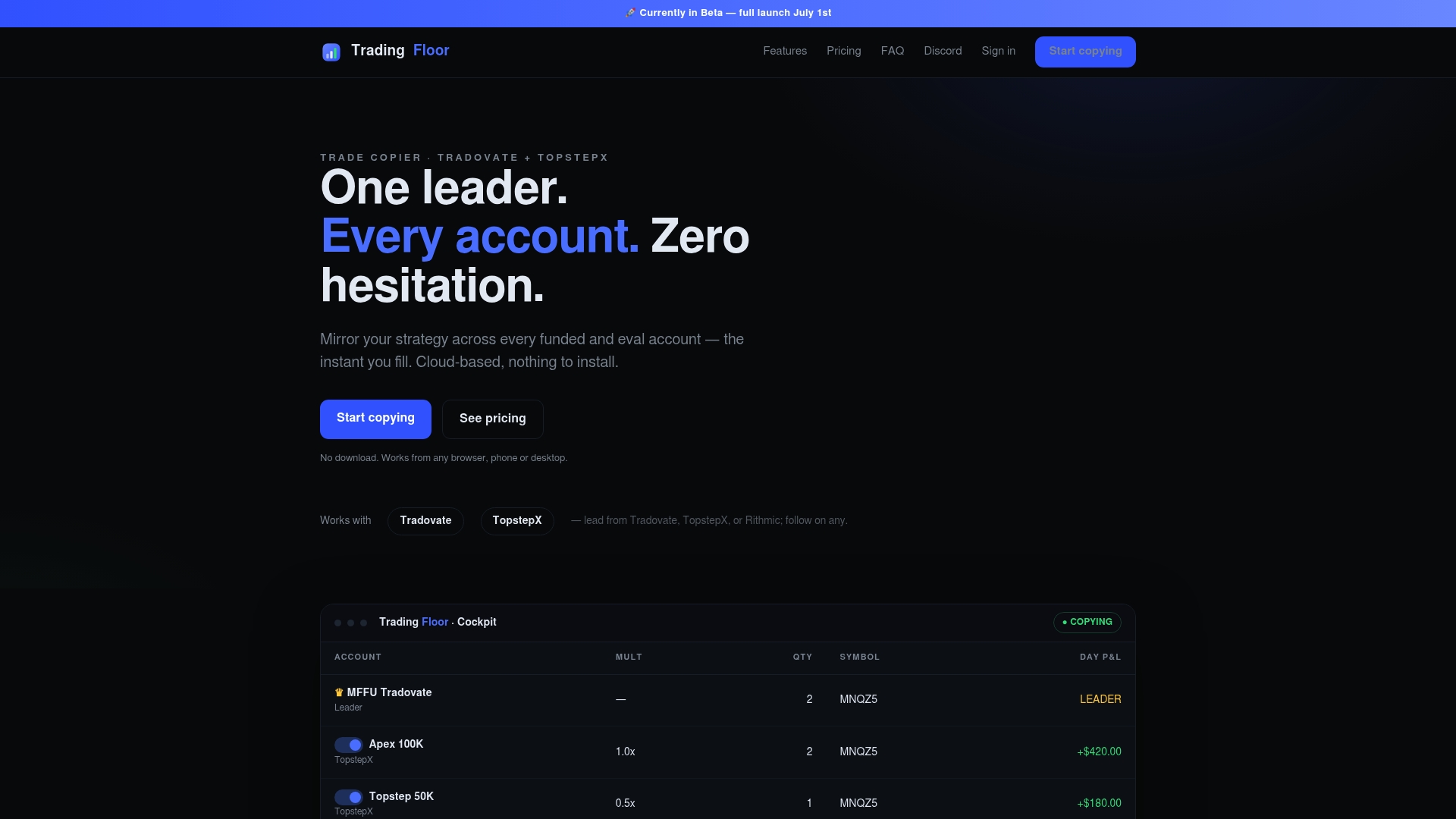
Per-account risk overrides, contract multiplier mapping, server-side stop propagation, auto-reconciliation on fill mismatches, and push alerts on desync events are all built into the platform. You connect your Tradovate, TopstepX, or Rithmic accounts, set the per-account parameters once, and the copier enforces them in real time across every follower. No installation, accessible from any device, and the 30-day free trial gives you a full simulated test window to run the checklist before your evaluation starts.
Start your free trial at Tradingfloor and run the simulated micro-order test on day one.
Useful sources and further reading
The sources below are worth bookmarking. Several are worth including in your audit package as evidence of the methodology behind your risk controls.
External sources:
- Evaluating Trading Strategies (Berkeley / Harvey): the academic foundation for why backtested Sharpe ratios require haircuts and why out-of-sample testing matters for evaluation readiness.
- What Is a Prop Firm Evaluation? (The5ers): clear breakdown of typical rule ranges across Phase 1 and Phase 2 evaluations.
- Trader Evaluation Checklist (Responsible Trading): practitioner-level checklist guidance with emphasis on consistency over speed.
- Pre-Trade Checklist: 10 Rules (KMF Journal): the binary gate framework that reduces impulsive entries.
- Funded Trader Program Checklist (OneUpTrader): 10-step evaluation checklist with practical pacing and routine guidance.
Tradingfloor internal guides:
- Types of trading evaluation account rules explained: covers profit targets, daily loss, drawdown, and minimum day rules in detail.
- Account evaluation strategy examples for prop traders: practical templates for applying risk management across evaluation accounts.
- Pass multiple prop firm evals at once with one strategy: how to run one consistent strategy across several vendor evaluations simultaneously.
- Trade the same strategy across multiple brokers: reconciliation guidance for cross-broker differences between Tradovate, TopstepX, and Rithmic.
Recommended
- Automate Trades During Account Evaluation: A Prop Trader’s Guide — Trading Floor
- Evaluation Account Management Best Practices for Prop Traders — Trading Floor
- Prop Trader Performance Optimization Explained — Trading Floor
- Account Evaluation Strategy Examples for Prop Traders in 2026 — Trading Floor
Trading Floor mirrors every trade across your Tradovate, TopstepX & Rithmic accounts in real time, from $25/mo.
Start copying →