Prop Trader Performance Optimization Explained

Prop trader performance optimization is the process of building measurable systems of discipline, risk management, and consistent execution to maximize profitability while reducing drawdown and costly errors. For prop traders managing funded accounts, performance is not a personality trait. It is a set of trackable metrics: Rule Adherence Score, daily drawdown limits, Calmar ratio, and consistency thresholds. Traders who treat these as engineering problems rather than willpower challenges pass evaluations at significantly higher rates and keep funded accounts longer.
What is prop trader performance optimization and why does it matter?
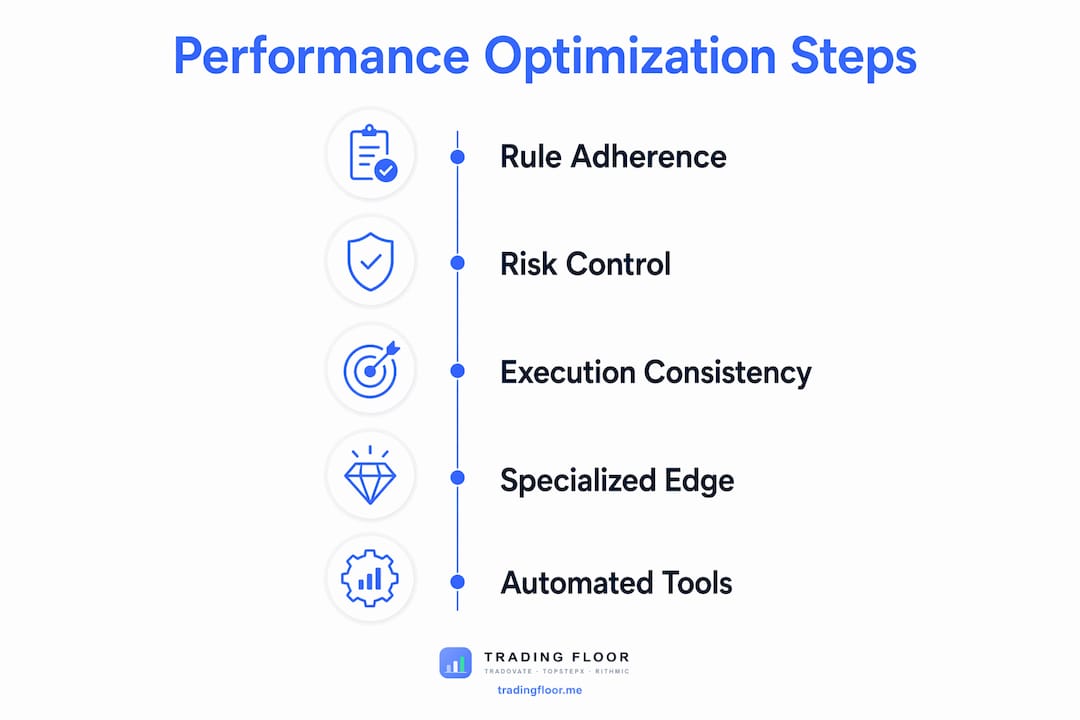
Performance optimization in prop trading is defined by three pillars: rule adherence, risk control, and execution consistency. Each pillar is measurable, and each has a direct impact on whether you pass an evaluation or lose a funded account. Prop firms design their rules to filter out traders who cannot maintain discipline under pressure. The traders who survive are the ones who build systems around those rules, not the ones who rely on instinct alone.
The Calmar ratio is one of the clearest indicators of strategy quality. Prop traders need a Calmar ratio of at least 2.0 to reliably pass evaluations. Strategies with a Sharpe ratio below 1.1 carry negative expected value when combined with tight 30-day challenge windows. That math alone explains why so many traders fail evaluations with profitable strategies. The strategy is not the problem. The system around it is.

How does the Rule Adherence Score improve trading discipline?
Trading discipline is a measurable system, not a personality trait. The Rule Adherence Score tracks every trade as either “rules followed” or “rules broken,” then calculates the percentage of compliant trades over a given period. A score above 85–90% correlates strongly with passing prop firm evaluations, even when the underlying strategy is identical to one that fails at lower scores.
The performance gap between compliant and non-compliant trades is stark. Trades tagged “rules followed” produce a 58% win rate and a 1.7 profit factor. Trades tagged “rules broken” produce a 35% win rate and a 0.6 profit factor. That difference is not about market conditions. It is about execution quality.
Tracking adherence also reveals patterns you cannot see in a standard trade log. If your “rules broken” trades cluster between 2:00 PM and 3:00 PM, that is decision fatigue showing up in your data. You can then build a rule that stops trading after 1:30 PM. The Rule Adherence tracking system turns subjective feelings about “bad days” into objective, fixable triggers.
Key behaviors that drive Rule Adherence Score improvement:
- Tag every trade in real time as compliant or non-compliant, not at end of day
- Define your rules in writing before the market opens, not during a trade
- Review non-compliant trades weekly to identify time-of-day or setup-specific drift
- Set a minimum score threshold (85%) below which you stop trading for the week
Pro Tip: Keep your trade journal open during the session. Tagging a trade as “rules broken” the moment you take it creates immediate accountability and stops you from rationalizing the entry afterward.
How do daily drawdown and consistency rules shape your strategy?
Prop firm risk controls are not obstacles. They are the design constraints your strategy must fit. Daily loss limits typically run 4–5% of initial balance, with total drawdown caps at 8–12%. Firms calculate drawdown based on equity including open floating losses, not just closed positions. Traders who track only closed P&L get surprised by breaches they never saw coming.
Consistency rules add another layer. Prop firms cap any single day’s profit at 30–50% of total gains, with 40% being the most common threshold. Payouts require a minimum of 4–10 trading days. That structure forces you to distribute profits deliberately rather than banking everything on one big day.
Here is how to build a strategy that fits these constraints:
- Calculate your daily risk budget. On a $100,000 account with a 5% daily limit, your maximum loss is $5,000. Set your actual risk at 3–3.5% to build a buffer.
- Distribute profits across days. If you hit 35% of your total target in one session, stop trading for the day. Protect the consistency rule.
- Size positions for gap risk. Overnight gaps and slippage can push floating losses past your daily limit before you can react. Reduce size on positions held near session close.
- Monitor equity, not just balance. A $200 open loss on a futures position counts against your drawdown the moment it exists, not when you close it.
- Build a safety margin. Treat 80% of your daily limit as your real limit. The final 20% is a buffer for slippage and spread.
Pro Tip: Use an automated kill switch set at 80% of your daily loss limit. Human discipline fails under stress, and a circuit breaker removes the decision entirely when you are most likely to make a bad one.
| Risk Parameter | Typical Prop Firm Standard | Recommended Trader Target |
|---|---|---|
| Daily loss limit | 4–5% of initial balance | 3–3.5% actual risk |
| Total drawdown cap | 8–12% | 6–8% actual exposure |
| Consistency cap (single day) | 30–50% of total profit | Stop at 35% of target |
| Minimum trading days (payout) | 4–10 days | Plan for 7+ days |
Why does specialization improve prop trading consistency?
More screen time does not create more edge. Focused specialization on narrow markets, specific sessions, and well-defined setups delivers repeatable results that broad, opportunistic trading cannot match. The traders who chase every setup across multiple instruments generate noise. The traders who master one or two setups in a defined window generate data they can actually use.
A tight playbook means you know exactly when to enter, where to place risk, and when to exit before the trade happens. True consistency starts with clear, predefined rules that remove in-trade negotiation. When you are in a position, your brain will argue for holding longer or cutting early. A written rule eliminates that argument.
Staying flat when your edge is absent is itself a profitable position. Every trade you skip that does not meet your criteria is a loss you did not take. Prop traders who understand this protect their drawdown buffer for the setups that actually fit their system.
Practical steps to build a focused trading routine:
- Pick one or two instruments and learn their behavior across different session times
- Define your setup criteria in writing: entry trigger, stop placement, and target
- Trade only during the session window where your edge is historically strongest
- Review your multi-platform trading practices to confirm your approach holds across accounts
How do automated tools improve multi-account execution?
Real-time equity monitoring is the foundation of multi-account risk management. Equity-based calculations catch open floating losses that balance-only tracking misses entirely. When you manage two or three funded accounts simultaneously, a gap move or a fast market can push all of them toward their drawdown limits at the same time. Without real-time monitoring, you find out after the breach.
Automated circuit breakers solve the human discipline problem. Kill switches set at 80% of the daily loss limit prevent full limit breaches by removing the trader from the decision at the exact moment stress is highest. This is not a convenience feature. It is a survival tool for anyone managing funded accounts at scale.
Maximum Adverse Excursion (MAE) analysis adds precision to stop placement. MAE-based exit optimization can increase net profitability by 15–20% by identifying how far losing trades move against you before reversing. If your stops are consistently wider than your MAE data supports, you are giving back profit on every trade. Tightening stops to match actual trade behavior reduces risk without reducing win rate.
Benefits of automated analytics and multi-account tools:
- Real-time equity dashboards flag drawdown risk across all accounts simultaneously
- MAE analysis identifies stop placement inefficiencies that cost money on every trade
- Automated kill switches remove emotional override at critical loss thresholds
- Copying trades across multiple accounts with individual risk controls prevents execution drift between funded and evaluation accounts
- Alert systems notify you of rule violations before they become account-ending breaches
| Analytics Tool | Primary Benefit | Key Metric |
|---|---|---|
| Real-time equity monitor | Catches floating losses before breach | Equity vs. balance gap |
| MAE analysis | Improves stop placement precision | Adverse excursion per trade |
| Kill switch (80% threshold) | Prevents full daily limit breach | Trigger level vs. limit |
| Rule Adherence tracker | Identifies execution drift by time/setup | Compliant trade percentage |
Pro Tip: Set dashboard alerts at 50% and 75% of your daily loss limit, not just at the kill switch level. The 50% alert gives you time to reduce size. The 75% alert tells you to close positions and stop trading.
Key Takeaways
Prop trader performance optimization works because measurable systems of rule adherence, risk control, and specialized execution outperform willpower and instinct in every funded account environment.
| Point | Details |
|---|---|
| Rule Adherence Score drives results | Compliant trades produce a 1.7 profit factor versus 0.6 for non-compliant trades. |
| Equity monitoring prevents surprises | Track floating losses in real time, not just closed balance, to avoid unexpected breaches. |
| Consistency rules require profit distribution | Cap single-day profits below 35–40% of your total target to stay within payout rules. |
| Specialization beats screen time | Narrow your markets, sessions, and setups to build repeatable, data-backed edge. |
| Automated kill switches protect accounts | Set circuit breakers at 80% of daily loss limit to remove emotional decisions under stress. |
What I’ve learned about sustainable performance in funded accounts
The biggest mistake I see prop traders make is treating discipline as something they either have or don’t. They blame a bad week on mindset rather than looking at their Rule Adherence Score and finding out they broke their rules on 40% of their trades between noon and 2:00 PM. That is not a mindset problem. That is a schedule problem with a simple fix.
Decision fatigue is real, and it shows up in the data before it shows up in your account balance. The traders who build automated controls around their weakest hours survive longer than the traders who rely on willpower to push through. I have watched traders with genuinely profitable strategies lose funded accounts because they did not have a kill switch and took one revenge trade past their daily limit.
Capital preservation is the actual job. Chasing payouts by front-loading profits into one big day is the fastest way to trigger a consistency violation or a drawdown breach simultaneously. The traders I respect most are the ones who treat a flat day as a win when their edge is not present. That mindset, backed by a written rulebook and real-time monitoring, is what keeps accounts funded month after month.
Managing multiple accounts without systematic control is not a performance strategy. It is a liability. The moment you have more than one funded account running, you need centralized monitoring and synchronized execution. Otherwise, you are making the same decision twice under different conditions and hoping the results match.
— KennyTrades
Tradingfloor: built for prop traders managing multiple accounts
Prop traders who manage more than one funded account need more than good rules. They need a system that enforces those rules across every account simultaneously.

Tradingfloor mirrors your net position across funded and evaluation accounts in real time, not just signals. Individual risk controls stay active on each account, so a position that hits a limit on one account does not automatically breach another. The platform runs in the cloud, requires no installation, and works across brokers including Tradovate and TopstepX. Real-time notifications and trade limit controls give you the visibility to catch problems before they become breaches. Check current platform status or review pricing and features to see which plan fits your account structure.
FAQ
What is a Rule Adherence Score in prop trading?
The Rule Adherence Score tracks the percentage of trades that follow your predefined rules versus those that deviate. Traders who maintain a score above 85–90% show significantly higher pass rates on prop firm evaluations.
How does daily drawdown work in prop firm accounts?
Daily drawdown is calculated on equity including open floating losses, not just closed positions. Most prop firms set daily loss limits at 4–5% of the initial account balance, with total drawdown caps at 8–12%.
What is the consistency rule in prop trading?
The consistency rule limits any single day’s profit to 30–50% of total gains, typically capped at 40%. This requires traders to distribute profits across a minimum of 4–10 trading days before qualifying for a payout.
Why does specialization improve prop trading results?
Specializing in narrow markets, defined sessions, and specific setups produces repeatable edge that broad trading cannot. Focused traders generate cleaner data, make fewer impulsive decisions, and maintain tighter rule adherence over time.
How does MAE analysis help prop traders?
Maximum Adverse Excursion analysis measures how far a trade moves against you before reversing. Using MAE data to tighten stop placement can increase net profitability by 15–20% without reducing win rate.
Recommended
- Multi-Platform Trading Best Practices for Prop Traders — Trading Floor
- Multi-Account Trade Execution Explained for Prop Traders — Trading Floor
- Trade the Same Strategy Across Multiple Brokers — Trading Floor
- Pass Multiple Prop Firm Evals at Once With One Strategy — Trading Floor
Trading Floor mirrors every trade across your Tradovate, TopstepX & Rithmic accounts in real time, from $25/mo.
Start copying →