Cross-Account Trade Management: A 2026 Trader's Guide

Cross-account trade management is the automated process of applying a single trading strategy across two or more accounts while maintaining individualized risk controls for each. The industry term for this practice is multi-account trade execution, and both terms describe the same core workflow. 90% of funded traders currently manage accounts across two to five prop firms. That number tells you this is no longer a niche tactic. It is the standard operating model for serious prop traders in 2026.
What is cross-account trade management and how does it work?
Cross-account trade management is defined as the systematic replication of a trading strategy across multiple accounts using automation software, with account-specific risk controls applied at every step. The goal is to scale capital deployment without multiplying manual effort or execution errors. A single signal fires once, and the automation handles the rest across every connected account.

The mechanics rely on a centralized trade copier that receives one signal, typically via a webhook URL, and fans it out to all linked accounts simultaneously. Each broker or prop firm account authenticates individually, so the system treats them as separate entities while still executing from one source. This architecture is what separates multi-account trade execution from simply logging into multiple platforms and placing trades by hand.
Key components of automated multi-account execution
- Webhook fan-out: One URL receives the signal and distributes it to all accounts in the system.
- Quantity multipliers: Each account gets a size assignment. A $25K account might run at 1x, while a $50K account runs at 2x, keeping position sizes proportional to each account’s balance.
- Jitter settings: Randomized millisecond delays stagger order fills across accounts so no two accounts show identical timestamps.
- Per-account authentication: Each broker and prop firm account connects independently, preserving individual account identity.
- Auto-flatten rules: Accounts can be configured to close all positions automatically if a risk threshold is hit.
Pro Tip: Never skip the jitter configuration. Identical fill timestamps across linked accounts are one of the primary signals prop firm detection algorithms look for.
What are the critical risk management techniques for multi-account trading?
Risk management in multi-account trading requires a layered defense, not a single rule. A 4-layer risk defense system covers position sizing, stop-loss placement, daily and weekly loss limits, and cumulative drawdown management. Each layer catches what the previous one misses.
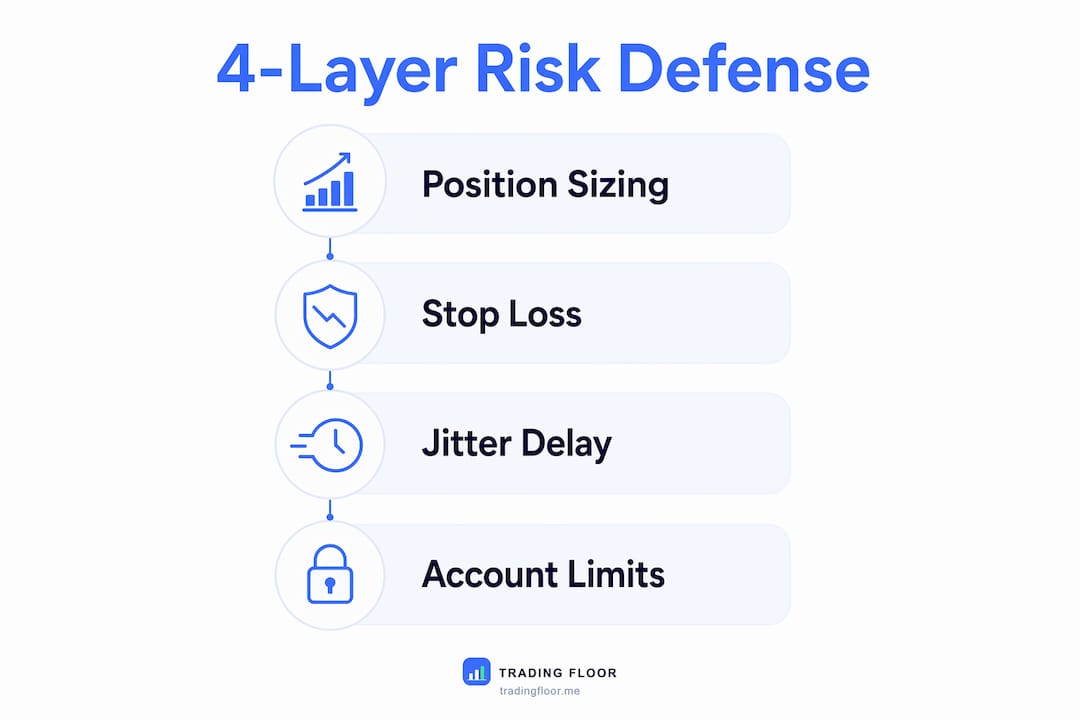
The layers work together because no single control is sufficient on its own. A stop loss protects a single trade. A daily loss limit protects the session. Drawdown management protects the account over time. Position sizing controls how much damage any one trade can do before the other layers activate.
The 4-layer risk defense system
- Position sizing: Assign a fixed percentage of each account’s balance to every trade. The one-percent rule suggests risking no more than 1% of capital on a single trade, which limits catastrophic loss from any one signal.
- Stop-loss placement: Set hard stop losses at trade entry and do not move them. Stop losses define the exact price at which a losing trade exits automatically, removing emotion from the decision.
- Daily and weekly loss limits: A 3% daily loss limit is the recommended threshold for funded accounts. Hitting this limit triggers an auto-flatten and prevents a bad session from becoming a blown account.
- Drawdown management: Track cumulative losses across the account’s lifetime. Prop firms set maximum drawdown thresholds, and your system must enforce them before the firm does.
| Risk layer | What it protects | Recommended threshold |
|---|---|---|
| Position sizing | Single trade loss | 1% of account balance |
| Stop loss | Individual trade exit | Set at entry, never moved |
| Daily loss limit | Session-level loss | 3% of account balance |
| Drawdown management | Account lifetime loss | Per prop firm rules |
Pro Tip: Configure each account’s risk limits to match its specific prop firm rules. A limit that passes on one firm may violate another’s terms. One-size-fits-all risk settings are a fast path to denied payouts.
Why does cross-account hedging trigger account flags and denied payouts?
Cross-account hedging is defined as holding opposing positions, one long and one short, across two linked accounts at the same time. The practice creates artificial risk neutralization. A trader appears to be taking risk on paper while actually holding a near-zero net position across accounts. Prop firms prohibit this because it defeats the purpose of their evaluation model.
Detection is more sophisticated than most traders expect. Firms monitor sub-second fill timing and shared network fingerprints, including IP addresses, across accounts. When two accounts show opposing fills within milliseconds of each other from the same IP, the pattern flags automatically. The consequence is a denied payout, account termination, or a permanent ban from the firm.
Cross-account hedging is hard to catch manually because the timing and sizing signals only become visible when reviewing multiple accounts at the same time. Automated detection systems reconstruct the full picture faster and more accurately than any human reviewer can.
The solution is not to avoid automation. The solution is to configure automation correctly. Jitter settings introduce randomized delays between fills, so accounts do not show coordinated timestamps. Auto-flatten rules close positions at the account level rather than letting opposing positions accumulate. Continuous behavioral monitoring of your own accounts catches patterns before a firm’s algorithm does.
Holding accounts at multiple prop firms simultaneously is universally permitted. What triggers denial is coordinated execution that looks like hedging, not the act of holding multiple accounts. The distinction matters. You can run the same strategy across ten accounts without issue. You cannot run opposing strategies across linked accounts and expect to collect payouts.
How to implement cross-account trade management effectively
Setting up multi-account trade management correctly from the start prevents most of the problems traders encounter later. The configuration sequence matters because each step depends on the one before it.
- Create one webhook URL in your automation platform and point all signal sources to it. This single entry point controls all downstream execution.
- Authenticate each account individually. Connect each broker and prop firm account separately. Tradingfloor supports connections across platforms including Tradovate and TopstepX, treating each account as a distinct entity.
- Assign quantity multipliers by account size. A $25K account runs at 1x. A $50K account runs at 2x. This keeps proportional position sizing consistent across accounts without manual adjustment on every trade.
- Configure per-account risk limits. Set daily loss limits, maximum position sizes, and drawdown thresholds for each account individually. Do not copy one account’s settings to another without checking the firm’s specific rules.
- Enable jitter on all accounts. Even a small randomized delay, measured in milliseconds, breaks the identical-timestamp pattern that detection algorithms target.
- Test with minimum size before going live. Run one contract per account through a full signal cycle and verify fills, sizes, and timestamps before scaling up.
- Monitor performance continuously. Review fill quality, slippage, and risk limit usage weekly. Automation does not eliminate the need for oversight. It shifts oversight from execution to configuration.
The most common pitfalls are manual re-entry after a missed signal and ignoring jitter settings because they seem minor. Manual re-entry creates inconsistent account states that compound over time. Ignoring jitter is the single fastest way to trigger a fraud flag. Both mistakes are avoidable with proper setup.
Pro Tip: Treat your multi-platform trading setup as a system, not a collection of accounts. Every configuration decision affects every account. Change one setting and audit the full system before the next trading session.
Key Takeaways
Cross-account trade management works when automation, proportional sizing, and account-specific risk controls operate as a single coordinated system rather than independent settings.
| Point | Details |
|---|---|
| Automation is the foundation | A single webhook signal fans out to all accounts, eliminating manual re-entry errors. |
| Proportional sizing prevents errors | Quantity multipliers scale position size to each account’s balance automatically. |
| Jitter protects compliance | Randomized millisecond delays break identical-timestamp patterns that trigger fraud detection. |
| Risk layers must be account-specific | Daily loss limits and drawdown rules vary by prop firm and must be configured individually. |
| Hedging across accounts ends payouts | Opposing positions in linked accounts trigger detection algorithms and result in denied payouts. |
Why most traders get multi-account scaling wrong
I have watched traders set up ten accounts, run the same strategy across all of them, and then wonder why one account gets flagged while the others do not. The answer is almost always configuration. They treated account count as a copy-paste problem and ignored the fact that each account lives inside a different firm’s compliance framework.
The traders who scale successfully treat account count as a lever, not a liability. They automate early, before the manual workload becomes unmanageable. They configure jitter and per-account risk limits before they add a second account, not after something goes wrong. That sequence matters more than the tools they use.
The compliance side of this is evolving fast. Prop firms are getting better at behavioral detection, and the gap between what a trader thinks is safe and what actually triggers a flag is narrowing. The traders who stay ahead of that curve are the ones who understand how detection works, not just how to execute trades. Reviewing your own accounts the way a firm’s algorithm would is a habit worth building now.
Automation does not make multi-account trading risk-free. It makes it manageable. The risk is still there. Your job is to configure the system so the risk stays where you put it.
— KennyTrades
How Tradingfloor handles multi-account trade management
Tradingfloor is built specifically for prop traders who need to mirror real-time positions, not just signals, across funded and evaluation accounts simultaneously.
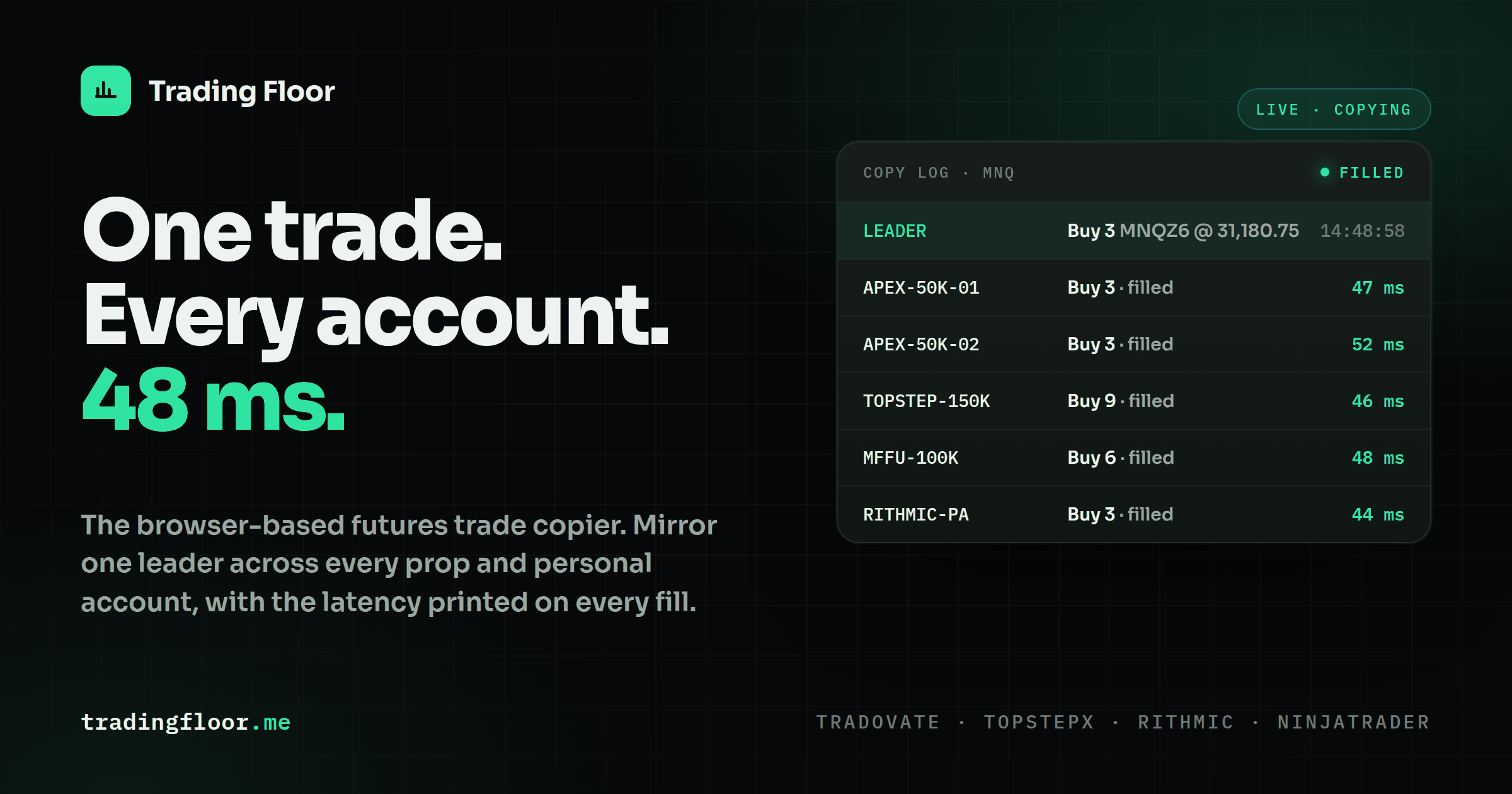
The platform copies the leader account’s net position to every connected account in real time, with individual risk controls applied at the account level. Traders running accounts on Tradovate and TopstepX can connect both within the same system. Trade limits, real-time notifications, and auto-flatten rules are all configurable per account. Tradingfloor runs in the cloud, so no installation is required and it works from any device. Check the pricing plans to see which tier fits your current account count, or visit Tradingfloor to see the full feature set.
FAQ
What is cross-account trade management in simple terms?
Cross-account trade management is the practice of applying one trading strategy across multiple accounts automatically, with separate risk controls for each account. A single signal triggers execution across all connected accounts without manual re-entry.
Is managing multiple prop firm accounts at the same time allowed?
Holding accounts at multiple prop firms simultaneously is universally permitted. What prop firms prohibit is cross-account hedging, which means holding opposing positions across linked accounts, and coordinated identical executions that mimic hedging patterns.
What is jitter and why does it matter for multi-account trading?
Jitter introduces randomized millisecond delays between order fills across accounts. It prevents identical timestamps that detection algorithms use to identify coordinated or hedged executions.
How should I set position sizes across accounts of different sizes?
Use quantity multipliers to scale position size proportionally to each account’s balance. A $25K account runs at 1x and a $50K account runs at 2x, keeping risk consistent as a percentage of each account’s capital.
What happens if cross-account hedging is detected?
Prop firms that detect cross-account hedging typically deny the associated payout, terminate the flagged account, or ban the trader from the platform entirely. Detection relies on sub-second fill timing analysis and shared network fingerprint matching across accounts.
Recommended
- Multi-Account Trade Execution Explained for Prop Traders — Trading Floor
- Passive Trade Management: A Practical 2026 Guide — Trading Floor
- Multi-Platform Trading Best Practices for Prop Traders — Trading Floor
- Account-Level Risk Management: A Trader’s Complete Guide — Trading Floor
Trading Floor mirrors every trade across your Tradovate, TopstepX & Rithmic accounts in real time, from $25/mo.
Start copying →