Best prop.tradovate.com Alternatives for Multi-Account Prop Traders

Tradingfloor is the top alternative to prop.tradovate.com for prop traders running multiple funded and evaluation accounts who need real-time net-position mirroring with per-account risk controls. For traders who prioritize raw execution speed, a Rithmic-based setup through NinjaTrader is the closest technical rival. For widest broker compatibility with minimal setup friction, Tradovate’s own cloud infrastructure remains a solid baseline, but it lacks native multi-account copying.
Quick shortlist:
- Tradingfloor — best overall for multi-account real-time position mirroring, per-account limits, and cloud accessibility across Tradovate, TopstepX, and Rithmic
- NinjaTrader + Rithmic — best for scalpers and order-flow traders who need microsecond-level precision and DOM-heavy strategies
- Tradovate — best for traders who want web-native access across devices with no installation overhead
- CQG — best for institutional-grade data feeds and exchange connectivity where broker-side integration is required
- TopstepX — best for traders already in the TopStep ecosystem who want native funded-account management
Pro Tip: Before committing to any alternative, run a parallel live pilot with a small subset of your funded accounts. Measure average slippage, fill latency, and reconciliation mismatch rate before scaling to your full account roster.
Table of Contents
- How do these prop.tradovate.com alternatives compare side by side?
- How do these alternatives actually differ technically?
- How do you choose the right alternative?
- What does multi-account copying actually cost?
- What does a realistic migration timeline look like?
- Why Tradingfloor is the recommended pick for multi-account prop copying
- Key Takeaways
- What experienced prop traders often get wrong about platform switching
- Tradingfloor’s 30-day free trial: what to test and how to start
- Further reading and sources
How do these prop.tradovate.com alternatives compare side by side?
| Dimension | Tradingfloor | NinjaTrader + Rithmic | Tradovate | CQG | TopstepX |
|---|---|---|---|---|---|
| Copy method | Net position mirroring | Signal/event copying | Broker-side account linking | Broker-side / API | Native funded-account sync |
| Supported brokers | Tradovate, TopstepX, Rithmic | Rithmic, CQG, others | Tradovate-native | CQG-native | TopStep-native |
| Latency & execution | Cloud-optimized, low-latency sync | Ultra-low latency via raw feed | Web-native, moderate latency | Institutional-grade | Platform-dependent |
| Per-account risk controls | Contract multipliers, slippage caps, trade limits | Manual configuration | Limited | Limited | Basic |
| Max multi-account capacity | Dozens of concurrent accounts | Platform-limited | Up to 20 (Apex-specific) | Varies | Funded accounts only |
| Pricing model | Monthly/annual subscription | License + data feed fees | Subscription tiers | Data feed + connectivity fees | Included with TopStep |
| Installation/hosting | Cloud, no install | Local install required | Web-native, no install | Local/hosted | Cloud |
| Funded/eval support | Full support | Partial | Partial | Partial | Full (TopStep only) |
| Trial/demo | 30-day free trial | Demo available | Demo available | Not publicly listed | Demo available |
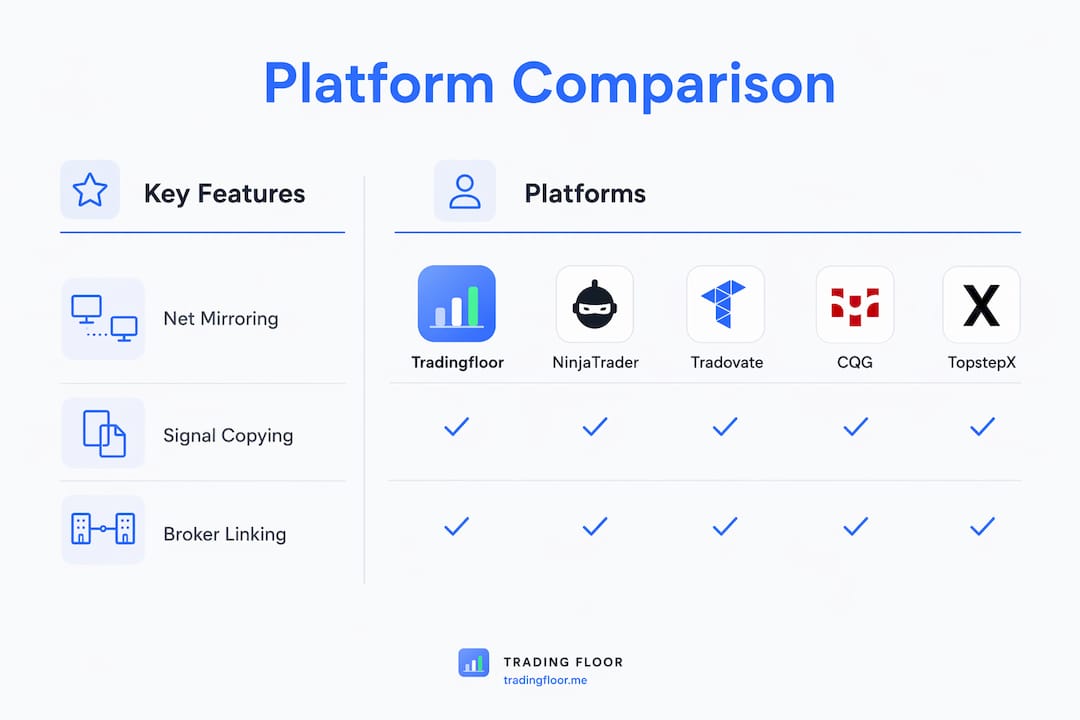
Key differentiator: Tradingfloor is the only option here that combines cloud hosting, net-position mirroring (not just signal copying), and per-account risk controls in a single subscription with no local install.
How do these alternatives actually differ technically?
The copy architecture is where most traders make the wrong call. There are three distinct approaches in play here.
Net position mirroring replicates the leader account’s exact net position across all follower accounts in real time. When the leader goes long 3 ES contracts, every follower mirrors that net position immediately, adjusted by each account’s contract multiplier. Reconciliation happens automatically when partial fills occur. This is what Tradingfloor uses, and it is the most reliable method for managing funded and evaluation accounts simultaneously because it handles order persistence and fill mismatches without manual intervention.
Signal/event copying fires a new order on each follower account when the leader triggers an entry or exit signal. Slippage compounds across accounts, and partial fills on the leader can leave followers in mismatched positions. NinjaTrader with a Rithmic feed uses this model. It is excellent for execution speed on a single account but gets messy at scale.
Broker-side account linking (Tradovate’s group trade feature, CQG’s account management) ties accounts at the broker level. It works within a single broker’s ecosystem but breaks down when you run accounts across Tradovate and TopstepX simultaneously.
For Rithmic versus Tradovate architecture specifically: Rithmic delivers raw market data with superior execution speed suited to scalpers and tape readers. Tradovate’s web-native client runs in any browser on macOS and Linux without virtualization, which matters for traders who travel or use multiple devices. Advanced order-flow tools like footprint charts typically require Rithmic connections or third-party terminals such as Sierra Chart or Quantower layered on top.
Pro Tip: Test your chosen solution during a scheduled macro event like FOMC or NFP before going live at full scale. Stability issues on cloud platforms during high-volatility events are a known risk, and discovering them mid-evaluation is expensive.
How do you choose the right alternative?
Start with this checklist of must-haves before evaluating any vendor:
- Real-time net-position mirroring (not signal copying)
- Per-account contract multipliers and slippage caps
- Funded and evaluation account support simultaneously
- Auto-reconciliation for partial fills
- Audit logs and trade journaling
- Cloud hosting with no local install dependency
- Push notifications for fills, errors, and limit breaches
Then ask vendors these questions directly:
- What is your latency SLA from leader fill to follower order submission?
- Which brokers and platforms do you support natively (Tradovate, Rithmic, TopstepX, CQG, NinjaTrader)?
- What is the maximum number of concurrent accounts you have tested in production?
- How does your system reconcile partial fills on the leader account?
- What are your trial terms, and can I test with real funded accounts during the trial?
- Where is data stored, and what encryption standard do you use?
Red flags that should disqualify a solution:
- No demo or trial with real funded accounts
- Per-account or per-feed fees not disclosed upfront
- Vendor-hosted only with no redundancy or status page
- No clear answer on reconciliation method for partial fills
- Platform lock-in that prevents testing across multiple prop firms
For more on funded account risk rules and what to verify before switching, that resource covers the prop-firm-specific constraints in detail.
What does multi-account copying actually cost?
Analysts recommend modeling the all-in cost rather than comparing headline subscription prices. The real number includes platform subscription, data feed fees, exchange clearing costs, and any per-account charges.
| Cost category | Typical range | Notes |
|---|---|---|
| Platform subscription | Varies by tier | Monthly or annual; check per-account caps |
| Market data feed (Rithmic) | — | Required for Rithmic-based setups |
| Market data feed (CQG) | Higher than Rithmic | Institutional pricing; not publicly listed |
| Exchange clearing/commission | Per contract | Depends on broker and contract type |
| Connection/port fees | Varies | Some vendors charge per broker connection |
For a small setup (3–5 accounts), the data feed cost often exceeds the platform subscription. At 10+ accounts, per-account fees from some vendors can double your monthly operating cost versus a flat subscription model.
Pro Tip: Build a simple breakeven model: (monthly platform fee + data feed costs) ÷ number of accounts = your per-account operating cost. Compare this across a 3-account, 10-account, and 20-account scenario before signing up. Subscription tiers that look expensive at 3 accounts often become the cheapest option at 15.
What does a realistic migration timeline look like?
Switching platforms mid-evaluation is one of the most common and costly mistakes. Plan your migration between funded cycles.
Step-by-step timeline:
- Sandbox/paper testing (Days 1–7): Connect the new platform to demo accounts. Verify copy method, latency, and reconciliation behavior with no real capital at risk.
- Funded demo dry-run (Days 8–14): Map your real account IDs, configure per-account limits and multipliers, and run the system in parallel with your current setup.
- Small live pilot (Days 15–21): Go live with 2–3 funded accounts. Measure slippage, fill latency, and reconciliation accuracy. Include at least one volatile session.
- Scale-up (Days 22–28): Add remaining accounts incrementally. Confirm notifications and audit logs are functioning.
- Full migration (Day 29+): Decommission the old setup only after the new system has run cleanly for at least one full week at scale.
Migration checklist:
- Confirm your prop firm allows platform changes between evaluation and funded stages
- Verify funded and evaluation accounts are treated interchangeably by the new system
- Test slippage caps and contract multipliers on each account individually
- Confirm reconciliation behavior under a partial fill scenario
- Keep a rollback plan active for the first 30 days
For a detailed copy trades walkthrough covering TopstepX and multi-account setup, that guide covers account mapping and configuration step by step.
Why Tradingfloor is the recommended pick for multi-account prop copying
Tradingfloor addresses every dimension on the checklist above out of the box. Real-time net-position mirroring means follower accounts track the leader’s exact net position, not a delayed signal. Per-account contract multipliers let you size each funded account differently. Slippage caps and trade limits protect individual accounts from runaway fills. Auto-reconciliation handles partial fills without manual intervention. Push notifications fire on fills, errors, and limit breaches.

The cloud-native architecture means no local install, no VPS dependency, and access from any device. For prop managers running dozens of funded and evaluation accounts across Tradovate and TopstepX simultaneously, that matters operationally.
For scalpers, the low-latency sync is the critical test. For discretionary swing traders managing multiple funded accounts, the audit logs and trade journaling are what keep you compliant with prop firm rules across accounts. For firms onboarding new traders, the group account management and affiliate referral features add operational leverage.
The 30-day free trial is long enough to run the full migration timeline above. Use it to test latency during at least one FOMC or NFP session, verify reconciliation under a partial fill, and confirm your prop firm’s funded/eval account rules are respected. Pair it with a no-code automation tool if you want to layer strategy automation on top of the copying infrastructure.
Pro Tip: During your trial, run Tradingfloor in parallel with your current setup for the first two weeks. Compare fill prices and reconciliation accuracy side by side before cutting over completely.
Key Takeaways
For multi-account prop traders, the copy architecture (net mirroring vs. signal copying) is the single most consequential technical choice, and Tradingfloor’s cloud-based net-position mirroring with per-account controls is the most production-ready option available.
| Point | Details |
|---|---|
| Copy method matters most | Net position mirroring avoids slippage compounding and reconciliation errors that signal copying creates at scale. |
| Model all-in cost | Platform fee plus data feed plus per-account charges often doubles the headline subscription price at 10+ accounts. |
| Migrate between funded cycles | Switching mid-evaluation risks progress resets; confirm platform interchangeability with your prop firm first. |
| Test during macro events | Validate execution during FOMC or NFP before going live at full scale to catch stability issues early. |
| Tradingfloor trial | A 30-day free trial covers the full migration timeline, including latency checks and funded/eval account verification. |
What experienced prop traders often get wrong about platform switching
The conventional wisdom says pick the platform with the lowest latency and the most broker integrations. That framing misses the actual bottleneck for most multi-account operators.
The real problem is not execution speed at the single-account level. It is reconciliation at scale. When you are running 15 funded accounts and a partial fill hits the leader, what happens to the 14 followers? Signal-copying systems leave you with mismatched positions you have to manually unwind, often during the same volatile session that caused the partial fill. That is where prop firm rule violations happen.
The traders who get this right treat the copier as the core infrastructure and the execution platform as a downstream component. They pick the copy architecture first, then verify broker compatibility, then worry about latency. Most do it in reverse order and end up rebuilding their stack six months later.
Tradingfloor’s 30-day free trial: what to test and how to start
Tradingfloor gives you 30 days to run the full migration playbook described above at no cost. During the trial, prioritize three tests: latency checks during a live volatile session, funded and evaluation account sync verification, and per-account limit configuration across your full account roster.
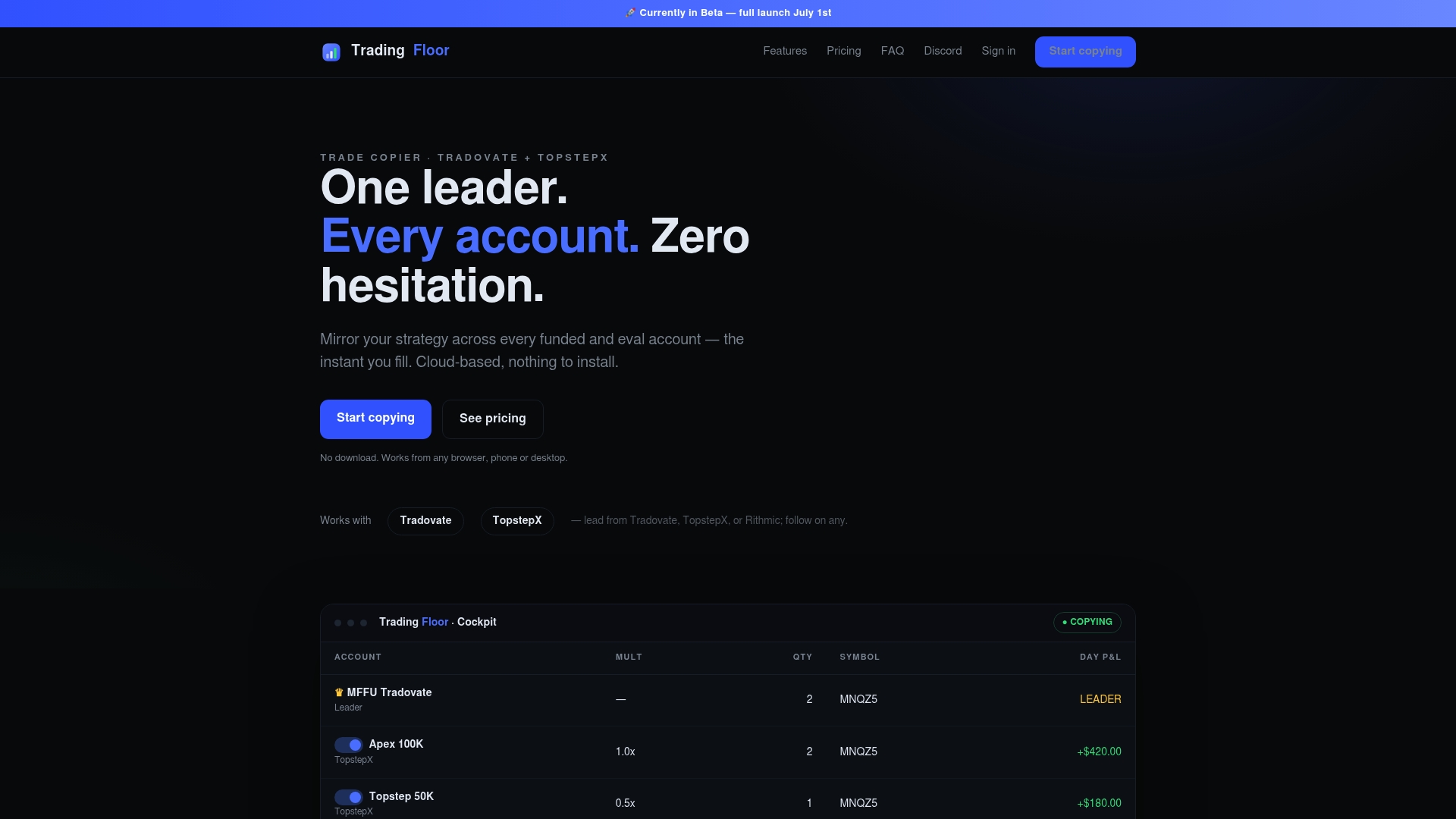
The platform is cloud-hosted with no local install required. Before your first large live test, check the system status page to confirm uptime and connectivity. Onboarding support is available if you need help mapping account IDs or configuring contract multipliers for the first time. Start your trial, run the pilot, and scale only after the reconciliation numbers check out.
Further reading and sources
- Rithmic vs. Tradovate: Which One Is Best for Prop Firm Traders? — covers execution architecture, latency tradeoffs, and subscription economics; cited throughout the comparative analysis and pricing sections.
- Best Prop Firm Trading Platform 2026: 6 Compared — supports the all-in cost modeling framework and migration risk guidance, including the platform lock-in warning.
- NinjaTrader vs. Tradovate vs. Rithmic: Best Platforms for Prop Trading 2026 — PropScorer’s breakdown of strategy fit by platform; supports the scalper vs. discretionary trader framing.
- Best Trading Tools 2026: Platforms, Charting & Data Feeds — practitioner write-ups on stability during high-volatility events and parallel pilot methodology.
- Best Prop Trading Firms 2026: 12 Firms on 10 Criteria — full firm comparison including Apex Trader Funding and TopStep; useful for verifying funded account structures and platform availability.
- Multi-Platform Trading Best Practices for Prop Traders — Tradingfloor’s own operational guide for managing trades across multiple prop platforms.
Recommended
- Best Tradease.io Alternatives for Multi-Account Traders — Trading Floor
- Top 4 nbs360.com Alternatives for 2026 — Trading Floor
- Multi-Platform Trading Best Practices for Prop Traders — Trading Floor
- How to Copy Trades Across Multiple Prop Firm Accounts Like TopstepX — Trading Floor
Trading Floor mirrors every trade across your Tradovate, TopstepX & Rithmic accounts in real time, from $25/mo.
Start copying →