Why Prop Evaluators Monitor Trading Patterns

Prop evaluators monitor trading patterns to determine whether a trader’s profits come from repeatable, risk-controlled behavior rather than a single lucky run near the evaluation limits. Evaluation failures mostly result from risk habits like position sizing, trade frequency, and drawdown breaches, not weak strategies. That single fact reframes everything. Passing an evaluation is not about hitting a profit target once. It is about proving that your process holds up under pressure, across dozens of trades, in real market conditions. Prop firms use behavioral analytics and layered data monitoring to make that judgment with confidence.
Why prop evaluators monitor trading patterns
Prop evaluators are not just checking whether you made money. They are asking a harder question: did you make money the right way? Behavioral signatures like size changes over time, holding time distribution, and equity curve smoothness predict a trader’s sustainability far better than a single trade outcome. A trader who doubles their position size after a losing streak is showing a stress response. That response is exactly what evaluators are trained to spot.
The importance of trading pattern analysis comes down to one word: repeatability. A firm that funds a trader is betting that the trader’s edge will persist across hundreds of future trades. Pattern monitoring gives evaluators the evidence they need to make that bet with confidence, or to decline it.

What specific trading behaviors do prop evaluators monitor?
Evaluators focus on a defined set of behavioral metrics. These are the signals that separate disciplined traders from those who got lucky during a favorable stretch of market conditions.
- Position sizing consistency. Oversizing is the most common cause of drawdown breaches. Evaluators track whether lot sizes stay proportional to account equity or spike erratically after losses.
- Trade frequency. Overtrading is a stress response. A trader who suddenly doubles their daily trade count after a bad session is chasing losses, not executing a plan.
- Holding time distribution. Evaluators look at how long trades stay open. Extremely short holding times can signal scalping strategies that conflict with firm rules. Unusually long holds may indicate a trader avoiding a stop loss.
- Equity curve smoothness. A smooth, gradual equity curve signals consistent execution. A jagged curve with large single-day swings signals high variance and poor risk control.
- Drawdown buffer usage. Firms track how close a trader gets to the maximum drawdown limit on a daily and overall basis. Repeatedly grazing the limit is a red flag, even if the trader never technically breaches it.
Pro Tip: Track your own position sizing ratio before your evaluation ends. If your average lot size in the final three days is larger than your average in the first week, that is a behavioral pattern evaluators will notice.
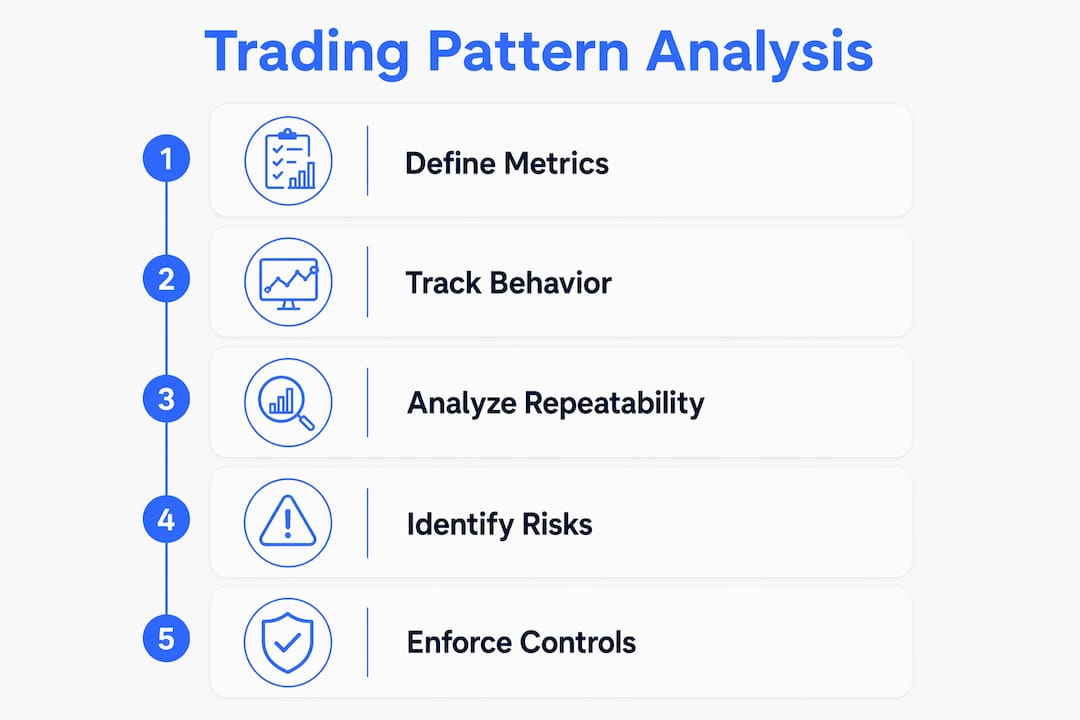
The key insight from risk habit analysis is that evaluators are running a time-series analysis on your behavior, not just a snapshot of your final P&L. They want to see how your process responds to a loss sequence, a drawdown, and a near-miss on a rule breach.
How do prop firms use data layers and real-time analytics?
Prop firms do not rely on a single metric. Six data layers form the foundation of modern evaluation monitoring: account state, trade execution, behavior, cross-account risk, identity, and lifecycle. Each layer catches a different category of risk.
Here is how each layer functions in practice:
- Account state. Firms track balance, equity, open positions, unrealized P&L, drawdown buffer, and target progress in real time. This layer catches limit breaches the moment they occur.
- Trade and order execution. Every entry, exit, modification, and cancellation is logged with a timestamp. Evaluators use this data to spot unusual timing patterns or rule violations at the order level.
- Behavioral analytics. This layer aggregates the metrics described above: size consistency, frequency, holding time, and equity curve shape. It builds a behavioral profile over the full evaluation period.
- Cross-account risk. Firms analyze whether multiple accounts are taking correlated positions at the same time. This catches coordinated hedging setups designed to guarantee a payout on at least one account.
- Identity and device signals. IP addresses, device fingerprints, and login patterns are tracked to link accounts that may belong to the same trader or trading ring.
- Lifecycle metrics. Firms track where a trader is in the evaluation cycle. A trader who changes behavior dramatically in the final days of an evaluation is flagged for review.
| Data layer | What it catches |
|---|---|
| Account state | Real-time drawdown and equity limit breaches |
| Trade execution | Order-level rule violations and timing anomalies |
| Behavioral analytics | Stress responses, overtrading, and sizing inconsistencies |
| Cross-account risk | Coordinated hedging and copy trading abuse |
| Identity signals | Multi-account fraud and device-linked rings |
| Lifecycle metrics | Late-stage behavior changes and rule gaming |
Layered, continuous enforcement provides redundancy. If one layer misses an edge case, another catches it. That redundancy is what makes scaled prop firm operations viable.
Why does equity-based drawdown monitoring matter more than balance?
Equity-based risk limits are the most misunderstood rule in prop trading. Breaches occur based on equity, not just closed trade results. A trader can have a positive closed P&L for the day and still breach a daily loss limit because of open floating losses.
The practical difference between balance-based and equity-based tracking is significant:
- Balance reflects only closed trades. It does not change while a position is open.
- Equity reflects closed trades plus the current unrealized P&L of all open positions. It changes tick by tick.
- Daily loss limits at most prop firms are calculated on equity, not balance. A $500 open loss counts against your daily limit even if you have not closed the trade.
Floating exposure monitoring and warning thresholds greatly reduce surprise breaches. Firms that implement automated kill switches can close all open positions the moment equity drops to the daily limit. This protects both the trader’s account and the firm’s capital.
Pro Tip: Calculate your real available daily loss room by subtracting your current floating P&L from your starting equity for the day, not from your balance. That number is your true remaining buffer.
The traders who fail evaluations due to equity breaches are almost always those who mentally track their P&L by closed trades only. The firm’s system is watching something different.
How do prop firms detect coordinated trading abuse across accounts?
Cross-account abuse is treated as a relationship problem, not an individual account problem. Firms analyze accounts jointly rather than in isolation. The goal is to detect setups where a trader holds opposite positions across two accounts, guaranteeing that one passes the evaluation regardless of market direction.
| Abuse type | Detection method |
|---|---|
| Opposite-side hedging | Position symmetry analysis across linked accounts |
| Copy trading rings | Timing correlation and identical size matching |
| Multi-account identity fraud | Device fingerprints and IP cluster analysis |
| Payout exploitation | Lifecycle pattern review at evaluation end |
Platforms scan in real time and alert on multi-account abuse patterns based on timing, exposures, and IP or device correlations. When an automated alert fires, an operations team member reviews the flagged accounts manually before any payout is processed.
The challenge for firms is that traders operating across multiple prop firms simultaneously are harder to catch. No single firm sees the full picture. Industry solutions that share anonymized risk signals across platforms are emerging, but cross-firm detection remains an open problem. For now, firms rely on the depth of their own data layers and the quality of their identity verification at account creation.
Key takeaways
Prop evaluators monitor trading patterns because profit alone does not prove a trader is ready to manage real capital at scale.
| Point | Details |
|---|---|
| Behavior over profit | Evaluators analyze risk habits like sizing and frequency, not just final P&L. |
| Six data layers | Firms track account state, execution, behavior, cross-account risk, identity, and lifecycle metrics. |
| Equity beats balance | Daily loss limits are calculated on equity, including floating losses, not closed trade balance. |
| Abuse detection is relational | Cross-account fraud is caught by analyzing accounts as a group, not individually. |
| Pattern consistency wins | A smooth, consistent behavioral profile across the full evaluation period is the strongest signal of fundability. |
Pattern monitoring reveals what profit numbers hide
Most traders I have worked with focus entirely on their profit target and treat the rules as a checklist. That mindset is exactly backward. The rules are the test. The profit target is just the minimum threshold to be considered.
What pattern monitoring actually reveals is how a trader behaves when the market goes against them. A trader who cuts size after a drawdown and waits for a high-probability setup is showing the behavior a firm wants to fund. A trader who doubles size to recover losses fast is showing the behavior that blows funded accounts. Both traders might pass the evaluation. Only one of them should.
The traders I have seen succeed consistently at the funded stage are those who treat their evaluation data as a feedback loop. They review their own behavioral metrics the same way a firm would. They catch their own stress responses before an evaluator does. That self-awareness is not a soft skill. It is a measurable edge.
— Kenten
Tradingfloor gives you the monitoring tools evaluators use
Passing a prop evaluation requires the same real-time visibility that evaluators have on your account. Tradingfloor gives prop traders a cloud-based dashboard that mirrors position data across funded and evaluation accounts simultaneously, with individual risk controls active on every account.
Tradingfloor tracks equity, drawdown, and trade behavior in real time across platforms including Tradovate and TopstepX. Real-time notifications fire before you approach a limit, not after you breach it. That early warning is the difference between a recoverable session and a failed evaluation. Traders managing multiple accounts can view and control all positions from a single interface, on any device, without installing software. See the full feature set and current pricing or go straight to the Tradingfloor platform to get started.
FAQ
Why do prop evaluators care about trading patterns beyond profit?
Profit alone does not prove repeatable skill. Evaluation failures mostly result from risk habits like position sizing and drawdown breaches, which pattern monitoring detects directly.
What is the difference between balance-based and equity-based drawdown tracking?
Balance reflects only closed trades, while equity includes open floating losses. Most prop firms calculate daily loss limits on equity, so open positions count against your limit in real time.
How do prop firms detect multi-account abuse?
Firms use cross-account correlation analysis that compares timing, position size, instrument choice, and identity signals like IP addresses and device fingerprints across all linked accounts.
What behavioral metrics matter most during a prop evaluation?
Position sizing consistency, trade frequency, holding time distribution, and equity curve smoothness are the primary behavioral signals evaluators use to assess trader discipline and risk control.
Can a trader pass an evaluation but still get flagged by pattern monitoring?
Yes. A trader who passes the profit target but shows erratic sizing, late-stage behavior changes, or cross-account correlations can be flagged for manual review before a funded account is issued.
Recommended
Article generated by BabyLoveGrowth
Trading Floor mirrors every trade across your Tradovate, TopstepX & Rithmic accounts in real time, from $25/mo.
Start copying →