Funded Account Risk Rules Explained for Prop Traders

Funded account risk rules are the mandatory quantitative limits and behavioral guardrails that govern how traders can operate within a prop firm’s allocated capital. These rules define daily loss ceilings, maximum drawdown thresholds, stop-loss requirements, and profit consistency constraints. Funded accounts are performance contracts with simulated capital, meaning payout eligibility depends on rule compliance, not just profits. Understanding these rules is the difference between a sustainable trading career and an abrupt account termination.
What are the standard risk limits in funded accounts?
Daily loss limits typically range between 4% and 5%, with maximum total drawdown limits around 8%–10%. Breaching either limit triggers automatic account termination. These are not soft warnings. The system closes your account the moment you cross the line.
The distinction between equity-based and balance-based drawdown calculation matters enormously. Equity-based drawdown systems factor in the floating profit or loss on open trades in real time. That means a position moving against you can eat into your drawdown buffer before you close it. Balance-based systems only count realized trades. Equity-based is the industry standard and the stricter of the two.
Here is a practical example. You trade a $100,000 funded account with a 5% daily loss limit. Your maximum daily loss is $5,000. If you have an open position down $4,800 at 2:00 PM, you have only $200 of buffer left for the rest of the session. Most traders do not think in those terms until it is too late.

| Rule Type | Typical Threshold | Consequence of Breach |
|---|---|---|
| Daily loss limit | 4%–5% of account balance | Immediate account termination |
| Maximum drawdown | 8%–10% of account balance | Permanent account closure |
| Equity-based calculation | Includes open P&L | Reduces buffer in real time |
| Stop-loss requirement | Mandatory on most platforms | Trade rejection or penalty |
Pro Tip: Track your equity drawdown, not just your realized P&L. Your account can breach its limit on an open position even if you have not closed a single losing trade that day.
For a broader look at how evaluation account frameworks structure these limits across different phases, the differences between evaluation and funded stages are worth studying before you start trading.
How do trade-level risk controls work in funded accounts?
Risk-per-trade limits are the second layer of funded account trading guidelines. Most firms cap individual trade risk at 1%–3% of account balance. Violating this does not always trigger immediate termination, but repeated breaches flag your account for review and can delay payouts.
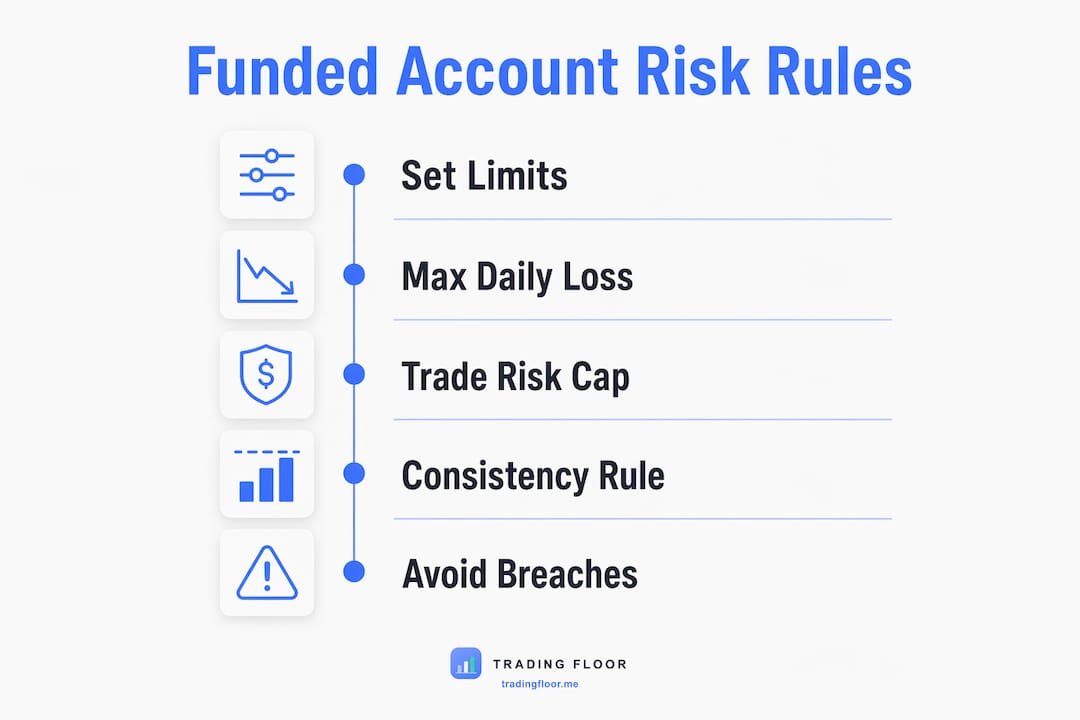
The correct way to calculate risk per trade starts with your stop-loss distance, not a fixed dollar amount. Position sizing must be scaled based on the remaining drawdown buffer rather than the nominal account balance. If you have already used 4% of your 8% drawdown buffer, your effective risk capital is half of what it was at the start. Sizing from the original balance at that point doubles your actual exposure.
Here is a step-by-step method for calculating position size correctly:
- Identify your stop-loss distance in ticks or pips for the instrument you are trading.
- Calculate your maximum dollar risk as a percentage of your remaining drawdown buffer, not your starting balance.
- Divide the dollar risk by the stop-loss distance multiplied by the per-tick or per-pip value to get your position size.
- Check aggregate exposure if you hold correlated positions. Two long positions in correlated instruments double your directional risk.
- Confirm the position fits within the daily loss limit given your current equity, not your balance.
Holding multiple correlated trades compounds risk in ways that a single-trade calculation misses. Two long positions in crude oil and natural gas, for example, move together under most market conditions. Your effective risk is the sum of both positions, not each in isolation.
Pro Tip: Before entering any trade, calculate how much of your daily loss limit is already consumed by open positions. Treat that consumed amount as spent capital, not recoverable buffer.
The account-level risk management guide on Tradingfloor covers position sizing frameworks in more depth, including how to apply them across multiple funded accounts simultaneously.
What is the consistency rule and how does it affect payouts?
The consistency rule is one of the most misunderstood elements of funded account risk rules explained across trading communities. Consistency rules cap the percentage of total profit that can come from a single trading day, typically at 30%–40%. Violating this rule does not terminate your account. It delays or reduces your payout.
Here is why the rule exists. Prop firms want to see repeatable, disciplined trading, not a single lucky day followed by flat performance. A trader who makes $9,000 in one session and loses $1,000 over the next nine days has a net profit of $8,000. But if that $9,000 day represents more than 40% of total profits, the payout gets flagged or reduced.
Consistency rule enforcement varies by firm. Some apply it only at the payout stage. Others enforce it during the evaluation phase as well. This distinction changes how you should structure your trading sessions from day one.
Practical adjustments to stay within the consistency rule:
- Cap your daily profit target at a fixed percentage of your total account profit goal. If your target is $10,000 and the cap is 30%, stop trading once you hit $3,000 in a single session.
- Reduce position size on strong trend days. When the market moves in your favor, the temptation is to add size. The consistency rule penalizes that behavior.
- Spread trades across sessions rather than concentrating entries in a single high-volatility window like the market open.
- Track your running profit total daily so you always know what percentage any given day’s gains represent.
- Review the firm’s specific threshold before your first trade. A 30% cap and a 40% cap require different session management strategies.
Traders who ignore the consistency rule often discover it at payout time, not during trading. That is the worst moment to learn it applies.
What tools and habits prevent funded account rule breaches?
Automated risk controls outperform manual discipline every time a trader faces a drawdown. Kill-switch systems that monitor equity tick-by-tick and halt trading at 80% of the daily loss limit significantly reduce accidental rule breaches. Waiting until you are at 100% of the limit to stop trading is too late. The 80% threshold gives you a buffer to close open positions without triggering termination.
Setting personal warning thresholds below the firm’s hard limits is the single most effective funded trading account safety tip available. If the daily loss limit is 5%, set your personal kill-switch at 3.5%. That 1.5% gap is your emergency margin. It absorbs slippage, spread costs, and the time it takes to exit a position cleanly.
Real-time equity monitoring is non-negotiable. Balance-only monitoring gives you a false sense of security when you have open positions. Your equity can breach the daily limit while your balance still looks fine. Detailed session record-keeping of risk metrics, daily limits, and timestamps helps resolve payout disputes quickly and keeps your trading behavior transparent.
- Use a platform that displays live equity drawdown, not just realized P&L.
- Set automated alerts at 50%, 75%, and 90% of your daily loss limit.
- Log every session with entry time, exit time, peak drawdown, and closing equity.
- Review your risk log weekly to identify patterns that push you toward the limits.
- Automate position copying and risk controls across multiple accounts to eliminate manual errors.
Pro Tip: Treat your personal daily loss limit as the real limit. Never think of the firm’s hard limit as your stopping point. By the time you reach it, you have already failed the day.
Tradingfloor’s approach to automating position copying across funded and evaluation accounts directly addresses the challenge of maintaining consistent risk controls without manual intervention on every trade.
Key Takeaways
Funded account risk rules define strict loss limits, trade-level controls, and consistency thresholds that traders must follow to maintain their account and qualify for payouts.
| Point | Details |
|---|---|
| Daily and total drawdown limits | Breaching 4%–5% daily or 8%–10% total triggers immediate account termination. |
| Equity-based calculation | Open positions reduce your drawdown buffer in real time, not just closed trades. |
| Position sizing from buffer | Calculate risk from remaining drawdown buffer, not the original account balance. |
| Consistency rule caps | Single-day profits must stay below 30%–40% of total profits to avoid payout delays. |
| Automated kill-switches | Setting personal halt thresholds at 80% of limits prevents accidental breaches. |
Why most traders fail funded rules before they fail the market
The traders I see struggle most with funded account rules are not bad traders. They are good traders who never adjusted their habits to a rule-governed environment. In a personal account, you can hold a losing position overnight and hope it recovers. In a funded account, that same decision can terminate your account before the market opens the next morning.
The biggest mistake I have watched repeatedly is sizing from the nominal balance instead of the drawdown buffer. A trader with a $100,000 account and a $6,000 drawdown buffer is not trading $100,000. They are trading $6,000 of real risk capacity. Treating it otherwise is how accounts end in the first week.
Emotional discipline sounds good in theory. Automated systems actually work. The traders who last in funded programs are the ones who remove themselves from the decision of when to stop. They set the kill-switch, they set the alerts, and they follow the session log without exception. The market does not care how confident you feel at 3:30 PM when you are $200 from your daily limit.
Aligning your strategy to the rules rather than fighting them is the only path to longevity. If your strategy requires wide stops that eat 4% per trade, it is not a funded account strategy. Adapt the strategy first. The rules are not going to change for you.
— KennyTrades
How Tradingfloor supports funded account risk management
Managing risk rules across multiple funded accounts manually is where most traders introduce errors. Tradingfloor mirrors real-time positions across funded and evaluation accounts simultaneously, with individual risk controls applied to each account. That means one decision at the leader account level propagates correctly without manual replication.

Tradingfloor works with platforms including Tradovate and TopstepX, giving traders real-time notifications and trade limit controls built directly into the workflow. For traders managing several accounts under different drawdown limits, that level of automation is what keeps rule compliance consistent. Check Tradingfloor’s pricing plans to find the right tier for your account structure, or review the live system status before your next trading session.
FAQ
What triggers automatic account termination in funded trading?
Breaching the daily loss limit (typically 4%–5%) or the maximum drawdown limit (typically 8%–10%) triggers immediate automatic account termination. Most platforms calculate this on an equity basis, meaning open positions count toward the limit in real time.
How does the consistency rule affect my payout?
The consistency rule caps the percentage of total profit that can come from a single trading day, usually at 30%–40%. Exceeding that cap delays or reduces your payout, even if your total profit meets the withdrawal threshold.
What is the difference between equity-based and balance-based drawdown?
Equity-based drawdown includes the floating profit or loss on open positions, reducing your buffer in real time. Balance-based drawdown only counts closed trades. Equity-based is the stricter and more common standard in funded accounts.
How should I calculate position size in a funded account?
Calculate position size from your remaining drawdown buffer, not your starting account balance. Sizing from the original balance after you have already used part of your buffer overstates your available risk capacity.
When does the consistency rule apply, during evaluation or at payout?
Enforcement varies by firm. Some apply the consistency rule only at payout, while others enforce it during the evaluation phase as well. Confirm the specific policy with your firm before designing your trading approach.
Recommended
- Account-Level Risk Management: A Trader’s Complete Guide — Trading Floor
- Types of Trading Evaluation Account Rules Explained — Trading Floor
- Multi-Account Trade Execution Explained for Prop Traders — Trading Floor
- How to Copy Trades Across Multiple Prop Firm Accounts Like TopstepX — Trading Floor
Trading Floor mirrors every trade across your Tradovate, TopstepX & Rithmic accounts in real time, from $25/mo.
Start copying →