Mirror Strategy Across Evaluation Accounts: 2026 Guide

Use a cloud-based position copier that mirrors your leader’s net positions across follower accounts with per-account multipliers, slippage caps, and pause controls. That single setup eliminates the manual errors that blow evaluations, and it takes less than 15 minutes to configure.
- Speed and accuracy: Sub-100ms position copies mean followers receive executed positions before slippage compounds across accounts.
- Must-have integrations: Verify support for Tradovate, TopstepX, Apex Trader Funding, and Rithmic before committing to any solution.
- Immediate next step: Connect one leader account and two followers, set contract multipliers to match each account’s size, and run a 10-minute smoke test with a single MES contract.
Pro Tip: Start your smoke test during low-volume hours. Thin markets amplify latency and partial-fill risk, so if your setup handles 6 AM CT without a reconciliation mismatch, it will handle the open.
Start your 30-day free trial with Tradingfloor and validate your setup before scaling to five or more accounts.
Table of Contents
- How does real-time position mirroring actually work?
- How do you connect accounts and start mirroring in minutes?
- What features does any mirroring solution need to have?
- Worked example: how do you scale a leader trade across accounts?
- What operational risk controls do you need before scaling?
- How do you fix latency, partial fills, and slippage problems?
- Which broker and platform integrations should you verify first?
- What should you check on pricing, trials, and prop-firm compliance?
- Why Tradingfloor is the right tool for mirroring evaluation accounts
- Key Takeaways
- The part most traders get wrong about multi-account mirroring
- Tradingfloor’s 30-day trial: what to test and how to start
- Sources and further reading
How does real-time position mirroring actually work?
Position mirroring and signal copying sound similar. They are not, and the difference determines whether your followers get filled at the same price or a different one entirely.
Position mirroring replicates the leader’s executed net position across every follower account. The copier reads the leader’s confirmed fill, calculates the scaled equivalent for each follower using per-account multipliers, and sends the order. The follower account holds the same directional exposure as the leader, adjusted for size. Reconciliation runs continuously to catch any mismatch between what the leader holds and what each follower holds.
Signal copying broadcasts an entry signal when the leader opens a trade. Each follower account then executes independently, which means fills depend on local latency, available liquidity, and the follower’s own order routing. Two followers on the same signal can end up with meaningfully different average prices during a fast market.
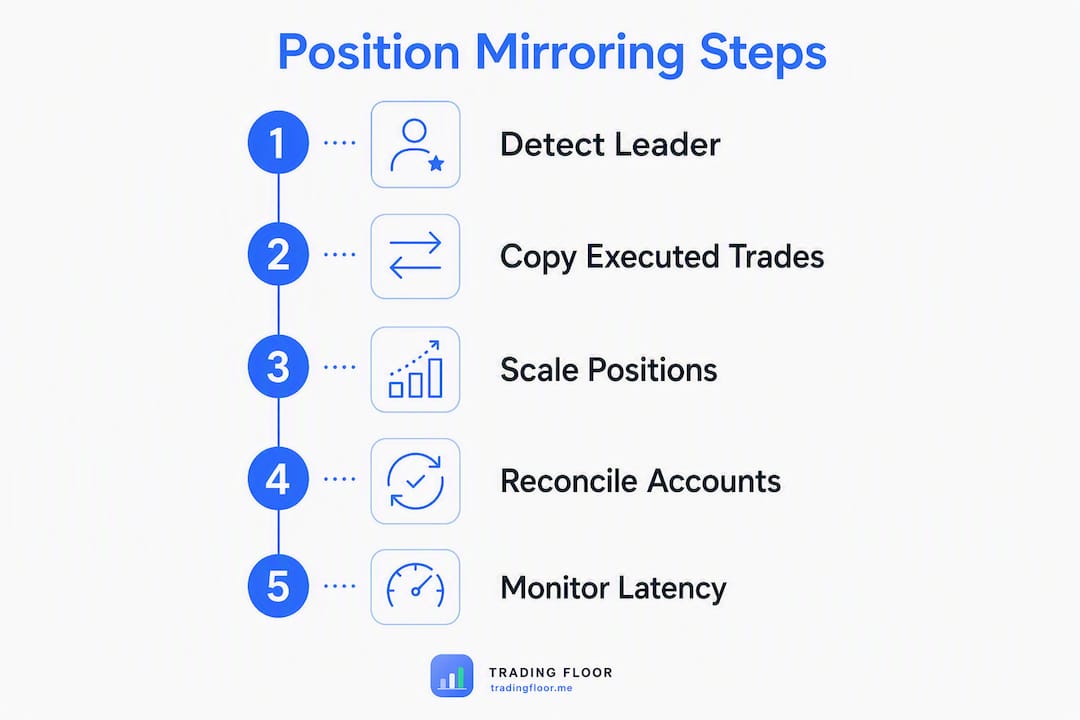
The leader → copier → follower flow
The cloud relay sits between your broker bridge and every follower account. The leader places a trade; the broker confirms the fill; the copier reads that confirmed position and dispatches scaled orders to each follower simultaneously. The reconciliation step then compares open positions across all accounts and flags any count mismatch for auto-retry or manual review.
Latency is the variable that separates a clean mirror from a messy one. Sub-100ms copy times produce fills close enough to the leader’s price that slippage is negligible on most futures contracts. At 100–500ms, you will see occasional partial fills during fast moves. Above 500ms, partial fills become frequent, and reconciliation reports will show persistent mismatches that require manual intervention. Cloud-based copiers with direct broker bridges consistently outperform VPS-based setups on this metric.
When latency is a constraint — say, a follower account sits on a broker with a slower API — position copy still beats signal copy because the reconciliation layer catches and corrects mismatches. Signal copy has no equivalent safety net.
Pro Tip: Enable execution log monitoring from day one. Check fill counts against leader positions after every session, not just when something looks wrong. Reconciliation mismatches caught early cost you one trade; caught late, they cost you an account.
For a deeper look at multi-account trade execution mechanics and how reconciliation works across platforms, Tradingfloor’s execution guide covers the edge cases most traders miss.
How do you connect accounts and start mirroring in minutes?
Six steps take you from zero to a tested mirror setup. Follow them in order and do not skip the smoke test.
- Create your leader account in the copier platform and link it to your primary broker account via API key or trade bridge. Confirm the connection shows “active” before adding any followers.
- Enable the API or broker bridge on each follower account. For Tradovate, this means generating a separate API credential per account. For Rithmic, confirm the bridge has trade-capable permissions, not read-only.
- Add follower accounts one at a time. Assign each a contract multiplier based on account equity relative to the leader. A follower with half the leader’s equity gets a 0.5x multiplier; a follower with equal equity gets 1x.
- Set per-account contract limits that respect each firm’s max position rules. Check the broker-level max daily loss setting on Rithmic independently of the copier — the copier’s limits and the broker’s hard stops must both be configured.
- Run a dry-run smoke test. Place a single MES contract on the leader. Confirm every follower received an identical net position. Check fill prices, timestamps, and P&L reconciliation before placing any real-size trade.
- Simulate a partial-fill scenario. Manually cancel one follower order mid-fill and verify the copier’s auto-retry or reconciliation alert fires correctly.
Pre-launch checklist
Before you go live, confirm each of the following:
- Account permissions on every broker allow trade-capable API access (not read-only)
- Maximum contract limits are set at both the copier level and the broker level
- Activation fees on funded or evaluation accounts are paid and accounts are in an active trading state
- Drawdown rules for each account are documented: static drawdown during evaluation, trailing drawdown on funded accounts per PropScorer’s evaluation breakdown
- Rithmic max daily loss is configured at the broker level, separate from the copier’s own stop rules
- Each evaluation account uses live market data and has its reset policy noted in case of a failed attempt
Evaluation account management best practices covers the firm-specific rule variations that catch traders off guard during setup.
What features does any mirroring solution need to have?
Any solution worth paying for covers six non-negotiables: per-account multipliers, pause/enable toggles, slippage caps, auto-reconciliation, latency monitoring, and secure API credential management. Missing any one of them creates a manual gap that will cost you an account eventually.

| Feature Category | What to Verify |
|---|---|
| Latency monitoring | Real-time copy latency display; alert threshold configurable below 500ms |
| Per-account risk controls | Contract multipliers per follower; max-contracts cap per account |
| Slippage handling | Configurable slippage cap per account; orders rejected or reduced if cap exceeded |
| Max followers | Confirm the plan tier supports your target follower count before subscribing |
| Audit logs | Timestamped fill-matching logs exportable within the trial period |
| Reconciliation reports | Automatic position comparison after every fill; mismatch alerts with auto-retry |
Security and API credential management
Use separate API keys for each follower account. Never reuse a single credential across multiple accounts — one compromised key should not expose the entire portfolio. Where the broker supports OAuth, prefer it over static API keys. For brokers that only offer static keys, rotate them quarterly and store them in a secrets manager, not a spreadsheet.
Distinguish between read-only and trade-capable keys. The copier needs trade-capable access on follower accounts; any monitoring or analytics tool should use read-only keys only. Confirm this scope in the broker’s API permission settings before connecting.
Pro Tip: Test every feature at one contract before scaling. Slippage caps behave differently during high-volatility opens than during midday sessions. A cap that passes a smoke test at 9 AM CT may reject valid fills at 8:30 AM CT during an economic release. Run your validation across at least two different session types.
Worked example: how do you scale a leader trade across accounts?
The math is straightforward once you fix the leader size and each follower’s equity ratio. Here is a concrete example.
Setup: Leader runs 2 MES contracts on a $50,000 account. Three follower accounts have different sizes.
- Calculate each follower’s equity ratio relative to the leader.
- Multiply the leader’s contract count by that ratio, then round down to the nearest whole contract.
- Apply the firm’s per-account contract cap if the result exceeds it.
| Account | Equity | Equity Ratio | Raw Contracts | Capped Contracts | P&L per Point ($5/MES) |
|---|---|---|---|---|---|
| Leader | $50,000 | 1x | 2 | 2 | — |
| Follower A | — | 0.5x | 1 | 1 | — |
| Follower B | $50,000 | 1x | 2 | 2 | — |
| Follower C | $10,000 | — | 0.4 → 0 | 0 | — |
Follower C drops out because 0.4 rounds to zero. That is a real operational consequence: accounts that are too small relative to the leader simply cannot participate at the minimum contract size. Either increase the account equity or accept that small accounts sit out certain trades.
Portfolio P&L on a 4-point MES move: Leader earns $40, Follower A earns $20, Follower B earns $40. Portfolio total: $100 across three active accounts.
Modeling survival rate across a larger portfolio
NexusFi Academy’s multi-account portfolio research frames the math clearly: a 60% survival rate across a portfolio of accounts can still be profitable if cost structure and payouts are modeled correctly. Success is aggregate, not per-account. On 10 accounts with a 60% pass rate, 6 accounts reach funded status. If each funded account generates $500/month in net payouts and each evaluation cost $150 in fees, the portfolio breaks even after roughly one month of funded trading and turns profitable from month two onward.
Drawdown type changes the effective cushion. Static drawdown during evaluation holds the floor at the starting balance, so a $1,000 drawdown limit stays at $1,000 regardless of profits. Trailing drawdown on funded accounts moves the floor up as equity grows, which tightens the effective cushion as you profit. Recalculate multipliers when an account transitions from evaluation to funded, because the same contract count carries more risk under trailing rules.
Pro Tip: Model your worst-case scenario before scaling: all accounts hit max drawdown in the same session. If that outcome wipes more than 20% of your total capital across the portfolio, your multipliers are too aggressive.
For detailed capital allocation guidance across multiple accounts and how to size positions relative to each firm’s drawdown structure, Tradingfloor’s allocation guide walks through the edge cases.
What operational risk controls do you need before scaling?
Treat the aggregate of all mirrored accounts as a single portfolio. That framing changes everything about how you set limits.
The most overlooked aspect of multi-account mirroring is portfolio-level risk management. A per-account stop that triggers at $500 loss means nothing if 10 accounts all hit it simultaneously in the same session. The aggregate loss is $5,000, which may represent a significant portion of total capital. The fix is a self-imposed portfolio-wide daily stop that shuts down all active accounts when combined equity drops by a defined percentage.
Portfolio-level rules
- Set a daily portfolio loss cap as a percentage of total combined equity across all accounts, not as a dollar amount per account.
- Configure a mandatory stop-all trigger in the copier that disables the leader and all followers when the cap is hit.
- Use staggered group activation: bring accounts online in groups of 3–5, not all at once, so you can observe behavior before full exposure.
- Maintain an equity buffer on each account before scaling. Accounts near their drawdown limit should be paused, not traded.
Account-level rules
- Set per-account max contracts at the copier level and verify the broker enforces the same limit independently.
- Document whether each account uses static or trailing drawdown and recalculate multipliers accordingly.
- Rithmic’s max daily loss setting is enforced at the broker level and operates independently of any copier rule. Confirm both are set before trading.
Scaling checklist (before adding a 5th or later follower)
- Portfolio-wide stop-all is configured and tested
- All active accounts have at least 50% of their drawdown limit remaining as a buffer
- Reconciliation reports from the prior 5 sessions show zero persistent mismatches
- Each account’s drawdown type is documented and multipliers reflect it
- Push notification alerts are active for stop-all events and reconciliation failures
Pro Tip: An automated stop-all that shuts the copier and sends push notifications is the single highest-value risk feature in any mirroring setup. Manual intervention during a fast market is too slow. If your solution does not support automated stop-all with notifications, that gap alone justifies switching providers.
How do you fix latency, partial fills, and slippage problems?
The three highest-probability failures in any mirroring setup are latency-caused partial fills, API disconnects, and contract-limit mismatches. Each has a clear detection and remediation path.
Latency-caused partial fills show up as follower positions that are smaller than the scaled target. Detect them in the reconciliation report: if the follower holds 1 contract and the multiplier called for 2, a partial fill occurred. Remediate by checking copy latency in the execution log. If latency exceeded 500ms at the time of the fill, the broker API may be throttling requests. Reduce follower count on that broker or switch to a direct bridge connection. Verify the fix by running a smoke test at the next session open.
API disconnects appear as followers that received no order at all. The reconciliation report shows the leader’s position with zero matching follower position. Remediate by checking the API key status on the affected follower account — keys expire or get revoked after inactivity on some platforms. Re-authenticate, confirm the connection shows active, and manually reconcile the open position if the leader is still in a trade.
Contract-limit mismatches occur when the copier calculates a contract count that exceeds the broker’s or firm’s per-account maximum. The order gets rejected at the broker level, not the copier level, so the copier may show the order as sent while the broker shows it as rejected. Check broker-level order rejection logs, not just the copier’s execution log.
Outage fallback checklist
- Disable new followers immediately when a system outage is detected
- Do not open new leader trades until connectivity is confirmed across all active followers
- Flatten leader position manually at the broker level if the copier cannot send close orders
- Use broker-level max-loss safeguards as the last line of defense — confirm these are set before every session
- After connectivity restores, run a full reconciliation report before resuming automated copying
Pro Tip: Set a reconciliation mismatch threshold alert at one contract. If any follower’s position count differs from the scaled target by even one contract, you want to know immediately, not at end of session. Small mismatches compound into large P&L discrepancies across a portfolio.
For step-by-step precise mirroring workflows and reconciliation procedures, Tradingfloor’s operational guide covers the exact remediation steps for each failure mode.
Which broker and platform integrations should you verify first?
Expect integrations for Tradovate, TopstepX, Apex Trader Funding, and Rithmic. Verify the API type and bridge method before purchasing any solution, because the integration method determines latency, order type support, and reconciliation behavior.
- Tradovate: — Uses an account-level API credential model. Each account requires a separate API key. Confirm the copier supports multi-credential Tradovate connections, not just a single-account bridge. Tradovate’s API supports market and limit orders; verify which order types the copier uses for follower fills.
Pre-connection validation checklist
- Confirm API permission scope (trade-capable vs read-only) on each platform
- Verify order type support (market, limit, stop) for follower accounts on each broker
- Test contract multiplier behavior with a single-contract smoke test before enabling full sizing
- Check position reconciliation timestamps: confirm the copier’s reconciliation clock matches the broker’s fill timestamp within an acceptable window
- Call or chat with platform support to confirm third-party bridge permissions before connecting
Pro Tip: Ask each platform’s support team one specific question: “Does your API rate-limit order submissions per account per second?” Rate limits are rarely documented publicly but directly affect how many follower accounts you can run on a single broker before latency degrades.
For practical guidance on handling contract code differences and broker-specific quirks when you trade the same strategy across multiple brokers, Tradingfloor’s broker guide covers the platform-specific edge cases.
What should you check on pricing, trials, and prop-firm compliance?
Expect subscription pricing with a 30-day free trial, tiers tied to follower count and latency SLAs, and a demo mode for pre-live validation. Some firms offer instant-funded accounts with higher upfront fees and progressive consistency rules — for example, a 20%→25%→30% consistency progression — which Tradeify’s instant funding comparison documents in detail. Model those rules before mirroring across multiple accounts, because consistency requirements change how you size and sequence trades.
Trial validation checklist
- Run latency sampling across at least three sessions during the trial and confirm average copy time stays below 200ms
- Export a reconciliation report after each session and verify fill counts match leader positions
- Test the stop-all rule during the trial: trigger it manually and confirm all followers halt and push notifications fire
- Review the SLA terms: what uptime does the provider guarantee, and what remediation do they offer for outages during market hours?
Prop-firm compliance checklist
- Document every account connected to the copier, including account numbers and ownership details
- Confirm with each prop firm that third-party position copying is permitted under your account agreement
- Maintain audit logs for at least 90 days; some firms request trade logs during payout reviews
- Verify that all connected accounts are owned by the same individual or entity — mirroring across accounts with different owners raises account-ownership compliance questions that some firms treat as a rule violation
- Check transfer-of-control clauses: some firms prohibit any arrangement where a third party controls trade execution on a funded account
Pro Tip: Send a written inquiry to each prop firm’s compliance team before connecting your accounts. A one-paragraph email asking whether third-party position copying is permitted creates a paper trail that protects you if a payout dispute arises later.
Why Tradingfloor is the right tool for mirroring evaluation accounts
Tradingfloor meets the full feature set that prop traders need: real-time position mirroring (not signal copying), per-account multipliers, slippage caps, auto-reconciliation, push notifications, and cloud-based access from any device with no installation required.
The integration list covers the platforms that matter: Tradovate, TopstepX, Apex Trader Funding, and Rithmic bridges. Per-account risk controls let you set different multipliers and contract caps for each follower independently, so a $10,000 evaluation account and a $50,000 funded account can run side by side without sharing risk parameters.
Three use cases where Tradingfloor’s setup pays off immediately:
- Passing 3–5 evaluations in parallel: One leader trade propagates to all evaluation accounts simultaneously. No manual entry, no timing gaps between accounts, no human error on contract counts.
- Staging account groups: Bring a new group of 3 evaluation accounts online while an existing funded group continues trading. The group-level enable/disable toggle makes this a one-click operation.
- Portfolio-wide stop-all enforcement: When the daily portfolio loss cap is hit, Tradingfloor shuts the copier and sends push notifications across all connected accounts. No manual intervention required during a fast market.
The 30-day free trial is the right place to validate reconciliation accuracy, copy latency, and failover behavior before committing to a paid tier. During the trial, run the full smoke test sequence from Section 3, export at least five reconciliation reports, and trigger the stop-all rule manually to confirm notifications fire correctly.
Pro Tip: Use the trial to test your worst-case scenario: open a leader position, then simulate an API disconnect on one follower. Confirm the reconciliation alert fires and the auto-retry resolves the mismatch without manual intervention. If it does not, that gap will cost you an account in live trading.
Key Takeaways
Mirroring a single leader strategy across multiple evaluation accounts requires position copying (not signal copying), per-account risk controls, and a portfolio-wide stop-all rule enforced before scaling beyond five followers.
| Point | Details |
|---|---|
| Start with three accounts | Prove the model on a leader plus two followers before scaling; costs are front-loaded and payouts are back-loaded. |
| Portfolio stop-all is mandatory | A daily portfolio loss cap that shuts all followers automatically prevents cascading failures across funded and evaluation accounts. |
| Validate reconciliation in the trial | Export fill-matching reports during the 30-day trial period to confirm position counts match the leader after every session. |
| Drawdown type changes your math | Recalculate contract multipliers when an account moves from static (evaluation) to trailing (funded) drawdown rules. |
| Tradingfloor covers the full stack | Real-time position mirroring, per-account multipliers, slippage caps, auto-reconciliation, and Tradovate/TopstepX/Rithmic integrations in one cloud-based platform. |
The part most traders get wrong about multi-account mirroring
The conventional wisdom says the hard part of mirroring is the technology. Get the right copier, connect your accounts, and the rest follows. That framing misses where accounts actually blow up.
The real failure mode is treating each account as an independent unit. A trader sets a $500 daily stop per account, runs 10 accounts, and feels disciplined. Then a correlated move hits all 10 simultaneously, and the portfolio absorbs a $5,000 loss in one session. Each individual stop fired correctly. The portfolio still took a hit that a single aggregate rule would have capped at $1,500.
The second thing traders underestimate is reconciliation lag. A mismatch that sits unresolved for two sessions becomes a position discrepancy that affects P&L reporting, payout calculations, and sometimes firm compliance reviews. The traders who pass multiple evaluations reliably are not necessarily the ones with the best strategy. They are the ones who check their reconciliation reports every session and catch mismatches before they compound.
Automation does not remove operational discipline. It moves the discipline upstream, into configuration and monitoring, where it belongs.
Tradingfloor’s 30-day trial: what to test and how to start
Prop traders running multiple evaluations simultaneously need one thing above all else: a copier that does not introduce errors the strategy did not make. Tradingfloor’s 30-day free trial gives you the time and access to validate exactly that, without committing to a subscription before you have confirmed it works for your specific account setup.
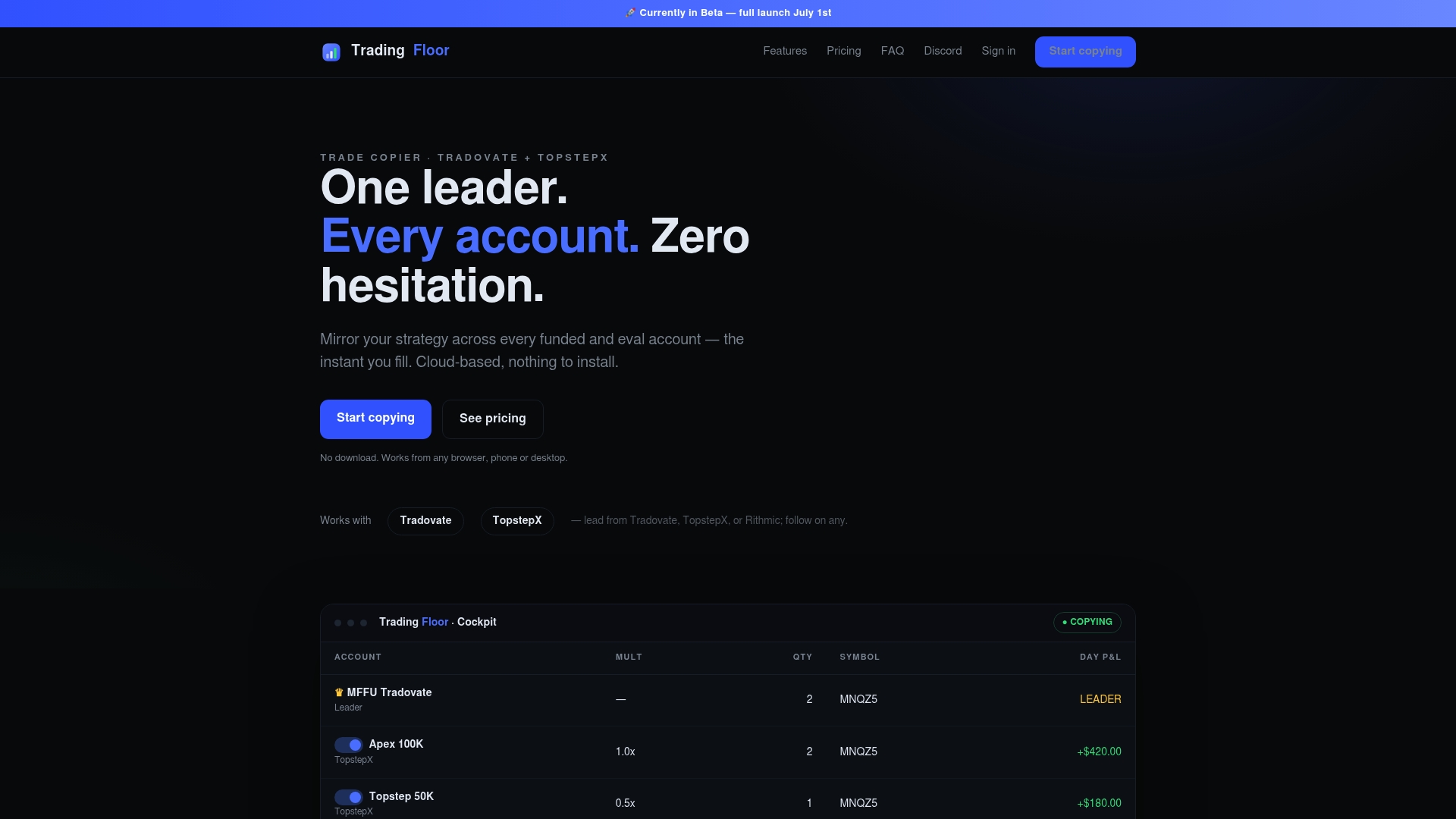
During the trial, prioritize four validation steps: latency sampling across multiple sessions, per-account multiplier behavior on accounts of different sizes, reconciliation report export after every session, and a live test of the stop-all rule with push notifications. The pricing page shows tier details and follower-count limits so you can match the right plan to your account count before the trial ends. Check system status for uptime history before your first live session.
Start your free trial at Tradingfloor and run your first smoke test today.
Sources and further reading
The sources below back the claims in this article and give you a starting point for deeper research on each topic.
- NexusFi Academy: Managing Multiple Funded Accounts — The most thorough public treatment of portfolio-level stop rules and survival-rate math for prop traders running multiple accounts.
- PropScorer Academy: Evaluation vs Funded Account — Clear breakdown of how drawdown rules change between evaluation and funded stages, with direct implications for contract sizing.
- Tradingfloor: Pass Multiple Prop Firm Evals at Once — Operational workflows for running one strategy across multiple evaluation accounts simultaneously.
- Tradingfloor: Cross-Account Trade Management Guide — Holistic monitoring and management practices for traders running multiple accounts in 2026.
- Tradingfloor: Multi-Platform Trading Best Practices — Covers broker-specific operational checklists and execution monitoring across Tradovate, TopstepX, and Rithmic.
Recommended
- Account Evaluation Strategy Examples for Prop Traders in 2026 — Trading Floor
- Pass Multiple Prop Firm Evals at Once With One Strategy — Trading Floor
- Evaluation Account Management Best Practices for Prop Traders — Trading Floor
- Sync Evaluation and Funded Accounts: 2026 Guide — Trading Floor
Trading Floor mirrors every trade across your Tradovate, TopstepX & Rithmic accounts in real time, from $25/mo.
Start copying →