Prop Trading Capital Allocation: A Practical Guide

Prop trading capital allocation is the process by which proprietary trading firms distribute their trading capital among traders and strategies to maximize profitability while controlling risk exposure. New traders typically start with accounts as small as $25,000 and can scale to $300,000 or more under profit-sharing splits of 70%–90%. Evaluation fees range from $50 to $700, with profit targets set between 6%–10% of the account balance. Understanding prop trading capital allocation means grasping two distinct layers: the firm decides how much total capital each trader receives, and the trader decides how to size individual positions within that capital. Both layers carry real consequences for performance and account survival.
What is prop trading capital allocation and how does it work?
Prop trading capital allocation is the strategic distribution of risk capacity among traders and strategies, designed to balance return on risk, consistency, and survival. It is not simply a budget decision. It is an operating system that governs how a firm grows and how individual traders scale their careers.
Firms allocate capital based on a trader’s demonstrated ability to meet specific performance benchmarks. These benchmarks typically include:
- Profit targets: Traders must hit a defined gain percentage, usually 6%–10%, during an evaluation phase before receiving a funded account.
- Drawdown adherence: Maximum drawdown limits, both trailing and static, define the outer boundary of acceptable loss.
- Consistency rules: Many firms require that no single trading day account for more than a set percentage of total profits, preventing lucky outlier days from masking poor overall performance.
- Risk-to-reward ratios: Firms track whether traders achieve gains efficiently relative to the risk they take.
Scaling works on a tiered system. A trader who passes an evaluation receives an initial funded account. After hitting profit milestones and maintaining clean risk metrics, the firm increases the account size. This progression rewards discipline as much as profitability.
Pro Tip: Treat the evaluation phase as a live test of your capital management habits, not just a profit target. Firms watch how you lose, not just how you win.
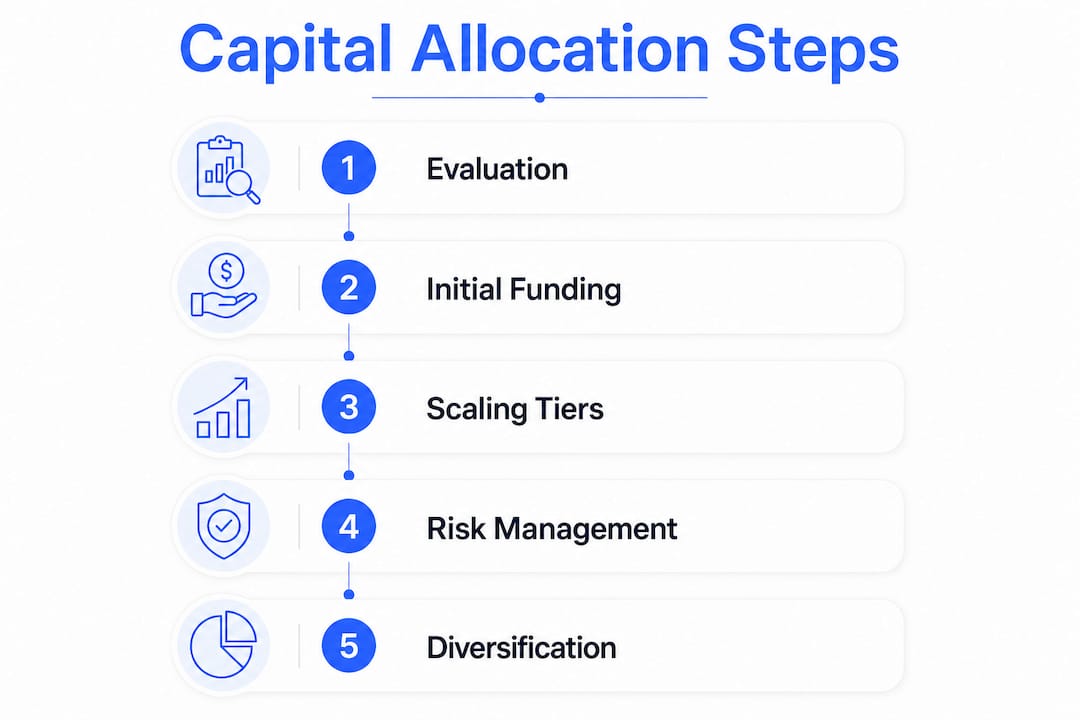
Profit-sharing structures directly influence how aggressively traders approach allocation. A 90% profit split gives a trader strong incentive to grow the account carefully. A lower split may tempt traders to take larger risks for the same net payout. Recognizing this dynamic helps traders calibrate their risk appetite to match the structure they are operating within.
What risk management principles govern capital allocation in prop trading?
Risk management in prop trading does not follow the same rules as retail trading. The most important shift is this: risk is calculated as a percentage of available drawdown room, not of the total account balance. This distinction prevents traders from sizing positions as if they have unlimited recovery room.
Here is a practical framework for applying risk rules inside a funded account:
- Calculate your drawdown cushion. If your account has a $2,500 maximum drawdown allowance, that cushion is your true risk capital, not the $50,000 nominal balance.
- Apply the 1.5%–2% rule to the cushion. On a $2,500 drawdown allowance, that means risking $37.50–$50 per trade, not $750–$1,000.
- Set a daily loss limit. Daily loss limits typically run at 25%–30% of the available drawdown room. On a $2,500 cushion, that is a $625–$750 daily cap.
- Use hard stop-losses on every trade. Prop accounts do not forgive discretionary overrides. A stop-loss is not optional.
- Track aggregate exposure, not just individual trades. If you hold three correlated positions, your real risk is the sum of all three, not each one in isolation.
Risk in a funded account is not about how much you can make. It is about how long you can stay in the game. Every trade that respects the drawdown cushion is a trade that keeps your account alive for the next opportunity.
Violating risk limits in a prop account typically results in account closure. There is no margin call, no grace period, and no negotiation. The firm’s rules are automated and enforced in real time. This makes pre-trade planning non-negotiable.
The funded account risk rules that govern these accounts exist for a reason. Firms have finite capital and cannot absorb unlimited losses from any single trader. Understanding this helps traders internalize risk limits as professional standards rather than arbitrary restrictions.
How do traders manage capital allocation across multiple prop firms?
Professional traders manage portfolios across 10–15 prop firms to reduce single-point failures and scale total funded capital responsibly. This is not overextension. It is portfolio thinking applied to prop trading.

The standard framework for multi-firm allocation is the 70/20/10 model:
| Allocation Tier | Percentage | Account Type |
|---|---|---|
| Core capital | 70% | Established, blue-chip prop firms |
| Growth capital | 20% | Mid-tier firms with scaling potential |
| Speculative capital | 10% | Experimental or high-yield accounts |
This structure protects the majority of funded capital while allowing controlled exposure to higher-risk, higher-reward opportunities. It mirrors how institutional portfolio managers think about asset class weighting.
Counterparty risk is real in prop trading. Firms can change rules, face regulatory pressure, or shut down. Diversifying across platforms that use different technologies, such as MT5, DXTrade, and Match-Trader, reduces the risk of a single platform outage wiping out all active positions.
Managing multiple accounts also requires careful attention to drawdown correlation. Copying the same trade across every account simultaneously concentrates risk rather than spreading it. If that trade hits its stop-loss, every account takes a hit at the same time. Traders who mirror trades across prop accounts need individual risk controls on each account, not a blanket copy of the leader position.
Pro Tip: Stagger your server reset times across firms when possible. Different daily reset windows give you more flexibility to recover from a bad morning session before the next firm’s daily limit resets.
Treating each strategy as a distinct risk engine, rather than funding all accounts equally in dollar terms, is the professional approach. Risk parity across strategies means each account contributes roughly equal risk to the portfolio, regardless of its nominal size. A $50,000 account running a volatile strategy may carry the same real risk as a $200,000 account running a conservative one.
What advanced capital allocation models do prop traders use?
Fixed and dynamic allocation models serve different purposes, and professional traders use both. Understanding when to apply each one separates disciplined capital management from guesswork.
Fixed allocation assigns a set percentage of risk to each strategy or account and holds it constant regardless of recent performance. The benefit is consistency. Fixed models prevent traders from over-weighting recent winners and under-weighting strategies that are temporarily underperforming.
Dynamic allocation adjusts exposure based on rolling performance metrics and market regime signals. Capital scales up after verified profit milestones and scales down when volatility rises or Sharpe ratio deteriorates. This approach avoids the “set and forget” trap that leaves traders overexposed during adverse conditions.
Key advanced frameworks include:
- Volatility targeting: Normalizes risk across strategies by adjusting position size when market volatility changes. A strategy that works well in low-volatility conditions may need smaller sizing during high-volatility regimes.
- Value-at-Risk (VaR) budgeting: Sets a maximum acceptable loss at the portfolio level and allocates risk to each strategy within that budget. It forces traders to think about aggregate exposure, not just individual trade risk.
- Fractional Kelly sizing: The Kelly Criterion calculates the theoretically optimal bet size for a given edge. Fractional Kelly, typically 0.25x–0.5x of the full Kelly amount, reduces drawdowns significantly while still capturing most of the growth benefit.
- Performance-based rebalancing: After a strategy hits a profit milestone, capital is redistributed. Underperforming strategies receive reduced allocation until they demonstrate recovery.
| Model | Best use case | Key risk |
|---|---|---|
| Fixed allocation | Stable, low-correlation strategies | Ignores changing market conditions |
| Dynamic allocation | Multi-strategy portfolios | Overreacts to short-term noise |
| Fractional Kelly | High-edge, high-variance strategies | Requires accurate edge estimation |
| VaR budgeting | Large multi-account portfolios | Underestimates tail risk in stress events |
Common mistakes include chasing recent PnL with short lookback windows and ignoring capacity constraints. Successful allocation requires pre-committed loss limits and stress testing of tail risks. Without these guardrails, even a profitable strategy can destroy an account during an unexpected market event.
Key Takeaways
Effective prop trading capital allocation requires managing risk at both the firm level and the trader level, using drawdown-based position sizing, multi-firm diversification, and dynamic rebalancing to protect accounts and scale capital responsibly.
| Point | Details |
|---|---|
| Drawdown-based risk sizing | Risk 1.5%–2% of your drawdown cushion per trade, not of the total account balance. |
| Multi-firm diversification | Use the 70/20/10 model across 10–15 firms to reduce counterparty and platform risk. |
| Dynamic rebalancing | Scale capital up after verified profit milestones and reduce exposure when volatility rises. |
| Fractional Kelly sizing | Use 0.25x–0.5x Kelly to reduce drawdowns while preserving most of the growth benefit. |
| Correlation management | Avoid copying identical trades across all accounts simultaneously to prevent synchronized drawdowns. |
What I’ve learned about capital allocation that most traders ignore
Most traders who move into prop trading bring a retail mindset with them. They think about capital allocation as “how much can I risk on this trade?” The professional question is different. It is “how do I keep every account alive long enough to compound?”
The shift that changed my approach was treating my funded accounts as a portfolio, not as separate bets. When I started thinking about aggregate drawdown exposure across all accounts, I stopped making the mistake of piling into the same setup everywhere at once. One bad day used to hit every account. After restructuring around the 70/20/10 model, a rough session in one tier rarely affected the others.
The second thing I stopped doing was chasing recent performance. When a strategy runs hot for two weeks, the temptation is to increase allocation. That is almost always the wrong move. Hot streaks often precede mean reversion, and over-weighting a recent winner right before it cools down is one of the fastest ways to give back gains. I now wait for a verified profit milestone across a longer window before adjusting size.
The third lesson is harder to accept: most traders underestimate how much of their edge comes from staying in the game rather than from any single trade. Consistent, small gains compound into serious capital over time. One blown account from a risk violation sets that compounding back by weeks or months. The traders I have seen scale successfully are not the most aggressive. They are the most disciplined about prop trader performance optimization and protecting their drawdown cushion above everything else.
— KennyTrades
How Tradingfloor helps you manage capital across funded accounts
Traders running capital across multiple funded accounts need more than discipline. They need the right infrastructure to execute consistently without manual errors.
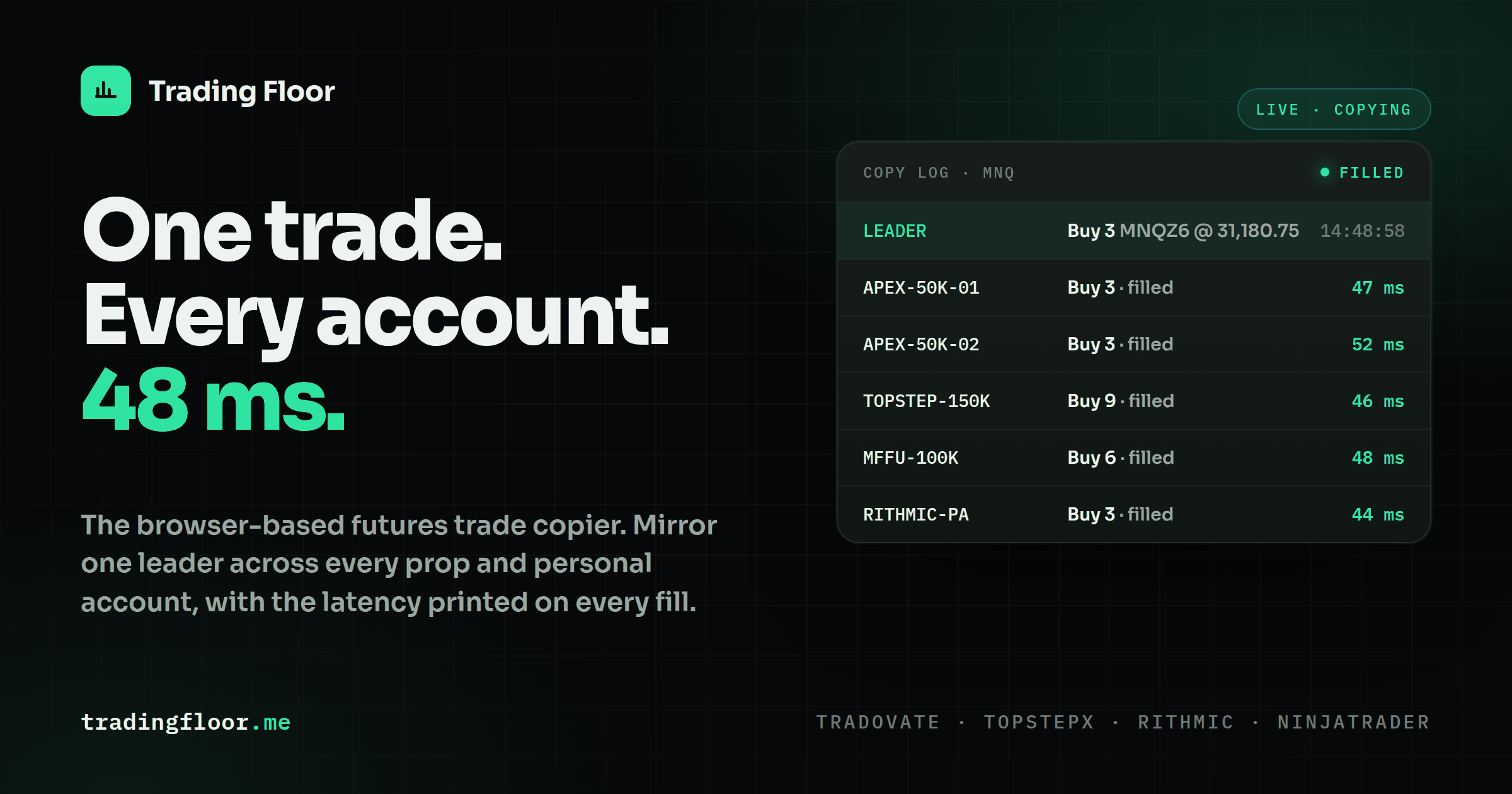
Tradingfloor is built for exactly this situation. It mirrors real-time positions across any number of funded and evaluation accounts, applying individual risk controls to each one rather than copying a flat position size everywhere. That means your 70% core accounts and your 10% speculative accounts can run the same strategy with different sizing rules, automatically. Tradingfloor works across platforms including Tradovate and TopstepX, runs entirely in the cloud with no installation required, and sends real-time notifications so you always know what is happening across your portfolio. Check out Tradingfloor’s pricing to find the plan that fits your current account structure.
FAQ
What is prop trading capital allocation?
Prop trading capital allocation is the process of distributing a firm’s trading capital among traders and strategies to maximize risk-adjusted returns. It operates at two levels: the firm assigns capital to traders, and traders size positions within their allocated drawdown limits.
How do prop firms decide how much capital to give a trader?
Firms evaluate traders through funded account challenges with profit targets of 6%–10% and strict drawdown limits. Traders who pass receive an initial funded account and can scale to larger allocations by hitting verified profit milestones consistently.
What is the 70/20/10 rule in multi-firm prop trading?
The 70/20/10 model allocates 70% of funded capital to established blue-chip firms, 20% to mid-tier growth firms, and 10% to experimental accounts. This structure reduces counterparty risk while allowing controlled exposure to higher-yield opportunities.
How should traders calculate risk per trade in a prop account?
Risk per trade should be 1.5%–2% of the available drawdown cushion, not of the total account balance. On a $2,500 drawdown allowance, that means risking $37.50–$50 per trade to preserve the account through normal losing streaks.
What happens if you violate risk limits in a prop trading account?
Violating risk limits, such as exceeding the daily loss limit or breaching the maximum drawdown, typically results in immediate account closure. Prop firms enforce these rules automatically, with no grace period or appeal process.
Recommended
- Prop Trading Funded Account Explained for Traders — Trading Floor
- Multi-Platform Trading Best Practices for Prop Traders — Trading Floor
- Passive Trade Management: A Practical 2026 Guide — Trading Floor
- Prop Trader Performance Optimization Explained — Trading Floor
Trading Floor mirrors every trade across your Tradovate, TopstepX & Rithmic accounts in real time, from $25/mo.
Start copying →