15–30 Minute Audit: Holiday Schedule Copying for Prop Traders

Holiday schedule copying means running your trade copier with time filters that automatically pause or adjust mirroring around exchange closures and prop-firm holiday rules, so a live position never gets duplicated into an account where it would violate that firm’s constraints. Before you copy a single trade this holiday season, confirm each connected firm’s copy-trading policy in writing and set your copier’s time filters accordingly. Trading Floor and account managers like KennyTrades treat this as a pre-flight step, not an afterthought.
TL;DR:
- Confirm each prop firm’s copy-trading policies in writing and set your copier’s time filters to avoid violating holiday or exchange holds.
- Build a detailed account map tracking platform, payout dates, permission status, and specific holiday rules for each firm to prevent operational errors.
- Use exchange-specific holiday calendars and enable automated pause settings before market closures to reduce Latency and partial fill risks.
- Test holiday configurations with small, low-capital trades and reconcile logs after reconnects to catch silent failures early.
- Implement a structured holiday operational plan that groups accounts by risk status, automates pauses, and documents override approval procedures.
Table of Contents
- Building Your Pre-Holiday Account Map Checklist
- How Do You Verify a Prop Firm’s Copy-Trading Rules?
- Configuring Your Copier for Exchange Holidays and Risk Limits
- Testing and Reconciling After a Holiday Window
- Your Holiday Operational Playbook: Pause, Group, Monitor
- Fixing Common Holiday-Related Copying Errors
- Why Holiday-Aware Controls Are Not Optional
- Trading Floor: Built for Holiday-Aware Multi-Account Copying
- Sources
Building Your Pre-Holiday Account Map Checklist
Before any exchange holiday or broker closure, run a fast audit of every connected account. This takes fifteen to thirty minutes and prevents most of the errors that show up during holiday weeks.
Build an account map that tracks these fields for each account:
- Firm name and account phase (challenge, verification, funded, or payout window)
- Platform (Tradovate, TopstepX, Rithmic, or other)
- Copy-trading permission status, with date of last written confirmation
- Upcoming payout date
- Firm-specific news and holiday-holding rules
A firm-by-firm account map recording platform, phase, payout timing, and holiday constraints cuts down on the kind of operational error that only surfaces after the market reopens. If any firm’s rules are unclear, request written confirmation rather than assuming silence means approval. Temporarily exclude accounts sitting close to a payout date, near a drawdown limit, or on a platform your copier doesn’t fully support yet.
Pro Tip: Keep the account map in a shared spreadsheet with a “last verified” date column. Stale confirmations from three months ago don’t count when a firm changes its rules mid-quarter.
How Do You Verify a Prop Firm’s Copy-Trading Rules?
Read the firm’s account agreement section on “third-party software” or “automated trading” before connecting anything. Some firms permit copying between accounts you personally own, provided you disclose the setup and get approval. Others prohibit any cloud-based copy tool outright, regardless of ownership. Firm policy varies enough that treating one firm’s approval as a template for another is a common and costly mistake.
Firms that ban copying usually detect it the same way: near-simultaneous fills across accounts, identical timestamps down to the second, or shared IP addresses hitting their servers within milliseconds of each other. This isn’t paranoia on their part. Balance-proportional sizing and clean symbol handling exist partly because identical, unscaled fills are exactly what trips detection systems.
Once you know a firm’s stance, log the specifics that go beyond a simple yes or no:
- No weekend or holiday overnight holding
- News-event blackout windows around high-impact releases
- Payout-week restrictions on new position size or leverage
Keep these entries next to the account map, not buried in an email thread you’ll forget by March.
Configuring Your Copier for Exchange Holidays and Risk Limits
Exchange holidays rarely line up across regions. The CME closes for Thanksgiving while European index futures keep trading, and a trade copier can let you build separate holiday calendars per exchange rather than pausing everything on one global switch.
- Enable time filters that pause copying automatically during known exchange holidays and broker maintenance windows, and layer in custom calendars where your leader and follower accounts track different exchanges.
- Check symbol mapping across brokers. A contract that trades as one ticker on Tradovate might carry a different suffix on TopstepX, and mismatched symbols are a leading cause of missed orders.
- Fix lot-step rounding before it fixes your account for you. Undersized follower accounts need lot sizes rounded down cleanly, not truncated in a way that leaves a partial position open.
- Set sizing defaults using equity-proportional scaling rather than fixed lots, with hard per-trade caps and a limit on max concurrent exposure across all mirrored accounts.
- Apply daily loss and drawdown brakes. A common starting point is roughly 0.5% risk per trade, a daily loss ceiling around 2% to 3%, and a total drawdown pause between 6% and 10%.
- Add phase-specific rules. An account in its payout week should carry tighter caps than one still in the evaluation phase.
Pro Tip: Set your holiday time filters at least 48 hours ahead of a known closure. Configuring them the morning of a holiday risks a follower catching one last mirrored trade before the pause takes effect. You can review how these filters behave in practice on Tradingfloor’s time filter documentation.
Testing and Reconciling After a Holiday Window
Never trust a new holiday configuration until you’ve tested it. Run a small dry-test trade into a low-cap follower account, or a sandbox account if your platform offers one, and confirm the fill matches what you expected on both symbol and size.
After any holiday closure or a reconnect event, reconcile your copier logs line by line against the platform’s own fill history:
- Compare timestamps between leader and follower fills for gaps longer than a few seconds
- Flag partial fills or orders that show as sent but never confirmed
- Check for stuck orders left open from before the closure
- Save screenshots and written firm confirmations for any account under compliance review
Log reconciliation after reconnects catches the silent failures that don’t throw an error message but still leave an account out of sync with your intended position. Tradingfloor’s OCO order copying with disconnect resilience is built specifically to reduce how often this reconciliation turns up a surprise.
Your Holiday Operational Playbook: Pause, Group, Monitor
Treat every account differently depending on where it sits in its life cycle, not as one undifferentiated pool you copy into uniformly.
- Exclude accounts automatically that are within a few percent of their drawdown limit, inside a payout window, or running on a platform your copier can’t fully verify yet.
- Group the rest into active, staging, and paused buckets. Staggering activation across groups instead of firing every account simultaneously limits how much of your portfolio can be hit by a single bad session.
- Decide overnight holding policy before the holiday starts, not during it. Closing all positions ahead of a multi-day closure is the conservative default; staggered re-entry the next session works only if every follower’s rules permit holding through the gap.
- Write a one-page policy stating which accounts pause automatically, who approves overrides, and what the aggregate daily loss throttle is across the whole group.
An advanced version of this adds a portfolio-level daily loss throttle that stops copying entirely once combined losses across all accounts hit a set threshold, regardless of which single account triggered it.
Fixing Common Holiday-Related Copying Errors
Latency and partial fills spike during thin holiday liquidity, showing up as delayed confirmations or an order that fills on the leader but stalls on a follower. Reduce trade size or pause the affected follower the moment you notice a lag pattern rather than waiting for it to resolve itself.
When a connection drops during a holiday session, reconcile before you resume:
- Flatten any position you can’t confirm matches the leader
- Resync the copier’s session rather than assuming it caught up automatically
- Manually accept any order stuck in a pending state longer than a few minutes
- Recheck symbol suffixes and min-lot rounding first, since these cause a disproportionate share of holiday-week mismatches
Pro Tip: If more than one account shows a fill discrepancy in the same session, stop copying across all accounts and audit manually before restarting. One mismatch is a bug; two at once usually means the feed itself is unreliable.
Why Holiday-Aware Controls Are Not Optional
Most account managers treat holiday scheduling as a calendar problem. It’s actually a risk-control problem. A time filter that pauses copying during a closure does the same job as a drawdown brake: it stops a small technical gap from becoming an account-ending event.
What gets underestimated is how much detection risk comes from lazy timing, not lazy sizing. Identical fills during a thin holiday session stand out more, not less, because volume is lower and firms are watching more closely. Centralized, per-account caps combined with OCO disconnect resilience close that gap before it opens.
— KennyTrades
Trading Floor: Built for Holiday-Aware Multi-Account Copying
Manually rebuilding time filters and risk caps for every holiday across every account is exactly the kind of drift that causes rule violations. Tradingfloor centralizes it: one leader position, mirrored across every funded and evaluation account, with the holiday logic built into the settings instead of your memory.
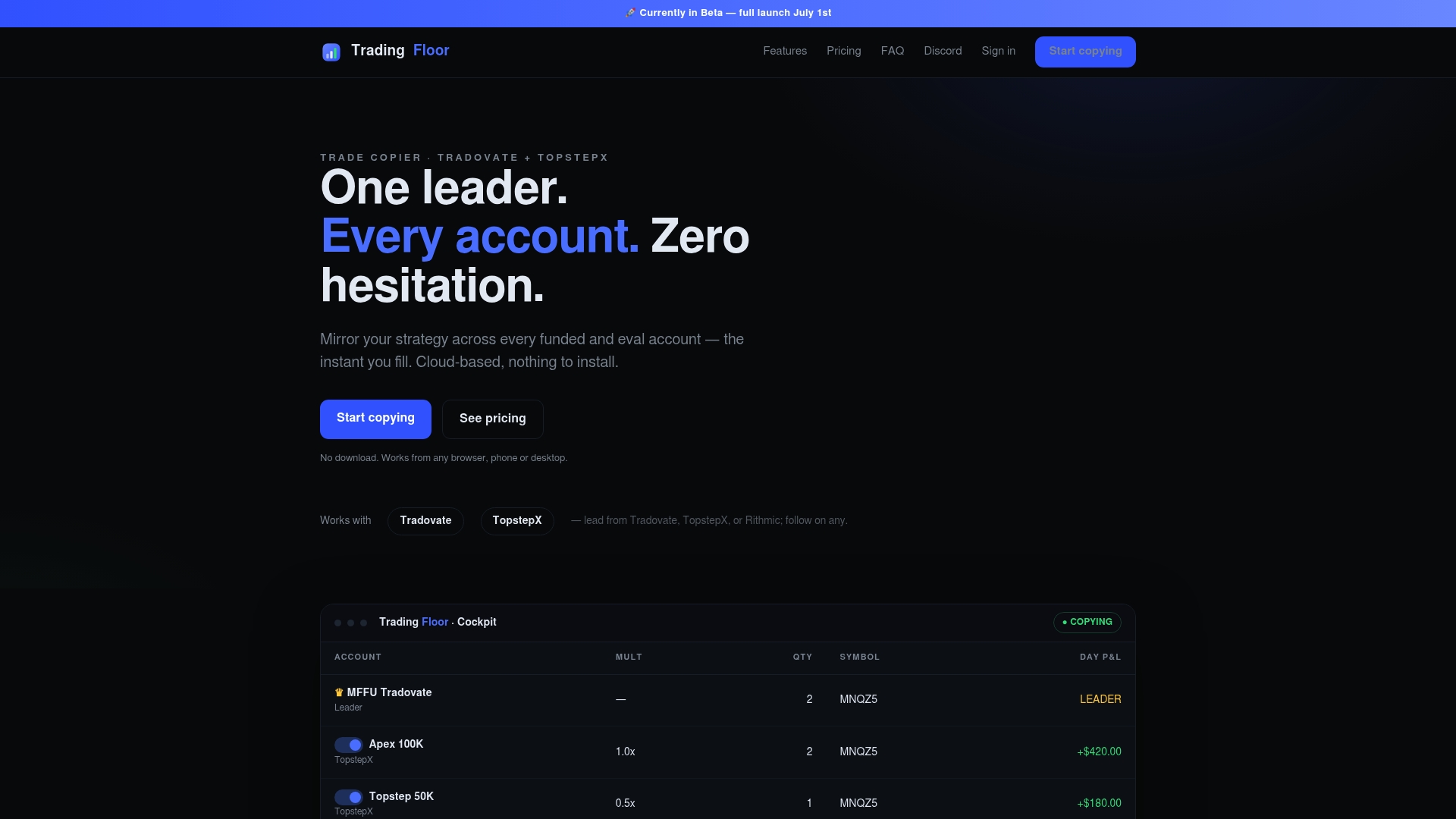
The platform can provide time filters tied to specific exchange calendars, per-account caps on trade size and daily loss, OCO order copying that survives a disconnect without duplicating fills, and cross-platform syncing across multiple broker platforms — similar to the features offered by the Options Portfolio Tracker for iPhone & Mac which supports maintaining accurate market calendars and planning around holidays. Start with the 30-day trial, connect a single low-cap follower account first, and request written compliance confirmation from that firm before scaling to the rest of your portfolio. If you’re running Earn2Trade accounts specifically, the Earn2Trade trade copier setup walks through the account-specific configuration. Set up your first mirrored account today and see how the holiday calendar behaves before your next closure hits.
Sources
For deeper reading, check Tradingfloor’s guides on time filters and holiday pauses, OCO order copying, and the list of prop firms allowing copy trading. For risk-setting benchmarks and firm-rule verification, see the risk settings guide and the multi-account management guide.
- Best Risk Settings for Copied Trades
- How to Manage Multiple Prop Firm Accounts | 2026 Guide
- Trade Copier for Prop Firms: How It Works
Recommended
- Trade Audit Trails for Prop Traders: A Practical Guide
- Trades Copied Right: Real-Time Mirroring for Prop Traders
- How to Automate Position Copying in Prop Trading
- Trading Error Logs for Prop Traders: A Complete Guide
Trading Floor mirrors every trade across your Tradovate, TopstepX & Rithmic accounts in real time, from $25/mo.
Start copying →