Exchanges, Not CFTC: How US Prop Traders Make Copy Trading Compliant

A cloud-based multi-account futures trade copier is legal in the U.S., but legality is not the bottleneck. The real constraints come from your exchange’s electronic-trading risk rules and, above all, your prop firm’s own copy-trading policy. Check that policy in writing before you mirror a single position, and keep execution logs from day one. Done right, with pre-trade risk controls and full audit records, compliant copying across funded and evaluation accounts is entirely workable.
TL;DR:
- Copy trading across multiple accounts is legal in the US if it complies with exchange risk controls, broker policies, and proper audit records are maintained.
- Focal regulatory controls include pre-trade limits, kill switches, self-match prevention, and disclosure requirements, rather than registration mandates.
- Traders must verify their prop firm’s specific rules on account ownership, limits, platforms, hold times, and hedging to avoid violations.
- Building a copier with technical safeguards like position caps, slippage limits, and immutable logs ensures compliance and audit readiness.
- Maintaining detailed and ongoing logs, conducting staged testing, and securing written approval are essential steps for sustainable, compliant scaling.
Table of Contents
- Is Copy Trading Legal in the US Under CFTC Rules?
- Prop-Firm Rules Decoded: The Compliance Checklist Before You Copy
- Engineering the Copier: Technical Controls That Satisfy Firms and Exchanges
- How Tradingfloor Maps to the Compliance Checklist
- Compliance Is the Growth Strategy, Not the Obstacle
- Sources
Is Copy Trading Legal in the US Under CFTC Rules?
Copy trading legality in the US isn’t governed by a single statute that names “trade copiers.” It’s governed by how the Commodity Futures Trading Commission regulates the exchanges where your orders get filled, and by whatever contract you signed with your prop firm. That’s the framework everyone searching “is copy trading legal in us” needs to understand before worrying about anything else.
Designated contract markets, the CME Group and other DCMs where futures trade, carry the front-line responsibility for managing electronic-trading risk. The CFTC’s Electronic Trading Risk Principles final rule requires DCMs to build pre-trade risk controls and acceptable practices, including kill switches, self-match prevention, and granular order limits, directly into their systems. Those controls exist to stop runaway algorithms and duplicate-fill cascades, exactly the kind of thing a poorly built copier can trigger across five accounts at once.
Here’s what actually falls under CFTC oversight when you’re running a copier:
- Pre-trade limits set by the exchange or your broker’s FCM, which cap order size and rate regardless of what software you’re using.
- Kill switches, which halt trading instantly if something breaks, whether that’s your copier or the exchange’s own systems.
- Self-match prevention, which stops your own accounts from trading against each other, a real risk when multiple funded accounts mirror the same signal.
- Disclosure requirements tied to any algorithmic or automated order flow you route through a broker.
One common misconception: that running a copier across multiple accounts might trigger new CFTC registration requirements as an algorithmic trader. It generally doesn’t. The Commission’s Regulation AT rulemaking ultimately leaned on exchange-level controls rather than sweeping registration mandates for individual proprietary traders. Registration thresholds turn on direct electronic access and volume, not on whether you’re mirroring your own trades across accounts you already own. The practical regulatory takeaway is simple: your compliance focus belongs on exchange and broker-level controls and on the written policy your prop firm hands you, not on some phantom federal ban.
Prop-Firm Rules Decoded: The Compliance Checklist Before You Copy
CFTC oversight is the floor. Your prop firm’s rulebook is the ceiling, and it’s usually far lower. Firm policy is where most copy-trading complaints actually originate, not the exchange, and firm rules vary enormously on what’s permitted.
Before you flip the switch on real-time position mirroring, verify these policy categories against your specific firm’s rulebook:
- Account ownership. Every account you copy into must be yours, under your name, with no household or shared-ownership gray zones.
- Account-count limits. Some firms allow a relatively high number of active evaluation accounts; others limit funded accounts to a smaller number, and the caps differ between evaluation and funded status.
- Allowed platforms and APIs. Confirm your copier connects through a supported integration, not an unofficial workaround.
- Cloud vs. VPS restrictions. Some firms permit cloud-based tools; others require VPS-hosted or native platform group trading only.
- Anti-hedging clauses. Mirroring positions across accounts can accidentally create offsetting trades that violate anti-hedging language.
- Minimum hold times and payout rules. Copied trades that close in milliseconds can violate hold-time minimums tied to payout eligibility.
- Aggregated drawdown handling. Confirm whether the firm tracks drawdown per account or across your entire portfolio of accounts with them.
Firms detect violations through patterns, not guesswork. Enforcement teams flag identical-millisecond fills, IP or credential clustering across accounts, and percentage-identical P&L patterns as red flags for undisclosed copying or cross-account hedging.
Pro Tip: Request firm approval in writing, and attach three things to your request: a sample execution log from a demo test, a reconciliation report showing account balances match expected copy outcomes, and a plain-language description of your risk controls (position caps, slippage limits). Firms approve faster when you hand them evidence instead of a promise.
Once you’ve mapped every category above, you’re ready to request written sign-off, not before.
Engineering the Copier: Technical Controls That Satisfy Firms and Exchanges
A checklist means nothing without a copier engineered to enforce it. This is where technical architecture and regulatory expectations converge, and it’s the part most traders skip until an account gets flagged.
Start with pre-trade limits baked into the software itself: per-account position caps, order-size ceilings, and margin-aware size scaling that adjusts the copied position based on each account’s available buying power. A signal sized for a $150,000 funded account shouldn’t blow through the margin on a $25,000 evaluation account.
Execution controls matter just as much:
- Slippage caps that reject a copy if the fill price drifts too far from the leader’s execution.
- Contract multipliers and symbol mapping, so a micro contract on one platform correctly maps to its standard equivalent on another.
- Staggered sequencing or micro-delay, spacing out fills by milliseconds across accounts to avoid the identical-timestamp pattern that triggers firm review.
Audit evidence is the difference between a clean compliance record and a frozen account. Immutable execution logs, per-copy receipts, and real-time exception alerts give you the paper trail firms ask for when they review multi-account activity. Reconciliation reports that automatically compare expected versus actual fills across accounts catch drift before it becomes a violation.
Test before you scale. Run the copier on demo accounts first, then move to micro-contract live smoke tests with real money but minimal size, then roll out to your full account set in stages. Automated checks for self-match conditions and cross-account hedging should run continuously, not just during setup. Tradingfloor’s guide to trade copying strategies and its multi-platform trading best practices both walk through staged rollout sequencing in more depth. For traders working across brokers with different licensing regimes, it’s worth noting that platform and broker-dealer rules can vary sharply outside the U.S., as this overview of trader registration in Finland illustrates, which is exactly why U.S. traders should anchor decisions to CFTC and firm-specific rules rather than assumptions carried over from other markets.
How Tradingfloor Maps to the Compliance Checklist
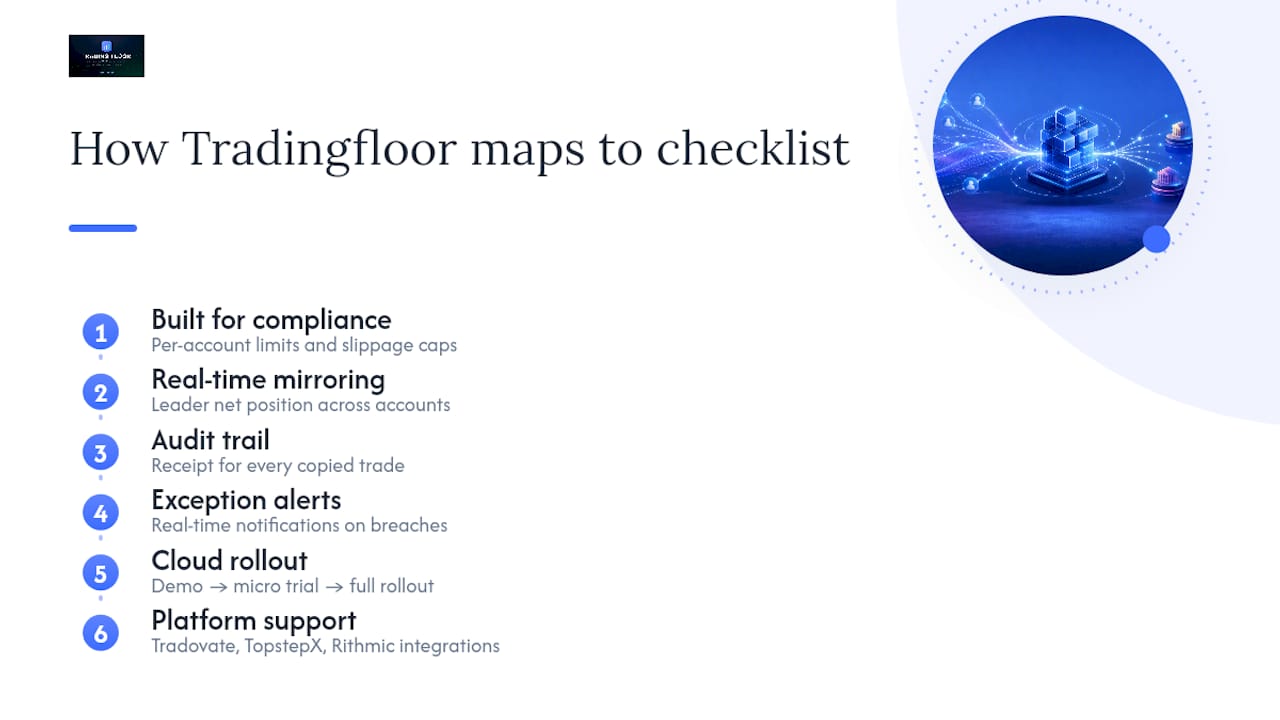
Every control this article just walked through, per-account risk limits, slippage caps, immutable logs, cloud accessibility, is a design decision, not an afterthought. Tradingfloor was built around that checklist rather than around it.
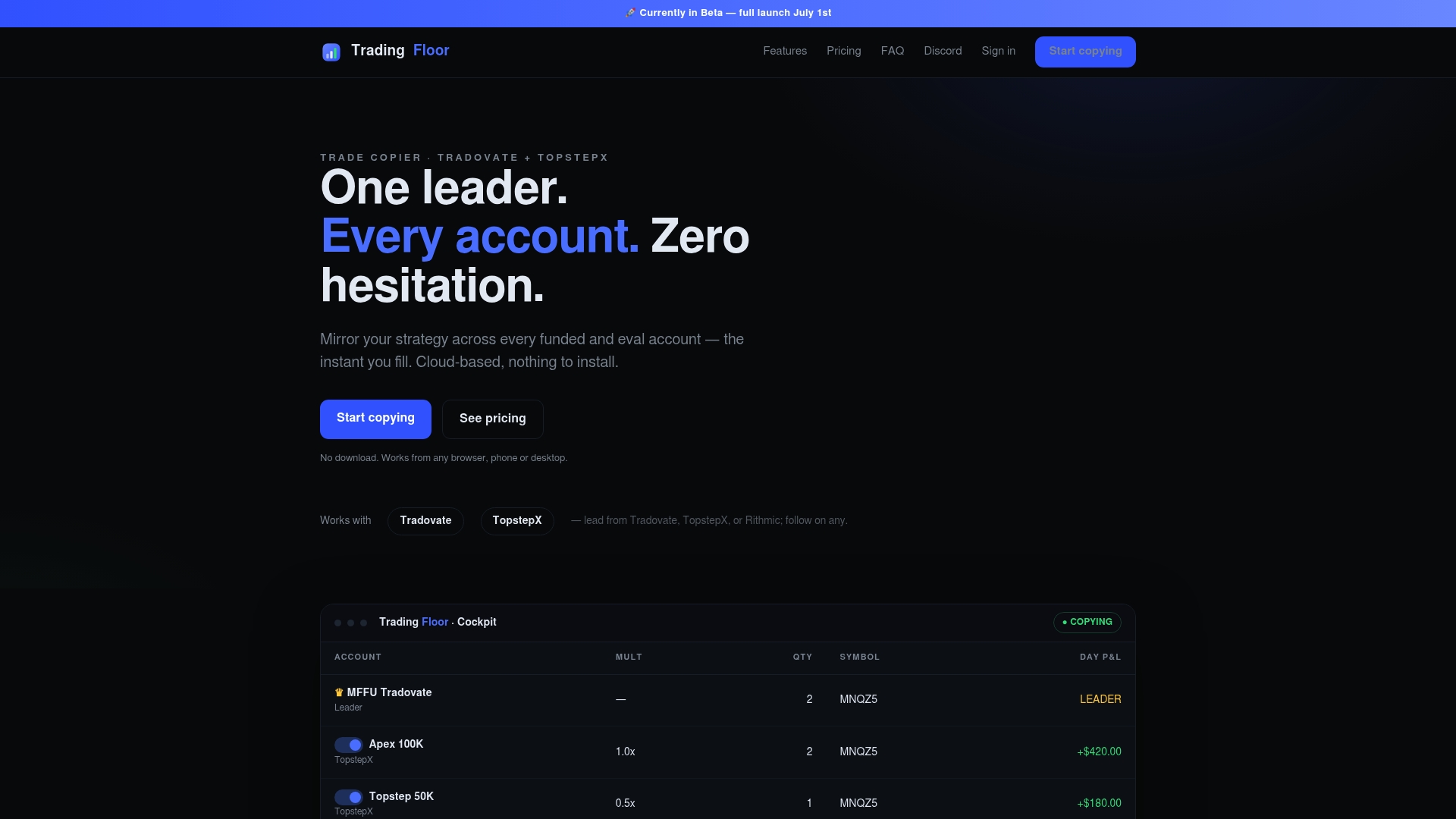
The platform mirrors your leader’s net position in real time across every funded and evaluation account you run, on Tradovate, TopstepX, Rithmic, and other supported platforms, while applying individual risk controls per account rather than a blanket setting. Every copied trade generates a receipt, giving you the audit trail firms ask for during review. Slippage caps and contract multipliers handle the symbol-mapping headaches that trip up manual copying between brokers. Real-time notifications flag exceptions the moment they happen instead of during a weekly review.
Because it’s cloud-based with no installation required, you can run the demo-to-micro-trial-to-full-rollout sequence from any device, then hand your firm the exact logs and reconciliation samples they need to sign off. If you’re weighing it against a manual setup or another tool, the Tradingfloor TradeSyncer alternative page breaks down receipts-on-every-copy pricing starting at $25 a month. Traders on specific platforms can also check the TopstepX trade copier integration or the Earn2Trade trade copier setup for platform-specific deployment steps. Start with the 30-day trial, run your demo test, and bring the logs to your firm before you ever mirror a live position.
Compliance Is the Growth Strategy, Not the Obstacle
Traders tend to treat compliance as friction standing between them and scale. That’s backwards. The traders who last are the ones who treat every approval request, every log file, every reconciliation report as an asset, not paperwork.
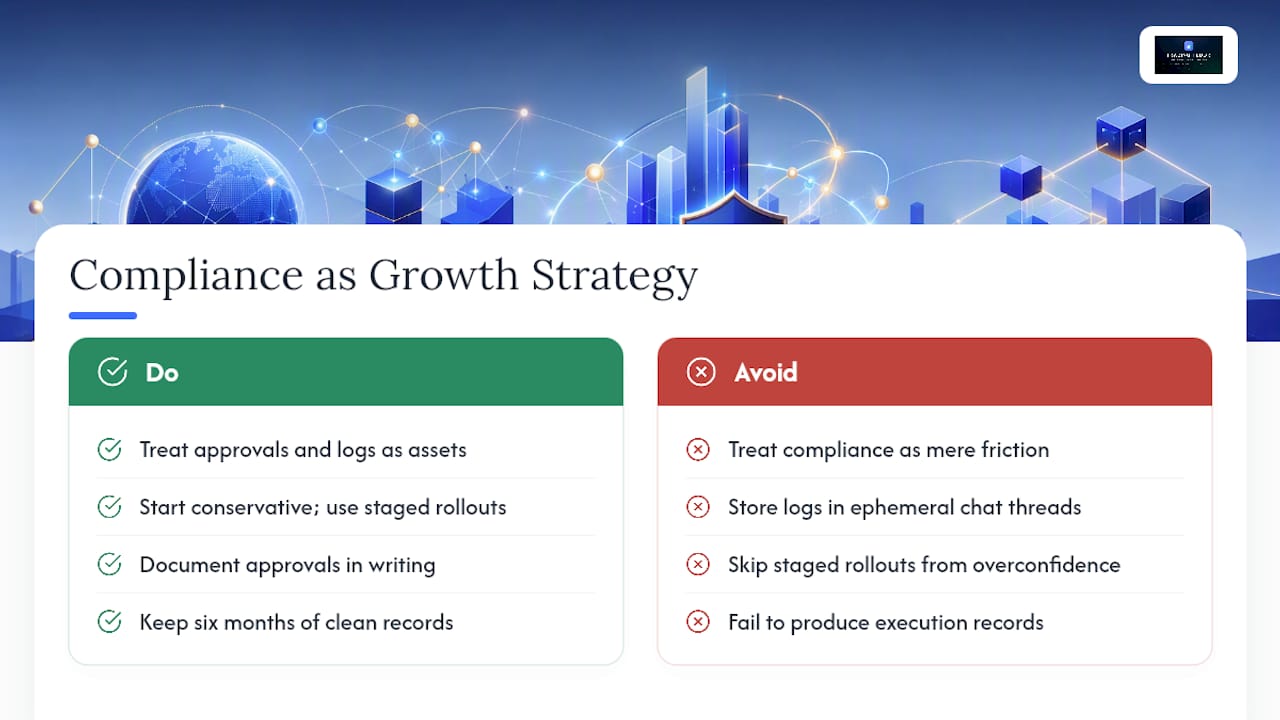
Start conservative. Run staged rollouts even when you’re confident the copier works, because the firm’s confidence in you matters more than your confidence in your code. Document every approval you get in writing, and keep those logs somewhere permanent, not buried in a chat thread that disappears in thirty days.
The trader who can produce six months of clean execution records when a firm asks questions is the trader who keeps scaling. The one who can’t is the one explaining a frozen account.
— KennyTrades
Sources
- Commodity Futures Trading Commission final rule: Electronic Trading Risk Principles (Jan 11, 2021)
- CFTC final rules and discussion on Regulation AT and risk principles
- How to Use a Trade Copier for Futures: Rules, Risks, and Top Firms | OnlyPropFirms
- Trade Copying Rules for Futures Prop Firms | Damn Prop Firms
Recommended
- Prop Firms That Allow Copy Trading (2026) — the actual rules, sourced
- How to Copy Trades Across Multiple Prop Firm Accounts Like TopstepX
- Trading Account Delegation Best Practices for Prop Traders
- Prop Firm Trade Copier — run every funded account as one floor
Trading Floor mirrors every trade across your Tradovate, TopstepX & Rithmic accounts in real time, from $25/mo.
Start copying →