Trades Copied Right: Real-Time Mirroring for Prop Traders

“Trades copied” means real-time net-position mirroring across multiple funded and evaluation accounts, not signal replay, and the production-ready approach requires per-account risk enforcement, idempotency, and a cloud-based copier like Tradingfloor.
- Why net-position mirroring matters: Signal replay re-fires raw order events, so partial fills, latency gaps, and rollover mismatches compound into desync. Mirroring the leader’s net position and deriving follower orders from the diff eliminates most of that drift.
- Core safety controls required: Per-account contract limits, daily loss caps, slippage caps, and duplicate-signal blocking with composite business keys and SHA-256 fingerprinting.
- Recommended production route: Cloud position-mirroring with immutable audit logs. Tradingfloor supports Tradovate, TopstepX, and Rithmic out of the box with a 30-day free trial.
Table of Contents
- How do trades get copied: signal replay vs. position mirroring?
- Per-account risk controls that protect funded accounts
- Setup checklist: from API connection to first live copy
- What breaks in live trading and how to catch it early
- Troubleshooting common failures fast
- Prop-firm rules you must verify before copying
- What to demand from any trade copier vendor
- How Tradingfloor handles production-ready position mirroring
- Key Takeaways
- The part most traders skip until it costs them
- Start your controlled demo on Tradingfloor today
- Useful sources
How do trades get copied: signal replay vs. position mirroring?
Two architectures dominate, and they fail in completely different ways.
Signal-level copying forwards raw order events from the leader’s feed directly to followers. The follower’s order management system replays each event in sequence. The problem: if the leader’s fill is partial, the follower fires the full intended size. If the leader cancels and re-enters during a fast market, the follower may execute both legs. Latency compounds every mismatch.
Net-position mirroring works differently. The system snapshots the leader’s current net position, computes the diff against each follower’s current position, and sends only the corrective order needed to close the gap. The data flow looks like this:
- Leader opens 5-contract ES long → system records net position: +5
- Follower A (1× multiplier, current position: 0) → system sends buy 5
- Follower B (0.5× multiplier, current position: 0) → system sends buy 2 (rounds down to minimum order size)
- Leader partially fills to +3 → system recalculates diff → sends corrective orders to both followers
Scalpers with holding periods under 30 minutes face structural execution problems because latency and fills erode thin per-trade margins. For futures prop accounts, target leaders whose average hold exceeds one hour.
Per-account risk controls that protect funded accounts

Start with hard per-account limits before touching multipliers. Every follower account needs a maximum contracts-per-instrument setting, a daily loss limit, a per-trade loss cap, and a total exposure ceiling. These are not optional guardrails; prop firms will close accounts that breach them.
For position sizing, three formulas cover most setups. Percentage-of-equity sizing scales the follower’s position proportionally to account size. Fixed-notional sizing assigns a dollar amount per contract regardless of account equity. Kelly-adjusted allocation is the most defensible for copy portfolios: use half- or quarter-Kelly, which lands practical per-leader allocations in the 8–15% range and caps any single leader at 25% of copy capital.
Sizing rule of thumb: spread across 6–8 leaders at 8–15% each. Cap any single leader at 25%. Rebalance quarterly, not emotionally.
Small follower allocations create a specific problem in futures: minimum order sizes. A follower account too small to meet the exchange minimum for a given contract simply cannot mirror a 1-contract position. Size accounts to clear that floor before going live.
Pro Tip: Set a mechanical unfollow trigger at a 15% drawdown breach on any single leader. Quarterly scaling reviews beat reactive sizing changes every time.
Setup checklist: from API connection to first live copy
- Connect broker APIs. Authenticate Tradovate, TopstepX, or Rithmic credentials in Tradingfloor. Verify read/write permissions for order placement, not just data feeds.
- Assign account roles. Designate one master account and map each follower account by ID. Confirm timezone settings match across all accounts.
- Map instruments and contracts. Verify contract symbols align across brokers. Set rollover mapping so the copier switches front-month contracts on schedule.
- Set multipliers and limits. Configure per-follower contract multipliers, daily loss limits, max-contracts-per-instrument, and slippage caps.
- Run demo fill tests. Place a test order on the master in a demo environment. Confirm all followers receive and execute the mirrored order within expected latency.
- Simulate partial fills. Manually trigger a partial fill on the master. Verify the system sends a corrective order rather than a duplicate full-size order.
- Run a duplicate-signal simulation. Fire the same signal twice within the deduplication window. Confirm the second signal is blocked and logged.
- Margin-stress test. Reduce a follower’s simulated equity below minimum margin. Confirm the system rejects the order and sends an alert rather than silently failing.
- Reconciliation check. After the demo session, run a snapshot-to-snapshot diff. Confirm P&L and position counts match between master and all followers.
For deeper configuration on Tradovate and TopstepX integrations, Tradingfloor’s blog covers the specifics.
What breaks in live trading and how to catch it early
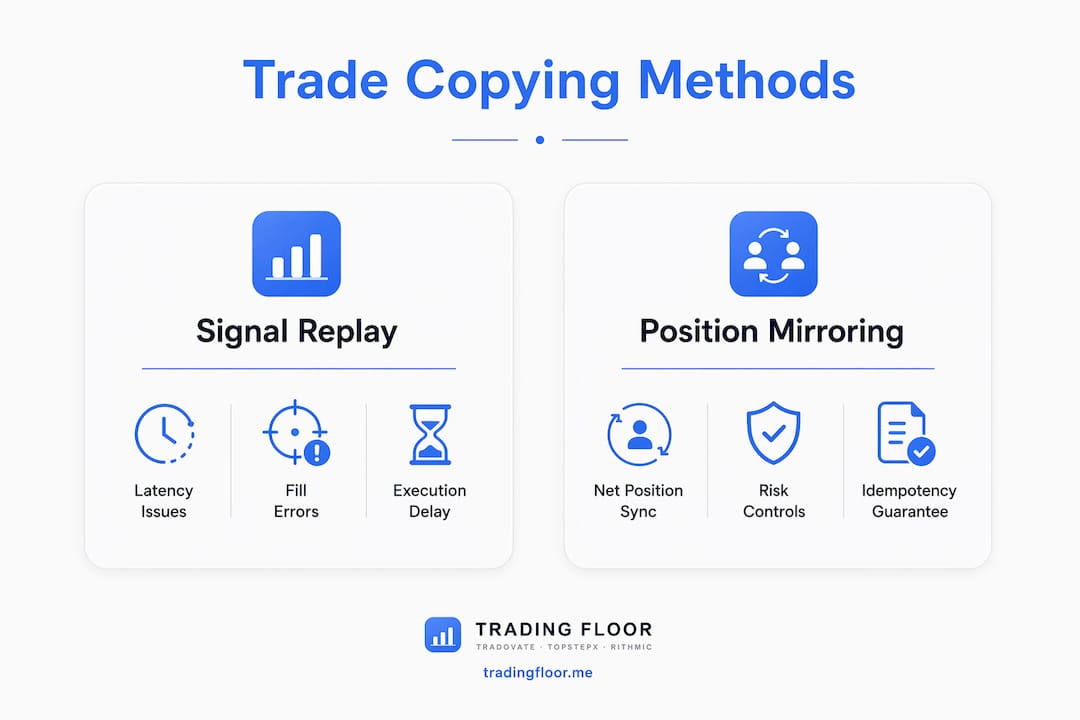
Execution latency is the most common source of position drift. An order that takes 200ms longer than expected during a fast market can fill at a materially different price than the leader. Set slippage caps per instrument and monitor fill-price deviation on every trade.
Partial fills create the second failure mode. When the leader’s order fills in two tranches, a signal-replay copier may fire two separate follower orders. A position-mirroring system recalculates the net diff after each fill event, so only one corrective order goes out.
Instrument mapping errors during rollovers cause silent desyncs. The master rolls to the new front month; a follower still mapped to the expiring contract gets rejected. Verify rollover dates in advance and test the mapping switch in demo before the live rollover date.
Audit requirement: Every copy event, blocked signal, fill mismatch, and reconciliation snapshot must write to an immutable, time-stamped log. Without that record, post-incident forensics are guesswork and compliance reporting is impossible.
Duplicate-signal blocking runs at the execution routing layer and logs every blocked signal. That log is your first stop when a follower account shows unexpected position counts.
Troubleshooting common failures fast
- Connection drop: Switch to queued snapshot mode immediately. On reconnect, run a full position diff before resuming live copying to avoid stale-state orders.
- Duplicate fills: Execute idempotency reconciliation using composite business keys (trade ID, venue, order ID, instrument, timestamp). Identify and reverse duplicate fills before end of session.
- Partial fill mismatch: Pause follower execution, snapshot all account states, recalculate multipliers against current equity, and resume with verified sync.
- Margin rejection: Isolate the affected follower, reduce position size or add margin, and confirm the account clears minimum requirements before re-enabling.
- Desync after rollover: Flatten the affected follower position manually, re-map the contract, and re-enter via a fresh mirroring snapshot.
Prioritize fixes by financial impact: open P&L exposure and margin risk first, then regulatory reporting, then operational cleanup.
Prop-firm rules you must verify before copying
Prop firms vary widely on what automated copying permits. Some treat it as outsourced trading and require written approval. Others prohibit simultaneous correlated positions across accounts. Verify these points before going live:
- Written permission for automated order execution on funded and evaluation accounts
- Allowed signal sources (internal strategy vs. external signal provider)
- Rules on simultaneous account trading and correlated exposure limits
- Allowed instruments and intraday scaling rules
- Whether copying counts as “outsourced” trading under the firm’s rulebook
For a detailed breakdown of consistency rule compliance when copying across prop accounts, Tradingfloor’s documentation covers the firm-specific edge cases.
Pro Tip: Request a signed policy confirmation from your prop firm for automated multi-account copying before you go live. Verbal approvals disappear; a written confirmation protects you when enforcement is ambiguous.
What to demand from any trade copier vendor
| Dimension | What to require |
|---|---|
| Position mirroring vs. signal replay | Net-position diff, not raw event replay |
| Idempotency | Composite business keys + SHA-256 fingerprinting |
| Per-account risk controls | Contract limits, daily loss cap, slippage cap per account |
| Broker integrations | Tradovate, TopstepX, Rithmic natively supported |
| Latency / order routing | Sub-second order routing with fill-latency logging |
| Cloud vs. local install | Cloud-native, no local install required |
| Audit logs and alerts | Immutable logs, push notifications, blocked-signal records |
| Pricing | Transparent subscription, no hidden per-trade fees |
Safety first: idempotency and deduplication are non-negotiable. Broker integrations come next. UX and pricing matter, but a fast, cheap copier that silently duplicates fills costs more than a subscription ever will.
How Tradingfloor handles production-ready position mirroring
Tradingfloor is built specifically for prop traders running funded and evaluation accounts. The feature set covers the full operational stack: cloud position mirroring, per-account multipliers, slippage caps, deduplication with idempotency, auto-reconciliation, trade journaling, push notifications, and native integrations for Tradovate, TopstepX, and Rithmic. No local install. Any device, any location.
The setup flow is straightforward. Connect the master account, map follower account IDs, assign multipliers and per-account limits, run the demo test checklist, then monitor live with full audit logs. The cloud-based position mirroring handles the net-position diff calculation and order routing automatically.
Tradingfloor supports group account management and an affiliate referral program for traders who manage accounts on behalf of others. The 30-day free trial gives you enough runway to complete the full demo checklist before committing real capital.
Key Takeaways
Real-time net-position mirroring with per-account risk controls and idempotency is the only production-safe architecture for copying trades across funded and evaluation futures accounts.
| Point | Details |
|---|---|
| Net-position mirroring beats signal replay | Mirroring the leader’s net position eliminates partial-fill and duplicate-order failures that signal replay cannot prevent. |
| Kelly-adjusted sizing caps risk | Use half- or quarter-Kelly: practical allocations per leader land in the 8–15% range with a 25% cap on any single leader across copy capital. |
| Idempotency is required | Composite business keys and SHA-256 fingerprinting prevent duplicate fills at the execution routing layer. |
| Prop-firm compliance first | Get written permission for automated copying before connecting any funded or evaluation account. |
| Tradingfloor for production | Tradingfloor provides cloud position mirroring, per-account controls, and Tradovate/TopstepX/Rithmic integrations with a 30-day free trial. |
The part most traders skip until it costs them
Most of the pain in copy setups does not come from the strategy. It comes from the infrastructure. A desync that happens at 9:32 AM during a fast ES move, when the leader fills in two tranches and the follower fires a duplicate order, is not a strategy failure. It is an idempotency failure. The fix is architectural, not tactical.
The traders who run multi-account copy setups without incident treat it the way a portfolio manager treats allocation: mechanical rules, scheduled reviews, and hard triggers for unfollowing. The ones who get into trouble are the ones who size emotionally after a good week or skip the reconciliation check because nothing looked wrong.
One practical note on quarterly scaling: the right time to increase follower allocations is after a scheduled review, not after a winning streak. The same discipline applies to unfollowing. A 15% drawdown trigger is a rule, not a suggestion.
Start your controlled demo on Tradingfloor today
Tradingfloor gives prop traders a 30-day free trial to run the full setup checklist before a single dollar of real capital is at risk. Connect one master account and one follower, run the demo fill tests, partial-fill simulations, and reconciliation checks described in this guide, and escalate to support if any desyncs appear.
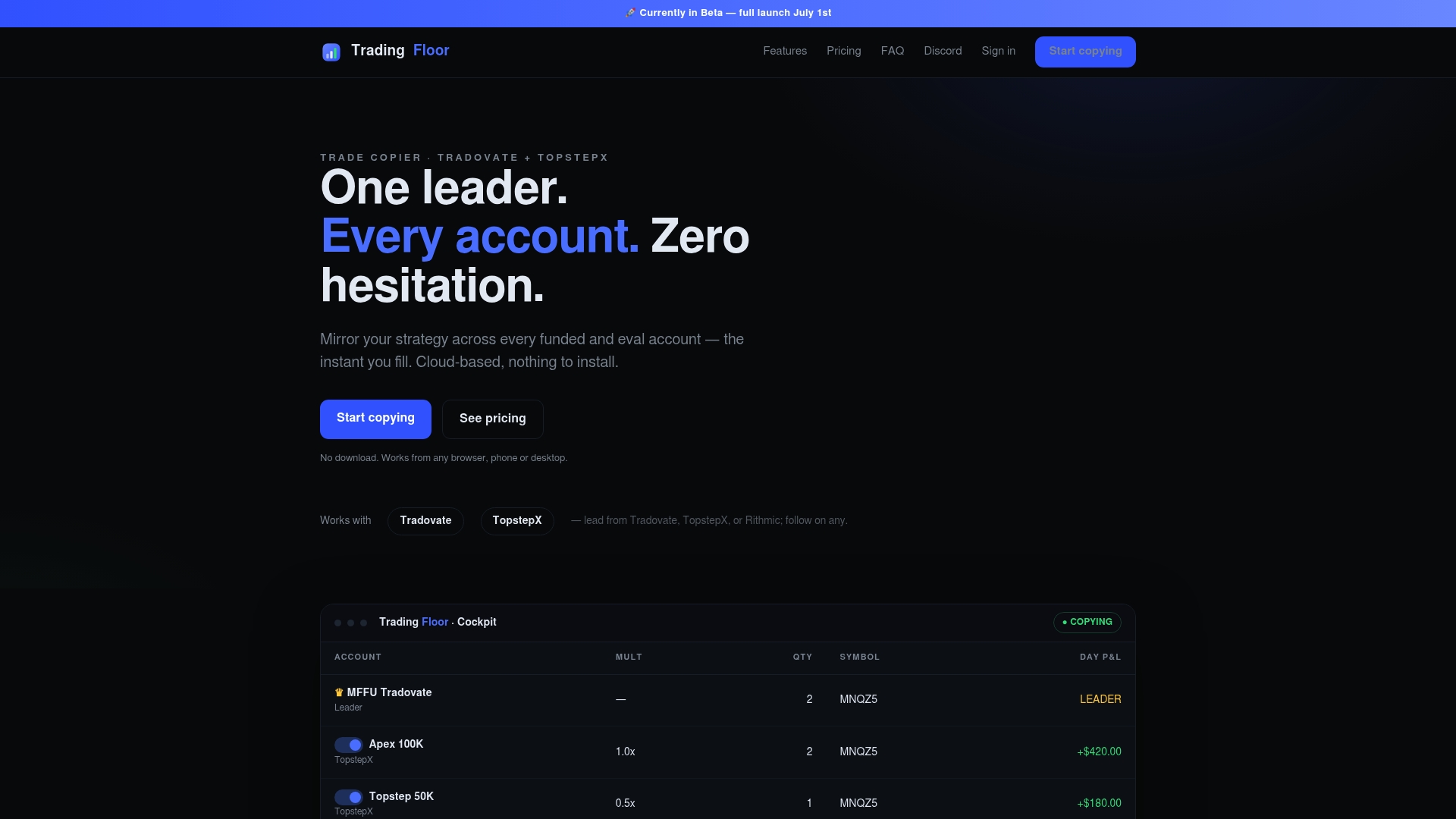
Native integrations for Tradovate, TopstepX, and Rithmic mean you are not stitching together broker connections manually. The cloud architecture means no installation, no local dependencies, and access from any device. Check the system status page for real-time uptime before onboarding, and start your trial at tradingfloor.me.
Useful sources
- Graph-Based Duplicate Trade Detection and Idempotency Framework — the primary technical reference for composite business keys, SHA-256 fingerprinting, and exactly-once processing semantics. Required reading for engineers building or auditing a copier.
- Bybit Copy Trading Deep Guide 2026 — covers Kelly-adjusted sizing, holding-period guidance, and allocation math. Most relevant for strategy sizing decisions, though the platform context is crypto rather than US futures.
- Duplicate Copy Trade Protection — Alertsify — explains execution-layer duplicate blocking and audit logging behavior. Useful for operations teams configuring alert thresholds.
- Types of Trade Copying Strategies: 2026 Guide — Tradingfloor — covers signal vs. position mirroring trade-offs and configuration examples for prop accounts. Start here for strategy-level decisions.
- Copy Trades Across Multiple Prop Firm Accounts — Tradingfloor — step-by-step configuration for TopstepX-style funded evaluation accounts. Most relevant for operations and policy checks.
Recommended
- How to Mirror Trades Across Prop Accounts Precisely — Trading Floor
- What Tools Let You Mirror Trades from One Tradovate Account to Several Others? — Trading Floor
- Why Traders Use Account Mirroring to Scale Fast — Trading Floor
- Best prop.tradovate.com Alternatives for Multi-Account Prop Traders — Trading Floor
Trading Floor mirrors every trade across your Tradovate, TopstepX & Rithmic accounts in real time, from $25/mo.
Start copying →