Stop Missed Closes: Close Only Copying Mode Checklist for Prop Traders

Close-only copying mode is a trade-copier setting that mirrors a leader account’s exit orders across follower accounts while blocking any new position opens. Prop traders reach for it during risk events, when a leader is entering manually outside the usual system, or when an evaluation account’s rules no longer match the leader’s exposure. Per-account limits like max contract size and daily loss caps stay active the entire time, so switching to close-only doesn’t mean switching off risk control.
TL;DR:
- Close-only mode prevents new entries on follower accounts but still allows all existing positions to be closed by the leader, maintaining risk controls.
- It should be used temporarily during manual entries, contract mismatch, drawdown events, or rule violations, not as a permanent default.
- Proper setup involves mapping accounts, testing on demo first, and implementing automated receipts and reconciliation to catch discrepancies early.
- Per-account size limits, daily loss caps, and multipliers remain essential to control the size and impact of each close, even in close-only mode.
- Connection issues, symbol mapping errors, or permission restrictions are the main causes of missed closes, which can be fixed by verified re-tests and manual management if needed.
Table of Contents
- What Is Close-Only Copying Mode and When Should You Use It?
- How Do You Enable and Test Close-Only Copying Mode?
- Which Per-Account Risk Controls Belong Alongside Close-Only Mode?
- How Do You Verify Close-Only Mode Is Working Correctly?
- What Causes Missed or Partial Closes, and How Do You Fix Them?
- What Trading Floor Recommends for Close-Only Setups
- Getting Close-Only Mode Right With Trading Floor
- Where to Read More on Trading Floor’s Copier Setup
- FAQ
What Is Close-Only Copying Mode and When Should You Use It?
Most trade copiers default to full mirroring: every leader open and close gets replicated across follower accounts. Close-only mode narrows that behavior to exits only, and that narrowing matters more than it sounds.
Think about a funded account that just hit 80% of its daily loss limit. You don’t want a new leader entry doubling down on that account, but you still want any open position closed if the leader closes theirs. That’s the exact gap close-only mode fills.
Common situations where traders reach for it:
- The leader is entering trades manually, outside the tested strategy, during a news event or unusual volatility.
- A follower account has a contract-size mismatch with the leader and can’t safely take new opens.
- An evaluation account is close to a drawdown limit and needs a temporary pause on fresh risk.
- A prop firm’s rules changed mid-cycle and new positions on that account now violate a restriction.
The trade-off is straightforward: you cut off unwanted new exposure, but you also give up any profit the leader’s next winning trade might have produced on that account. Trading Floor’s guide on types of trade copying strategies breaks down how close-only compares with a full stop-copy or a pause-new-trades setting, which is worth reading before you decide which lever to pull.
Pro Tip: Don’t leave close-only mode on indefinitely as a “safer” default. It quietly caps your upside on every follower account it touches, so treat it as a temporary control tied to a specific condition, not a permanent setting.
How Do You Enable and Test Close-Only Copying Mode?
Rushing this configuration is how traders end up with a follower account that either misses closes or takes on the wrong size. Work through it in order.
Preparation
- Map every follower account to its correct leader and confirm the broker integration is live (Tradovate, TopstepX, and Rithmic each handle order routing slightly differently).
- Take a snapshot of your current copy settings before changing anything, so you can revert quickly if something breaks.
- Confirm which accounts actually need close-only versus a full stop-copy. They’re not interchangeable.
Enabling the mode
- Toggle close-only mode on for the specific follower accounts affected, not the whole group, unless every account shares the same risk condition.
- Set symbol and exclusion rules so only the relevant instruments are restricted. Trading Floor’s guide on automating position copying covers exclusion logic in detail.
- Configure contract multipliers and slippage caps per account. A leader closing 5 contracts shouldn’t translate into an oversized close on a smaller follower account.
- Turn on receipts and push notifications for every copy action before you go live.
Testing and ramp
- Run a dry test on a demo account or with a single micro contract first.
- Verify the receipt matches the leader’s close exactly, then confirm auto-reconciliation shows no mismatch.
- Only after a clean test do you extend the setting to additional accounts, one batch at a time.
Enabling receipts and reconciliation as a default when close-only mode goes live is the fastest way to catch a missed close before it turns into an audit problem, according to Trading Floor.
Which Per-Account Risk Controls Belong Alongside Close-Only Mode?
Close-only mode blocks new opens, but it does nothing to control how big a close gets replicated. That’s where your per-account settings carry the real weight.
Start with a max contract size per account. If your leader closes a 10-contract position and a follower account is only rated for 2 contracts, the multiplier needs to scale that close down automatically, not just cap the open. Pair that with a daily loss limit specific to each account, especially on evaluation accounts where breaching a drawdown threshold ends the challenge outright.
Position-size multipliers deserve more attention than most traders give them. A flat 1:1 copy ratio works fine when every account trades the same size, but funded and evaluation accounts rarely do. Set the multiplier so a leader’s exit scales proportionally to each account’s approved size, not a fixed number that made sense on day one and stopped making sense after an account got resized.
- Cap max contract size per follower account, separate from the leader’s own sizing.
- Set a daily loss limit that halts copying automatically once breached.
- Use a multiplier tied to each account’s approved contract size, not a global default.
- Turn on trade journaling and receipts so every close leaves an auditable record.
Pro Tip: Review your multipliers every time an account gets resized after a payout or a drawdown reset. A multiplier that was correct last month can quietly become wrong after a funded account’s parameters change.
Reconciliation matters here too. If a follower account shows a position that doesn’t match what the leader’s close should have produced, you want that flagged before the next session starts, not discovered during a weekly review.
How Do You Verify Close-Only Mode Is Working Correctly?
Turning the setting on isn’t the finish line. Confirm it’s actually behaving as expected before you walk away from the screen.
- Check that every follower account received a receipt matching the leader’s close, including the correct contract multiplier applied.
- Set alerts for failed receipts, dropped connections, or any position mismatch between leader and follower.
- Run a daily reconciliation pass and keep the audit log. Prop firms reviewing an evaluation account will ask for exactly this kind of record.
- Spot-check one account manually even when automated reconciliation shows green, at least during the first week.
Trading Floor’s receipt system exists specifically for this kind of verification, according to Trading Floor, and pairing it with automated reconciliation catches most discrepancies before they compound into a bigger problem.
What Causes Missed or Partial Closes, and How Do You Fix Them?
A missed close almost always traces back to one of four causes: a dropped connection between the leader feed and the follower account, a symbol mapping error, a partial fill that never completed, or a permission restriction on the follower account itself.
- Check the connection status on both leader and follower accounts first. A stale connection is the single most common cause of a missed close.
- Replay the receipt log to see whether the close order was ever sent or if it stalled before reaching the broker.
- Verify symbol and multiplier mappings, especially after adding a new account or switching broker platforms.
- Run a controlled re-test on a single account before re-enabling copying across the full group.
- If the issue repeats, pause copying on that account and manage the position manually until the root cause is resolved.
Trading Floor’s article on common automated investing mistakes walks through several of these failure patterns with more detail on prevention.
What Trading Floor Recommends for Close-Only Setups

Receipts on, multipliers conservative, test on one account before scaling to the group. That’s the default Trading Floor recommends for close-only mode, and it’s a deliberately unglamorous stance: the traders who get burned by copy settings are almost never the ones testing too little on purpose, they’re the ones who assumed a setting worked because it worked last time.
Trading Floor was built around mirroring actual positions rather than signals, which is exactly why close-only mode functions as a precise exit filter instead of a rough approximation. For account mapping quirks across different prop firms, the account mapping guide is worth bookmarking, and it’s the kind of documentation that separates a copier you can trust with funded capital from one you have to babysit.
— KennyTrades
Getting Close-Only Mode Right With Trading Floor
Trading Floor mirrors a leader’s real net position, not just a signal, and every close-only configuration keeps the same per-account controls active that you’d use on any other mode: contract size caps, daily loss limits, and multipliers set per account.
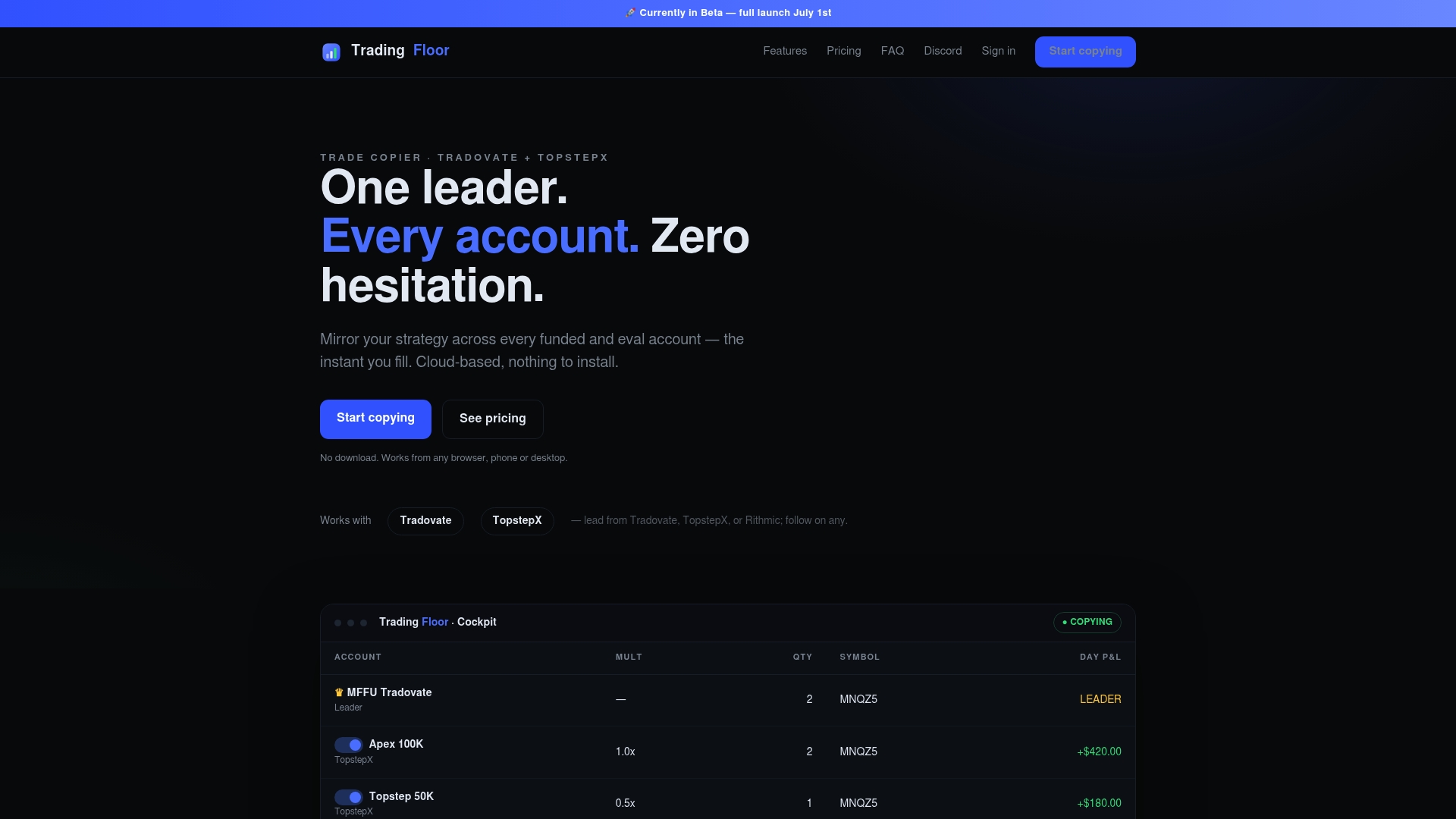
Because it’s cloud-based, there’s nothing to install on any device you manage accounts from, and receipts fire the moment a copy action executes, so you’re not waiting on a support ticket to confirm a close went through. Support spans multiple funded-account platforms, which matters when your evaluation accounts don’t all sit on the same broker.
The practical next step is small: run a single micro-contract test with close-only mode enabled on one account before extending it further, then read through the strategy types guide to decide whether close-only, pause-new-trades, or a full stop-copy fits your current situation better. If you’re managing Take Profit Trader accounts specifically, the Take Profit Trader trade copier page walks through setup for that platform, and a free trial is the fastest way to see the receipts and reconciliation in action on your own accounts.

Where to Read More on Trading Floor’s Copier Setup
Three pages fill in the details this guide didn’t have room for: the automated position copying guide covers exclusion rules step by step, the trade copying strategy guide compares close-only against pause and stop-copy modes, and the multi-account copying mistakes article catalogs the configuration errors that cause missed closes most often.
FAQ
Does Close-Only Mode Block All New Trades?
Yes, it blocks new open orders from the leader account while still mirroring any close or exit order to preserve your existing risk controls.
Can I Apply Close-Only Mode to Just One Follower Account?
Yes, close-only mode should be applied per account, since the accounts needing it usually have a specific risk condition that others don’t share.
What Happens if a Follower Account Misses a Close?
Check the connection and receipt log first. A missed close is almost always a dropped connection, a symbol mapping error, or a permission restriction, and pausing copying while you investigate prevents a bigger mismatch.
Do I Still Need Per-Account Limits With Close-Only Mode On?
Yes, close-only mode only restricts new opens. Max contract size, daily loss limits, and multipliers still need to be set on every account to control how large a mirrored close gets applied.
How Do I Know Close-Only Mode Is Actually Working?
Confirm a receipt was generated for every leader close on each follower account, then check that automated reconciliation shows no position mismatch at the end of the session.
Recommended
- Stop Accidental Copies: 5 Steps to Exclude Accounts for Prop Traders
- Prop Traders: Audit Proof Entry Only Copying Across 5 Funded Accounts
Trading Floor mirrors every trade across your Tradovate, TopstepX & Rithmic accounts in real time, from $25/mo.
Start copying →