3 Firm Aware Daily Loss Limit Methods Funded Traders Must Use

A daily loss limit is a fixed dollar cap on how much you can lose in one session before you’re forced to stop. Set it before you place a single trade, not after a bad fill, and keep it in the 1–3% range that most educational sources recommend. The exact number that matters isn’t the percentage. It’s whether your firm calculates it off your starting balance, your account equity, or your intraday high water mark, because those three methods produce very different real numbers.
TL;DR:
- Most firms calculate daily loss limits based on account balance, equity, or high water mark, which can lead to significantly different risk caps.
- Enforcement methods vary, with some firms auto-liquidating positions immediately upon breach, affecting the loss price and potential total risk.
- Traders should set their personal limits well below the firm’s maximum to account for spreads, slippage, and unexpected gaps, especially when managing multiple accounts.
- Using buffers of 25-35% on the daily loss limit helps absorb unexpected losses from spreads and floating positions, reducing accidental breaches.
- Tools that mirror risk across multiple accounts and provide instant alerts can help traders avoid breaches and better manage risks on several funded accounts simultaneously.
Table of Contents
- What a Daily Loss Limit Actually Does
- How Firms Calculate and Enforce the Daily Cap
- How to Set Your Personal Daily Loss Limit
- Position Sizing Math: What the Numbers Actually Look Like
- What to Do the Moment You Hit Your Limit
- Common Ways Traders Breach Limits Without Meaning To
- How Trading Floor Helps You Enforce Limits Across Multiple Accounts
- The Part of This Everybody Gets Backwards
- A Simpler Way to Keep Every Account Inside Its Limit
- Sources
What a Daily Loss Limit Actually Does
A daily loss limit works like a circuit breaker. Once your losses for the session hit a preset dollar figure, trading stops, either because you stop yourself or because the platform stops you. Most funded account providers reset the limit at a fixed clock time, often around the U.S. evening, and the counter starts fresh the next session regardless of what happened the day before.
The logic behind it isn’t really about math. It’s about behavior. A trader down $800 on the day is not thinking clearly, and the trades that follow a bad stretch tend to be worse than the ones that caused it. A daily loss limit setting works precisely because it’s decided in advance, when you’re calm, and applied later, when you’re not. That’s a pre-commitment device, the same principle behind a gambler leaving credit cards at home.
Enforcement varies by firm, and the difference matters more than traders expect. Some platforms simply flag the breach and expect you to close out manually. Others liquidate every open position the instant the limit is touched and lock the account for the rest of the session. A firm that auto-liquidates removes your ability to “wait it out” hoping a losing trade turns around, which is exactly the point. You lose the position at whatever price the market happens to be, not the price you wanted.
The gap between a firm that pauses trading and one that force-closes positions can cost you real money on a bad tick, so read your specific rulebook rather than assuming your last funded account worked the same way as your current one.
How Firms Calculate and Enforce the Daily Cap
This is where most traders get blindsided, because the word “daily loss limit” hides three genuinely different calculation methods, and firms rarely explain the difference clearly.
Static, start-of-day limits set your cap based on your account balance at the moment the session opens. Lose that dollar amount and you’re done, no matter what happens afterward. It’s simple and predictable, but it means your available risk shrinks as your balance shrinks. A losing streak compounds against you.
Trailing or loss-from-top limits calculate the cap from your highest equity point of the day, not your starting balance. If you’re up $600 by mid-morning and then give back $900, you can breach the limit even though you’re still net positive versus where you started. This model protects unrealized profit aggressively, which is exactly why some firms use it and some traders hate it.
Balance-snapshot models take a periodic reading of your account rather than tracking continuously. The distinction sounds technical, but Prop Firm Bridge’s breakdown of calculation bases shows it changes how much risk you actually have available at any given moment during the session, especially with open positions still moving.
The single most common trap: floating P&L. If your firm counts unrealized losses toward the limit, and most funded account providers do, an open position that’s underwater on paper can trigger a breach before you ever click “close.” You don’t need to lose the money. You just need the position to be losing it right now.
A few operational details worth checking in your specific rulebook:
- Whether the limit is based on equity (including open positions) or balance (realized only)
- The exact daily reset time and time zone, since Apex Trader Funding’s help center notes resets commonly land in the evening ET, which affects overnight and pre-market exposure
- Whether weekend gaps count against Friday’s limit, Monday’s limit, or neither
- Whether the firm auto-liquidates or simply flags the breach for manual action
Read the actual rulebook page for your provider before you assume anything. The funded account risk rules that govern one firm rarely match another firm’s language word for word, and the differences show up exactly when you can least afford a surprise.
How to Set Your Personal Daily Loss Limit
Your firm’s maximum allowed loss is not your target. It’s the ceiling. The number you actually trade by should sit comfortably underneath it, and there are three practical ways to arrive at that figure.
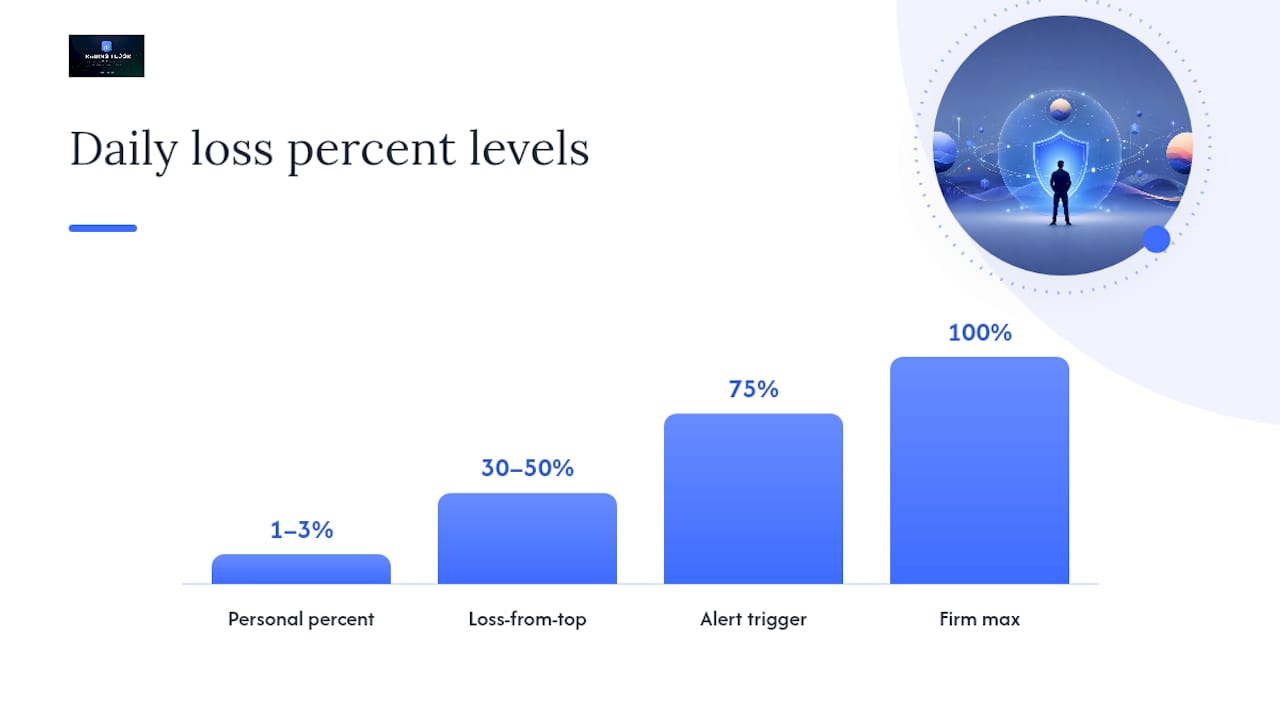
1. The percentage method. Take 1–3% of your account size and convert it to a dollar figure. On a $50,000 account, that’s $500 to $1,500 per day. Newer traders should sit at the low end of that range; the 1-3% guideline shows up across most educational sources because it leaves enough room to survive a rough week without threatening the account.
2. The mirror-average-winning-day method. If you’ve traded long enough to have real data, look at your average winning session in dollars. Set your daily loss limit close to that number. The logic: your limit should roughly match what a typical good day earns you, so one bad day can’t erase two or three good ones. This only works if you have at least 20 to 30 sessions of honest data behind you. Guessing at this number without a track record just recreates the percentage method with extra steps.
3. The loss-from-top variant. Once you’re up meaningfully on the day, consider tightening your personal limit to protect those gains rather than risking back down to your starting point. If you’re $1,000 ahead by noon, decide in advance how much of that you’re willing to give back. Many experienced funded traders draw this line at 30 to 50% of the day’s peak profit.
Before your session starts, run through this checklist:
- Confirm your firm’s DLL calculation method (static, trailing, or balance-based)
- Convert your personal percentage limit into an exact dollar figure
- Set a platform alert at 75% of that limit, not 100%
- Decide your loss-from-top rule if you go green early
- Write the number down somewhere you’ll actually see it mid-session
Pro Tip: Set your personal limit tighter than your firm’s published maximum, not equal to it. A firm that allows $1,000 in daily losses gives you no cushion for a spread widening or a slow fill if your own limit is also $1,000. Trade to a lower number and treat the firm’s cap as a wall you never intend to touch.
The traders who blow funded accounts almost never do it by hitting their limit once. They do it by treating the limit as a target to approach rather than a wall to avoid.
Position Sizing Math: What the Numbers Actually Look Like
Once you know your daily loss limit in dollars, position sizing becomes arithmetic, not guesswork. The formula is straightforward:
Risk per trade × maximum number of losing trades ≤ Daily loss limit − buffer
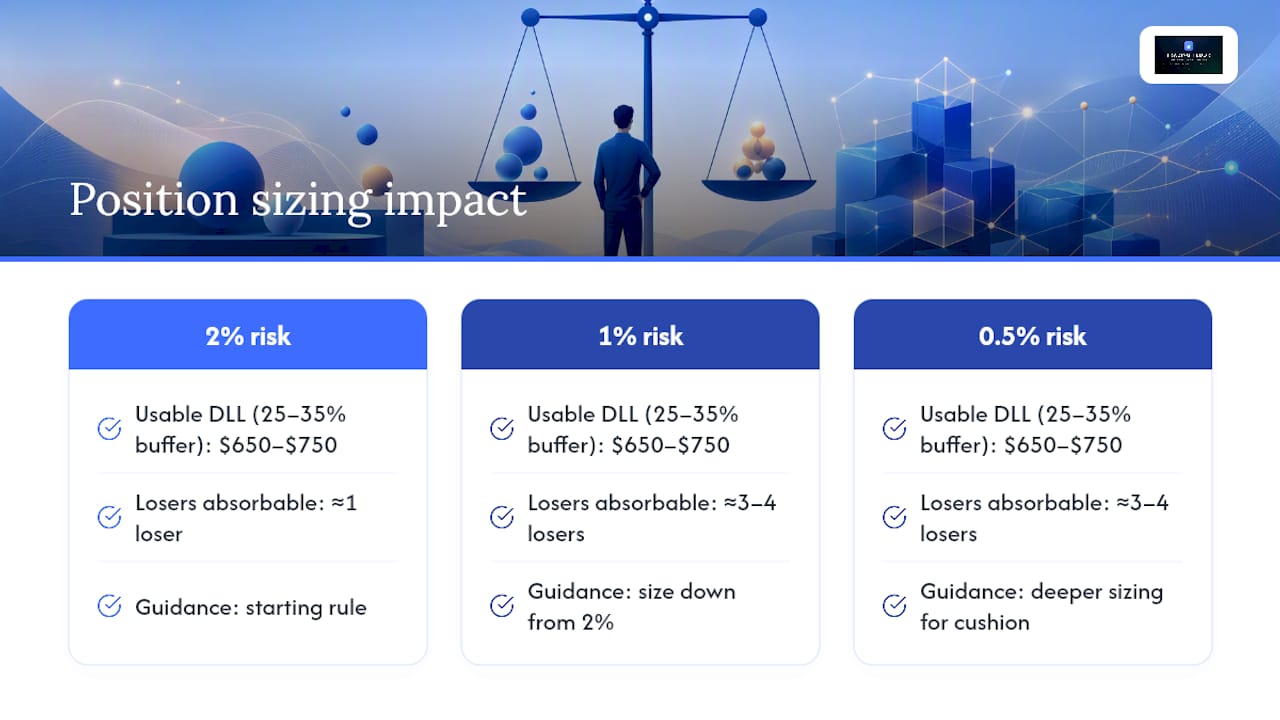
Start with the 2% rule: risk no more than 2% of account equity on any single trade. That’s your starting point, not your ceiling, and on a smaller account it often needs to come down further to leave room for a losing streak.
The buffer matters more than most traders realize. Slippage, spread widening, and floating losses on positions that haven’t hit your stop yet all eat into your daily allowance before you’ve “officially” lost anything. Practitioner guidance consistently recommends holding back a 25–35% buffer of your daily limit for exactly this reason. If your DLL is $1,000, treat $650 to $750 as your real trading budget and leave the rest as shock absorption.
Here’s how that plays out across different account sizes:
That last column looks alarming on purpose. If your per-trade risk equals your full 2% figure, one bad trade can eat your entire usable daily allowance. That’s why most active traders risking a fixed percentage per trade actually size down to 0.5% to 1% per trade, not the full 2%, so they can absorb three or four losers before the daily cap forces them out.
That’s a realistic cushion for a normal, unlucky morning.
What to Do the Moment You Hit Your Limit
The instant your daily loss limit is reached, your job shifts from trading to damage control. Follow this sequence:
- Close every open position immediately, even ones you believe will recover. The limit exists precisely to override that belief.
- Log out of the platform, not just close the chart. Removing physical access reduces the temptation to “check one more setup.”
- Wait until the next scheduled session before reviewing anything analytically. Same-day review while emotions are still hot rarely produces useful conclusions.
- Journal the session while details are fresh: trades taken, whether you followed your own rules, where slippage or spread hurt you, and one specific corrective action for tomorrow.
- Decide whether the problem was the limit or the plan. If you hit your DLL because of one outlier trade that broke your own risk rules, fix the plan. If you’re hitting it regularly on rules you followed correctly, the limit itself may be too tight for your strategy’s normal variance.
That last distinction separates traders who improve from traders who just keep resetting the same mistake. A limit you hit every third day isn’t protecting you anymore, it’s just documenting a strategy that doesn’t fit your account size.
Common Ways Traders Breach Limits Without Meaning To
Most daily loss limit breaches aren’t caused by reckless trading. They’re caused by structural blind spots traders don’t see coming until it’s too late.
- Floating losses count before you act. An open position sitting underwater can breach your limit on paper even if you haven’t clicked to close it, especially under equity-based calculation.
- Weekend and overnight gaps can consume your entire daily allowance in a single tick when the market reopens, with no chance to react in between.
- Correlated positions create hidden concentration. Two “different” trades in related instruments can move together and double your real exposure while looking diversified on your screen.
- Spread widening during news events turns a normal-looking stop distance into a much larger loss than you planned for.
The fix for all four is the same discipline: build in a buffer, flatten positions ahead of major scheduled events, and treat correlated trades as one position for sizing purposes, not two separate small ones.
How Trading Floor Helps You Enforce Limits Across Multiple Accounts
Running the same strategy across several funded and evaluation accounts multiplies the DLL math you just worked through, and it multiplies the ways a single mistake can breach limits on accounts you weren’t even watching. Tradingfloor mirrors your net position in real time across every connected account on platforms like Tradovate and TopstepX, with per-account risk caps and push alerts that flag exposure before it becomes a breach.
That’s the exact failure point covered in drawdown protection for follower accounts, where uneven manual sizing across accounts is what actually blows them, not the strategy itself.
The Part of This Everybody Gets Backwards
Most advice on daily loss limits treats the percentage as the hard part. It isn’t.
The bigger blind spot is buffer discipline. Traders size positions right up to their theoretical limit and then get blindsided by a spread widening or a gap they didn’t plan for.
If you manage several funded accounts running similar setups, the risk changes shape entirely. You’re not managing one limit, you’re managing several simultaneously, and a manual sizing mistake on account three while you’re focused on account one is how good traders lose funded accounts over a rule violation that had nothing to do with their edge.
Get the calculation basis right before you touch the percentage. That’s the order most guides get backwards.
— KennyTrades
A Simpler Way to Keep Every Account Inside Its Limit
If you’re running one account, a written number and a platform alert will get you most of the way there. If you’re running four or five funded and evaluation accounts on the same strategy, manually resizing every trade to respect each account’s own daily loss limit is where traders actually make mistakes, not in their market read.
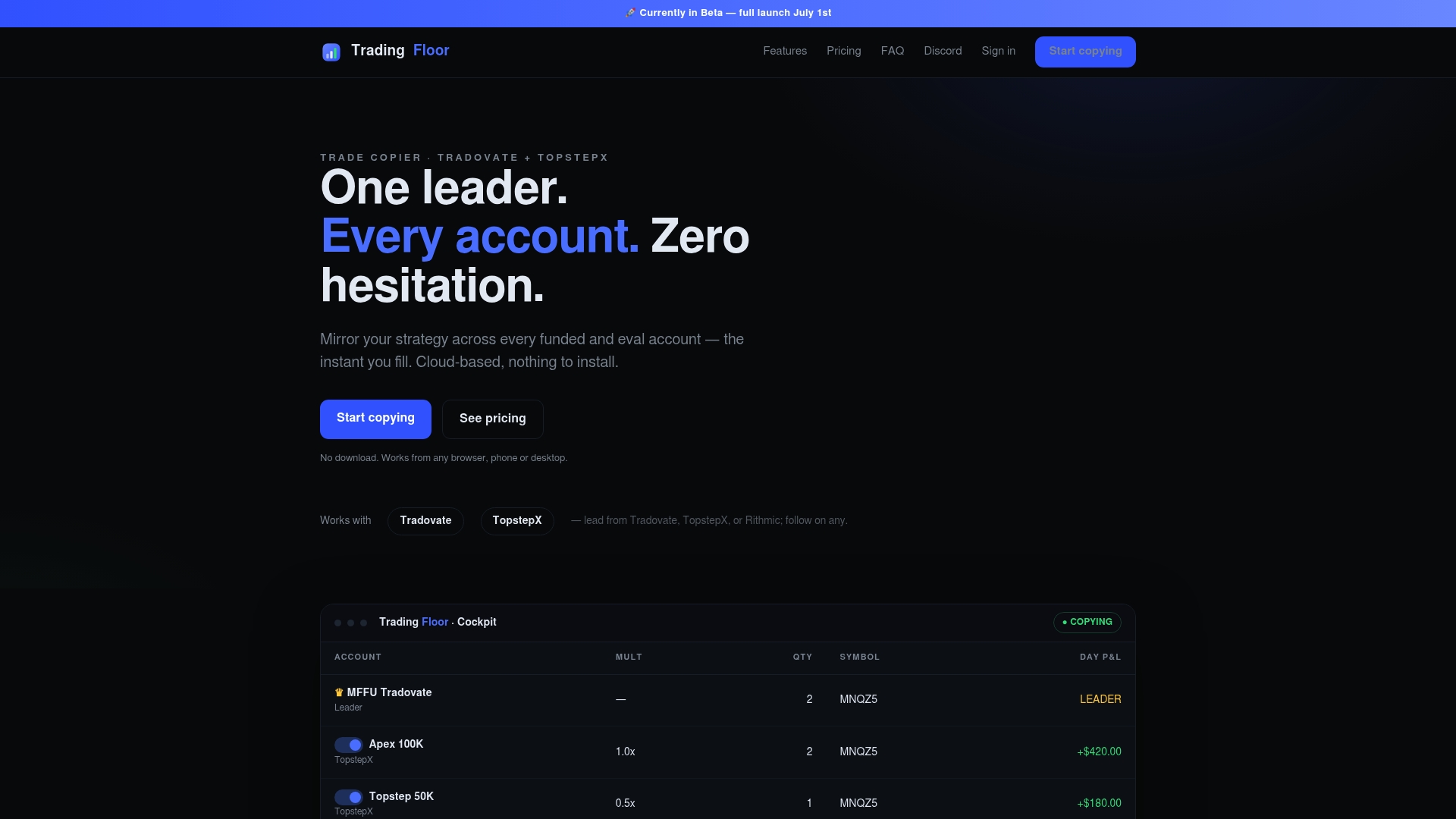
Tradingfloor mirrors your net position across every connected account in real time, with per-account risk caps that respect each account’s own DLL calculation and instant alerts if a position pushes you toward a breach. It’s built specifically for traders juggling multiple Tradovate, TopstepX, or Rithmic accounts who need consistent sizing without doing the math five times under pressure. If you run funded accounts through Take Profit Trader, the Take Profit Trader Trade Copier mirrors one trade across every one of those accounts automatically, sized correctly for each account’s own rules. Start a trial and connect your accounts to see how it handles your specific setup.
Sources
- Daily loss limit setting — Algosys Terminal Academy
- How Prop Firms Calculate Daily Loss Limits (2026) — Prop Firm Bridge
- Daily Loss Limit explained — Apex Trader Funding Help Center
Recommended
- Funded Account Risk Rules Explained for Prop Traders
- Prop Account Trade Limit Setup: Your 2026 Guide
- Recover From a Drawdown Hit Without Losing Funded Accounts
- Types of Trading Evaluation Account Rules Explained
Trading Floor mirrors every trade across your Tradovate, TopstepX & Rithmic accounts in real time, from $25/mo.
Start copying →