2% Daily Loss Limit for Funded Traders With Multi Account Enforcement

A daily loss limit is the dollar amount you’re willing to lose in one session before you stop trading, no exceptions. Most traders should start at a small percentage of their account equity or match their average winning day, whichever is smaller. When you hit it, close every position, log out, and don’t touch the platform again until the next session.
TL;DR:
- Set a strict daily loss limit based on a small percentage of your account or your average profitable day, and enforce it at the platform level.
- Include realized and unrealized P&L, along with commissions and fees, in your calculations to prevent overshooting the limit unnoticed.
- Use ATR-based stop sizing to ensure individual trades risk no more than a manageable portion of your daily limit, especially on volatile instruments.
- Implement pre-trading routines like setting limits the night before and adding mandatory cool-downs after losses to reinforce discipline.
- For multiple accounts, utilize software tools that automatically monitor and prevent exceedance of combined risk, avoiding manual tracking failures during fast markets.
Table of Contents
- What Is a Daily Loss Limit and Why Prop Traders Live by It
- Three Ways to Calculate Your Daily Loss Limit
- Making the Limit Enforceable, Not Just Written Down
- The Math Behind a Limit That Actually Holds
- The Behavioral Side: Setting It Cold and Sticking to It Hot
- Three Worked Examples You Can Adapt Today
- Your Daily Loss Limit Setup Checklist
- How Multi-Account Enforcement Changes the Equation
- What I’ve Learned Watching Traders Blow Past Their Own Limits
- Automate Enforcement Across Every Funded Account You Run
- Sources
What Is a Daily Loss Limit and Why Prop Traders Live by It
A daily loss limit (DLL) is a hard stop on how much money you can lose in a single trading day before all trading activity ends. It’s not a suggestion or a mental goal. It’s a number you write down before the market opens and enforce the same way whether you’re up $500 or down $500 by 10 a.m.
There are two common variants. Loss-from-top measures the drawdown from your highest intraday equity peak instead, which matters if you’re up $2,000 by lunch and want to protect most of that gain rather than give it all back by end of day.
Prop firms build daily loss limits into their rules for a reason that has nothing to do with being strict for its own sake. Topstep, for example, lets traders configure a Daily Loss Limit or a tighter Personal Daily Loss Limit directly in risk settings for the Trading Combine and Express Funded Account, and breaching it typically closes open positions automatically and can restrict access for the rest of the day. The firm isn’t trying to catch you out. It’s preventing one bad morning from wiping out months of consistent gains.
For independent traders, the mechanism is the same even without a firm enforcing it:
- A DLL acts as a circuit breaker against revenge trading and emotional cascades, not primarily as protection for any single trade.
- Hitting the limit should trigger an automatic, non-negotiable stop: flat all positions, no new entries, session over.
- Consequences of ignoring it compound fast. One overridden limit teaches your brain that the number is negotiable, and the next breach gets easier.
Three Ways to Calculate Your Daily Loss Limit
Picking the actual number is where most traders get stuck between “too tight to be useful” and “too loose to matter.” Three methods cover almost every situation.
- Percentage of account. This is the most common starting point. DayTradingToolkit recommends beginners start around 2% and move up to 3% only after a track record of consistent profitability, while capping aggressive limits well below 5% regardless of experience. A $10,000 account at 2% gives you a $200 daily cap. A $100,000 funded account at 1% gives you $1,000. The percentage should shrink as your account grows in absolute dollar terms, not stay fixed forever.
- Multiple of per-trade risk. If you already know your risk per trade, say $100, a daily cap of three times that ($300) means you can take three full losses before you’re done. Work backward from a fixed daily number: if your limit is $600 and you want room for four losing trades, your per-trade risk should be capped at $150. This keeps the daily limit and your position sizing mathematically connected instead of two unrelated rules.
- Mirror your average winning day. Tradicted’s guidance suggests pulling 20 to 30 days of trading journal data and setting your loss limit close to what you typically make on a good day. If your average winning day nets $400, capping losses at $400 to $500 keeps your risk proportional to your actual edge instead of an arbitrary percentage pulled from a blog post.
Whichever method you choose, recalculate periodically as your account balance changes, but avoid adjusting the limit mid-session. Adjusting the number after a string of losses defeats the entire purpose of having one.
Making the Limit Enforceable, Not Just Written Down
A number on a sticky note doesn’t stop anyone from overriding it at 2 p.m. when a setup “looks too good to skip.” Enforcement has to happen at the platform level, the account level, and the personal level, stacked together.

Start with what your broker or prop firm already gives you. Many platforms support price and P&L alerts that fire at a preset threshold, and funded-account firms often build in automatic lockouts once a daily limit is breached. Topstep’s Trading Combine and Express Funded Account, for instance, close positions and restrict further trading once the configured DLL triggers, removing the decision from your hands entirely.
The calculation itself needs to include more than your closed trades. Algosys Terminal’s implementation sequence stresses tracking realized and unrealized P&L together and factoring in commissions and fees, since an open losing position can push you past your limit even if you haven’t closed it yet. A trader who only checks realized losses can blow through the cap without realizing it until the statement prints.
Manual backstops matter when software isn’t watching:
- Close all open positions the moment the limit is hit, don’t wait for a “better exit.”
- Log out of the platform or hand your password to someone else for the rest of the day.
- Use an accountability partner who has permission to call you out if you mention getting back in.
- Set up an automated kill switch or script if your platform’s API supports one.
Pro Tip: If you manage more than one funded or evaluation account, check that each account has its own alert and its own lockout. Multi-account traders lose more often to a single breached account triggering a cascade of overtrading on the others than to any single bad trade.
The Math Behind a Limit That Actually Holds
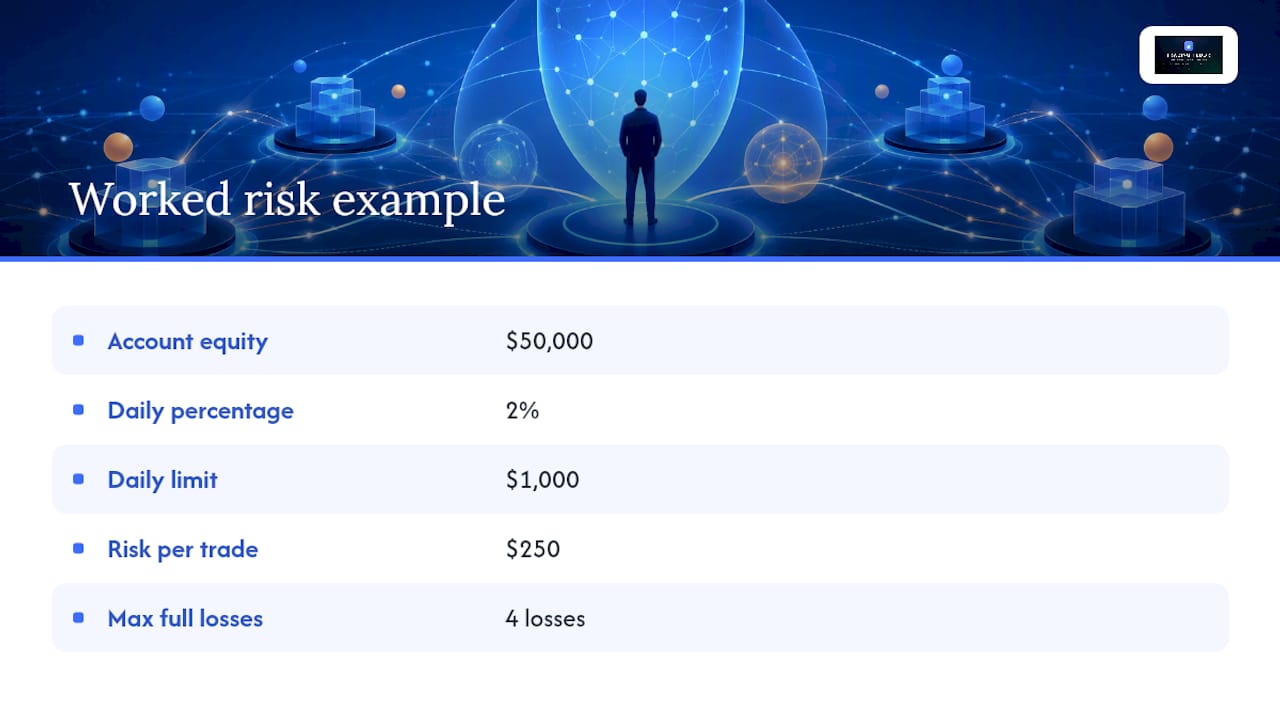
Two formulas do most of the work here. The first is straightforward: Daily Limit = Account Equity × Daily Percentage. A $50,000 account at 2% gives you a $1,000 cap. The second checks whether your position sizing actually respects that cap: Max Full Losses = Daily Limit ÷ Risk Per Trade. If your daily limit is $1,000 and each trade risks $250, you have room for four full losses before the day ends.
The part traders skip is checking that a single trade’s stop distance can’t eat the entire daily budget on one adverse move. Using Average True Range (ATR) to size your stop keeps this in check. If a stock’s 14-day ATR is $2.00 and you’re trading 100 shares, a stop placed at 1.5x ATR risks roughly $300 on that trade alone, which needs to fit comfortably inside your daily cap, not consume most of it.
Here’s how the numbers shake out across a few common account sizes at a 2% daily limit:
Keeping the per-trade risk at roughly one-quarter of the daily limit gives you enough losing trades in a row to survive a bad morning without a single stop-out ending your session prematurely. If your ATR-based stop routinely risks more than a third of your daily cap on one trade, your position size is too large for the limit you’ve set, not the other way around.
The Behavioral Side: Setting It Cold and Sticking to It Hot
The number only works if you set it when you’re calm, not mid-drawdown. Setting your daily loss limit the night before, before you’ve seen a single tick move, removes the temptation to adjust it based on how the first hour feels.
Cool-down rules matter just as much as the dollar figure itself. A common and effective one: stop trading for the rest of the session after two consecutive losses, even if you haven’t technically hit your dollar cap yet. DayTradingToolkit’s research on compliance points to mandatory cool-downs and social accountability, telling someone else when you’ve stopped, as two of the most reliable ways traders actually stick to the rule instead of rationalizing an exception.
Journal every session against the plan, not just the outcome:
- Did you set the number before market open, or during the session?
- Did you hit the limit and stop, or override it “just this once”?
- Score yourself on discipline separately from profit and loss. A green day where you ignored your own rules is a worse trading day than a red one where you followed them exactly.
Pro Tip: Revisit your limit’s size, not your commitment to it, once a month. If you’re hitting it constantly, your position sizing is too aggressive relative to your account, not your rule too strict.
Three Worked Examples You Can Adapt Today
Beginner, $5,000 account. A 1% daily limit caps losses at $50 for the day. With a per-trade risk of $12.50, that’s four full losing trades before you’re done, which is enough runway to avoid stopping out on the first bad entry while still keeping the account intact.
If the instrument’s ATR suggests a stop that risks $180 per contract, that fits safely under the cap with room for more than three losses before hitting the limit.
Prop trader, loss-from-top on a funded account. Say you start the day flat and climb to +$800 by midday. A loss-from-top rule capping the pullback at $400 from that peak locks in at least $400 of the gain even in the worst case, rather than letting a flat-from-open rule allow the entire $800 to evaporate before triggering.
- Calculate your dollar limit from account equity and chosen percentage.
- Divide that limit by your per-trade risk to confirm how many losses you can absorb.
- If trading intraday gains, decide upfront whether loss-from-top protection applies once you’re ahead.
Traders who mirror their limit to their average winning day rather than a flat percentage often find the number feels less arbitrary and gets followed more consistently.
Your Daily Loss Limit Setup Checklist
Paste this into your trading plan and fill in your own numbers before your next session.
- Set your inputs: account equity, desired daily percentage (1% to 3%), per-trade risk dollar amount, and current ATR for your instrument.
- Calculate before open: daily limit in dollars, max full losses allowed, and whether loss-from-top applies today.
- Write the number down somewhere visible, not just in your head.
- Set platform alerts at your dollar threshold and confirm any broker or prop-firm lockout rules that apply automatically.
- After a hit: close all positions immediately, log the session in your journal, and enforce a mandatory cool-down before you trade again.
| Step | Action | When |
|---|---|---|
| Calculate | Set dollar limit from equity and percentage | Night before |
| Enforce | Alerts, lockouts, accountability partner | Before market open |
| React | Close positions, stop trading | The moment limit is hit |
| Review | Journal entry, discipline score | End of day |
How Multi-Account Enforcement Changes the Equation
Enforcing one daily loss limit is manageable. Enforcing the same discipline across three or five funded accounts on different platforms during a fast market is a different problem entirely. This is where software enforcement earns its place over manual willpower.
Tradingfloor’s trade limit controls and real-time notifications let you set per-account risk parameters that mirror your net position across every funded and evaluation account you run, whether on Tradovate, TopstepX, or another supported broker. Instead of manually watching five separate P&L tickers, you get a single alert when any account approaches its cap, and drawdown protection that flags a breach before it cascades into panic trading on the others.
Software enforcement makes the most sense once you’re managing more than one account at a time, since that’s exactly where manual tracking breaks down fastest. Match the platform to how you actually trade: if you’re copying one leader’s positions across several funded accounts, real-time mirroring with individual risk controls beats trying to eyeball four terminals at once.
What I’ve Learned Watching Traders Blow Past Their Own Limits
Set the number at night, never during the session, and always include your open unrealized P&L in the calculation, not just what’s already closed. Those three habits separate traders who actually respect their limit from traders who have one written down somewhere and ignore it the moment a trade goes against them.
The mistake I see most often isn’t picking the wrong percentage. It’s tying the daily loss limit to a profit target instead of treating it as a standalone rule, so a trader who’s already up for the day quietly raises their risk tolerance because “it’s the house’s money now.” That’s backwards. The limit exists independent of how the day started. Ignoring commissions and open risk is the second most common failure, and it’s the quieter one, since it lets traders blow past their real limit without noticing until the account statement confirms it.
None of this requires perfect discipline. It requires a number, written down before you need it, and a system that doesn’t ask you to trust yourself in the moment.
— KennyTrades
Automate Enforcement Across Every Funded Account You Run
Manually tracking a daily loss limit across one account is hard enough when a trade moves fast. Across three or four funded accounts on different brokers, it’s close to impossible without something watching the numbers for you. Tradingfloor is built specifically for that gap: real-time position mirroring with per-account risk controls, so a limit breach on one account triggers a notification before it turns into a cascade across the others.
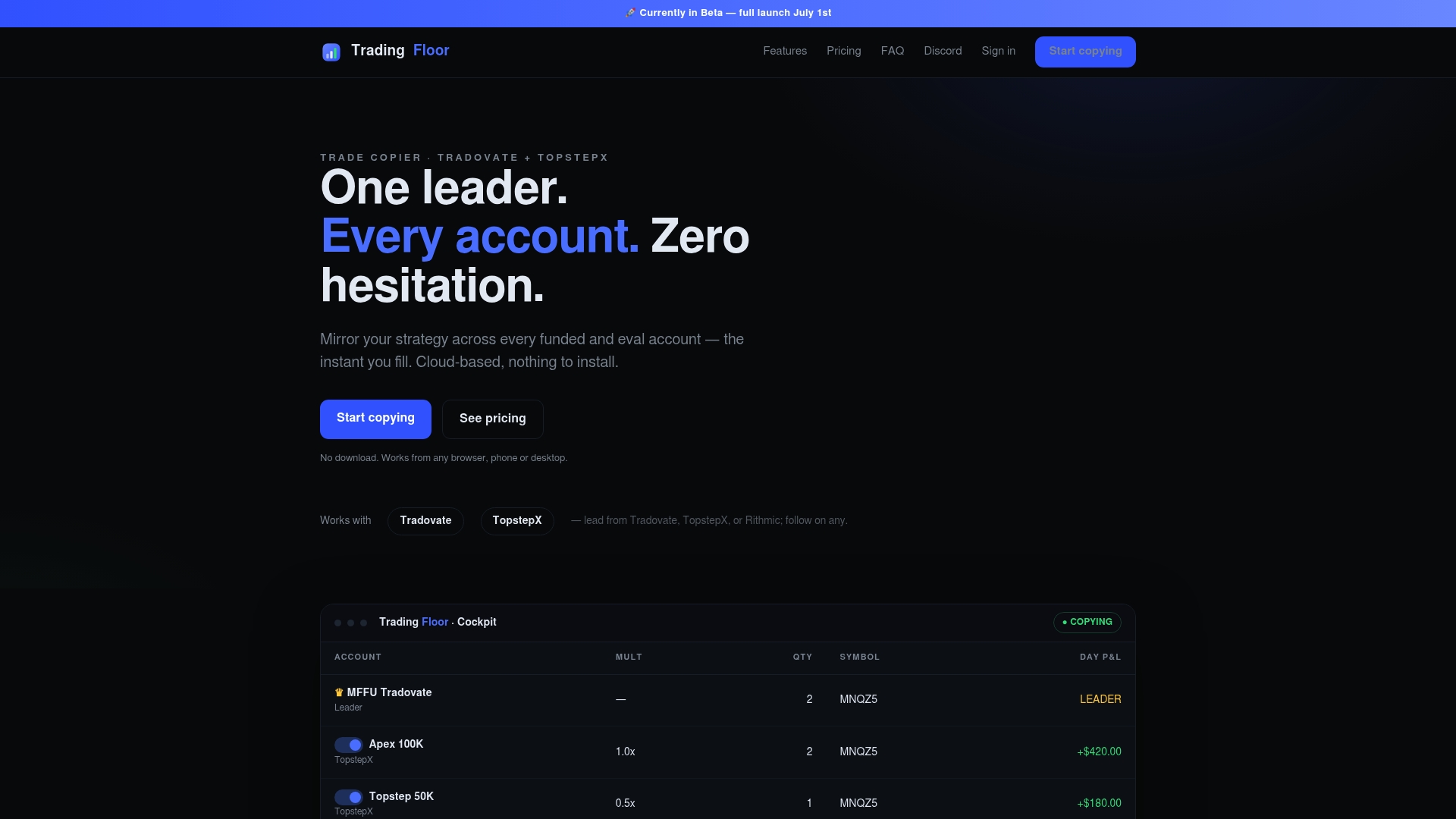
The TopstepX Trade Copier mirrors your net position across every funded and evaluation account you manage, with trade limits and drawdown protection built into the same dashboard you’re already watching. It’s cloud-based, so there’s nothing to install and no reason to juggle five separate broker tabs during a volatile open. Prop traders running multiple evaluation accounts on Tradovate or TopstepX get the most out of it, since that’s exactly where manual limit enforcement tends to fail first. Start a trial and connect your accounts before your next session opens.
Sources
- Daily Loss Limit in the Trading Combine and Express Funded Account
- Daily Loss Limit: How to Set One and Stick to It - Tradicted
- Daily Max Loss Rule for Day Trading: When to Stop Trading | DayTradingToolkit
- Daily Loss Limit in Trading — Academy | Algosys Terminal
Recommended
- Funded Account Risk Rules Explained for Prop Traders
- Prop Account Trade Limit Setup: Your 2026 Guide
- Multi-Account Discipline for Freelance Prop Traders
- Recover From a Drawdown Hit Without Losing Funded Accounts
Trading Floor mirrors every trade across your Tradovate, TopstepX & Rithmic accounts in real time, from $25/mo.
Start copying →