Prop Account Trade Limit Setup: Your 2026 Guide

Prop account trade limit setup is the process of defining daily loss caps, per-trade risk thresholds, and position size rules to protect your funded capital and stay compliant with firm requirements. Most prop firms enforce a daily loss limit of 4–5% of account size and a trailing drawdown that rises with your equity. Getting these numbers wrong does not just cost you a trade. It terminates your account. This guide covers the exact parameters to configure, the formulas to size your positions correctly, and the steps to keep limits aligned across multiple platforms.
What risk parameters does a prop account trade limit setup require?
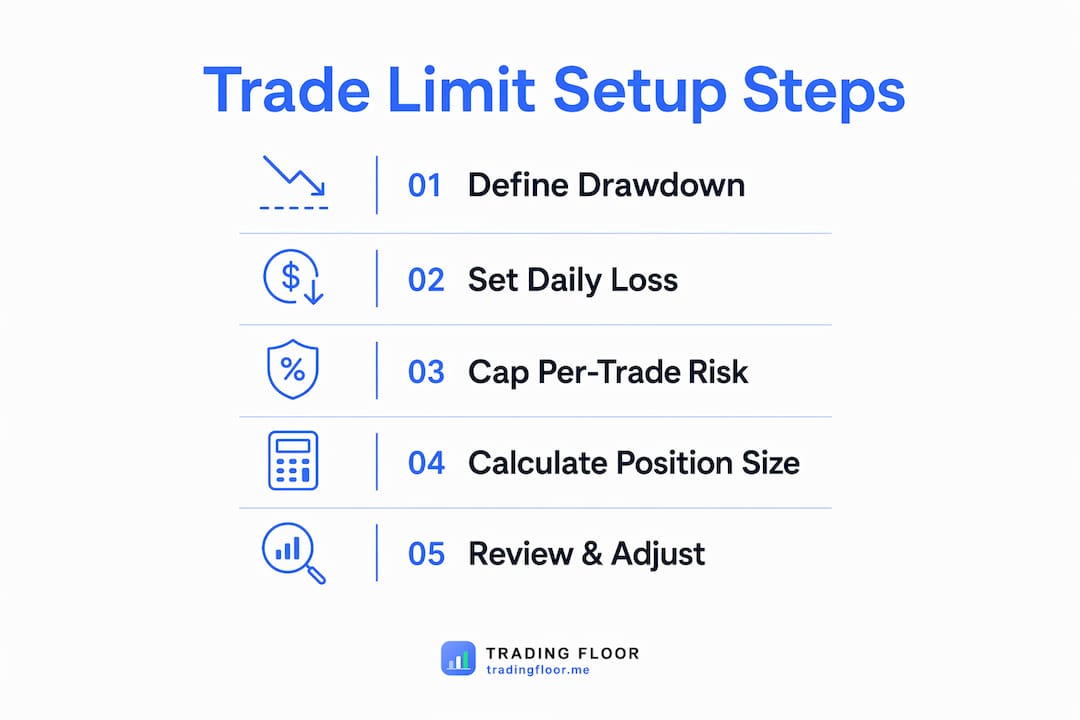
The five core parameters in any funded account risk setup are daily loss limit, per-trade risk cap, maximum open positions, trailing drawdown floor, and position size. Each one serves a different function, and misconfiguring any single one can breach your account even when your trading is profitable.
Daily loss limit is the maximum dollar amount you can lose in one trading day before the firm locks your account. Most firms set this at 4–5% of the starting account balance. On a $50,000 account, that translates to a $2,000–$2,500 daily cap.

Per-trade risk cap is the fraction of that daily limit you risk on any single trade. Cap per-trade risk at 20–33% of your daily loss limit to allow multiple setups without hitting the daily cap early. On a $500 daily limit, that means targeting $100–$120 risk per trade, which gives you at least three attempts before you approach the threshold.
Position size must be calculated from your drawdown budget, not from margin availability. Sizing from margin causes accounts to breach drawdown limits before margin is ever fully used. That is a common and costly mistake.
| Parameter | Typical range | Purpose |
|---|---|---|
| Daily loss limit | 4–5% of account balance | Caps single-day damage |
| Per-trade risk | 20–33% of daily loss limit | Allows multiple trades per day |
| Max open positions | 1–3 contracts or lots | Prevents overexposure |
| Trailing drawdown floor | Rises with equity peak | Defines absolute loss boundary |
| Internal personal buffer | 60–80% of firm limits | Absorbs slippage and errors |
Pro Tip: Set your personal daily loss limit at 60–80% of the firm’s official cap. That buffer absorbs slippage, bad fills, and execution errors before you ever touch the hard limit.
Risk per trade in prop trading runs much lower than in retail accounts. Prop risk per trade sits around 0.3–0.5% of account size, compared to the 1% standard in retail trading. A $50,000 account with a $2,500 drawdown can survive 16 consecutive losses at 0.3% risk, but only 5 losses at 1%. That difference is the margin between staying funded and starting over.
How do you calculate trade limits from drawdown and daily loss rules?
The standard formula for maximum contract sizing in a funded account is: Max contracts = (Trailing drawdown remaining × risk fraction) / (stop loss ticks × tick value). This formula ties every trade directly to your current drawdown buffer, not to your starting balance.
Here is how to apply it step by step:
- Find your current drawdown buffer. Subtract your current equity drawdown floor from your current account equity. If your floor is $47,500 and your equity is $51,000, your buffer is $3,500.
- Apply the risk fraction. The typical risk fraction is 8–12% of your remaining drawdown buffer. On a $3,500 buffer at 10%, that gives you $350 of risk available per trade.
- Determine your stop loss in ticks. If you trade ES futures with a 4-tick stop and each tick is worth $12.50, your stop loss value per contract is $50.
- Calculate max contracts. Divide $350 by $50. You can trade a maximum of 7 contracts. Most traders should stay well below that ceiling.
- Adjust for trailing vs. static drawdown. Most funded accounts use trailing drawdowns, meaning the floor rises as your equity peaks and never falls back. Recalculate your buffer every morning before the session opens.
Pro Tip: Recalculate your max contract size every single morning. Your trailing drawdown floor from yesterday may be higher than you remember, which shrinks your available buffer.
The practical implication of trailing drawdowns is significant. If you made $1,000 yesterday and your floor moved up by $1,000, your buffer is the same size as before. You did not gain more risk capacity. You just moved the floor up. Traders who ignore this end up oversizing on winning streaks and blowing accounts they thought were safe.
Set your per-trade risk to 20–33% of your daily loss limit as a separate, parallel constraint. Both the drawdown formula and the daily limit cap apply simultaneously. Whichever produces the smaller position size is the one you use.
How do you sync trade limits across multiple prop trading platforms?
Managing more than one funded account multiplies your risk exposure unless you treat each account as a separate, isolated risk unit. Each funded account needs its own dedicated risk budget, independent of the others. Running correlated trades across accounts at the same time compounds your aggregate loss if the market moves against you.
The most common mistakes traders make when managing multiple accounts include:
- Ignoring aggregate daily loss. Your combined loss across all accounts can exceed any single firm’s daily limit. Track total dollar exposure, not just per-account exposure.
- Missing platform-specific reset times. Daily loss limits reset at firm server time, often 5:00 PM ET, not at your local midnight. A trade placed at 4:45 PM ET on a firm with a 5:00 PM reset can accidentally breach the next day’s limit.
- Assuming identical rules across firms. Different firms define drawdown differently. Some use end-of-day balance, others use intraday equity peaks. Confirm the exact calculation method for each account.
- Relying on platform alerts alone. Software alerts are a backup, not a primary control. Pre-market preparation is the real defense.
Pro Tip: Build a simple spreadsheet that lists each account’s drawdown floor, current equity, daily limit, and trades taken. Update it before every session. Five minutes of preparation prevents account-ending mistakes.
Tradingfloor addresses the multi-account synchronization problem directly. The platform mirrors a leader account’s net position across funded and evaluation accounts in real time, while applying individual risk controls to each account. That means you can manage multi-platform trade limits from a single interface without manually reconciling positions across different broker dashboards.
What are the best practices for monitoring and enforcing trade limits?
Ongoing discipline separates traders who keep funded accounts from those who repeatedly restart evaluations. The process starts before the market opens, not after a loss occurs.
- Run pre-market calculations. Determine your max position size, daily loss limit, and the number of trades you can take before reaching your personal buffer. Write these numbers down.
- Set internal limits tighter than firm limits. Personal limits at 60–80% of official caps create a buffer for slippage and execution errors. This is the single most effective way to avoid accidental breaches.
- Use a risk band protocol. Assign three zones to your daily loss progress. Green means you are below 40% of your daily limit. Yellow means 40–70%. Red means above 70%. In the red zone, reduce position size or stop trading entirely.
- Track floating P&L against your drawdown floor in real time. Open positions affect your trailing drawdown floor while they are live. A large unrealized loss can move your floor before you close the trade.
- Document every trade. Record entry, exit, risk taken, and how it compared to your pre-market plan. This creates accountability and reveals patterns in how you breach your own rules.
Automated risk features in trading platforms are useful but insufficient. Trader discipline and preparation remain the primary risk defenses. Hard software limits catch what preparation misses, but they should never be your first line of defense.
Automated trade limit enforcement works best as a secondary layer. The primary control is rigorous pre-market preparation and position sizing. Software catches what discipline misses, not the other way around.
Understanding evaluation account rules for each firm you trade with is non-negotiable. Firms vary on whether they calculate drawdown from intraday highs, end-of-day balance, or a rolling window. Each variation changes your effective risk capacity, sometimes by hundreds of dollars on a single session.
Key Takeaways
Effective prop account trade limit setup requires sizing every position from your drawdown buffer, setting personal limits below firm caps, and tracking aggregate exposure across all funded accounts daily.
| Point | Details |
|---|---|
| Size from drawdown, not margin | Use the drawdown formula to calculate max contracts; margin availability is irrelevant to risk capacity. |
| Cap per-trade risk at 20–33% | Limiting each trade to 20–33% of your daily loss limit keeps you active through multiple setups. |
| Set personal limits tighter | Personal caps at 60–80% of firm limits absorb slippage and prevent accidental hard breaches. |
| Track firm reset times | Daily limits reset at firm server time, not local midnight; confirm the exact time for each account. |
| Isolate each account’s budget | Each funded account needs its own risk budget to prevent correlated trades from compounding losses. |
Why I think most traders set limits in the wrong order
Most traders I have seen set their trade limits by starting with the firm’s rules and working backward. They look at the daily loss cap, pick a position size that feels comfortable, and call it done. That approach skips the most important step: figuring out how many consecutive max-loss days your account can actually absorb before termination.
The right order is bottom-up. Start with your drawdown buffer. Decide how many losing days you can tolerate. Then size your trades so that each loss is a fraction of that buffer, not a fraction of your nominal balance. A $50,000 account with a $2,500 drawdown is not a $50,000 account for risk purposes. It is a $2,500 account. Size it accordingly.
The psychological benefit of this approach is real. When you know exactly how much you can lose before a breach, you stop making emotional decisions mid-trade. The numbers are already set. Your only job is to execute within them. Traders who skip this step end up making position size decisions in real time, under pressure, which is exactly when they make the worst choices.
Multi-account management adds another layer of complexity that most traders underestimate. Running three funded accounts without coordinating their risk budgets is not three times the opportunity. It is three times the exposure if your trades are correlated. Tradingfloor’s position mirroring with per-account risk controls solves this directly. You set the limits once and the platform enforces them across every account simultaneously.
The traders who stay funded longest are not the ones with the best entries. They are the ones who never let a single bad day end their account.
— KennyTrades
Tradingfloor makes multi-account limit management practical
Managing trade limits across multiple funded accounts gets complicated fast. Tradingfloor is built specifically for prop traders who need consistent risk enforcement without manually reconciling positions across different broker platforms.

Tradingfloor mirrors your leader account’s net position across funded and evaluation accounts in real time, with individual risk controls applied to each account. You get real-time notifications when limits are approached, and the platform runs entirely in the cloud with no installation required. Check the system status page for live uptime monitoring before every session. For traders managing multiple accounts on Tradovate or TopstepX, the pricing plans are built to scale with your account count without adding manual overhead.
FAQ
What is a prop account trade limit setup?
Prop account trade limit setup is the process of configuring daily loss caps, per-trade risk thresholds, and position size rules on a funded trading account to comply with firm rules and protect capital.
How do I calculate my max position size for a funded account?
Use the formula: Max contracts = (Trailing drawdown remaining × risk fraction) / (stop loss ticks × tick value). The typical risk fraction is 8–12% of your remaining drawdown buffer.
What is the difference between a trailing and static drawdown?
A trailing drawdown floor rises as your equity peaks and never falls back, while a static drawdown floor stays fixed at the starting level. Most funded accounts use trailing drawdowns, which shrink your risk buffer as you profit.
Why should my personal limits be lower than the firm’s limits?
Internal limits at 60–80% of firm caps create a buffer for slippage, bad fills, and execution errors that can push you past the hard limit unexpectedly.
How do daily loss limit reset times affect multi-account management?
Firm daily limits reset at server time, often 5:00 PM ET, not at local midnight. Trading near that reset window without knowing the exact time can accidentally charge a loss to the next day’s limit and cause a breach.
Recommended
- Cross-Account Trade Management: A 2026 Trader’s Guide — Trading Floor
- What Is a Master Trading Account? A 2026 Guide — Trading Floor
- Multi-Account Trade Execution Explained for Prop Traders — Trading Floor
- Funded Account Risk Rules Explained for Prop Traders — Trading Floor
Trading Floor mirrors every trade across your Tradovate, TopstepX & Rithmic accounts in real time, from $25/mo.
Start copying →