Protect Funded Accounts: Practical Per Account Risk Limits Workflow

Per-account risk limits are the specific loss thresholds you set for each individual trading account, capping how much you’ll risk on any single trade and how much the account can lose in a day before you stop. A workable starting point is risking a small percentage of account equity per trade with a modest intraday drawdown ceiling on the account itself, adjusted based on your strategy’s volatility and your program’s rules. Everything below explains why that math works and how to customize it.
TL;DR:
- Per-account risk limits should be based on a percentage of each account’s balance and adjusted for the specific product’s multiplier and stop distance.
- Most funded programs impose strict daily loss caps, tiered position size limits, and restrictions on correlated holdings to protect capital.
- Risk rules must be calibrated considering account objectives, with tighter limits for preservation accounts and looser restrictions for evaluation accounts.
- Automated platform controls like loss locks and notifications are essential to enforce risk thresholds and prevent human error during trading.
- Avoid sizing trades solely by contract count; always convert to dollar risk, especially when switching between products with different multipliers.
Table of Contents
- What Per-Account Risk Limits Are and Why They Matter
- Common Per-Account Limit Types and How to Calculate Them
- How Funded and Prop Firms Set Account Risk Limits
- How to Set Per-Account Risk Limits That Match Your Goals
- Monitoring, Automation, and Platform Risk Settings
- Common Mistakes and Advanced Tips for Multi-Account Traders
- How Trading Floor Supports Per-Account Enforcement
- Discipline Beats the Occasional Big Win
- A Trade Copier Built Around Per-Account Enforcement
- Where to Read the Primary Rules Yourself
- Sources
What Per-Account Risk Limits Are and Why They Matter
A per-account risk limit is a dollar or percentage threshold applied to one specific trading account, not your entire trading operation. If you run three funded accounts and a personal brokerage account, each one gets its own ceiling, calculated against that account’s own balance, not some blended total across everything you trade.
That distinction sounds obvious until you actually manage multiple accounts. Traders who mirror trades across several funded evaluations often size positions the same way in every account, forgetting that a $50,000 account and a $150,000 account should never take on the same dollar risk from an identical trade. Account-level limits force you to recalculate for each account’s actual balance, which is exactly the point.
The rationale is survival first, growth second. A trader who caps losses at a small percentage per trade can withstand many consecutive losing trades before a substantial portion of their account is wiped out, whereas risking a larger percentage per trade shortens that capacity significantly. Account risk management works because it removes the emotional decision from the moment you’re losing money and already thinking clearly worse than you were an hour ago.
Per-account limits sit in a hierarchy alongside two other constraints:
- Per-trade rules govern a single position: your stop-loss distance, your entry size, your maximum contracts on one ticket.
- Account-level limits govern the whole account over a period: daily loss caps, weekly drawdown ceilings, maximum open exposure at any moment.
- Exchange and broker margin requirements are external constraints set by CME Group, your futures commission merchant, or your prop firm. They exist independent of your own risk policy and will liquidate you regardless of what your personal spreadsheet says.
Confusing these three is a common failure point. Setting risk thresholds means thinking about both the single trade and the account as a whole, every time.
Common Per-Account Limit Types and How to Calculate Them
Five limit types cover most of what serious traders and funded accounts actually enforce:
- Percent-per-trade limit. The maximum percentage of account equity you’ll risk on one position, typically 0.5% to 2% for account preservation, up to 3% for aggressive growth phases.
- Daily or weekly drawdown limit (DLL). A hard stop on cumulative losses within a period, calculated from either the account’s starting balance or a trailing high-water mark depending on the program.
- Maximum position size. A cap on contracts, shares, or lots open at once, independent of dollar risk, often used to prevent oversized bets during high-conviction trades.
- Product or order-type caps. Restrictions on which instruments you can trade or how large a single order can be, common in prop firm rulebooks to prevent concentration in one volatile product.
- Notional and concentration limits. A ceiling on total exposure to correlated positions, whether that’s three E-mini contracts in different indices or several tech stocks that all move together.
Here’s the math that actually matters: converting a percentage into a dollar figure and then into a position size.
That’s $500 of dollar risk on any single trade. If you’re trading a Micro E-mini S&P 500 futures contract with a $5 multiplier per point, and your stop is 20 points away from entry, your risk per contract is $100. Divide your $500 dollar-risk budget by $100 per contract, and you can trade five contracts while staying inside your rule.
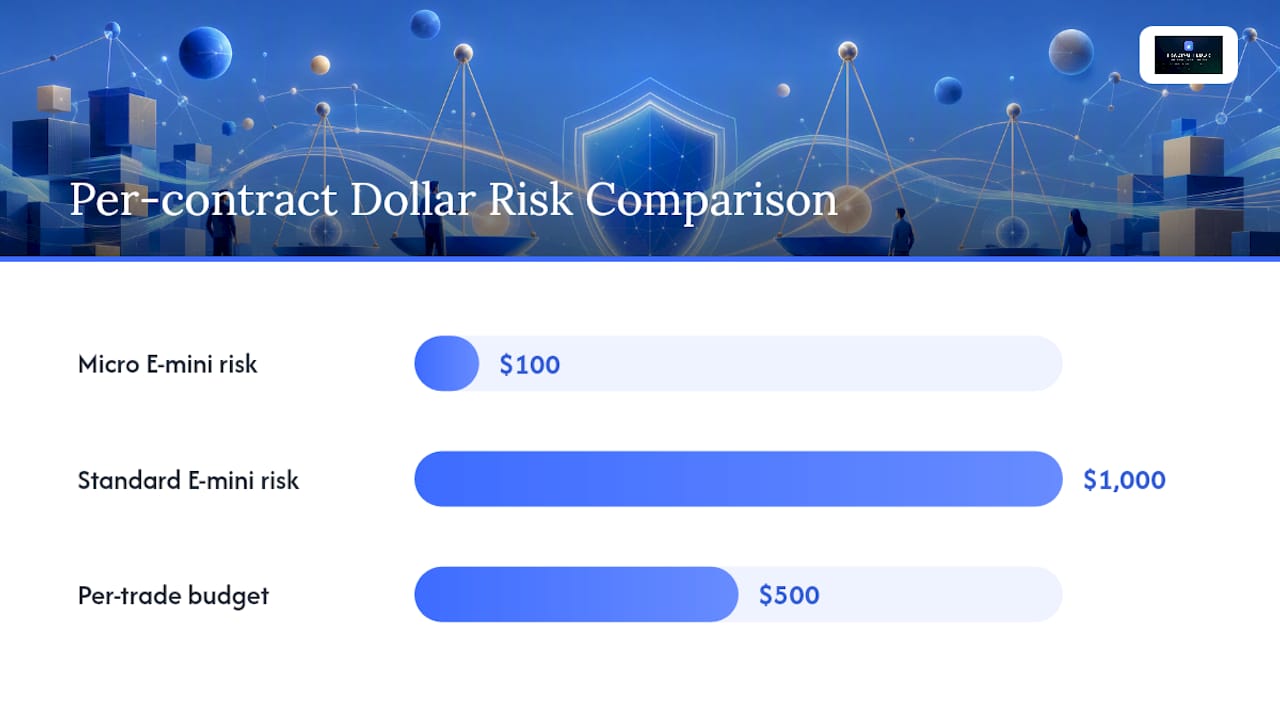
That calculation changes completely if you swap into the standard E-mini S&P, where the multiplier jumps to $50 per point. The same 20-point stop now risks $1,000 per contract, twice your entire budget on one contract alone.
The number that trips up most new futures traders isn’t the percentage. It’s the multiplier. A trader who sizes by “number of contracts” instead of dollar risk can unknowingly double or triple their intended exposure just by switching products, without ever touching their percent-per-trade rule.
This is why dollar-at-risk sizing beats raw contract counts as a practice. Volatility shifts, contract specifications differ across products, and a rule that feels consistent in your head can produce wildly inconsistent dollar exposure in practice.
How Funded and Prop Firms Set Account Risk Limits
Funded trading programs don’t leave risk limits to trader discretion, and their published rulebooks are the clearest real-world template you’ll find for structuring your own policy.
FundedNext requires traders to keep risk exposure under 3% of account value at any given time, with structured penalties triggered when that ceiling gets breached, based on the program’s own published risk limit guidelines. It reflects a balance between giving traders enough room to run a real strategy and protecting the firm’s capital from a handful of bad trades wiping out an account.
Topstep structures its limits differently, using tiered daily loss limits and maximum position sizes that scale with account balance and account state, documented in its Live Funded Account parameter tables. A trader moving from a smaller evaluation account to a larger funded one will see both numbers shift, which means a risk policy calibrated for one tier can be dangerously loose or unnecessarily tight for another.
A few things consistently count as violations across most programs:
- Realized losses combined with floating (unrealized) losses on open positions, not just closed trades.
- Breaching the daily limit intraday, even if the account recovers by end of day.
- Merged or aggregated exposure across multiple accounts under the same trader, in programs that track that.
Penalties range from a warning and account reset to full account termination, and reclassification to a lower risk tier is common on funded programs when a trader shows a pattern of near-breaches.
The practical takeaway: read your program’s actual documentation rather than relying on forum summaries, and set your personal risk rules at or below the firm’s ceiling, never at it. A daily loss limit primer aimed at funded traders makes a similar point: the gap between your personal stop and the firm’s hard stop is your margin for error on a bad execution or a slippage event, and that margin disappears fast if you’re already running at the maximum the firm allows.
How to Set Per-Account Risk Limits That Match Your Goals
Setting risk thresholds isn’t a one-size-fits-all exercise. A trader preserving capital in a live funded account needs a tighter policy than someone growing a small evaluation account where the downside is a reset, not real money. Here’s a workflow that adapts to either situation.
-
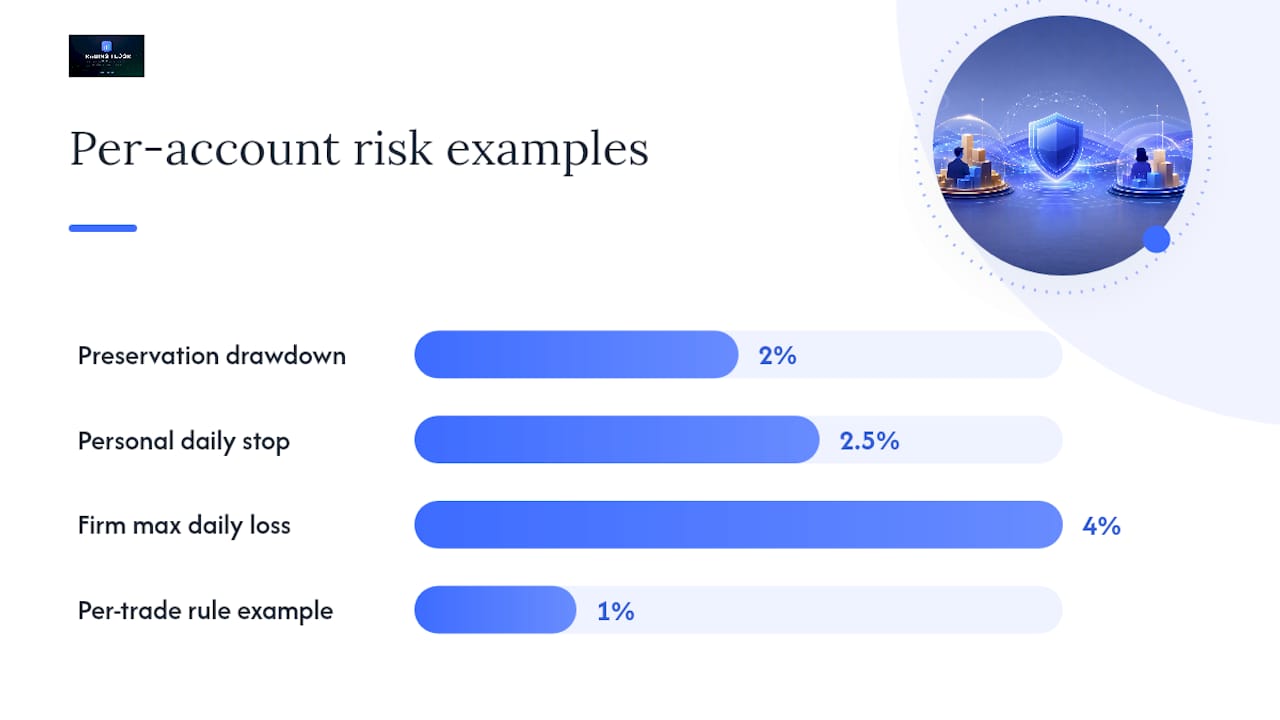
Define the account’s objective and acceptable drawdown. A preservation-focused account (your primary funded account, close to payout) might tolerate only 2% total drawdown before you scale down. An evaluation account you’re trying to pass can absorb more variance since the cost of failure is lower.
-
Set your account-level drawdown ceiling first, then your percent-per-trade rule. Work top-down. If your firm’s max daily loss is 4%, don’t set your personal daily stop at 4% too. Set it at 2% to 2.5%, leaving room for the unexpected. From there, divide that daily ceiling by the number of trades you realistically take per day to land on a sensible per-trade percentage.
-
Compute dollar risk with a simple formula. Dollar risk equals account balance multiplied by your percent-per-trade rule. A $100,000 account at 1% gives you $1,000 of risk budget per trade, full stop.
-
Convert dollar risk into contracts or shares using the instrument’s actual multiplier and your stop distance. For options, this means pricing the maximum loss on the specific spread or strategy, not just the premium paid, since assignment risk and spread width both affect true dollar exposure.
-
Layer in complementary limits beyond the percentage rule. Add a maximum position size cap so a single high-conviction trade can’t quietly exceed your dollar-risk math through leverage or added contracts. Add a product concentration check if you trade multiple correlated instruments across your accounts. Write all of it down in an actual document, not a mental note. A one-page risk policy per account, reviewed monthly, catches drift before it becomes a habit.
-
Test the policy on a demo account before applying it live, then enforce it through platform settings rather than willpower. Tradovate’s risk settings let you configure loss limits, profit targets, and trade guardrails directly on the account, which removes the moment of hesitation where discipline usually breaks down.
Pro Tip: *Calibrate your percent-per-trade rule to your strategy’s actual win rate and average loss size before locking it in, not to a round number you saw in a forum post.
The FSB’s guidance on risk appetite frameworks makes a point worth borrowing here: limits work best when they’re measurable, sensitive to the actual shape of your portfolio, and reviewed periodically rather than set once and forgotten. A rule that made sense for your strategy six months ago may not fit the volatility regime you’re trading in now.
Monitoring, Automation, and Platform Risk Settings
Setting a limit and walking away is how limits get broken. Monitoring turns a policy into an enforced habit, and four metrics deserve a daily look.
Floating P/L matters as much as realized losses, since an open position sliding against you counts toward most firms’ drawdown calculations even before you close it. Intraday utilization tells you how much of your daily loss budget you’ve already spent, ideally checked after every closed trade, not just at day’s end. Position concentration flags when several open trades across correlated instruments are effectively one big bet wearing different tickers. Margin usage shows how much cushion you have before a broker-side margin call forces a liquidation you didn’t choose.
Platform-level controls do the enforcement work that human attention tends to skip under pressure:
- Loss protection settings automatically flatten positions or lock the account once a preset dollar or percent loss hits, removing the decision entirely.
- Trade guardrails cap order size or trade frequency, useful for catching a fat-finger entry before it becomes a real problem.
- Risk locks prevent new orders once a daily limit triggers, which is the digital equivalent of someone physically taking your mouse away.
- Alerts and push notifications flag utilization thresholds (say, 70% of your daily limit used) so you get a warning before the hard stop, not after.
Tradovate documents configurable loss limits, profit targets, and risk locks as native platform features, and automation like this measurably reduces the human error that creeps into manual, multi-account operations.
Multi-account trade copiers introduce a wrinkle here. Mirroring a leader’s position across five funded accounts is efficient, but only if each account keeps its own risk settings intact rather than inheriting a single blanket size from the source account. A copier that mirrors net position while respecting each account’s individual multiplier and risk ceiling avoids the trap of one aggressive account dragging four conservative ones into the same drawdown.
Common Mistakes and Advanced Tips for Multi-Account Traders
The single most common mistake is sizing by contract count instead of dollar risk, discussed earlier in the math section. The second most common: ignoring correlation across accounts. If you’re long the same sector in three different funded accounts, a single adverse move doesn’t hit you once. It hits you three times simultaneously, and your account-by-account risk limits won’t catch that because each one, in isolation, looks fine.
Contract multipliers cause a related failure. A trader who mentally treats “one contract” as a fixed unit of risk gets blindsided switching between products with different point values, a mistake that’s invisible until the statement arrives.
A few edge cases deserve specific attention. Merged account inheritance happens when a firm combines evaluation accounts under one trader profile, sometimes carrying forward violations you didn’t expect to merge. Passive mark-to-market breaches occur when you’re not actively trading, but an open position drifts past your daily limit purely from price movement while you’re away from the screen. Intraday margin spikes, often tied to volatility events like an economic release, can force liquidations even when your own risk math said you had room.
Pro Tip: Run a simple worst-case simulation on your open positions before major news events, estimating what a two or three standard deviation move would do to your floating P/L. If that scenario would breach your daily limit, you’re carrying too much size into the event, regardless of what your stop-loss says.
Advanced traders keep a written, dated risk policy per account and a simple exposure log tallying dollar-at-risk by instrument across every account they run, catching concentrated bets that individual account limits miss entirely.
How Trading Floor Supports Per-Account Enforcement
Certain trade copier platforms apply per-account stop enforcement, per-account contract multipliers, and real-time notifications when mirroring a leader’s net position across multiple funded and evaluation accounts, allowing each account to keep its own risk ceiling intact even while trades sync across brokers. Traders wanting a full configuration walkthrough can review the step-by-step guide to setting risk controls across multiple accounts or the broader account-level risk management primer for the underlying framework.
Discipline Beats the Occasional Big Win
My rule for mirroring trades across accounts is simple: the moment any account gets within striking distance of its daily loss limit, I cut position size on that account by half, even if the setup looks perfect. It feels conservative right up until the day it saves the account. Consistent, boring risk management outperforms a hot streak almost every time, because the hot streak eventually ends and the account has to still be there when it does.
— KennyTrades
A Trade Copier Built Around Per-Account Enforcement
Mirroring one strategy across five funded accounts usually means five different balances, five different daily loss limits, and five chances for a single oversized position to violate one account’s rules while staying fine in another. Tradingfloor is built specifically for that problem: it copies a leader’s real-time net position across every funded and evaluation account you run, while keeping each account’s own multipliers, stop enforcement, and loss thresholds intact rather than applying one blanket setting everywhere.
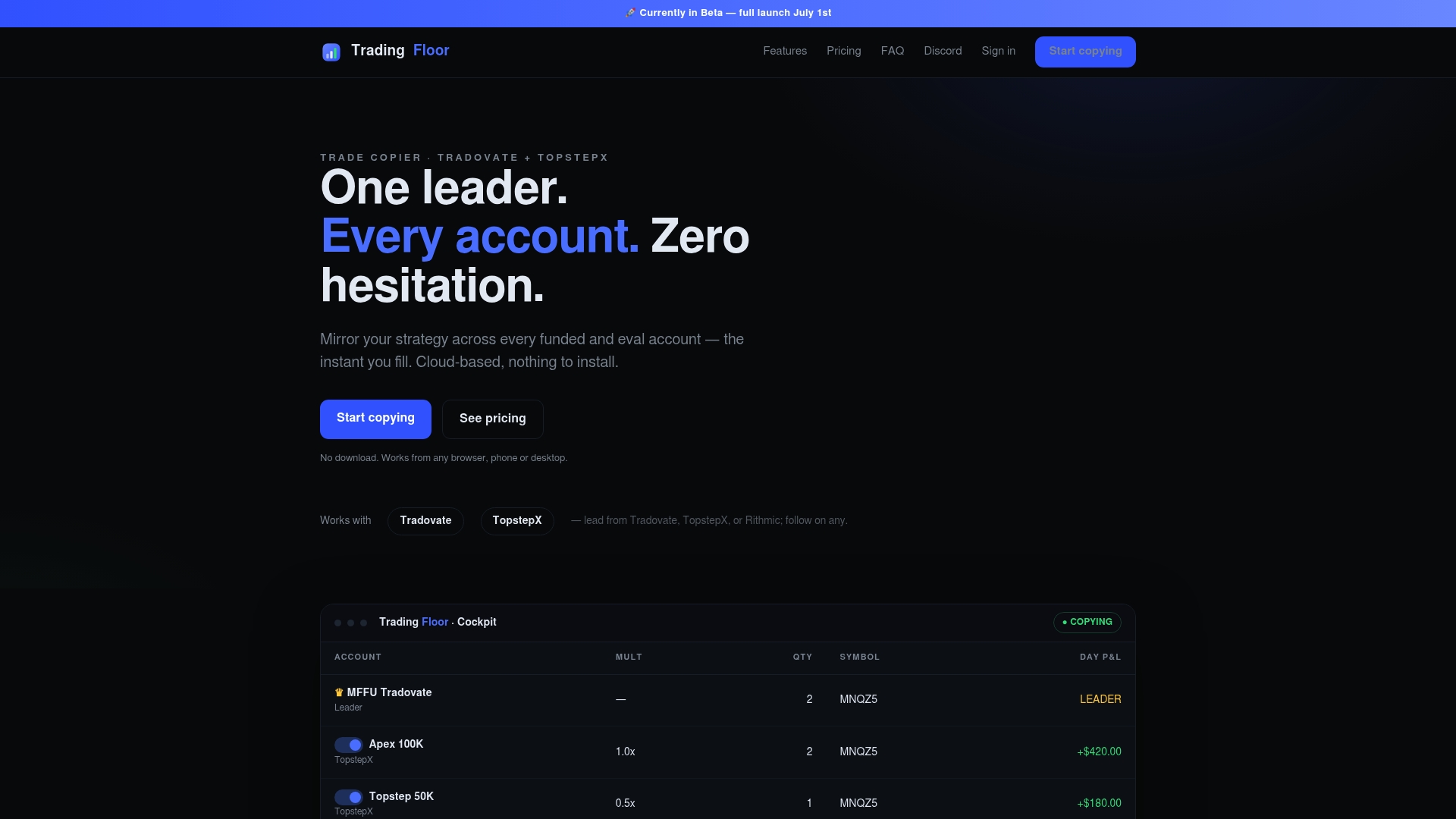
Such platforms are often cloud-based, work across devices with no installation, and integrate with popular brokers used by prop and funded traders day to day. Real-time push notifications flag limit utilization as it happens, not after the fact, and per-account slippage caps and reconciliation reduce the manual checking that eats up time when you’re running more than one account. This setup suits prop traders juggling multiple funded programs at once, and traders scaling an evaluation account toward a live payout without wanting to babysit five platforms.
If you’re managing more than one account and tired of resizing trades manually every time you mirror a position, the TradeSyncer alternative page walks through pricing starting at $25 per month and what the per-account controls look like in practice. Start there, or check the Lucid Trading Trade Copier page if you’re specifically mirroring across Lucid Trading accounts.
Where to Read the Primary Rules Yourself
Program rulebooks and regulatory guidance change, so it’s worth reading the source documents directly rather than relying on secondhand summaries. The BCBS large exposure framework sets out how regulators think about concentration limits at an institutional level, capping single-counterparty exposure at 25% of eligible capital, a principle that scales down surprisingly well to personal position sizing. The FSB’s risk appetite framework guidance covers why limits need periodic review rather than a set-and-forget approach.
For platform-specific rules, FundedNext’s risk limit documentation and Topstep’s account parameter tables are worth bookmarking directly, since both firms update these terms periodically. Tradovate’s risk settings documentation covers the platform controls referenced throughout this guide.
Sources
- FSB principles for risk appetite frameworks
- What are the Risk Limits on a FundedNext Account?
- Risk Settings - Tradovate
Recommended
- Funded Account Risk Rules Explained for Prop Traders
- How to Set Risk Controls Across Multiple Accounts
- 2% Daily Loss Limit for Funded Traders With Multi Account Enforcement
- Recover From a Drawdown Hit Without Losing Funded Accounts
Trading Floor mirrors every trade across your Tradovate, TopstepX & Rithmic accounts in real time, from $25/mo.
Start copying →