Multi-Account Discipline for Freelance Prop Traders

Treat every funded account as a completely separate risk entity, set a hard portfolio-level daily loss cut, and replicate execution across accounts rather than aggregating exposure. Those three rules, applied before you place a single trade, are what separate traders who build a durable multi-account business from those who blow several evaluations in a single bad session. The replication-not-aggregation principle is the foundational rule: each account gets its own risk envelope, its own documented rules, and its own stop. No account bails out another.
- Rule 1: Each funded account is independent. Its drawdown, daily loss limit, and position sizing are calculated in isolation, never pooled.
- Rule 2: Set a per-trade risk cap (typically 0.5%–1% of account size) and a per-account daily loss limit before the session opens.
- Rule 3: Enforce a portfolio daily stop. When aggregate P&L across all accounts hits a preset threshold, stop trading everything, not just the losing account.
Pro Tip: If you use a trade copier, configure a kill-switch or pause function before going live. One misfire on the master account should not cascade across every funded account you own.
Key Takeaways
Disciplined multi-account trading requires replication-not-aggregation, per-account risk rules, and a repeatable weekly structure enforced before the first trade of each session.
| Point | Details |
|---|---|
| Replicate, never aggregate | Size each account independently based on its own balance and risk percentage, not the portfolio total. |
| Per-account daily stop | Set a daily loss limit per account and a portfolio-level aggregate stop; enforce both before each session. |
| Cluster your copier | Use 2–3 accounts per master to cap the blast radius of any single bad trade or configuration error. |
| Weekly reconciliation | Review aggregate P&L, flag accounts within 25% of max drawdown, and update account plans every week. |
| Tradingfloor enforces your rules | Tradingfloor mirrors positions in real time with per-account limits, slippage caps, and push notifications across Tradovate and TopstepX. |
Table of Contents
- How a professional framework keeps your multi-account trading consistent
- The core truth about trading multiple funded accounts
- Why replicating execution is the first principle, not aggregating exposure
- Per-account risk controls you must implement
- How do you synchronize execution across accounts: manual vs automated?
- How Tradingfloor handles multi-account synchronization in practice
- Why most traders lose funding when they run multiple accounts
- When should you add a new funded account, and when should you scale back?
- A safe weekly operating structure for multi-account traders
- Tax, bookkeeping, and compliance basics for U.S. traders with multiple accounts
- Can you make a living trading multiple funded accounts?
- Common myths about trading multiple funded accounts
- Tradingfloor gives you the infrastructure to enforce what you already know
- Sources
How a professional framework keeps your multi-account trading consistent
Ad-hoc multi-account activity is how traders lose several funded accounts in the same week without understanding why. A professional framework turns that chaos into a structured operation. The starting point is account tiering: assign each account a business role before you fund it.
- Income/core accounts: Your most proven strategy, tightest risk rules, smallest position sizes. These generate payouts.
- Development accounts: Testing refinements to an existing edge. Slightly wider risk tolerance, but still documented.
- Experimental accounts: New strategies or markets. Treat these as R&D. Never copy experimental trades to core accounts.
Mapping accounts to roles forces you to think about strategy consistency across brokers before you open a position, not after a loss. Each account gets a one-page plan: the instrument, the setup criteria, the max daily loss, the contract cap, and the payout target. That document is the single source of truth for every decision on that account, a principle Gartner’s account management research identifies as the foundation of confident, repeatable decision-making.
Track these metrics centrally, updated at least weekly:
- Aggregate P&L across all accounts
- Per-account survival rate (how many sessions end without hitting the daily stop)
- Average drawdown per account versus its trailing drawdown limit
- Payout cadence: how often each account generates a withdrawal versus how often it resets
Pro Tip: Build a simple spreadsheet with one row per account. That visual flag is faster than reading numbers under pressure.
The core truth about trading multiple funded accounts
More accounts do not mean more diversification if you run the same edge on all of them. That is the central trap. When your strategy is correlated across every account, a bad session does not affect one account. It affects all of them simultaneously, at the same time, in the same direction.
NexusFi’s portfolio approach framework makes this explicit: correlated risk is the biggest hidden failure mode for multi-account traders. The accounts look independent on paper because they sit at different prop firms. In practice, they share the same entry logic, the same instrument, and the same behavioral tendencies. When the market moves against your setup, every account bleeds together.
Running the same strategy across ten accounts without per-account risk controls is not a multi-account operation. It is one large, undisciplined position split across ten separate failure points.
The math compounds the problem. A single bad session that would cost you $500 on one account costs $5,000 across ten. The mistakes that are survivable at small scale become account-ending at scale. This is why:
- Correlation risk must be assessed before adding any new account, not after.
- Accounts trading the same instrument on the same timeframe are correlated by definition, regardless of which firm holds them.
- A one-bad-day rule (stop all accounts after a defined aggregate loss) is the only structural protection against a cascade.
Why replicating execution is the first principle, not aggregating exposure
Replication means you execute the same trade logic on each account independently, with position sizes calculated per account. Aggregation means you treat all accounts as one pool and size accordingly. The difference sounds subtle. The consequences are not.
Each account’s sizing is derived from its own parameters.
Aggregation (not this): You have $150,000 across three accounts and size as if you have one $150,000 account, trading 3 contracts on each. Now you are running 9 contracts of correlated risk with the drawdown protection of 3 separate accounts.
PropScorer’s multi-account scenario analysis shows why per-account sizing must shrink as account count grows. The theoretical earnings scale with account count, but so do the losses. A 20-account all-in approach where sizing is not adjusted per account produces a worst-case loss that wipes the entire portfolio in a single session.
- 3-account batch: Each account risks 1% per trade. Worst-case single-session loss: 3 daily stops triggered. Total loss is bounded and recoverable.
- 20-account all-in: Sizing not adjusted per account. One bad trade triggers 20 daily stops simultaneously. Total loss is catastrophic and likely unrecoverable across all accounts.
The math forces a clear rule: as account count increases, per-account risk percentage must decrease. It means your per-account risk should drop to keep total portfolio risk at a level you can survive.
Per-account risk controls you must implement
Every funded account needs a documented risk ruleset before the first trade. These are not suggestions. Prop firms enforce some of them automatically; the rest are your responsibility.
| Risk Parameter | Definition | Recommended Setting |
|---|---|---|
| Max risk per trade | % of account balance risked on a single position | 0.5%–1% |
| Static drawdown limit | Maximum total loss from starting balance | Per firm rules (typically 10%) |
| Trailing drawdown limit | Maximum loss from account high-water mark | Per firm rules (typically 4%–6%) |
| Daily loss limit | Maximum loss allowed in a single session | 2%–3% of account balance |
| Contract/lot cap | Maximum contracts per trade | Set at 50%–75% of firm maximum |
Portfolio-level protections sit on top of per-account rules:
- Aggregate daily P&L cut: Define a dollar amount across all accounts. When total losses hit that number, stop trading for the day on every account.
- Cluster sizing: Never run more than 3–4 accounts on identical setups simultaneously. Spread entry times by at least a few minutes to reduce fill correlation.
- Kill-switch procedure: Know exactly how to pause or stop your copier within 30 seconds. Practice it before you need it.
Propfolio’s multi-account management guide identifies centralized tracking and daily reconciliation as the operational backbone for catching cross-account problems before they compound.
That early warning gives you time to reduce size or sit out, rather than reacting after the limit is already breached.*
For consistent trade sizing across accounts, document your sizing formula per account and review it every time an account’s balance changes materially.
How do you synchronize execution across accounts: manual vs automated?
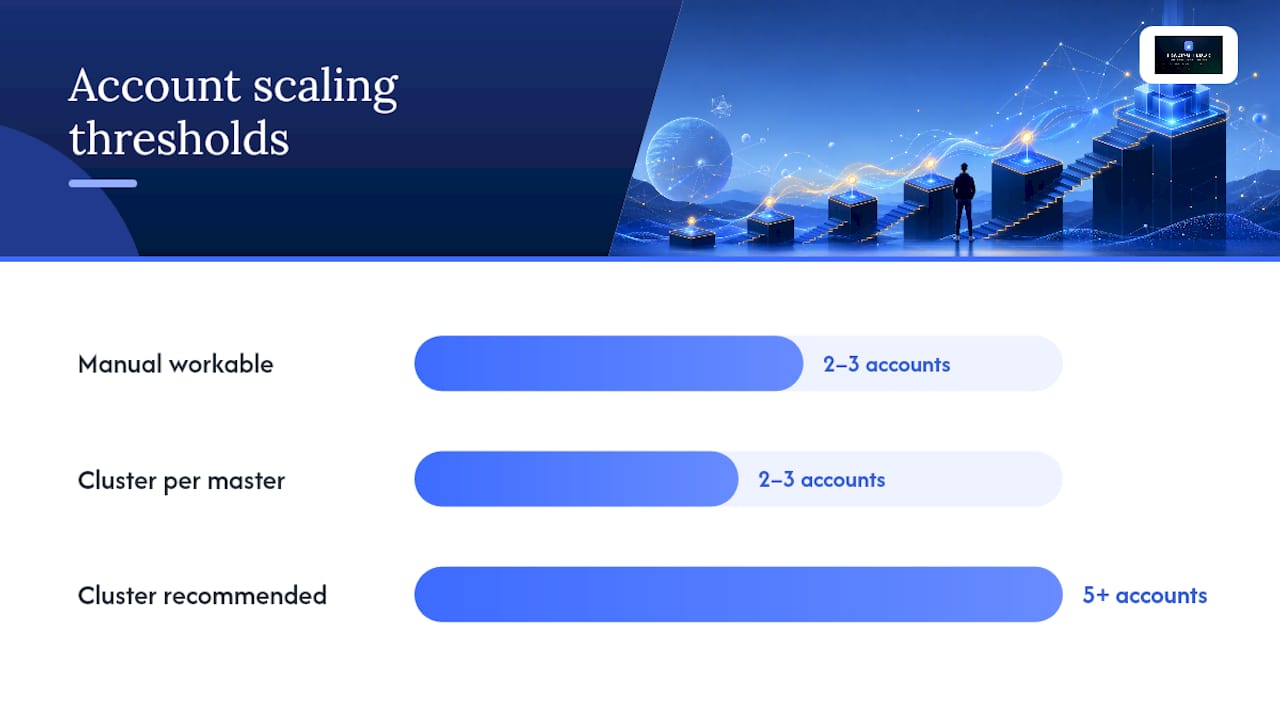
Manual replication works when you manage two or three accounts on the same platform. You enter each trade separately, confirm each fill, and log each position. At that scale, the operational overhead is manageable and the risk of a copier misconfiguration is zero.
Past three accounts, manual entry becomes a liability. Latency between entries creates inconsistent fills. You miss a stop adjustment on one account while managing another. The cognitive load of tracking multiple positions manually during a fast-moving session leads to errors that a copier would prevent.
Trade copier patterns worth knowing fall into three categories:
- Single-master: One account drives all others. Simple to configure, but one bad master trade hits every account simultaneously.
- Batch copying: A group of accounts shares a master. Limits blast radius compared to single-master-all.
- Cluster approach: 2–3 accounts per master, with independent accounts as a firewall. This is the recommended structure for traders running 5 or more funded accounts.
Synchronization callout: The cluster approach caps the maximum number of accounts affected by a single master failure. If one cluster’s master has a bad session, the other clusters continue operating independently.
Common failure modes to monitor:
- Partial fills: The master fills at a better price than the copies. Log the difference and set a maximum acceptable slippage cap per account.
- Latency: Copies execute seconds after the master. On fast-moving instruments, this creates meaningful price differences. Test latency before going live.
- Copier misconfiguration: Wrong contract multiplier, wrong account mapped to wrong master. Verify every setting after any platform update.
For multi-platform execution, keep platform differences explicit. Tradovate and TopstepX handle order types and position limits differently. A copier that works correctly on one platform may behave unexpectedly on another without platform-specific configuration.
How Tradingfloor handles multi-account synchronization in practice
Tradingfloor mirrors the master account’s net position in real time across any number of funded and evaluation accounts, including accounts on Tradovate and TopstepX. It copies positions, not just signals, which means the copy accounts reflect the master’s actual state rather than receiving an instruction to act. The distinction matters when the master partially closes a position or adjusts a stop: the copies update automatically.

Per-account risk controls are enforced at the platform level. You set contract limits, slippage caps, and daily loss thresholds per account inside Tradingfloor’s dashboard. If a copy account hits its configured limit, it stops receiving copies without affecting the master or other accounts. Push notifications alert you in real time when any account approaches or breaches a threshold.
The platform is cloud-based, so there is no software to install and no local machine that has to stay running. You can monitor and adjust from any device. Tradingfloor’s cross-account trade management guide walks through platform compatibility and per-account constraint setup in detail.
Implementation checklist for a new trader:
- Map every funded and evaluation account to a role (income, development, or experimental).
- Assign each account to a cluster of 2–3 accounts per master.
- Set contract multipliers per account based on account size and your per-account risk percentage.
- Configure slippage caps for each account and each platform.
- Set daily loss thresholds and enable push notifications for the 50% warning level.
- Test the kill-switch by pausing the copier manually before your first live session.
- Run a paper or small-size live session for at least five trading days before copying at full size.
This gives you time to catch configuration errors, latency issues, and unexpected platform behavior before they cost you a funded account.*
For traders on TopstepX specifically, Tradingfloor’s TopstepX trade copier page covers the platform-specific settings and compatibility notes.
Why most traders lose funding when they run multiple accounts
The failure modes are predictable, and they are almost always behavioral before they are operational.
Increased position size: Traders who pass multiple evaluations feel more confident and quietly increase size on each account. The per-account risk rules they documented get ignored. When the market turns, every account is oversized simultaneously.
Revenge trading: A loss on one account triggers an attempt to recover on another. The second account was not set up for that trade. Now two accounts are in drawdown for the same emotional reason.
Rule drift: The documented strategy gets bent over time. One exception becomes the new normal. By the time a trader notices, the edge has been replaced by improvisation.
Operational errors: Wrong account selected, wrong contract size entered, copier mapped to the wrong master. These errors are rare on one account and frequent across ten.
Each failure mode multiplies costs when multiple accounts are involved. A revenge trade on one account costs one daily stop. The same behavioral pattern copied across five accounts costs five daily stops in the same session.
Corrections:
- On increased size: Review your per-account sizing formula every Monday. If you changed it, document why. If you cannot document a reason, revert.
- On revenge trading: Apply the one-bad-day rule. One account hitting its daily stop is a signal to stop trading all accounts for the day, not a trigger to trade harder.
- On rule drift: Keep a one-page strategy document per account. Review it before the first trade of each week.
- On operational errors: Use a pre-market checklist (covered in the next section) and verify copier mappings after any platform update. Avoiding consistency rule violations when copying trades is a specific risk that deserves its own review step.
When should you add a new funded account, and when should you scale back?
Adding accounts before you have proven your edge is how traders fund prop firms instead of getting funded by them. The scaling criteria are straightforward, but most traders skip them.
Criteria for adding a new account:
- You have at least 60 days of documented, consistent performance on your current accounts.
- You have received at least one payout from an existing funded account.
- Your operational setup (copier, tracking, daily checklist) is running without errors.
- You have reviewed your per-account risk rules and confirmed they are still being followed.
- The new account fits an existing cluster or you have a plan for a new cluster.
PropScorer’s phase-scaling approach recommends proving your edge on 1–2 accounts first, then moving to 3–5 with a copier, and only considering 10 or more after stable payouts and clean operational history. Skipping phases is the most common reason traders end up paying for evaluations repeatedly without building a sustainable income.
Signals to scale back:
- You have breached a per-account rule more than twice in the past 30 days.
- Two or more accounts are within 25% of their maximum drawdown simultaneously.
- Monthly evaluation fees exceed your monthly payouts.
- You are making operational errors (wrong size, wrong account, missed stops) more than once per week.
Decision checklist before buying another evaluation:
- Are all current accounts profitable over the past 60 days?
- Is your copier running without errors?
- Are your evaluation fees covered by existing payouts?
- Have you documented the strategy for the new account?
If any answer is no, fix that first. Evaluation account management best practices cover the stage-based decisions that determine when an evaluation account is ready to become a funded account and when it should be abandoned.
A safe weekly operating structure for multi-account traders
Discipline without structure is just intention. A repeatable weekly routine is what converts good rules into consistent execution.
Daily pre-market checklist (before the session opens):
- Check every account’s current drawdown versus its limit. Flag any account within 25%.
- Review the economic calendar. Identify high-impact events. Decide which accounts sit out during those windows.
- Confirm copier mappings and cluster assignments are correct.
- Verify that daily loss thresholds are set and notifications are active.
- Review yesterday’s trades on any account that hit 50% of its daily loss limit.
Intraday rules:
- Single-screen focus during active trading. No switching between accounts mid-trade.
- Maximum trades per session: set a number and stick to it. More trades do not mean more edge.
- Log every trade immediately after exit, not at end of day. Memory degrades fast.
- If any account hits its daily stop, stop trading that account and do not compensate on others.
End-of-week reconciliation:
- Pull aggregate P&L across all accounts.
- Calculate each account’s survival rate for the week (sessions without hitting the daily stop).
- Identify any account within 25% of its maximum drawdown and decide whether it trades next week.
- Review the trade log for any entries that deviated from the documented strategy.
- Update the account plan for any account whose parameters changed.
Centralized journaling and reconciliation are the tools that catch cross-account patterns. If three accounts show losses at the same time on the same day, that is a system or behavioral signal, not three independent events.
Pro Tip: Schedule your weekly reconciliation for Saturday morning, not Sunday night. Saturday gives you time to research any anomalies before Monday’s session. Sunday night reviews under time pressure lead to rushed decisions.
Tax, bookkeeping, and compliance basics for U.S. traders with multiple accounts
Running multiple funded accounts creates a recordkeeping obligation that most traders underestimate until tax season.
Records to keep per account, updated at minimum monthly:
- Trade-by-trade P&L log with entry date, instrument, size, entry price, exit price, and net result
- All evaluation fees paid, with dates and amounts
- All payouts received, with dates and amounts
- Platform subscription fees and any other trading-related expenses
- Account balance at the start and end of each month
U.S. freelance traders typically report trading income as self-employment income unless they qualify for trader tax status under IRS guidelines. Trader tax status (Section 475 mark-to-market election) allows ordinary loss treatment and deduction of trading expenses, but it requires meeting specific activity and intent tests. The IRS does not automatically grant it, and the election has a filing deadline. Prop firm payouts are generally treated as ordinary income, not capital gains, because the trader does not own the capital. The Pattern Day Trader rule applies to margin accounts at U.S. broker-dealers; most prop firm funded accounts operate under different structures, but confirm the rules with each firm individually.
Practical bookkeeping steps:
- Keep a separate bank account for trading income and expenses. Mixing personal and trading finances creates reconciliation problems.
- Reconcile your trade log against your payout records every month, not once a year.
- Track evaluation fees separately from funded account fees. They are different expense categories.
The single most expensive bookkeeping mistake multi-account traders make is treating all prop firm income as identical. Payouts, evaluation refunds, and bonuses may have different tax treatments. Confirm the specifics with a CPA who works with active traders before you file.
Can you make a living trading multiple funded accounts?
The theoretical math is appealing. PropScorer’s scenario modeling illustrates it clearly: 5 accounts at $150,000 each, a typical monthly return target, and a profit split produces income potential in theory. The gap between that number and what most traders actually earn comes down to two factors: survival rate and consistency.
Headline return percentages are irrelevant if you cannot survive long enough to collect them. A trader who earns 10% in month one and blows two accounts in month two has a negative net result, regardless of the month-one number.
Realistic scenario planning:
- Conservative: 2 funded accounts, 2%–3% monthly return, 80% profit split, 70% survival rate across sessions. Monthly income is modest but sustainable.
- Moderate: 5 funded accounts, 3%–4% monthly return, 80%–90% split, consistent operational discipline. Monthly income becomes meaningful after 6–12 months of proven performance.
- Aggressive: 10+ accounts, high return targets, minimal operational infrastructure. High income ceiling, high probability of losing multiple accounts simultaneously.
Setting income targets requires accounting for evaluation fees, platform subscriptions, and the months where payouts do not arrive because accounts reset. Plan for at least three months of fees before expecting net positive cash flow from a new account. The traders who build sustainable income from multi-account setups treat it as a business with operating costs, not a lottery where more tickets mean more wins.
Common myths about trading multiple funded accounts
Myth: More accounts means less risk because losses are spread out.
Reality: If you run the same strategy on all accounts, losses are not spread. They are multiplied. Diversification requires genuinely uncorrelated strategies or instruments, not just more accounts running the same setup.
Myth: Copying all accounts to one master is the most efficient approach.
Reality: A single-master-all setup means one bad trade hits every account simultaneously. The cluster approach (2–3 accounts per master) limits the blast radius and is the operationally sound alternative.
Myth: Evaluation fees are negligible at scale.
Reality: At 10 accounts, evaluation fees become a significant monthly fixed cost. A trader paying $150–$300 per evaluation who resets two accounts per month is spending $300–$600 before a single profitable trade. At 20 accounts, that math becomes a serious drag on net income.
Myth: A good strategy does not need documented rules.
Reality: A strategy that exists only in your head degrades under pressure. The version you trade in a losing session is not the same as the version you trade in a winning one. Documentation is what keeps the strategy consistent when discipline is hardest to maintain.
The myths survive because they feel efficient. More accounts, one master, skip the paperwork. The reality is that every shortcut in multi-account management has a specific, predictable failure mode. Test the truth in your own trading by tracking how often a shortcut leads to a rule breach, and how much that breach costs across all accounts simultaneously.
What the replication-first approach actually demands from you
The conventional wisdom on multi-account trading focuses on the upside: more accounts, more income, more capital at work. That framing is not wrong, but it buries the real constraint. The limiting factor is not capital. It is operational capacity.
Most traders who blow multiple funded accounts in a single session do not fail because their strategy stopped working. They fail because they were running more accounts than their operational setup could support. The copier was misconfigured. The kill-switch was never tested. The per-account rules were documented once and never reviewed. The weekly reconciliation was skipped for three weeks because the accounts were profitable.
The replication-first approach demands something specific: you must be able to manage your worst day before you scale for your best day. That means testing the kill-switch before you need it, running at half size for the first 30 days of any new copier configuration, and treating a single account breach as a signal to review the entire portfolio, not just the account that triggered it.
Trading Floor as a synchronization tool is worth using precisely because it enforces the rules you set, not the ones you intend to set. The per-account limits, the push notifications, the cluster structure: these are not features that make trading easier. They are structural constraints that make discipline automatic when it is hardest to maintain manually.
Tradingfloor gives you the infrastructure to enforce what you already know
Managing 5 or 10 funded accounts with manual entry or a misconfigured copier is how traders pay evaluation fees indefinitely. Tradingfloor’s cloud-based position mirroring copies your master account’s net position in real time across Tradovate, TopstepX, and Rithmic accounts, with per-account contract limits, slippage caps, and daily loss thresholds enforced at the platform level.
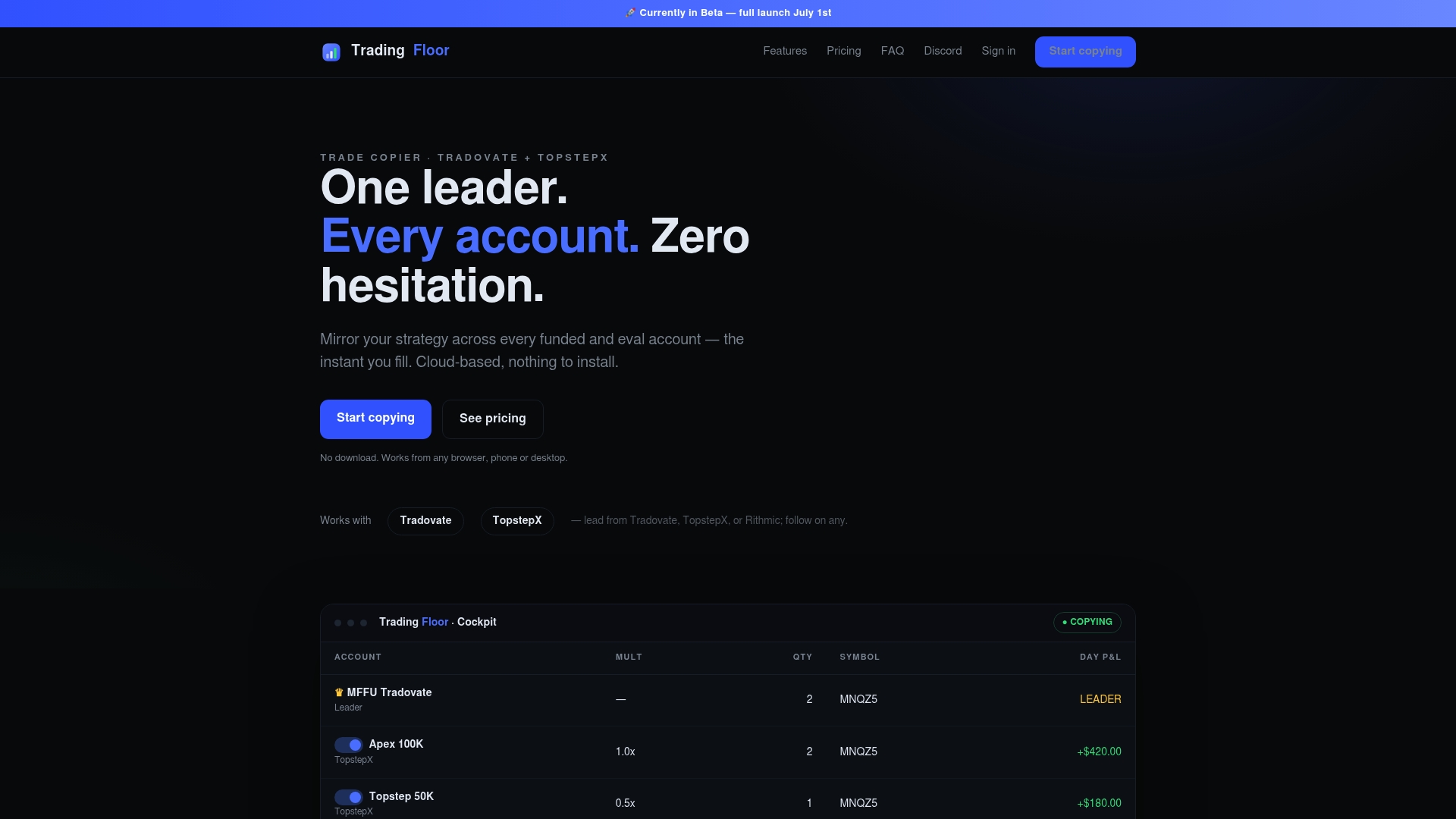
No installation. No local machine dependency. Every account’s risk parameters are set independently, so one account hitting its limit does not affect the others. Push notifications alert you before a breach, not after. The built-in trade journal and auto-reconciliation handle the recordkeeping that most traders skip until it costs them at tax time.
Start with a 30-day free trial: map your accounts, configure your clusters, set your per-account limits, and run your first live session at half size. The TradeSyncer alternative page shows exactly what Tradingfloor offers compared to other copier options, starting from $25/month after the trial. Set up your accounts today and trade your next session with the infrastructure your discipline deserves.
Sources
The following sources back the core claims in this article and are worth reading in full for deeper context:
- The Multi-Account Strategy: 1, 5, or 20 Accounts? — PropScorer Academy
- Managing Multiple Funded Accounts: The Portfolio Approach to Prop Firm Trading - NexusFi Academy
- How to Trade Multiple Funded Accounts Safely | EdgeProp Blog
- Running Multiple Prop Firm Accounts: My 20-Account Strategy
Confirm the specific rules for each funded account with the issuing prop firm before configuring any copier or synchronization tool. Firm rules on consistency, position limits, and daily loss thresholds vary and are updated periodically.
This article is general information, not financial or tax advice. Consult a qualified professional before making decisions about your trading structure or tax filing.
This article is general information, not a substitute for advice from a qualified financial advisor. Consult a qualified financial professional about your own circumstances before acting on anything here.
Recommended
- Multi-Account Trade Execution Explained for Prop Traders — Trading Floor
- Multi-Platform Trading Best Practices for Prop Traders — Trading Floor
- Consistent Trade Sizing Across Accounts: A Prop Trader’s Guide — Trading Floor
- Prop Trader Performance Optimization Explained — Trading Floor
Trading Floor mirrors every trade across your Tradovate, TopstepX & Rithmic accounts in real time, from $25/mo.
Start copying →