Funded Traders: Verify Contract Multipliers or Risk $3,000 ES Swings

A contract multiplier is the number the exchange assigns to a futures contract that turns a quoted price change into a dollar amount. It’s the single figure standing between you and knowing your real exposure. Move one point in the E-mini S&P 500 (ES) and the multiplier of $50 means you just made or lost $50 per contract, no matter what your account balance says about “buying power.”
TL;DR:
- The contract multiplier determines the dollar exposure per price movement and varies by asset class, requiring verification from the exchange’s spec sheet for each new trade.
- Multipliers like $50 for ES or 1,000 barrels for crude oil directly influence how tick values translate into real dollar amounts, impacting risk calculations.
- Confirming the multiplier involves checking the tick value and notional value against exchange specifications before trading to prevent costly errors.
- Changes in contract multipliers over time, such as the evolution from the 1982 S&P 500 to the smaller micro E-mini products, reflect traders’ demand for more precise position sizing.
- Properly understanding and verifying multipliers is essential for accurate leverage management, especially when copying trades across multiple accounts or adjusting for different asset types.
Table of Contents
- What Is a Contract Multiplier in Trading?
- Contract Multiplier Examples: ES, CL, GC, MES, and MNQ
- Common Multiplier and Tick Value Reference
- How to Verify a Contract Multiplier Before You Trade It
- How Contract Multipliers Drive Leverage and Position Risk
- Pre-Trade Multiplier Checklist
- How Trading Floor Handles Multipliers Across Multiple Accounts
- How Contract Multipliers Have Changed Over Time
- Three Heuristics for Trading Multiplier Math
- Sources
What Is a Contract Multiplier in Trading?
The multiplier is set by the exchange, not by your broker, and it’s fixed for the life of the contract specification. Every futures contract quotes a price, but that price means nothing in dollars until you multiply it by the contract’s assigned size. CME Group defines this relationship directly: notional value equals price times multiplier, and tick value equals tick size times multiplier.
Those two formulas do almost all the work in this article:
- Notional value = Price × Multiplier. This tells you the total dollar exposure one contract controls, which is almost always far larger than your margin deposit.
- Tick value = Tick size × Multiplier. This tells you what each minimum price increment is worth in cash, which is what actually moves your account balance.
Robinhood’s contract specs breakdown confirms the multiplier is exchange-defined and cites crude oil (CL) at 1,000 barrels per contract and gold (GC) at 100 troy ounces as the canonical examples. Never trust a broker’s display or a third-party data feed as the final word on a multiplier. Pull it from the exchange spec sheet every time you trade a new root.
Contract Multiplier Examples: ES, CL, GC, MES, and MNQ
Here’s how the arithmetic plays out on five contracts you’ll actually trade.
- E-mini S&P 500 (ES). Multiplier is $50 per index point, tick size is 0.25, so tick value is $12.50. A 5-point move nets $250 per contract ($50 × 5). Investopedia confirms the ES multiplier is around fifty dollars per point, with smaller multipliers for the E-mini Nasdaq-100 and E-mini Dow.
- Crude oil (CL). Multiplier is 1,000 barrels, tick size is $0.01, so tick value is $10.00. A $0.50 move equals $500 per contract.
- Gold (GC). Multiplier is 100 troy ounces, tick size is 0.10, so tick value is $10.00. A two-dollar move results in a couple hundred dollars per contract, consistent with the multiplier.
- Micro E-mini Nasdaq-100 (MNQ). Scaled to one-tenth the standard multiplier, so you’d need 10 MNQ contracts to match one standard NQ contract’s notional.
- Micro E-mini S&P 500 (MES). Multiplier is $5 per point, exactly one-tenth of ES, letting you size positions in $12.50 increments instead of $125 jumps.
Per-tick reality check: on ES, a single tick is worth $12.50. On CL and GC, it’s $10.00. Those numbers look small until you’re holding ten contracts and the market ticks against you twenty times in a minute.
Common Multiplier and Tick Value Reference
Quoting conventions differ by asset class, and that’s where traders get tripped up. Treasuries quote in 32nds of a point against a $100,000 face value, while grains quote in cents per bushel. Always confirm the current spec on the exchange before sizing a position, since these values can change.
Treasury futures (ZN, ZB) quote in fractions of face value, so their multiplier math looks different from index or energy contracts even though the underlying formula never changes.
How to Verify a Contract Multiplier Before You Trade It
Two independent checks catch nearly every multiplier error before it costs you money.
- Tick arithmetic. Rearrange the formula to multiplier = tick value ÷ tick size. If a data vendor lists ES tick value at $12.50 and tick size at 0.25, you get $50, which matches the exchange spec. If the math doesn’t reconcile, distrust the feed.
- Notional sanity check. Multiply the candidate multiplier by the current price and ask if the resulting number is plausible for that asset. A gold contract at $2,000/oz with a 100-ounce multiplier should show roughly $200,000 in notional value. If your platform shows $20,000 or $2 million, something’s wrong.
Quote-convention traps show up most often in Treasuries and grains, where face-value and cents-based quoting can silently distort a multiplier calculation.
Pro Tip: Run the tick arithmetic check every time you add a new root to your watchlist, not just once when you first learn a symbol. Exchanges do occasionally revise specs, and a stale assumption is how six-figure notional errors happen.

How Contract Multipliers Drive Leverage and Position Risk
Your posted margin and your actual notional exposure are two completely different numbers, and the multiplier is what separates them. A $50 ES multiplier means one contract can control over $250,000 in notional value at typical index levels, while your margin requirement might be a fraction of that.
That gap is where leverage actually lives, and experts consistently point to notional exposure, not margin, as the real risk gauge professionals track.
- A 1% move on ES (roughly 60 points at current levels) nets $3,000 per contract ($50 × 60).
- The same 1% move on CL, depending on price, might swing $500 to $700 per contract because the multiplier and typical price level differ.
- Two traders risking “1% of the underlying” on different roots can end up with wildly different dollar risk if they don’t run the multiplier math first.
Practical sizing works backward from dollar risk: decide how much you’re willing to lose on the trade, divide by the tick value times your stop distance in ticks, and that gives you contract count. Skip the multiplier step and you’re sizing blind.
Pre-Trade Multiplier Checklist
Run through this before every new position, especially on a symbol you haven’t traded recently.
- Confirm the exact symbol and front-month contract, since multipliers can differ across contract months on some products.
- Verify the multiplier and tick size against the current exchange spec sheet, not a cached broker value.
- Calculate tick value and total notional for your intended position size before entering the order.
- Decide whether a micro contract substitution changes your margin requirement or commission cost meaningfully.
- Check for display factor differences between your broker’s platform and the raw exchange quote.
How Trading Floor Handles Multipliers Across Multiple Accounts
Copying trades across several funded and evaluation accounts multiplies the multiplier problem. Get one root’s multiplier wrong and you’ve scaled an error across every mirrored account simultaneously.
Trading Floor stores a per-root multiplier setting and uses it to calculate per-account notional and tick value before mirroring a leader’s position onto follower accounts on platforms like Tradovate and TopstepX.
- Per-account risk limits cap exposure independently, even when the same signal fires across ten accounts at once.
- Slippage caps and real-time notifications flag fills that deviate from expected tick value.
- Auto-reconciliation checks that mirrored positions match the leader’s net position after multiplier-adjusted sizing.
The multiplier setup and configuration guide walks through storing these values correctly, and the multi-account execution breakdown covers how mirrored sizing interacts with each account’s own risk settings.
How Contract Multipliers Have Changed Over Time
Contract multipliers aren’t set in stone. The original S&P 500 futures contract launched in 1982 with a $500 multiplier, five times the size of today’s ES. When that proved too large for many retail-scale traders, the exchange introduced the E-mini S&P 500 in 1997 at one-fifth the size, with the $50 multiplier that’s now standard.
The same pattern repeated with Micro E-mini products launched in 2019, cutting E-mini multipliers by another factor of ten. MES and MNQ exist because exchanges kept hearing the same complaint: full-size contracts were too coarse for precise risk sizing, especially for traders working smaller accounts or fine-tuning exposure around volatile events.
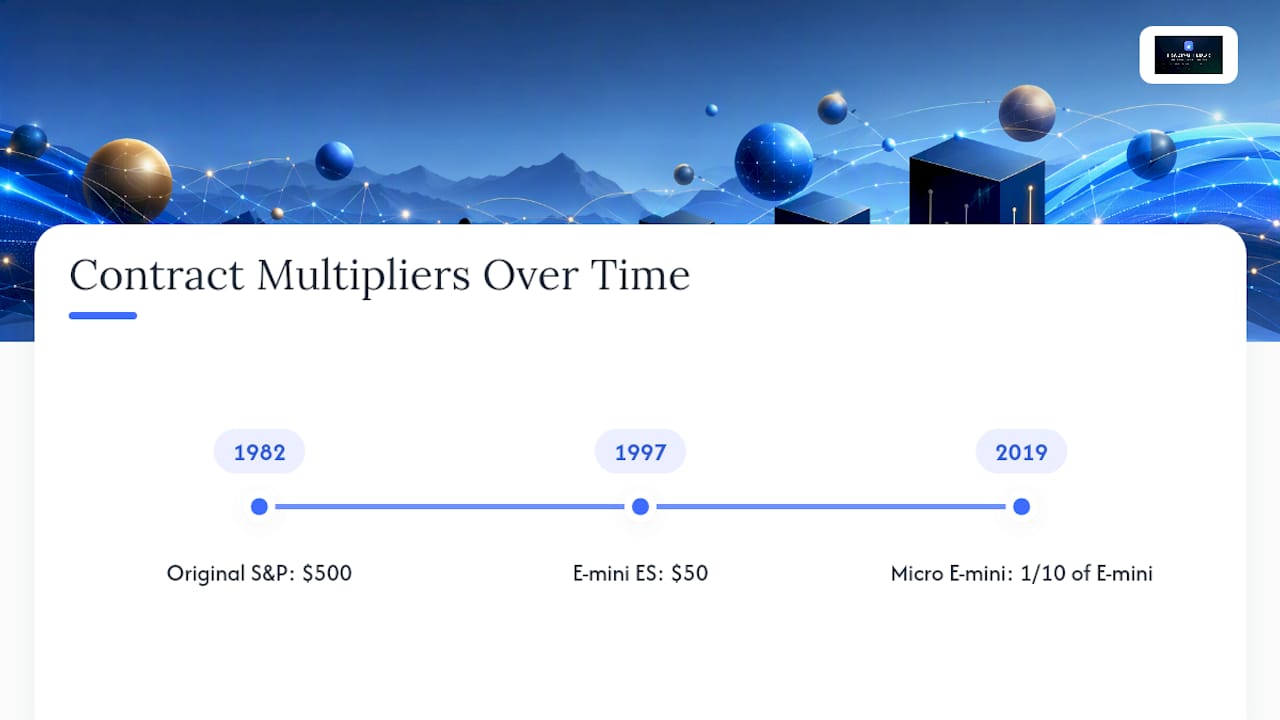
This history matters for a practical reason: it shows multipliers respond to market structure and trader demand, not fixed physics. A contract that feels standard today (ES at $50) was itself a scaled-down version of something larger. Exchanges will likely keep introducing smaller-denomination products as retail futures participation grows, and legacy traders sometimes still quote position sizes in “old” contract terms out of habit, which can create confusion when talking across generations of traders. Always confirm which version of a contract someone means, especially in older trading literature or forum posts that predate the E-mini or Micro launches.
The practical lesson: never assume a multiplier from memory, even for a contract you’ve traded for years. Spec changes happen, and the exchange is always the final word.
Three Heuristics for Trading Multiplier Math
Every multiplier error I’ve seen traces back to skipping the arithmetic and trusting a display number instead. Verify tick value numerically, every single time, before you size anything.
Size from dollar risk backward into contracts, never forward from contracts into whatever risk shows up. And if you’re copying trades across multiple accounts, automate the multiplier check. Manual scaling across accounts is where errors compound fastest.
— KennyTrades
Sources
Don’t take any single explainer’s word for a multiplier value. Cross-reference CME Group’s contract specs education directly against the exchange’s live spec sheets. Investopedia’s futures overview and Robinhood’s contract specs guide both offer solid plain-language explanations, and the quote-convention breakdown from FlashAlpha covers the traps that catch even experienced traders off guard. For the broader leverage mechanics behind multiplier-driven notional exposure, this leverage explainer breaks down the margin-versus-leverage distinction clearly.
If you’re managing multiplier settings across multiple funded accounts, the Take Profit Trader Trade Copier applies per-root multiplier data automatically so every mirrored position calculates the correct tick value and notional exposure without manual recalculation on each account.
- What are futures contract specs? — Robinhood Learn
- Introduction to futures: about contract notional value — CME Group
- What do S&P 500, Dow and Nasdaq futures contracts represent? — Investopedia
- CME futures contract multipliers: the quote conventions that break notional math — FlashAlpha
Recommended
- Funded Account Risk Rules Explained for Prop Traders
- Contract Multipliers Setup: Formulas and Verification Steps
- Evaluation Account Management Best Practices for Prop Traders
- Prop Trading Leader Accounts: What Funded Traders Need to Know
Trading Floor mirrors every trade across your Tradovate, TopstepX & Rithmic accounts in real time, from $25/mo.
Start copying →