Why Traders Use Account Mirroring to Scale Fast

Account mirroring is defined as the automatic replication of trades from a master account to one or more follower accounts in real time. Traders use account mirroring to eliminate manual execution errors, synchronize strategies across multiple funded accounts, and manage aggregate risk from a single terminal. The technique is especially critical for prop traders running evaluation and funded accounts simultaneously on platforms like Tradovate and TopstepX. Where manual execution across ten accounts can take nearly a minute, automated mirroring completes the same task within milliseconds. That speed difference is not a convenience. It is the difference between a filled order and a missed trade.
Why traders use account mirroring: the core case
Account mirroring solves a problem that grows with every account you add. Each additional account multiplies the chance of a missed entry, a wrong lot size, or a forgotten stop loss. Mirroring removes that risk by treating every follower account as an automatic extension of the master.
The structure is straightforward. You execute one trade on the master account. The mirroring software reads that position and replicates it across every linked follower account within milliseconds. Stop losses, profit targets, and order types copy over automatically. You never touch the follower accounts manually.

This matters most for prop traders, who face firm-specific drawdown limits and rule sets on every account. Centralized execution enables portfolio management of $500,000 to $1,000,000 or more from one master terminal. That scale would be unmanageable without automation.
Tradingfloor mirrors the leader’s net position, not just entry signals. That distinction matters because net position mirroring accounts for partial fills, scale-ins, and position adjustments in real time. Signal-based systems can lag or misfire when the master account’s position changes mid-trade.
How does account mirroring work technically?
The master-follower architecture is the foundation of every mirroring system. The master account is where you trade. Follower accounts receive and replicate every action the master takes, including entries, exits, stop adjustments, and partial closes.
The speed of that replication depends on infrastructure. Cloud-based mirroring software and VPS hosting maintain 24/7 synchronization and prevent liquidity gaps during high-impact news events. A home internet setup can fail if the connection drops for even three seconds during a volatile market move, creating dangerous trade mismatches between master and follower accounts.
Server geography is a factor most traders underestimate. VPS proximity to broker servers in cities like London or New York is critical for avoiding price slippage during fast markets. A VPS in the same data center as your broker can cut execution latency to under 10 milliseconds. A home setup routed across multiple hops can add hundreds of milliseconds of delay.
Key technical components of a well-built mirroring setup include:
- Master account terminal: The single point where all trading decisions originate.
- Mirroring software or cloud platform: Reads master positions and pushes copies to follower accounts.
- VPS hosting near broker servers: Reduces latency and keeps the system running 24/7.
- Per-account risk controls: Lets you set individual trade limits, lot size multipliers, and drawdown caps on each follower.
- Order retry logic: Automatically retries rejected orders so no follower account misses a fill.
Pro Tip: Run a test trade on your master account before going live. Verify that every follower account receives the correct lot size, stop loss, and profit target before you risk real capital.
What are the main benefits of trading account mirroring?
The most direct benefit is the elimination of “fat-finger” errors. Manual entry across multiple accounts creates constant opportunity for wrong lot sizes, missed stops, and duplicate orders. Automated trade copying removes that mental strain by centralizing focus on the master account alone.
Risk synchronization is the second major advantage. Every follower account mirrors the same stop loss and profit target as the master. That means your risk-to-reward ratio stays consistent across the entire portfolio, not just on the account you happen to be watching. Account mirroring automates stop-loss and profit target placement while keeping all accounts compliant with firm-specific rules.
The psychological benefit is underrated. Treating all multi-account equity as a single bankroll is the key to emotional detachment and disciplined risk management. Traders who monitor aggregate drawdown instead of individual account balances avoid panic decisions during volatility. You stop reacting to one account being down and start managing the portfolio as a whole.
Core account mirroring benefits at a glance:
- Error reduction: No manual re-entry means no missed stops or wrong lot sizes.
- Strategy consistency: Every account runs the exact same trade at the same time.
- Scalability: Add more follower accounts without adding more screen time.
- Compliance support: Firm rules apply uniformly across all accounts through centralized controls.
- Mental clarity: One terminal, one focus, one decision per trade.
How does account mirroring differ from copy trading?
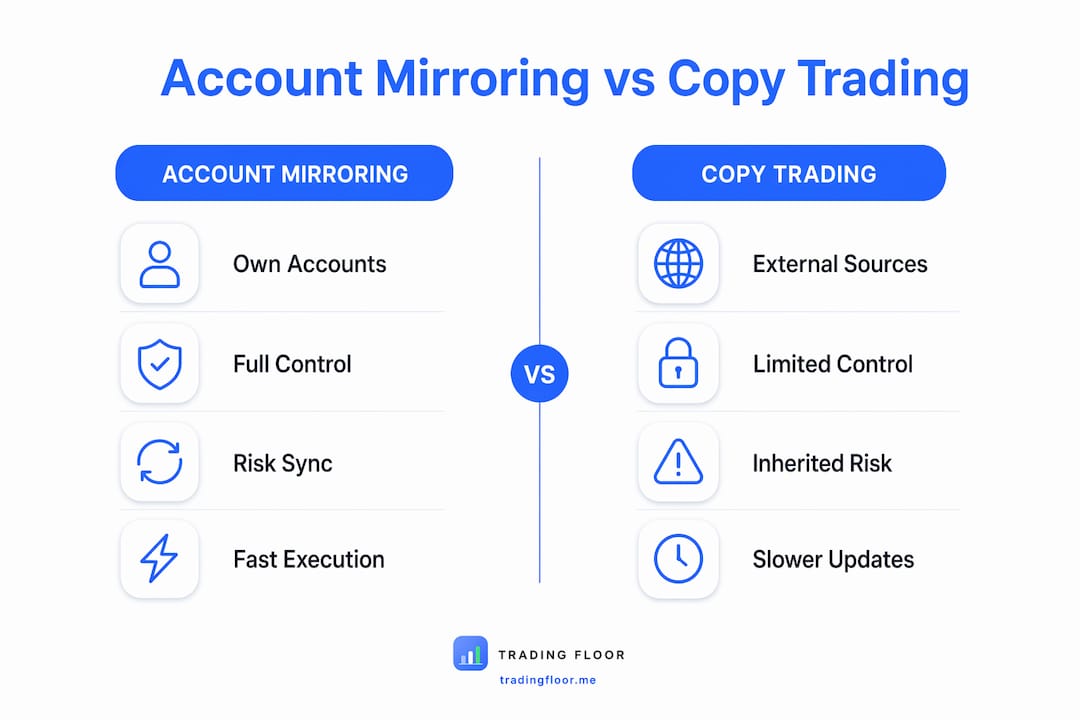
The terminology confusion between mirroring and copy trading costs traders real money. Mirror trading is internal synchronization of accounts you own, while copy trading refers to following external traders or signals from other people. The distinction affects control, risk, and compliance in ways that matter to prop traders.
With account mirroring, you control every variable. You set the lot size multiplier, the risk per trade, and the drawdown cap on each follower account. The strategy is yours. The execution is yours. No external party has any influence over your positions.
Copy trading introduces a layer of dependency. You follow someone else’s signals, which means you inherit their risk tolerance, their timing, and their potential mistakes. For retail investors exploring new strategies, that social element can be useful. For prop traders managing funded accounts under strict firm rules, it creates compliance risk.
The table below shows where each approach fits:
| Feature | Account mirroring | Copy trading |
|---|---|---|
| Account ownership | All accounts owned by one trader | Follower copies external trader |
| Strategy control | Full control over every parameter | Dependent on signal provider |
| Risk customization | Per-account multipliers and caps | Limited by provider’s settings |
| Prop firm compliance | Designed for internal multi-account use | Typically not permitted by prop firms |
| Transparency | Complete, since you are the source | Varies by platform and provider |
Prop firms generally prohibit copy trading from external sources because it violates the principle that the trader is executing their own strategy. Account mirroring, by contrast, is internal. You are the leader. You are also every follower. That distinction keeps you compliant. Tradingfloor is built specifically for this internal model, copying trades across prop firm accounts while keeping each account’s risk controls independent.
What best practices make account mirroring work reliably?
Setup quality determines whether mirroring helps or hurts you. A poorly configured system with wrong multipliers or a slow VPS can create worse outcomes than manual trading. Follow these steps to build a reliable setup.
-
Test with a small trade first. Before going live, place a minimal position on the master account and confirm every follower receives the correct lot size, stop loss, and profit target. This catches scaling errors before they cost you.
-
Set proportional lot size multipliers. A $50,000 account and a $100,000 account should not receive the same lot size. Expert traders scale position sizes based on each account’s balance to maintain proportional risk. Applying a static multiplier across accounts of different sizes is the most common and costly mistake in mirroring setups.
-
Use a VPS close to your broker’s servers. Latency is not just about internet speed. Server geography determines how fast your orders reach the broker. Place your VPS in the same city as your broker’s matching engine.
-
Monitor aggregate drawdown, not individual accounts. Set your risk limits based on the total portfolio, not account by account. This prevents you from cutting a trade early on one account while letting it run on another.
-
Enable order retry logic. Advanced trade copiers support automatic retries for rejected orders, proportional sizing, and real-time synchronization. Without retry logic, a rejected order on one follower account creates a position mismatch that compounds over time.
-
Review and update your setup regularly. Broker API changes, platform updates, and firm rule changes can break a mirroring configuration silently. Schedule a monthly check of every follower account’s settings.
Pro Tip: Treat your mirroring system as a trading tool that needs maintenance, not a set-and-forget solution. A misconfigured multiplier on one account can wipe a week of gains across your entire portfolio.
For traders running the same strategy across multiple brokers, consistent configuration across platforms is non-negotiable.
Key Takeaways
Account mirroring is the most reliable method for traders to maintain strategy consistency, reduce execution errors, and manage proportional risk across multiple funded accounts simultaneously.
| Point | Details |
|---|---|
| Speed advantage | Automated mirroring replicates trades in milliseconds versus nearly a minute for manual execution. |
| Risk synchronization | Stop losses and profit targets copy automatically, keeping all accounts at the same risk level. |
| Mirroring vs. copy trading | Mirroring is internal and fully controlled; copy trading follows external signals and risks prop firm violations. |
| Static multiplier trap | Always scale lot sizes to each account’s balance. Identical sizes across different accounts create uneven risk. |
| VPS placement matters | A VPS near your broker’s servers cuts latency and prevents slippage during volatile market conditions. |
The mental shift that makes mirroring actually work
Most traders set up account mirroring and then keep watching each account individually. That defeats the purpose. The real power of mirroring comes when you stop thinking in accounts and start thinking in portfolio.
I made that mistake early on. I had four accounts mirrored correctly, but I was still checking each one after every trade. When one account hit a drawdown, I would second-guess the master trade. That emotional noise is exactly what mirroring is supposed to eliminate. The moment I switched to monitoring only the aggregate equity curve, my decision-making got cleaner.
The other thing traders miss is that mirroring is only as good as the infrastructure behind it. I have seen traders run a solid strategy and still blow accounts because their VPS was in the wrong city or their software had no retry logic. The technology is not optional. A cloud-based platform with 24/7 uptime and real-time notifications is not a luxury. It is the baseline for running multiple funded accounts professionally.
Prop firm compliance is where mirroring gets complicated. Every firm has different rules on position limits, drawdown calculations, and trade timing. Your mirroring software needs to respect those rules per account, not just globally. That means per-account trade limits and individual risk caps are non-negotiable features, not nice-to-haves. If your platform does not support that level of granularity, you are one bad trade away from a violation.
The traders who get the most from mirroring treat the copier as a professional tool. They test it, maintain it, and update it. They do not assume it works. They verify it works, every time.
— KennyTrades
Tradingfloor: built for multi-account trade management
Managing multiple funded accounts without the right infrastructure is a liability, not a strategy. Tradingfloor mirrors the leader’s net position across funded and evaluation accounts in real time, with individual risk controls on every follower account.
The platform runs in the cloud, so there is no software to install and no dependency on a single machine. Real-time notifications and trade limit controls keep you compliant with prop firm rules on platforms like Tradovate and TopstepX. You can check Tradingfloor’s live system status at any time to confirm uptime before a major trading session. For traders ready to scale, Tradingfloor’s pricing plans are built around the number of accounts you run, not arbitrary feature tiers.
FAQ
What is account mirroring in trading?
Account mirroring is the automatic replication of trades from a master account to one or more follower accounts in real time. It copies entries, exits, stop losses, and profit targets without manual input.
Why do prop traders use account mirroring instead of trading each account manually?
Manual execution across multiple accounts takes nearly a minute and creates constant risk of errors. Automated mirroring completes the same replication in milliseconds and keeps every account synchronized with the master.
Is account mirroring allowed by prop firms?
Account mirroring of your own accounts is generally permitted because you remain the trader executing the strategy. Copy trading from external signal providers is typically prohibited by prop firms as it violates their requirement that you trade your own strategy.
What is the static multiplier trap in account mirroring?
The static multiplier trap occurs when a trader applies the same lot size to accounts of different sizes, creating uneven risk exposure. The fix is to use proportional scaling so each account’s position size reflects its actual balance.
How does Tradingfloor differ from standard trade copier software?
Tradingfloor mirrors the leader’s net position rather than just entry signals, which accounts for partial fills and mid-trade adjustments. It runs in the cloud with per-account risk controls, making it purpose-built for prop traders managing multiple funded accounts.
Recommended
- What Tools Let You Mirror Trades from One Tradovate Account to Several Others? — Trading Floor
- Multi-Account Trade Execution Explained for Prop Traders — Trading Floor
- Multi-Platform Trading Best Practices for Prop Traders — Trading Floor
- Trade the Same Strategy Across Multiple Brokers — Trading Floor
Trading Floor mirrors every trade across your Tradovate, TopstepX & Rithmic accounts in real time, from $25/mo.
Start copying →