Multi Account Copiers Synced Through Contract Rolls for Prop Traders

Contract rollover copying means keeping every mirrored account pointed at the same live contract as expiry approaches, so no follower gets stuck holding an illiquid front month while the leader has already moved on. The rule that prevents almost every copy failure: map symbols to the contract with the active open interest and volume, not just to a date on a calendar. Check your mapping and size-conversion settings now, before the next roll window hits.
TL;DR:
- Rollover timing varies by product, with equity index futures typically migrating liquidity in the two weeks before the third Friday of the expiry month.
- Check exchange-specific calendars and monitor open interest and volume to confirm actual market shifts rather than relying solely on fixed calendar dates.
- Platforms may automatically remap contracts based on date schedules or volume thresholds, but mismatches can cause order rejections and liquidity issues if not configured correctly.
- Running pre- and post-roll checks, including symbol mapping, size conversions, and order reconciliation, prevents exposure mistakes during contract transitions.
- Automating follower order submission timing and keeping a live roll calendar significantly reduces manual babysitting and increases copy reliability during roll windows.
Table of Contents
- What Is Contract Rollover Copying and Why Does It Matter?
- When Do Futures Contracts Roll? Timing and Calendar Rules
- How Do Platforms Handle Rollovers Differently?
- A Step-by-Step Checklist for Rollover-Proof Copying
- Symbol Mapping and Continuous Contracts, Explained for Builders
- How Trading Floor Handles Rollover Copying
- What Traders Get Wrong About Rollovers
- Get Rollover Copying Right Without Babysitting Every Account
- Where to Verify Roll Dates and Technical Details
- Sources
- FAQ
What Is Contract Rollover Copying and Why Does It Matter?
A futures rollover happens when a trader closes (or offsets) a position in the expiring front-month contract and opens an equivalent position in the next active contract, usually to keep exposure alive rather than take physical delivery or cash settlement. That single event is where copy systems most often break.
A copied position can desync in a few predictable ways:
- The leader’s platform auto-rolls into a new symbol, but the follower account is still mapped to the expired one.
- Liquidity drains out of the front month gradually, so fills on the old contract get worse right as the copier tries to execute.
- Contract multipliers differ between full-size and micro versions, so a straight one-to-one copy produces the wrong notional exposure.
The decision to roll instead of let a contract expire almost always comes down to wanting continuous market exposure. Copiers that don’t account for that distinction end up either duplicating a delivery event nobody wanted or silently dropping exposure at the worst possible moment.
When Do Futures Contracts Roll? Timing and Calendar Rules
Equity index futures typically roll in the two weeks before the third Friday of the contract month, which is when CME Group’s own roll date calendar shows open interest migrating from the nearby contract into the deferred one. That’s a general pattern, not a universal rule. Some products, particularly certain FX futures, roll on a monthly cadence instead of quarterly, and grain or energy contracts often follow entirely different expiry logic tied to delivery schedules.
A few things worth building into your routine:
- Check the exchange’s own calendar for each product you trade or copy. Don’t assume every contract follows the equity index quarterly pattern.
- Watch open interest and volume directly, since these are the real-time signals that confirm the market has actually shifted, regardless of what a calendar predicted.
- Set a reminder a week ahead of the expected roll window so you can test your copier’s behavior before real money moves.
Treating the roll as a fixed date on paper, rather than a market event confirmed by liquidity, is the single most common planning mistake among account managers running multiple copied accounts.
How Do Platforms Handle Rollovers Differently?
Trading platforms fall into two broad camps, and knowing which one you’re dealing with tells you what to watch for.
Date-driven systems work off a scheduled database update. NinjaTrader’s Auto Rollover and Database Management workflow lets users batch-roll instrument mappings ahead of expiry, often with a manual prompt to confirm the switch. This is predictable, but it means a human has to act, or nothing changes.
Volume-driven systems remap automatically once trading activity crosses a threshold in the next contract, without waiting for a specific date. This tends to track reality more closely but can catch traders off guard if they expected the calendar date to be the trigger.
Mismatches between the two show up in familiar ways:
- Rejected orders because a symbol no longer exists on one account but still does on another.
- Orders quietly filled on an expired or near-death contract with thin liquidity.
- Partial fills or unusually wide slippage right as liquidity shifts during expiry and depth thins out.
Checking your instrument list, auto-roll notification settings, and the copier’s error log the day before and after a known roll window catches most of these before they cost real money.
A Step-by-Step Checklist for Rollover-Proof Copying
Run this in three phases: before the roll, during it, and after.
Pre-roll (start about a week out):
- Confirm the exchange’s official roll date for each instrument you copy, using the product’s own calendar rather than a generic rule of thumb.
- Update symbol mappings across every connected account so leader and followers point to the same target contract.
- Test size conversions for mini and micro equivalents. A full-size contract copied one-for-one onto a micro account produces wildly wrong exposure.
- Set slippage caps and refresh your OCO (one-cancels-other) templates so protective orders are ready to reattach after the switch.
At the roll:
- Either pause copying briefly or enable symbol-conversion logic so new orders route correctly during the transition.
- Watch open interest and volume directly rather than trusting the calendar date alone.
- Confirm any auto-roll prompts on the leader account and make sure the same mapping decision propagates to every follower.
Post-roll:
- Run a reconciliation pass across all accounts to catch position or size mismatches.
- Verify protective orders carried over correctly rather than vanishing during the symbol switch.
- Log the event: what rolled, when, and whether anything needed manual correction.
Pro Tip: Stagger follower order submission by a few hundred milliseconds instead of firing every account simultaneously. It reduces the odds that a brief liquidity gap during the roll causes wildly different fill prices across accounts holding the same trade.
Randomizing submission order slightly and setting up automated alerts for any account that fails to match the leader’s new symbol turns a manual babysitting job into something you can trust to run itself.
Symbol Mapping and Continuous Contracts, Explained for Builders
Anyone automating copy logic needs a clear answer to one question: which contract does “the current contract” actually mean, right now, in code?

Continuous-contract frameworks solve this with data mapping modes that stitch or adjust price series so backtests don’t show a fake price jump at every roll. QuantConnect’s continuous contract documentation describes a SymbolChangedEvent pattern: when the mapped contract switches, the system liquidates the position in the old symbol and submits a market order for the same net quantity in the new one, with logging attached so the switch is auditable later.
A contractDepthOffset setting determines exactly which contract you’re following. Zero means front month; higher values mean deferred contracts further out. This matters enormously once minis and micros enter the picture, since each carries its own multiplier and needs its own offset configuration rather than inheriting the parent contract’s settings.
Backtest engines typically fire roll events at midnight Eastern Time, while live systems often don’t see the equivalent contract change until 6 or 7 AM Eastern. A copier scheduled around the backtest timing will misfire in live trading.
That gap between simulated and live timing is where a surprising number of “the strategy worked in testing” failures actually originate.
How Trading Floor Handles Rollover Copying
Trading Floor mirrors a leader’s net position in real time across every connected funded and evaluation account, with per-account risk controls that stay independent even when the underlying contract changes. OCO orders replicate alongside the position and survive brief disconnects instead of vanishing mid-roll.
The defaults worth turning on match the checklist above almost exactly: entry-only copying to avoid duplicating adjustment trades, slippage caps sized to the instrument, contract conversion rules for mini and micro accounts, and audit logs that record every mapping decision for later review.
What Traders Get Wrong About Rollovers
Most rollover-copying failures trace back to the same three habits: trusting a calendar date instead of confirming with volume, forgetting that a micro account needs its own size conversion, and never actually testing how OCO orders behave when a symbol switches mid-position.
The single habit that fixes most of this is unglamorous: keep a live roll calendar for the instruments you actually trade, and run a dry-run a few days before each expected roll. Common automation mistakes tend to surface in that dry-run, not on the day it counts.
— KennyTrades
Get Rollover Copying Right Without Babysitting Every Account
Trading Floor mirrors a leader’s net position across every funded and evaluation account in real time, with per-account risk controls that keep firing correctly even when the underlying contract changes underneath you. That means no manual re-mapping across a dozen accounts during a roll window, no mismatched OCO orders left behind, and an audit trail that prop firms can actually review.
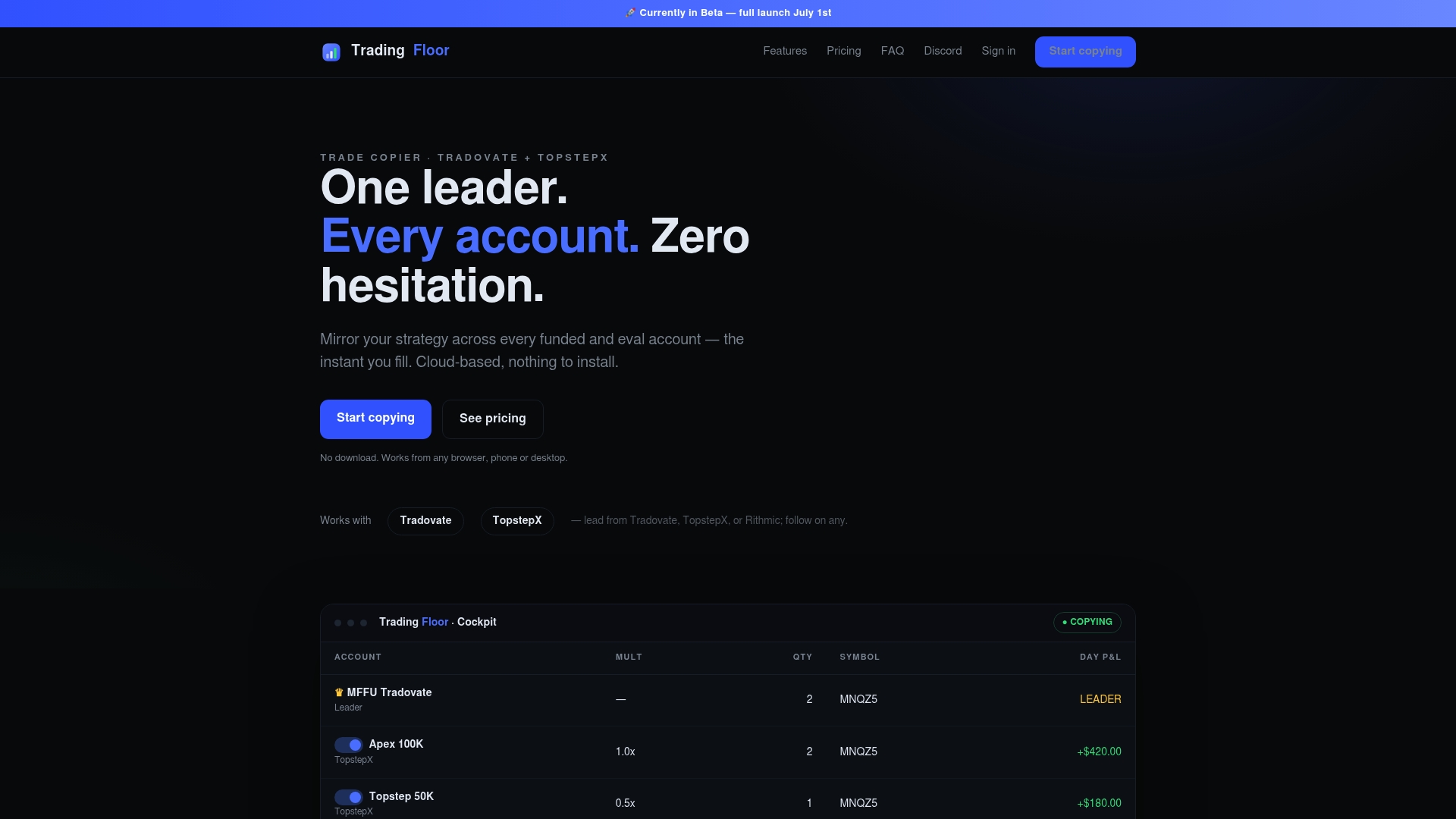
For traders running Tradovate accounts across multiple funded programs, the auto-reconciliation feature alone catches most of the mismatches this article walks through, before they turn into a flattened account. Plans start at $25 per month or $250 per year on the Starter tier, with Pro available at $50 monthly or $500 annually for higher account counts. Start a trial, connect your accounts, and run your next roll window as a scheduled event instead of a scramble.
Where to Verify Roll Dates and Technical Details
Before your next roll window, bookmark a short list rather than relying on memory. CME Group’s roll date calendar is the authoritative source for exact expiry and roll windows on equity index products, and it updates every contract cycle. NinjaTrader’s support documentation walks through the platform-specific Auto Rollover workflow, useful if you’re diagnosing why a particular account didn’t update.
For anyone building or maintaining automated copy logic, QuantConnect’s continuous contracts documentation is the clearest reference on symbol-change events and depth offsets. Bookmap’s analysis of liquidity around expiry is worth a read if you want to understand why fills get worse right before a roll, and copy-trading fraud remains a real risk in this space. Recovera’s guide to identifying copy-trading scams is a useful reference if you’re vetting a new copier service.
Sources
- CME Group: Roll dates for equity index futures
- QuantConnect documentation: continuous contracts and SymbolChangedEvent
- NinjaTrader support: How do I roll over a futures contract?
- Bookmap: Trading around expiry — how futures liquidity shifts when contracts roll over
FAQ
What Is a Contract Rollover?
A contract rollover is the process of closing a position in an expiring futures contract and opening an equivalent position in the next active contract month, to keep market exposure continuous rather than let the contract expire or go to delivery.
How Often Do Futures Contracts Roll Over?
Most equity index futures roll quarterly, with the roll window typically falling in the two weeks before the third Friday of the contract month. Some products, including certain FX futures, roll monthly instead, so always check the specific contract’s own calendar.
How Do I Roll Over a Futures Contract?
You close or offset the position in the expiring contract and open a matching position in the next contract, ideally once volume and open interest have clearly shifted rather than on the calendar date alone. Platforms like NinjaTrader offer an Auto Rollover tool that handles this at the account level, while copiers like Tradingfloor extend the same logic across every connected account.
What Is a Nasdaq Futures Contract Rollover?
It works the same as any other equity index rollover: exposure moves from the expiring Nasdaq futures contract into the next quarterly contract as liquidity migrates, typically in the two weeks before the third Friday of the expiring month. The exact date should always be confirmed against the exchange calendar rather than assumed from the previous quarter’s pattern.
Does Trading Floor Handle Contract Conversions Automatically?
Trading Floor supports contract conversion rules and per-account risk controls so mini and micro accounts scale correctly when a leader’s position moves to a new contract. Current pricing and plan details are available on the Trading Floor pricing page.
Recommended
- How to Copy Trades Across Multiple Prop Firm Accounts Like TopstepX
- Earn2Trade Trade Copier — mirror one trade across every Earn2Trade account
- Prop Traders: Audit Proof Entry Only Copying Across 5 Funded Accounts
- Trades Copied Right: Real-Time Mirroring for Prop Traders
Trading Floor mirrors every trade across your Tradovate, TopstepX & Rithmic accounts in real time, from $25/mo.
Start copying →