What Is a Master Trading Account? A 2026 Guide

A master trading account is defined as a centralized account that executes trades once and distributes them automatically to multiple linked sub-accounts. This structure is the standard tool for proprietary trading firms, investment managers, and individual traders who run more than one funded account at the same time. Understanding how it works, where it fits within compliance rules, and how it differs from a managed trading account gives you a real edge when scaling your trading operation in 2026.
What is a master trading account and how does it work?
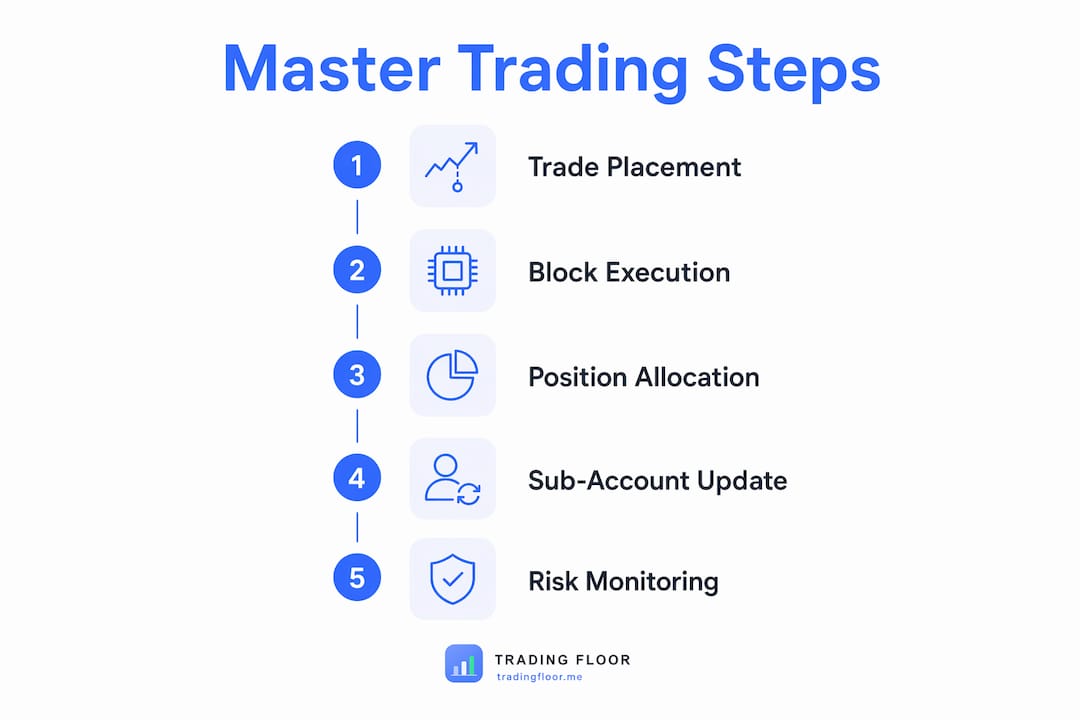
A master trading account sits at the top of a linked account structure. You place one trade on the master account, and that trade replicates across every connected sub-account according to predefined rules. The sub-accounts are sometimes called slave accounts, and the relationship between them is often called a master-slave architecture.
Block trades executed via a master account can reduce commissions and improve execution prices. That matters because splitting the same trade across five accounts manually would mean five separate fills at potentially different prices. The master account consolidates that into one efficient execution.

The allocation step happens after the block trade fills. The platform or trade copier software divides the position across sub-accounts using percentages, fixed lot ratios, or account-equity-based sizing. A trader with three funded accounts might allocate 40% to the largest account and 30% each to the two smaller ones.
Pro Tip: Set your allocation ratios before you go live. Changing them mid-session while positions are open creates sizing mismatches that are hard to unwind cleanly.
Allocation example across sub-accounts
| Sub-account | Account size | Allocation ratio | Lot size received |
|---|---|---|---|
| Account A | $100,000 | 40% | 4 lots |
| Account B | $50,000 | 30% | 3 lots |
| Account C | $50,000 | 30% | 3 lots |
Trade copier software, including Local Trade Copier tools and expert advisors (EAs), handles real-time trade replication with configurable settings for symbol mapping and risk-based lot management. These tools are what make the master-slave structure practical at scale.
What are the compliance and risk rules for master accounts?
Compliance is the most underestimated part of master account trading. Most serious proprietary trading firms prohibit master accounts that function as external signal services. As of 2026, the rule is clear: the master account must be owned and actively managed by the individual trader, not fed by a third-party signal provider or copy trading service.
“A single mistake on the master account replicates at machine speed across all slave accounts, risking concurrent breaches of risk parameters on every linked account simultaneously.”
That quote captures the core danger. Error propagation is not a theoretical risk. A fat-finger entry or a misconfigured stop on the master account hits every sub-account within milliseconds. By the time you notice, the damage is already distributed.
The specific risks to watch for include:
- Error propagation: One bad trade on the master replicates instantly to all sub-accounts before you can intervene.
- Ratio breaches: Misconfigured trade copier multipliers cause sized trades on sub-accounts that exceed their individual risk limits, triggering premature daily loss limit breaches.
- Platform restrictions: Some brokers restrict automated copy trading activity, and prop firms enforce these restrictions strictly.
- Ownership violations: Using a third-party signal source as your master account breaks most prop firm rules and can result in account termination.
Pro Tip: Run your master account setup on a demo or paper account for at least two weeks before connecting live funded accounts. Confirm that every sub-account receives the correct lot size under different market conditions.
Managed trading accounts are a separate concept entirely. A managed account involves a third-party professional making discretionary trading decisions on your behalf, often with performance fees attached. A master trading account is a self-directed tool. You make every decision. The account structure just copies your execution across multiple destinations.
What are the benefits of a master trading account?
The efficiency gains from a master account structure are concrete and measurable. Traders who manage multiple funded prop accounts without a master account spend significant time entering duplicate trades manually, which introduces timing differences and human error.
Master accounts enable block trading, consolidated reporting, and efficient risk oversight for fund managers and registered investment advisors. Individual prop traders get the same structural advantage at a smaller scale.
The key benefits are:
- Reduced workload: One trade entry covers all linked accounts. No manual repetition.
- Better execution prices: Block trading through the master account means a single fill rather than multiple partial fills at varying prices.
- Consolidated performance view: You monitor one account’s P&L and risk metrics, then verify sub-accounts match. Oversight becomes faster.
- Scalability: Adding a new funded account to your structure means connecting it to the existing master setup, not rebuilding your entire workflow.
- Strategy separation: You can run different strategies on different sub-accounts while still using the master account as the execution source for each.
The scalability point deserves emphasis. A trader who passes multiple prop firm evaluations can scale across accounts without proportionally increasing their workload. The master account structure is what makes that possible.
How to use a master trading account effectively
Setting up a master trading account correctly takes more planning than most traders expect. The technical connection is straightforward. The configuration details are where most mistakes happen.
- Choose a compatible broker or platform. Not all platforms support master account functionality or automated trade copying. Verify that your broker allows it and that your prop firm’s rules permit it before you build anything.
- Configure your trade copier settings carefully. Set the lot sizing method, the allocation ratios, and the maximum position size per sub-account. Match these to each sub-account’s specific risk limits, not a generic default.
- Map symbols correctly. If your sub-accounts are on different brokers, the instrument names may differ. A trade copier’s symbol mapping feature handles this, but you must set it up manually for each pair.
- Validate replication accuracy before going live. Place test trades on the master account and confirm each sub-account receives the correct size and direction. Check trade mirroring accuracy across every connected account.
- Monitor daily loss limits per account. Each sub-account has its own drawdown rules. A position that is fine on the master account may push a smaller sub-account close to its daily limit. Build alerts for each account separately.
Pro Tip: Keep a simple spreadsheet that tracks each sub-account’s current drawdown, daily loss limit, and remaining buffer. Update it at the start of every session. This takes five minutes and prevents the most common ratio-related breach.
Cross-account trade management in 2026 also means staying current with each platform’s automation policies. Broker and prop firm rules change. A setup that was compliant in january may need adjustment by june if a firm updates its terms.
Key Takeaways
A master trading account is the most efficient structure for traders managing multiple funded accounts, but it requires precise configuration and strict compliance with prop firm rules to work safely.
| Point | Details |
|---|---|
| Core definition | A master account executes one trade and distributes it automatically to all linked sub-accounts. |
| Compliance requirement | The master account must be self-directed; external signal services are prohibited by most prop firms as of 2026. |
| Biggest risk | Error propagation replicates mistakes across all sub-accounts at machine speed before you can intervene. |
| Key benefit | Block trading through the master account improves execution prices and eliminates manual trade repetition. |
| Setup priority | Validate lot sizing ratios and daily loss limits per sub-account before connecting any live funded account. |
The part most traders skip until it costs them
I have watched traders build technically correct master account setups and still blow funded accounts within the first week. The problem is almost never the software. It is the assumption that because the master account is sized correctly, every sub-account is fine too.
The ratio math is where it breaks down. A 2-lot trade on a $100,000 master account feels conservative. That same trade copied at a 1:1 ratio to a $25,000 sub-account is suddenly a much larger relative position. If that sub-account has a $500 daily loss limit, one bad trade can end it before lunch.
The other thing I see consistently is traders treating the master account as a set-and-forget system. It is not. Platform conditions change, broker execution speeds vary, and prop firm rules get updated. The traders who keep funded accounts long-term are the ones who check their multi-platform setup regularly, not just when something breaks.
One more distinction worth making: a master trading account is not a managed account. If you are considering handing control of your trading to a third party, that is a completely different product with different legal and fee structures. A master account keeps you in the driver’s seat. Every decision is yours. The structure just executes your decisions across more accounts at once.
Test everything on paper first. Size each sub-account’s allocation to its actual risk limits, not the master account’s limits. And check your prop firm’s current rules before you connect anything live.
— KennyTrades
Tradingfloor makes multi-account execution practical
Managing multiple funded accounts from a single master setup is exactly what Tradingfloor is built for. The platform mirrors your net position across funded and evaluation accounts in real time, with individual risk controls applied per account rather than a blanket setting.
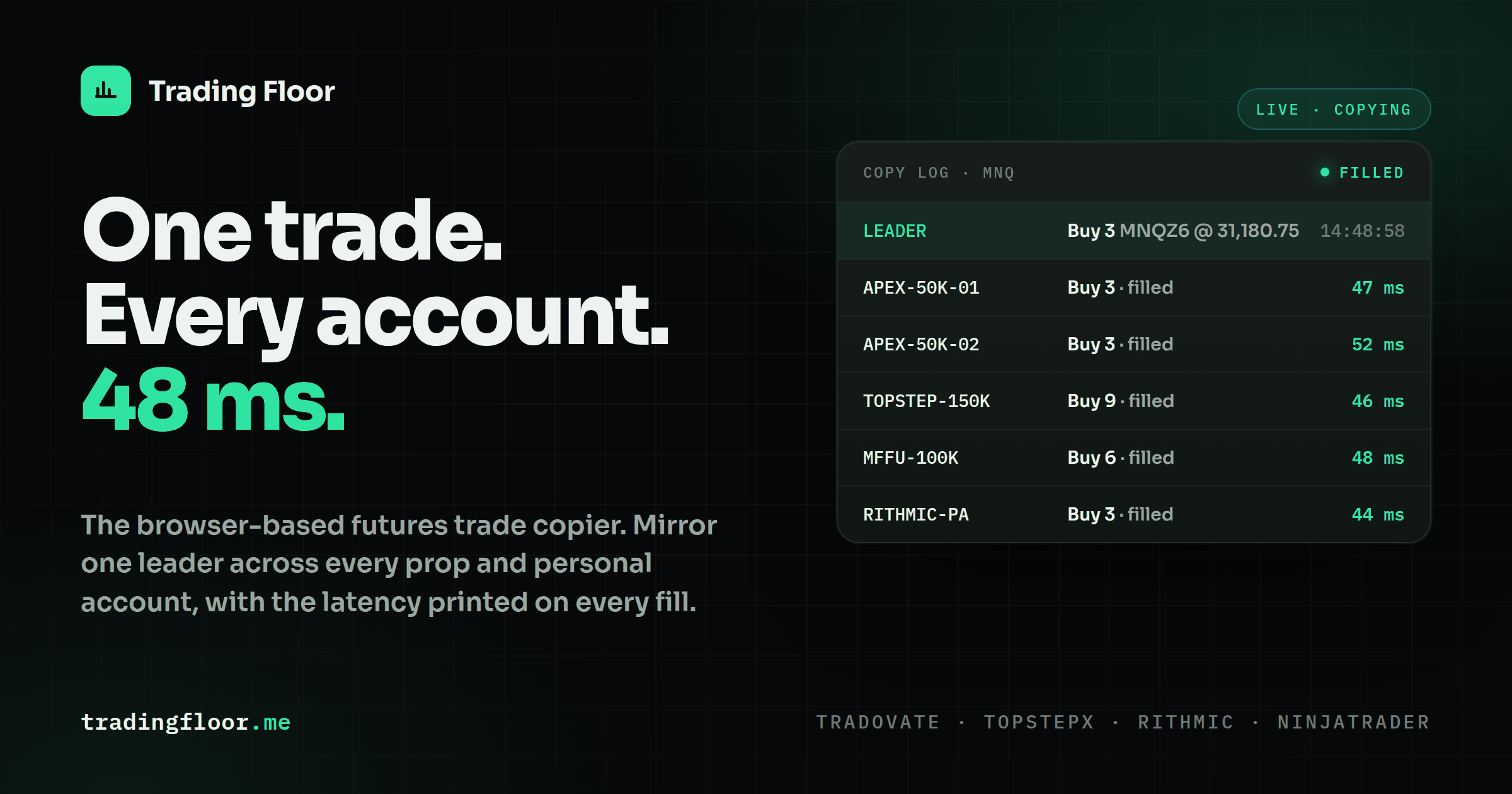
Tradingfloor runs in the cloud, so there is nothing to install and it works from any device. It supports platforms including Tradovate and TopstepX, with real-time notifications and trade limit controls built in. Traders who want to scale without rebuilding their workflow for every new account use Tradingfloor as the execution layer that connects everything. Check the platform pricing to see which plan fits your current account structure, or visit Tradingfloor to see the full feature set.
FAQ
What is a master trading account in simple terms?
A master trading account is a single account that automatically copies your trades to multiple linked sub-accounts. You trade once, and every connected account receives the same position according to predefined sizing rules.
How does a master trading account differ from a managed account?
A master trading account is self-directed. You make every trading decision. A managed account gives a third-party professional discretionary control over your funds, usually in exchange for performance fees.
Are master trading accounts allowed at prop firms?
Most prop firms allow master accounts only when the trader owns and actively manages the master account. External signal services used as the master source are prohibited as of 2026.
What is the biggest risk of using a master trading account?
Error propagation is the primary risk. A mistake on the master account replicates instantly across all sub-accounts, potentially breaching risk limits on every linked account before you can act.
Do all brokers support master trading account setups?
No. Some brokers restrict automated copy trading, and prop firms often enforce additional limits. Always verify platform compatibility and firm rules before building your setup.
Recommended
- Cross-Account Trade Management: A 2026 Trader’s Guide — Trading Floor
- Account-Level Risk Management: A Trader’s Complete Guide — Trading Floor
- Passive Trade Management: A Practical 2026 Guide — Trading Floor
- Multi-Account Trade Execution Explained for Prop Traders — Trading Floor
Trading Floor mirrors every trade across your Tradovate, TopstepX & Rithmic accounts in real time, from $25/mo.
Start copying →