Prop Trading Funded Account Explained for Traders

A prop trading funded account is a trading account where a proprietary trading firm supplies the capital, letting you trade significant sums while risking only a one-time evaluation fee. The firm keeps a portion of your profits in exchange for providing that capital. Traders commonly keep between 70% and 90% of profits generated in a funded account, with the firm absorbing losses beyond defined limits. Understanding how this structure works is the difference between treating a funded account like a personal brokerage and treating it like the conditional business arrangement it actually is.
What is a prop trading funded account and how does it work?
A prop trading funded account gives you access to firm capital under a strict, automated risk framework. You do not own the capital. You have permission to trade it, provided you follow the firm’s rules. Traders’ true risk capital is their drawdown limit, not the total account size. A $100,000 funded account with a 5% max drawdown means your real exposure is $5,000.
The account balance you see on screen is an interface, not liquid capital you can withdraw freely. Funded accounts are often simulated or rule-restricted environments, and the reported balance reflects a trading interface rather than cash in a brokerage account. This distinction matters enormously for how you manage risk. Treating the full account size as “your money” is one of the fastest ways to blow a funded account.

What is a prop trader in this context? A prop trader is someone who trades a firm’s capital under agreed rules, earns a profit share, and absorbs no personal loss beyond the evaluation fee paid upfront. The firm profits from the trader’s performance and from evaluation fees collected across its trader base.
How does the evaluation and funding process work?
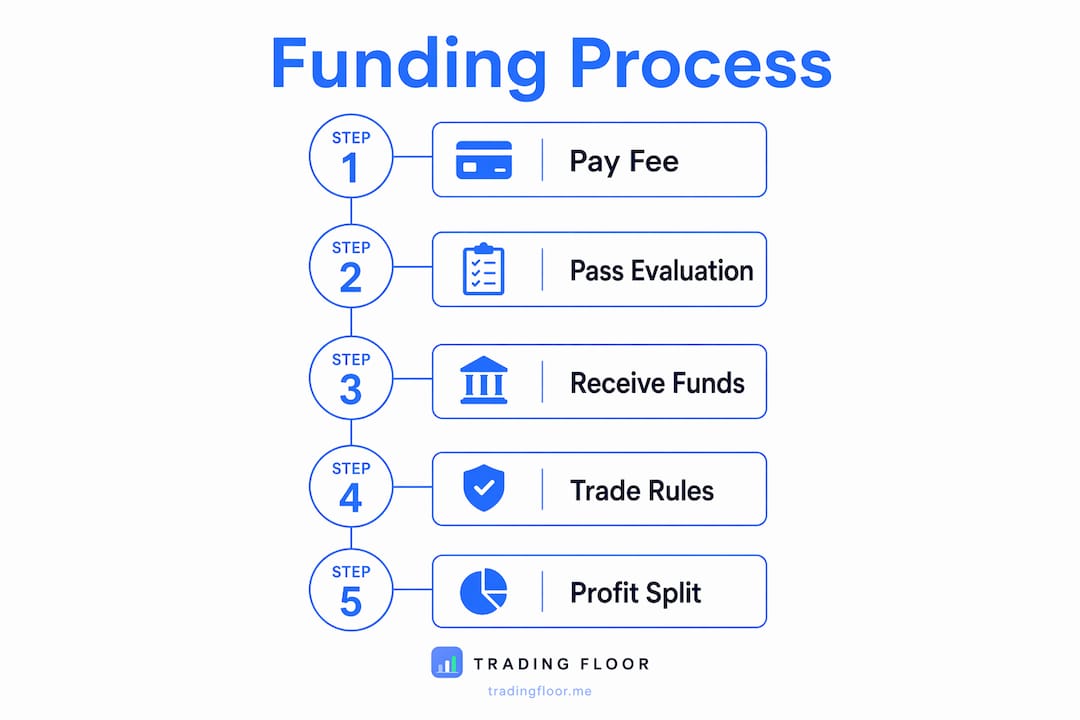
The path from applicant to funded trader follows a structured sequence. Most programs use one of three models: a two-step evaluation, a one-step evaluation, or instant funding.
- Pay the evaluation fee. Evaluation fees typically range between $19 and $600 depending on account size and firm. This fee is non-refundable and grants access to a simulated account with virtual capital ranging from $5,000 to $200,000 or more.
- Pass the challenge phase. You must hit a profit target, usually 8–10% of the account, without breaching daily loss or max drawdown limits. Typical funded account rules include a max daily loss of 2–4% and a max drawdown of 3–6%.
- Complete the verification phase (two-step models). A second, lower profit target confirms your consistency. One-step models skip this phase but often carry tighter rules or lower profit splits.
- Receive funded account access. After passing, you trade the funded account under the same risk rules. Payouts become available after meeting minimum thresholds and payout schedule requirements.
- Request a payout. Firms review your trade data before releasing funds. Prohibited behaviors can result in denial even when profit targets are met.
Funded accounts typically require passing evaluation challenges with separate profit targets and drawdown criteria at each stage. One-step models offer faster access but usually come with tradeoffs in profit split or rule strictness.
Pro Tip: Treat the evaluation fee as a business expense, not a gambling stake. Most traders require multiple attempts to pass. Budget for two to three attempts before your first funded account.
What are the key rules, risk controls, and profit-sharing mechanics?
Funded accounts operate under rules that protect the firm’s capital. Breaking any single rule typically results in immediate account termination, regardless of overall profitability.
Core risk rules every funded trader faces
- Daily loss limit: The maximum you can lose in a single trading day, usually 2–4% of account size. Breaching this ends your trading day or terminates the account.
- Max drawdown: The total loss allowed from the account’s peak or starting balance. Static drawdown is fixed from the starting balance. Trailing drawdown moves upward as your account grows, shrinking your safety margin over time.
- Minimum trading days: Most firms require a minimum number of active trading days to prevent lucky single-day passes.
- Consistency rules: Some firms flag accounts where a single day’s profit represents an outsized percentage of total gains. This prevents traders from passing on one lucky trade.
- Restricted strategies: News trading, holding positions over weekends, and high-frequency scalping are commonly prohibited.
Trailing drawdown rules can shrink safety margins as the account grows, requiring careful strategy adjustment to avoid abrupt termination. A trader who grows a $100,000 account to $110,000 under a trailing drawdown rule may find their floor has risen to $107,000, leaving only $3,000 of breathing room.
Profit split and payout mechanics
| Feature | Typical Range |
|---|---|
| Trader profit split | 70%–90% of net profit |
| Evaluation fee | $19–$600 per attempt |
| Max daily loss limit | 2%–4% of account size |
| Max drawdown limit | 3%–6% of account size |
| Profit target (challenge) | 8%–10% of account size |
Profit splits are contingent on passing payout reviews. Firms scrutinize trade data for prohibited behaviors during every withdrawal request. Meeting the profit target is necessary but not sufficient. Full compliance with every rule is required before a payout clears.
Pro Tip: Read the full rule set before you pay any evaluation fee. Pay specific attention to trailing vs. static drawdown, news trading restrictions, and payout schedules. These three factors determine whether a program fits your trading style.
What are the advantages and potential pitfalls of funded accounts?
The real advantages
- Capital access without full personal risk. A funded account gives you access to significant capital without personal downside beyond the evaluation fee. A trader who passes a $100,000 challenge for $150 gains exposure to capital they could never self-fund at that scale.
- Profit earning potential at scale. An 8% monthly return on a $100,000 funded account generates $8,000 in gross profit. At a 80% split, the trader takes home $6,400 from a $150 investment in the evaluation fee.
- Defined risk environment. The firm’s rules force discipline. Traders who struggle with position sizing in personal accounts often perform better under enforced limits.
- No margin calls on personal funds. When a funded account hits its drawdown limit, it closes. The trader loses access, not personal savings.
The pitfalls traders underestimate
- Reset fees accumulate fast. Reset fees and re-qualification costs after a breach are underestimated risks. A trader who fails three challenges at $200 each has spent $600 before earning a dollar.
- Payout delays and thresholds. Minimum withdrawal amounts and bi-weekly or monthly payout schedules mean profits are not immediately accessible.
- Firm solvency risk. Firm solvency and payout reliability vary widely. Some firms have poor payout records flagged in public trader communities. Choosing an unreliable firm means profits may never arrive.
- Psychological pressure. Trading under strict loss limits creates a different mental environment than personal account trading. Many traders freeze up near drawdown limits and make worse decisions as a result.
Managing a funded account requires adapting your trading strategy to strict rules. Treating it like a personal account leads to failure in most cases.
How do you choose and succeed with a funded prop account?
Choosing the right program is as important as passing the evaluation. A program with a high profit split means nothing if the firm delays payouts or terminates accounts on technicalities.
- Verify firm credibility first. Check independent review platforms and trader community forums for payout track records. Look for firms with documented, on-time payouts over at least 12 months.
- Match the rule set to your trading style. A news trader needs a firm that permits news trading. A swing trader needs a firm that allows overnight and weekend holds. Mismatching your style to the rules guarantees failure.
- Assess the drawdown type. Static drawdown is more forgiving for traders who build account equity slowly. Trailing drawdown suits traders who grow accounts quickly and then scale back risk.
- Calculate the true cost of failure. Factor in the cost of multiple evaluation attempts before committing. A $500 evaluation fee on a $200,000 account is reasonable. A $500 fee on a $25,000 account with tight rules is a poor value proposition.
- Study funded account risk rules before you trade. Understanding daily loss limits and drawdown mechanics in detail prevents the most common termination causes.
For traders managing multiple funded accounts simultaneously, syncing evaluation and funded accounts through a position-mirroring system removes the manual execution errors that cause rule breaches across accounts. Tradingfloor mirrors a leader account’s net position across funded and evaluation accounts in real time, with individual risk controls applied per account.
Key Takeaways
A funded prop trading account is conditional access to firm capital, not ownership of it. Your real risk is the drawdown limit and evaluation fees, not the account balance shown on screen.
| Point | Details |
|---|---|
| Funded account definition | A firm provides capital; you trade it under strict rules and keep 70%–90% of profits. |
| True risk capital | Your drawdown limit is your actual risk, not the total account balance. |
| Evaluation process | Pass profit targets and drawdown rules across one or two challenge phases to receive funding. |
| Payout compliance | Meeting profit targets is not enough; full rule compliance is required before any withdrawal clears. |
| Firm selection matters | Verify payout reliability and match rule sets to your trading style before paying any evaluation fee. |
Why funded accounts reward discipline more than talent
I have seen traders with genuinely strong market instincts blow funded accounts inside two weeks. I have also seen methodical, average traders hold funded accounts for years. The difference is not skill. It is the willingness to treat the funded account as a conditional business arrangement rather than a personal trading account with extra capital.
The mental shift required is significant. When you trade your own money, you set your own rules. When you trade a firm’s capital, the rules are set for you, and breaking them has immediate consequences. Traders who resist this adjustment almost always fail. The ones who accept it, and who build their strategy around the firm’s constraints rather than against them, tend to succeed.
The evaluation fee is the most misunderstood part of the whole structure. Traders who view it as a cost feel frustrated when they fail. Traders who view it as a business investment in accessing institutional-scale capital approach it completely differently. They study the rules, size positions conservatively, and treat each attempt as a learning cycle. That mindset shift alone accounts for a large portion of the performance gap between traders who eventually get funded and those who keep failing evaluations.
Consistency beats performance in funded accounts. A trader who returns 2% per month without a single rule breach will outlast a trader who swings for 10% and clips a daily loss limit in month two. The firm’s rules are designed to select for consistency. Trade accordingly.
— KennyTrades
Tradingfloor for prop traders managing funded accounts
Prop traders managing multiple funded accounts face a specific execution problem: applying the same trade across several accounts manually introduces timing errors and rule breaches.
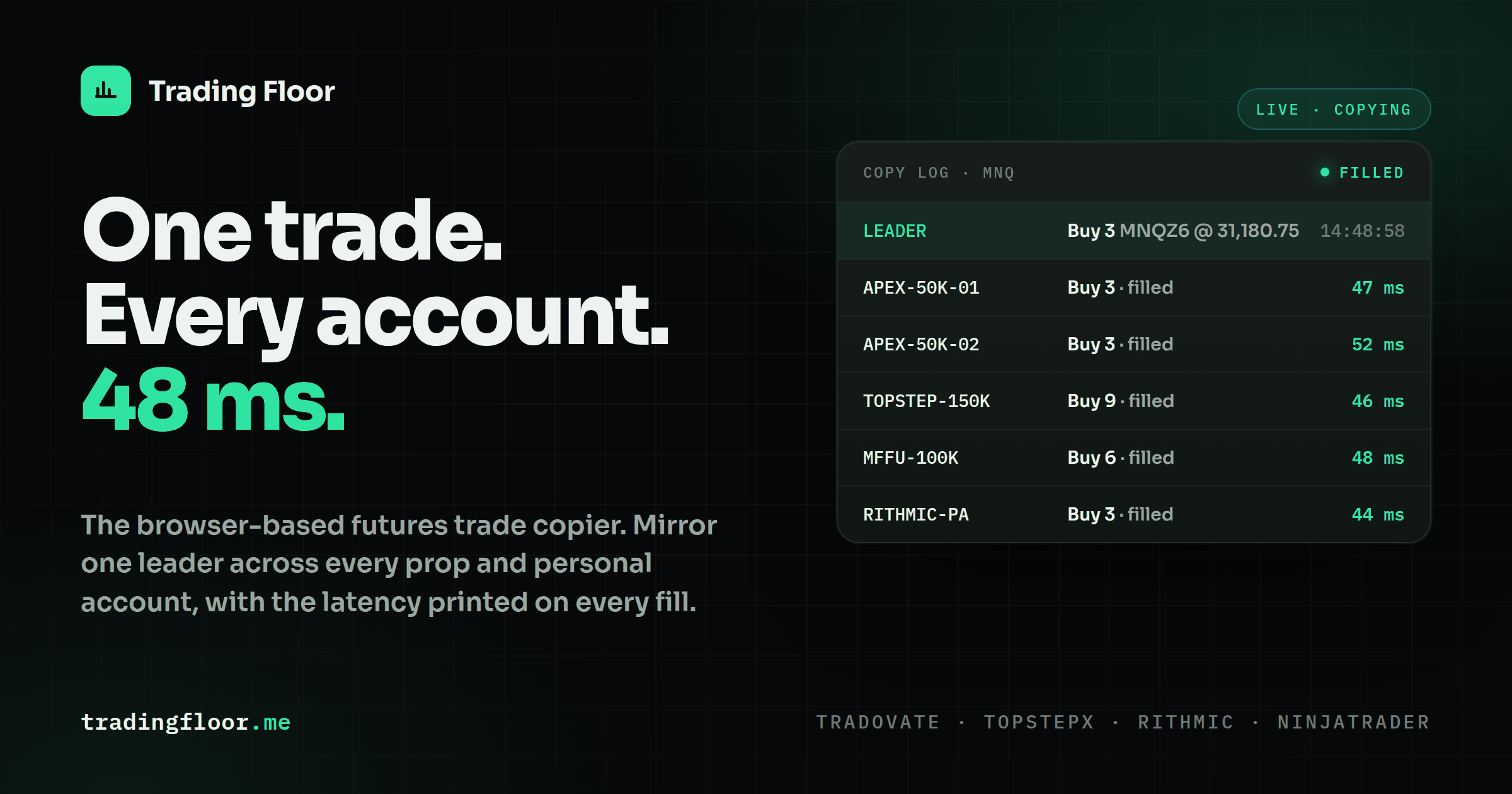
Tradingfloor solves this by mirroring a leader account’s net position across all connected funded and evaluation accounts in real time, with individual risk controls applied per account. The platform runs in the cloud, works across Tradovate and TopstepX, and requires no installation. Traders get real-time notifications and trade limit controls built in. Check Tradingfloor’s pricing plans to find the tier that fits your account count, or visit Tradingfloor to see how position mirroring works in practice.
FAQ
What is a prop trading funded account?
A prop trading funded account is a trading account where a proprietary firm provides the capital. Traders follow the firm’s risk rules and keep 70%–90% of profits generated.
How much does a funded account evaluation cost?
Evaluation fees typically range between $19 and $600 depending on account size and program model. The fee is non-refundable and grants access to a simulated account for the challenge phase.
What causes a funded account to be terminated?
Breaching the daily loss limit, exceeding the max drawdown, or violating prohibited trading rules such as news trading or overnight holds causes immediate account termination. Payout requests can also be denied if prohibited behaviors are detected during review.
What is the difference between static and trailing drawdown?
Static drawdown is fixed from the starting account balance and does not change. Trailing drawdown rises as the account grows, shrinking the safety margin over time and requiring more conservative risk management as profits accumulate.
Can you trade multiple funded accounts at the same time?
Yes, and many experienced prop traders do. Managing multiple accounts manually increases the risk of timing errors and rule breaches. Position-mirroring tools like Tradingfloor automate execution across accounts while applying individual risk controls to each one.
Recommended
- Funded Account Risk Rules Explained for Prop Traders — Trading Floor
- Prop Trader Performance Optimization Explained — Trading Floor
- Multi-Account Trade Execution Explained for Prop Traders — Trading Floor
- Top 4 nbs360.com Alternatives for 2026 — Trading Floor
Trading Floor mirrors every trade across your Tradovate, TopstepX & Rithmic accounts in real time, from $25/mo.
Start copying →