Passive Trade Management: A Practical 2026 Guide

Passive trade management is defined as a trading approach that uses limit orders or systematic, rules-based strategies to minimize active oversight, reduce transaction costs, and maintain consistent account performance with minimal manual intervention. The term covers two distinct but related concepts: order-level execution tactics, where traders place limit orders to provide liquidity rather than take it, and portfolio-level strategy, where traders follow index replication or quant models instead of making frequent discretionary decisions. Both approaches share the same core goal. They reduce the cost, cognitive load, and emotional drag that active trading creates.
What is passive trade management and how does it work?
Passive trade management is the practice of structuring trades so that execution and position management happen through predefined rules rather than real-time judgment calls. At the order level, this means using limit orders to provide liquidity rather than market orders that take it. At the portfolio level, it means following a systematic strategy, such as index tracking or factor-based rebalancing, instead of timing the market.
The contrast with active trade management is direct. Active traders make frequent discretionary decisions, respond to news, and adjust positions constantly. Passive approaches yield better net results for most traders once transaction fees, taxes, and emotional trading mistakes are factored in. That finding holds across retail and institutional contexts.

Passive portfolios carry lower turnover and expense ratios than actively managed funds because they trade infrequently. Lower turnover means fewer taxable events and smaller cumulative fee drag over time. For traders managing multiple accounts, those savings compound quickly.
How do the mechanics of passive order execution work?
Passive order execution centers on one key distinction: limit orders provide liquidity, while market orders remove it. When you place a limit order to buy at $50.00, your order rests on the order book and waits. A seller who wants immediate execution fills against your order. You provided liquidity. Many exchanges reward that behavior with maker rebates, effectively paying you a small fee for the fill.
Passive order filling improves profitability by avoiding slippage and reducing execution fees at most venues. The bid-ask spread is a real cost. A trader who consistently takes liquidity with market orders pays that spread on every trade. A trader who provides liquidity with limit orders avoids it, and sometimes earns a rebate on top.
The risk is non-execution. Passive orders rest on the book and wait for the market to come to them. If price moves away before your order fills, you miss the trade entirely. That is a real tradeoff, not a minor footnote. Traders managing passive execution need to account for queue position and price placement carefully.
Passive execution applies across asset classes. In crypto derivatives, limit orders on perpetual futures avoid the taker fee, which can run 0.05% or higher per trade. In equities, limit orders on lit exchanges qualify for maker rebates on venues like NYSE or Nasdaq. In options markets, resting limit orders at the mid-price often fill without paying the full spread.
Pro Tip: Place your limit orders one tick inside the spread rather than at the mid-price. You stay passive, improve queue priority, and still avoid paying the full spread on most fills.
How do passive trading strategies differ from active approaches?
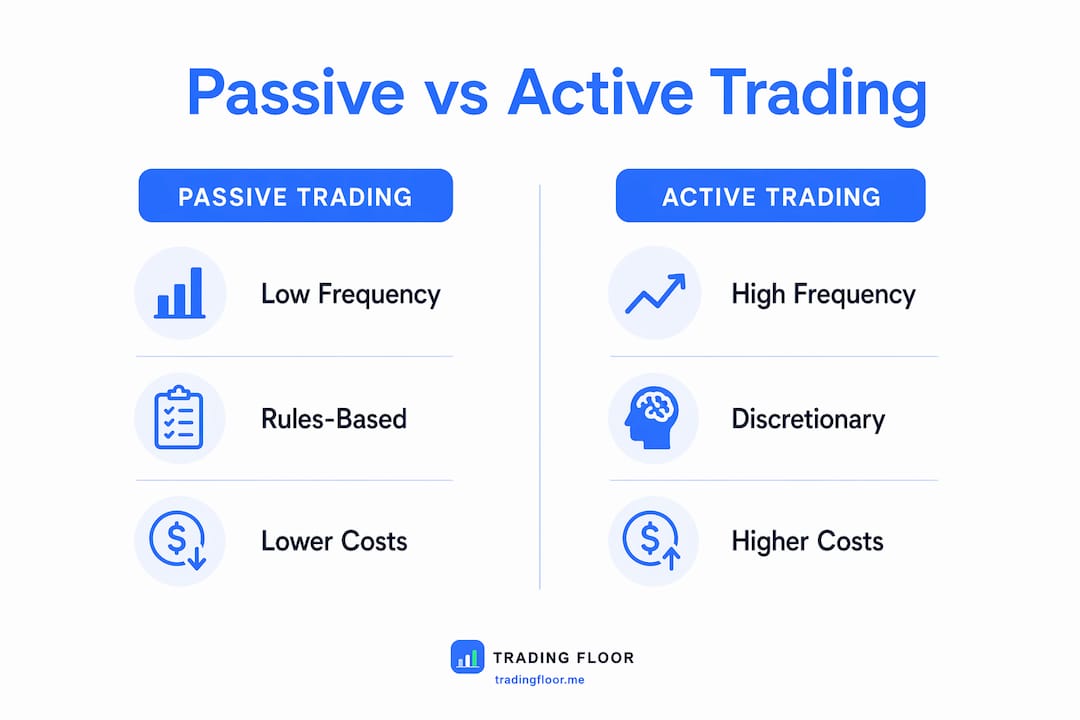
Passive trading strategies are defined by low trade frequency, rules-based decision-making, and alignment with a benchmark or systematic model. The three most common forms are buy-and-hold investing, index replication through ETFs, and quantitative rules-based models that rebalance on a schedule rather than in response to market signals.
Active strategies do the opposite. They attempt to time the market, exploit short-term mispricings, and generate alpha through frequent trades. The higher the trade frequency, the higher the cumulative cost. Active strategies also carry a psychological cost. Every decision point is an opportunity for emotional error.
The table below summarizes the key differences.
| Trait | Passive trading | Active trading |
|---|---|---|
| Trade frequency | Low, scheduled | High, discretionary |
| Decision-making | Rules-based | Judgment-based |
| Transaction costs | Low | High |
| Tax efficiency | High | Low |
| Emotional demand | Low | High |
| Typical benchmark | Index or model | Alpha vs. market |
Index funds replicate market indexes with lower costs and reduced tax drag compared to actively managed funds. That cost advantage is not marginal. Over a 20-year horizon, a 1% annual fee difference compounds into a significant performance gap. Passive strategies do not need to beat the market. They need to match it cheaply.
Pro Tip: If you run a rules-based passive strategy, write down the exact conditions that would cause you to override the model. If you cannot define them in advance, you do not have a passive strategy. You have an active one with extra steps.
What systematic passive strategies do traders use today?
Systematic passive strategies give traders a structured way to generate returns or income without constant monitoring. The most widely used approaches fall into three categories.
-
Factor-based ETFs. These funds track indexes built around specific return drivers such as value, momentum, low volatility, or quality. They rebalance automatically on a schedule. Traders gain exposure to proven return factors without selecting individual securities or timing entries.
-
Managed futures programs. Trend-following commodity trading advisors (CTAs) use rules-based models to go long or short futures contracts across asset classes. The strategy runs systematically. The trader’s role is capital allocation and periodic review, not daily execution.
-
Systematic options income strategies. Covered calls and cash-secured puts are the most accessible forms. Covered calls and cash-secured puts can provide 3–8% annual yield when managed with strict rules on strike selection, position sizing, and timing. The key word is strict. Discretionary overrides destroy the passive nature of the strategy.
-
Quant model rebalancing. Rules-based quant strategies define entry, exit, and sizing criteria in advance. The quant fund market reached a valuation of $16 trillion in 2024, reflecting how widely institutions have adopted systematic approaches. Retail traders now access similar logic through algorithmic platforms and hands-off trading systems built for individual accounts.
-
Multi-account passive execution. Prop traders managing funded and evaluation accounts simultaneously can mirror a single leader account across all positions. Retail traders can integrate multiple broker accounts into systematic passive strategies, spreading risk and simplifying execution without manual duplication.
Risk control sits at the center of every one of these approaches. A systematic strategy without predefined loss limits is not passive. It is unmanaged.
What psychological challenges come with passive trade management?
The biggest obstacle to passive trade management is not technical. It is behavioral. Traders often fail passive strategies due to emotional impulses that lead to excessive intervention during market fluctuations. The market drops 5%, and the urge to “do something” overrides the rules. That single override often costs more than months of disciplined passive execution saved.
The concept of “structured minimalism” captures what successful passive management actually requires. You build the rules, test them, and then commit to following them without modification during live trading. The structure is the work. The minimalism is the discipline.
Common psychological pitfalls include:
- Panic selling during drawdowns. Passive strategies are designed to hold through volatility. Exiting during a drawdown locks in losses and breaks the strategy’s statistical basis.
- Overconfidence after wins. A strong run tempts traders to increase position size or add discretionary trades outside the model. Both actions introduce active risk into a passive framework.
- Model distrust. Systematic rules feel wrong during periods when they underperform. Systematic trading rules protect traders from psychological pitfalls by defining decisions ahead of time. Trusting the model through underperformance is what separates traders who benefit from passive strategies from those who abandon them too early.
- Under-execution. Some traders set limit orders too conservatively and miss fills repeatedly. They then switch to market orders, pay the spread, and wonder why their results deteriorate.
Pro Tip: Keep a decision log. Every time you feel the urge to override your passive strategy, write down the reason. Review it monthly. Most overrides look irrational in hindsight, and that pattern is the most effective cure for impulsive intervention.
How can traders implement passive trade management to improve account performance?
Practical implementation starts with choosing the right tools and committing to a defined process. The following steps apply whether you are managing a single retail account or multiple funded prop accounts.
- Use limit orders by default. Replace market orders with limit orders for all non-urgent entries and exits. Place them at or inside the current spread. You reduce transaction costs immediately and build the habit of passive execution.
- Align with an index or benchmark. If your goal is portfolio growth rather than active alpha, allocate the core of your account to low-cost ETFs that track broad market indexes. Let the benchmark do the work.
- Add a rules-based options layer. Systematic covered calls on existing equity positions or cash-secured puts on stocks you want to own generate income without requiring daily decisions. Define strike selection and timing rules in advance and follow them without deviation.
- Use a passive trading strategy framework that matches your account type and risk tolerance. Rules-based frameworks remove the guesswork from position sizing and entry timing.
- Automate multi-account execution. Traders managing more than one account face the greatest risk of manual error and inconsistency. Mirroring a single leader position across all accounts through a systematic platform removes that risk entirely.
- Monitor on a schedule, not continuously. Set weekly or monthly review intervals. Checking positions hourly creates the conditions for impulsive overrides. Scheduled reviews keep you informed without triggering emotional responses.
The goal is not zero involvement. The goal is involvement only when the rules require it.
Key Takeaways
Passive trade management outperforms active approaches for most traders once transaction costs, taxes, and behavioral errors are accounted for, making systematic rules and limit order execution the foundation of consistent account performance.
| Point | Details |
|---|---|
| Limit orders reduce costs | Passive limit orders avoid the bid-ask spread and can earn maker rebates at most exchanges. |
| Rules eliminate emotion | Predefined systematic rules prevent impulsive overrides that destroy passive strategy returns. |
| Passive beats active after fees | Lower turnover and tax drag give passive strategies a structural edge over active trading. |
| Systematic options generate income | Covered calls and cash-secured puts provide 3–8% annual yield when managed with strict rules. |
| Multi-account execution scales passivity | Mirroring a leader account across funded accounts removes manual duplication and reduces errors. |
Why passive management changed how I think about trading
The first time I ran a fully passive strategy across multiple accounts, I expected to feel like I was missing something. Every experienced trader I knew was glued to charts, adjusting positions, reacting to news. Doing less felt wrong. It felt like laziness dressed up as strategy.
What I actually found was the opposite. The accounts running systematic limit order execution and rules-based rebalancing outperformed the accounts where I was actively involved. Not because the passive rules were genius. Because active involvement introduced errors, costs, and timing mistakes that the passive model simply did not make.
The hardest part was not the setup. It was the discipline to leave the model alone during a two-week drawdown in february of last year. Every instinct said to intervene. The rules said to hold. The rules were right.
What I tell traders now is this: passive management is not a beginner’s shortcut. It is an advanced discipline that requires more self-control than active trading, not less. The technology available today, including cloud-based multi-account platforms and trade copying strategies that mirror positions in real time, makes systematic passive execution more accessible than ever. The barrier is not technical. It never was.
— KennyTrades
How Tradingfloor supports passive trade management across accounts
Traders who run passive strategies across multiple funded and evaluation accounts face a specific problem: keeping every account in sync without constant manual intervention.
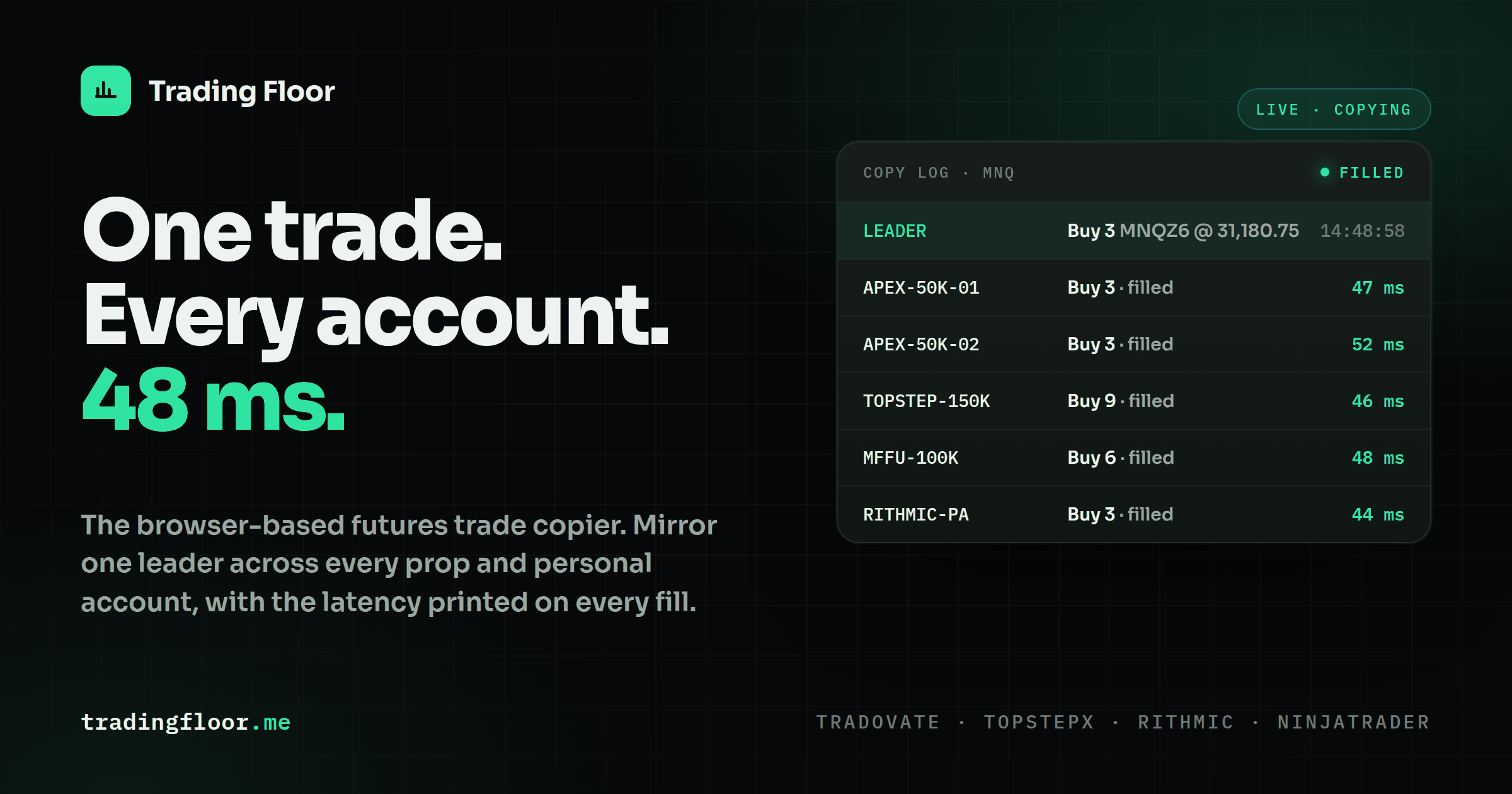
Tradingfloor solves that problem directly. The platform mirrors a leader account’s net position across all connected accounts in real time, covering brokers including Tradovate and TopstepX. You set the rules once. Every account follows. Individual risk controls stay in place for each account, so a single bad fill in one account does not cascade across the rest. For prop traders running passive strategies at scale, Tradingfloor’s multi-account platform removes the manual overhead that turns a clean passive system into a full-time job. Pricing details are available at Tradingfloor pricing.
FAQ
What is passive trade management in simple terms?
Passive trade management is the practice of using limit orders or systematic rules to manage trades with minimal active decision-making. The goal is to reduce transaction costs, emotional errors, and manual workload while maintaining consistent performance.
How does a limit order make trade management passive?
A limit order rests on the order book and waits for the market to come to it, rather than immediately taking the available price. This avoids paying the bid-ask spread and can earn maker rebates, making execution more cost-efficient without requiring active monitoring.
Is passive trade management suitable for prop traders?
Passive trade management works well for prop traders, especially those managing multiple funded accounts. Systematic rules and multi-account mirroring tools reduce manual errors and keep all accounts aligned without constant oversight.
What is the biggest risk of passive trade management?
The primary execution risk is non-execution. If the market moves away from your limit price before your order fills, the trade does not execute. Traders must account for queue position and price placement to manage this risk effectively.
How does passive trading differ from active trading?
Passive trading uses low-frequency, rules-based strategies aligned with a benchmark or model. Active trading relies on frequent discretionary decisions and market timing. Passive approaches typically deliver better net results after fees, taxes, and behavioral costs are considered.
Recommended
- Passive Trading Strategy Types Explained for Traders — Trading Floor
- Types of Trade Copying Strategies: 2026 Guide — Trading Floor
- Trading Execution Best Practices: A 2026 Trader’s Guide — Trading Floor
- Examples of Hands-Off Trading Systems That Work — Trading Floor
Trading Floor mirrors every trade across your Tradovate, TopstepX & Rithmic accounts in real time, from $25/mo.
Start copying →