Top Tools for Passing Trading Evaluations in 2026

The fastest path through a prop-firm evaluation is an integrated stack: a cloud trade copier with per-account risk controls as the operational core, Monte Carlo simulation to validate your edge before you pay a single evaluation fee, and a prop-specific journal to catch behavioral leaks before they blow an account. Piecemeal setups fail because one weak link, a missed daily loss limit (DLL) on account three or an oversized position on account two, can wipe weeks of progress in a single session.
Tradingfloor anchors that stack. It mirrors your net position in real time across every funded and evaluation account, enforces per-account DLL and drawdown limits automatically, and reconciles fills without you touching a second platform.
Three must-have tool types:
- Cloud trade copier with per-account risk controls (prevents fat-finger errors and inconsistent sizing)
- Monte Carlo simulator to estimate pass probability against the firm’s exact rules before you pay the eval fee
- Prop-specific journal and analytics to surface behavioral leaks, tilt patterns, and rule violations in real time
Industry data shows that roughly 90% of traders fail evaluations, making pre-eval simulation the cheapest risk-management move available.
Table of Contents
- What tool categories actually matter for evaluation success?
- How do you build a single workflow from these tools?
- How does Monte Carlo simulation actually estimate your pass probability?
- How do you configure safe copy-routing across multiple accounts?
- What does the evaluation process actually cost, and how long does it take?
- What should your daily routine look like, and what triggers a stop?
- Key Takeaways
- The integrated approach beats the “better indicator” trap
- Tradingfloor gives you the multi-account infrastructure evaluations demand
- Useful sources and further reading
What tool categories actually matter for evaluation success?
Four categories cover the full evaluation workflow. Each solves a distinct failure mode.
Cloud trade copier. Copies your net position across all accounts simultaneously, applying per-account contract multipliers and slippage caps. Without it, manual synchronization across platforms creates fat-finger errors, missed entries, and inconsistent risk sizing — the most common operational failure for multi-account traders.
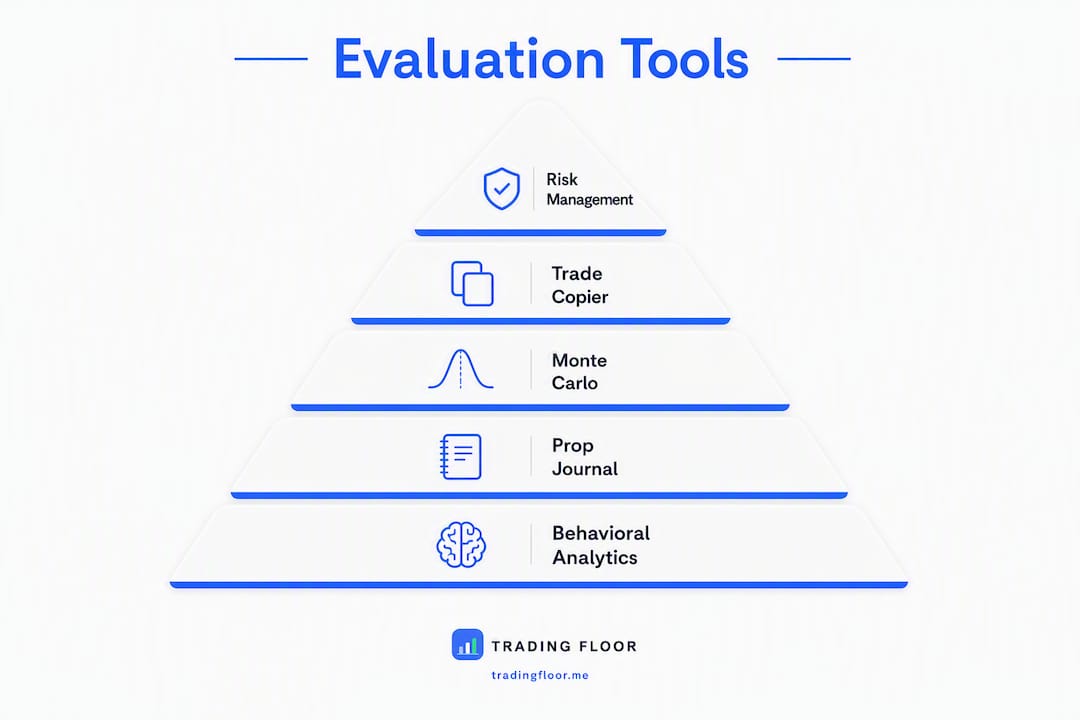
Monte Carlo simulator. Runs thousands of randomized trial sequences using your win rate, average win/loss, and R-multiple distribution against the firm’s profit target, drawdown rule, and DLL. The output is a pass probability and a sensitivity table showing how a 5% shift in win rate changes your odds. Running a large number of simulated challenge attempts produces the kind of statistical clarity that gut feel never will.

Prop-specific journal and analytics. Generic journals don’t track DLL distance, progress to profit target, or per-account drawdown. Advanced prop-focused journals tag trades with rule-followed flags, compute real-time distance-to-DLL, and flag tilt patterns before they become account-killers. As one practitioner framing puts it: if you don’t know your numbers, you have a hobby, not a business.
Risk-management tooling. Position-sizing calculators, automated DLL enforcement, and circuit-breaker alerts. Automating size and DLL enforcement removes the “scared money” overtrading that causes premature account failure.
Pro Tip: The category traders consistently under-invest in is behavioral analytics. Tilt detection and overtrading flags predict account failure earlier than P&L drawdown does — by the time the P&L signals danger, the behavioral pattern has usually been running for days.
How do you build a single workflow from these tools?
Sequence matters. Jumping straight to live evaluation without validating your edge first is how traders pay the same eval fee three times.
- Collect baseline stats. Pull your last 100–300 trades. Compute win rate, average win, average loss, and R-multiple distribution. This is the raw input for everything downstream.
- Run Monte Carlo simulations. Feed those stats into a simulator alongside the target firm’s rules: profit target, drawdown type (trailing vs. static), DLL, and number of trading days. Run many trials. If pass probability comes back below 40%, fix the edge before paying the fee.
- Configure the trade copier. Map each account, set per-account contract multipliers, apply slippage caps, and lock in per-account DLL limits. Tradingfloor handles this at the account level so a breach on one account doesn’t cascade.
- Connect the journal. Every copied trade should auto-log. Use analytics to flag DLL violations, oversized positions, and trade-hopping across sessions.
- Run a two-week dry run. Use demo or sandbox accounts, reconcile fills daily, and confirm the copier executes consistently before touching live eval accounts.
- Go live with the operational checklist active. Pre-market brief, DLL distance check, position-size template, circuit-breaker thresholds confirmed.
Passing multiple evaluations simultaneously with one strategy is achievable, but only when the copier configuration is locked before the first live session.
Pro Tip: During the dry run, deliberately trigger a DLL breach on a demo account to confirm the circuit breaker fires correctly. If it doesn’t stop copying, fix the configuration before going live.
How does Monte Carlo simulation actually estimate your pass probability?
The underlying logic: the simulator draws random sequences from your trade distribution and runs each sequence against the firm’s rules until the account either hits the profit target or violates a drawdown or DLL rule. Repeat that 10,000 times and you get a pass rate.
Essential inputs:
| Input | Why it matters |
|---|---|
| Win rate (from 50–300 trades) | Small errors here shift pass probability by 10–20 percentage points |
| Average win / average loss | Determines expectancy per trade |
| Trade-size variance | Captures inconsistent sizing that simulators often miss |
| Slippage and commissions | Erodes expectancy; must be modeled honestly |
| Profit target and drawdown rule | The firm’s exact parameters, not generic defaults |
| Drawdown type: trailing vs. static | Path-dependent; trailing drawdown tightens as equity peaks |
| Number of trading days allowed | Affects how many trials reach the target before time expires |
Trailing drawdown rules deserve special attention. Because the trailing floor rises with equity peaks, an early winning streak can actually shrink your remaining buffer, making later losses more dangerous. Simulators that model trailing vs. static drawdown expose this path-dependence directly.
Example sensitivity table (illustrative, not sourced figures):
| Scenario | Win Rate | Drawdown Type | Approx. Pass Probability |
|---|---|---|---|
| Base case | 60% | Static | — |
| Win rate +5% | 57% | Static | — |
| Win rate -5% | 40% | Static | — |
| Base case | 60% | Trailing | — |
| Win rate +5% | 57% | Trailing | — |
Treat any result below 40% pass probability as a hard stop. Don’t pay the evaluation fee.
Pro Tip: Use the simulator’s sensitivity table to set a minimum win-rate threshold for going live. If your edge requires a 57% win rate to hit 60% pass probability, and your last 100 trades show 51%, you’re not ready.
How do you configure safe copy-routing across multiple accounts?
Configuration checklist before the first live copy:
- Account mapping: confirm each evaluation and funded account is correctly mapped to the leader account
- Contract multipliers: set per-account multipliers so a 2-contract leader trade copies as 1 contract on a smaller account
- Slippage cap: define the maximum acceptable fill deviation; reject copies that exceed it
- Per-account position limits: cap the maximum open contracts per account independently
- DLL enforcement: set each account’s daily loss limit so the copier pauses automatically on breach
- Order routing priority: confirm the sequence in which accounts receive the copied order
Tradingfloor integrates with Tradovate and TopstepX natively, which covers the majority of US futures prop traders. For Tradovate alternatives and multi-account platform options, the configuration principles remain the same: map instruments, set multipliers, test fills.
Common connectivity pitfalls include mismatched contract symbols between accounts, session-time mismatches that cause partial fills, and API credential expiry. Auto-reconciliation catches fill discrepancies after market close; push notifications surface them in real time.
Pro Tip: Activate accounts one at a time during initial setup. Confirm fills match the leader on the first account before adding the second. Staggered activation makes it easy to isolate which account has a configuration problem.
What does the evaluation process actually cost, and how long does it take?
Cost breakdown:
| Category | Typical range | Notes |
|---|---|---|
| Evaluation fee | $100–$300+ | Varies by firm and account size |
| Trade copier subscription | $30–$100/month | Cloud-based; no installation costs |
| Prop-specific journal | $30–$60/month | Some include Monte Carlo tools |
| Data / connectivity fees | up to $50/month | Platform-dependent |
Timeline estimates:
- Data collection and baseline stats: 1–2 weeks
- Simulator testing and parameter tuning: 1 week
- Dry-run copying and reconciliation: 1–2 weeks
- Live evaluation: 2–8 weeks depending on firm rules
The total pre-eval setup runs 3–5 weeks. That feels slow until you compare it to paying a $300 evaluation fee three times because the edge was never validated. Treat subscription costs as insurance. A $50/month journal that catches one DLL violation pays for itself in the first week.
What should your daily routine look like, and what triggers a stop?
Daily checklist:
- Pre-market brief: review overnight news, confirm platform connectivity, check API credentials
- DLL distance check: calculate how far each account sits from its daily loss limit before the first trade
- Open positions and size check: confirm no residual positions from the prior session; verify sizing matches the template
- Correlation and exposure scan: check for unintended concentration in one instrument across accounts
- Trade log reconciliation: confirm all prior-session fills logged correctly in the journal
- End-of-day reconciliation: compare fills across all accounts; flag any discrepancy above the slippage cap
Red-flag protocol. Trigger an automatic copy pause or manual stop when:
- Two consecutive sessions hit the DLL
- A single trade exceeds the maximum R-size defined in the position-sizing template
- Fill discrepancy between accounts exceeds the slippage cap on more than one trade in a session
- Streak length exceeds a pre-defined losing-trade threshold (e.g., five consecutive losses)
Behavioral metrics predict failure earlier than P&L does. An overtrading pattern — more trades per session than the baseline average, shorter hold times, entries outside the defined setup criteria — typically appears one to three days before a significant drawdown. A prop-specific evaluation checklist built around these signals catches the pattern before the account is at risk.
Key Takeaways
An integrated stack led by a cloud trade copier with per-account risk controls, Monte Carlo simulation, and a prop-specific journal gives multi-account futures traders the highest realistic chance of passing evaluations consistently.
| Point | Details |
|---|---|
| Simulate before you pay | Run many Monte Carlo trials against the firm’s exact rules; skip the fee if pass probability is low. |
| Configure per-account DLL first | Set individual daily loss limits and slippage caps before copying a single live trade. |
| Use behavioral metrics, not just P&L | Overtrading and tilt patterns appear days before a drawdown; track them daily. |
| Budget 3–5 weeks for setup | Data collection, simulation, dry run, and reconciliation testing before live evaluation. |
| Tradingfloor as the copier anchor | Real-time position mirroring, per-account DLL enforcement, and auto-reconciliation across Tradovate and TopstepX accounts. |
The integrated approach beats the “better indicator” trap
The conventional wisdom in prop-trading circles is that failing an evaluation means you need a better entry signal. That’s almost never the cause. The failure logs I’ve reviewed consistently show the same pattern: a trader with a genuine edge who violated a DLL on day four, sized up after a winning streak, or missed a fill discrepancy that compounded across three accounts.
The tools that actually move pass rates are the boring ones: DLL enforcement, circuit breakers, auto-reconciliation. A trader who ran simulator passes at a low baseline probability, tightened position sizing to match the firm’s trailing drawdown sensitivity, and enabled per-account DLL enforcement on the copier can realistically improve that probability significantly. Not because the edge changed, but because the edge stopped being undermined by operational errors.
The integrated stack isn’t about adding complexity. It’s about removing the gaps where discipline breaks down under pressure.
Tradingfloor gives you the multi-account infrastructure evaluations demand
Managing three evaluation accounts manually while protecting each one’s DLL is operationally unsustainable. Tradingfloor solves that directly: real-time position mirroring copies your net position across every funded and evaluation account the moment you execute, with per-account DLL limits, contract multipliers, and slippage caps enforced independently on each account.
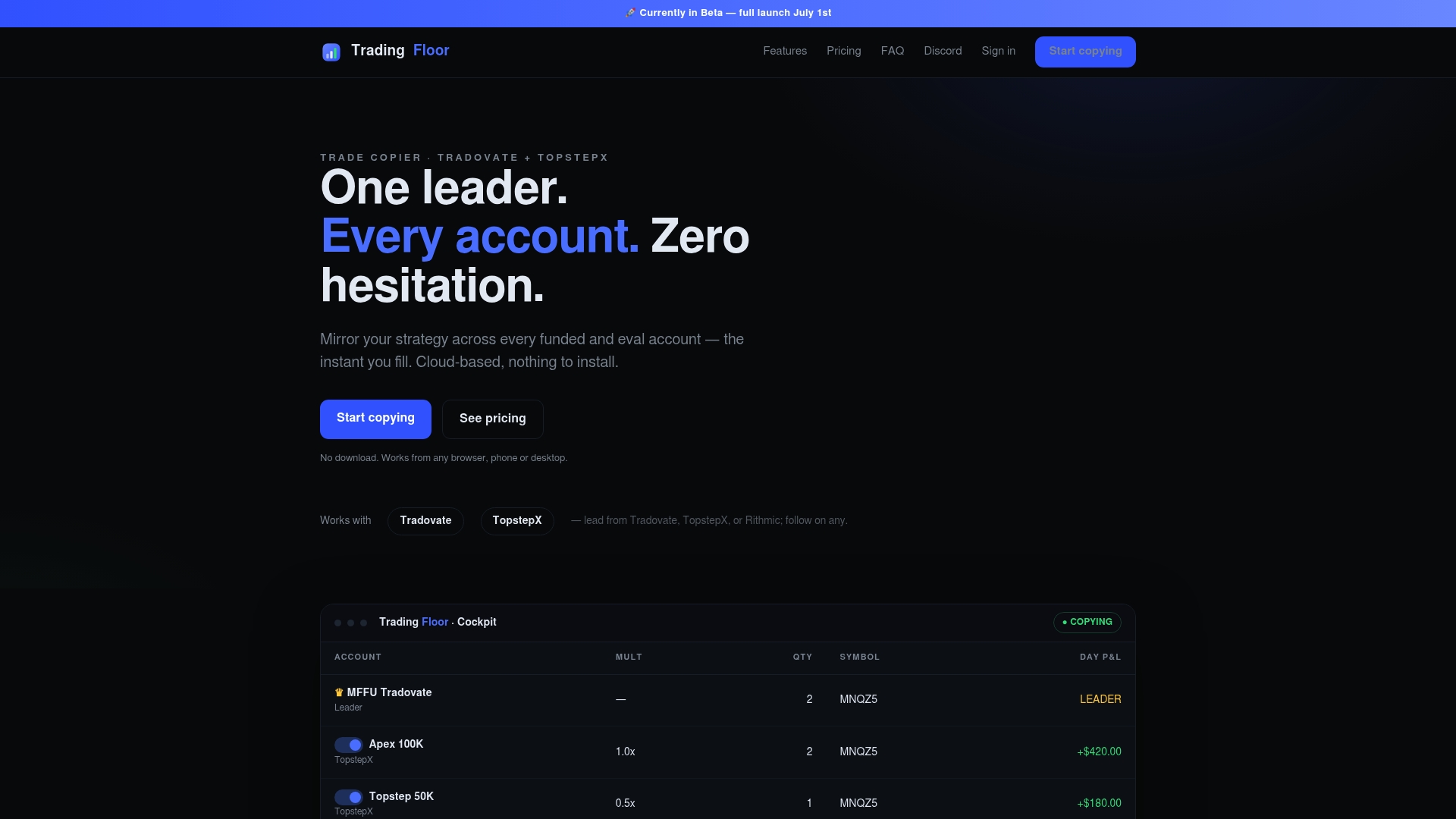
No installation. Accessible from any device. Auto-reconciliation runs after market close so you start each session with clean books. Push notifications flag any fill discrepancy or DLL approach in real time, cutting the reaction window from minutes to seconds.
The 30-day free trial gives you enough time to complete the dry-run phase and the first live evaluation cycle. Check current system availability and start your free trial to get the copier configured before your next evaluation opens.
Useful sources and further reading
| Source | Why it’s relevant |
|---|---|
| Prop Firm Monte Carlo Simulator — The Daily Profiler | Free browser-based simulator; input your stats and run pass-probability scenarios against firm rules |
| Tanto Prop Firm Simulator | Supports trailing vs. static drawdown presets and 10,000-trial runs; useful for sensitivity analysis |
| TradePerformance — Prop Firm Tools | DLL tracker, circuit breaker alerts, and behavioral analytics in one dashboard |
| TradiusPro — Edge Analysis | Expectancy by setup, rule-followed P&L, and prop-specific tagging |
| Automate Trades During Evaluation — Tradingfloor Blog | Step-by-step guide to configuring automated copying safely during evaluations |
| Consistent Trade Sizing Across Accounts — Tradingfloor Blog | Contract multiplier mapping and sizing consistency for multi-account copier setups |
| Evaluation Account Management Best Practices — Tradingfloor Blog | Operational best practices for running funded and evaluation accounts simultaneously |
Recommended
- Account Evaluation Strategy Examples for Prop Traders in 2026 — Trading Floor
- Evaluation Phase Trading Checklist for Prop Traders — Trading Floor
- Pass Multiple Prop Firm Evals at Once With One Strategy — Trading Floor
- Trading Performance Review: A Complete 2026 Guide — Trading Floor
Trading Floor mirrors every trade across your Tradovate, TopstepX & Rithmic accounts in real time, from $25/mo.
Start copying →