Automate Trades During Account Evaluation: A Prop Trader's Guide

Automated trading during evaluations is the practice of using rule-based algorithms to execute trades on your behalf, removing emotion and inconsistency from the process. For prop traders managing multiple funded accounts, the ability to automate trades during account evaluation is not a convenience. It is a competitive necessity. Manual execution across three or more accounts simultaneously creates gaps in timing, sizing errors, and the kind of impulsive decisions that fail evaluations. Algorithmic systems use precise IF-THEN logic to monitor market conditions and fire orders faster than any human, with zero subjective judgment involved.
What do you need before you automate trades during account evaluation?
Preparation determines whether your automation passes or blows an evaluation. Three things must be in place before you write a single line of code.
A fully defined strategy. Every entry, exit, stop, and target must be expressible as a binary condition. “I buy when price looks strong” is not a rule. “I buy when the 9 EMA crosses above the 21 EMA on a 5-minute chart with RSI above 50” is a rule. Ambiguity in your logic becomes a bug in your code.

A compatible execution environment. Your automation needs a platform that accepts programmatic orders. Common choices include MetaTrader 4 and 5 (via Expert Advisors), NinjaTrader (via NinjaScript), and API-connected platforms like Tradovate. Check that your prop firm’s evaluation account supports the platform you plan to use. Some firms restrict third-party software, so confirm this before building.
Risk parameters aligned with evaluation rules. Most prop firm evaluations enforce a daily loss limit near 5% of account balance. Dynamic position sizing based on 0.5%–1% risk per trade keeps individual losses proportional regardless of account size. Fixed dollar stops cause disproportionate damage when account balances vary across multiple accounts.
| Requirement | What It Means in Practice |
|---|---|
| Defined IF-THEN rules | Every condition for entry, exit, and stop must be binary and testable |
| Compatible platform | MetaTrader, NinjaTrader, or API-enabled broker accepted by your firm |
| Risk parameters | Daily loss cap coded at 4.5% or below; position size as % of balance |
| Live market data feed | Real-time data required; delayed feeds cause execution errors |
| Demo account access | Needed for forward-testing before evaluation capital is at risk |
- Confirm your prop firm allows automated or algorithmic trading before building
- Use a VPS (virtual private server) to keep your bot running 24/7 without relying on your local machine
- Separate your strategy logic from your risk logic in the code so each can be updated independently
- Test your platform connection with a paper trading account before touching evaluation funds
Pro Tip: Read your prop firm’s terms of service specifically for language about “automated systems,” “EAs,” or “third-party software.” Some firms ban specific strategies like grid trading or martingale outright, and your code must reflect those restrictions from day one.
How to execute the automation process step by step
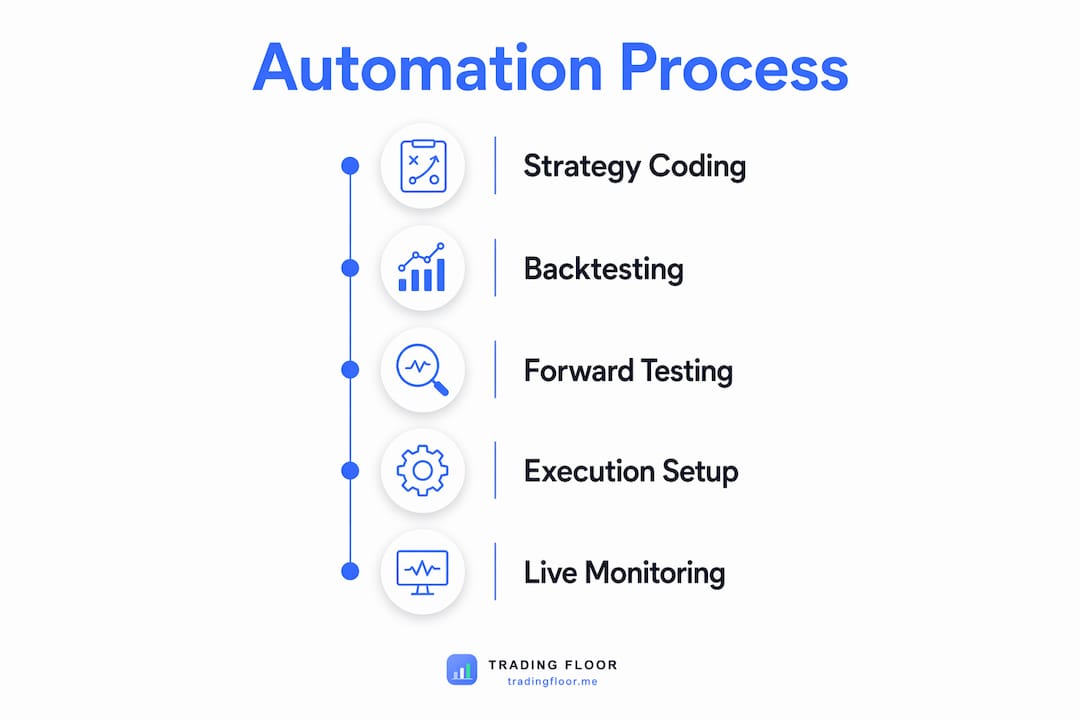
The full automation process spans five phases and typically takes 2–4 months to complete reliably. Rushing any phase increases the chance of a costly failure during the actual evaluation.
-
Convert your strategy to code. Write your IF-THEN rules in the scripting language of your chosen platform. Focus on clean logic first. Performance comes later. Every condition that a human trader would check manually must be represented in the code.
-
Backtest on historical data. Run your algorithm against at least 12 months of historical price data. Look for consistency across different market conditions, not just peak performance. A strategy that returns 30% in trending markets but loses 20% in ranging markets is not evaluation-ready.
-
Forward-test on a demo account for at least 30 days. Experts recommend a minimum 30-day forward-test before using any automated system in a live evaluation. Backtests cannot replicate real spread conditions, partial fills, or latency. A demo account running in real time catches these issues without risking capital.
-
Add safety features before going live. This step is non-negotiable. Your system needs a daily P&L monitor that halts all trading when floating and realized losses reach 4.5% of account balance. It also needs an equity peak watchdog that shuts down the bot if the account drops to 91% of its starting balance. These layered stop mechanisms prevent a single bad session from ending your evaluation.
-
Scale from micro to full size. Start with the smallest position size your platform allows. Confirm execution quality, fill times, and risk behavior match your demo results. Only then increase to your target position size.
| Phase | Key Activity | Minimum Duration |
|---|---|---|
| Strategy coding | Translate rules into executable code | 1–2 weeks |
| Backtesting | Historical data validation across market conditions | 1–2 weeks |
| Demo forward-testing | Real-time validation without capital risk | 30 days |
| Safety feature integration | Daily halt, equity watchdog, spread filters | Before any live use |
| Live scaling | Gradual size increase with performance monitoring | Ongoing |
Pro Tip: Add a partial-close feature to your code. Taking 50% off the table at a defined profit target locks in gains and reduces the risk of a winning trade reversing into a loss, which is one of the most common ways traders fail evaluations late in the cycle.
How does automation enforce discipline during prop firm evaluations?
Automation enforces discipline by making rule violations physically impossible. A human trader can decide to ignore a daily loss limit. A coded system cannot. That distinction is the core reason hard-coded daily loss halts and equity peak watchdogs represent the foundation of any serious evaluation automation.
The most common evaluation failures trace back to three behaviors: overtrading after a loss, increasing position size to recover, and holding trades through news events. Automation eliminates all three. The bot does not feel frustration. It does not chase losses. It executes the rules or it stops.
“Rigid enforcement of risk rules separates systematic trading from gambling. Hard-coded halts and equity watchdogs enforce discipline beyond what human willpower can sustain during a losing streak.”
For traders running multiple funded accounts simultaneously, automation also prevents correlated risk buildup. Without automation, a trader might open the same directional trade on five accounts at once without realizing the combined exposure. A coded system with a max open risk limit stops that from happening.
Automated systems also prevent these specific mistakes:
- Taking trades outside defined session hours
- Entering during high-spread news windows like NFP or FOMC releases
- Using forbidden strategies such as martingale or grid scaling
- Exceeding the maximum number of open positions allowed by the firm
- Holding trades over the weekend when the firm prohibits it
Pro Tip: Build a “kill switch” into your system that a human operator can trigger manually. Even fully automated systems benefit from a one-click shutdown in case of a broker outage, data feed failure, or unexpected market event. Risk controls must be hardcoded into your system, but a manual override adds a final layer of protection.
What are the most common pitfalls when automating trade execution?
Slippage is the most underestimated problem in automated evaluation trading. During high-impact news events, spreads can inflate 5–10 times their normal level. A system without spread filters will enter trades at those inflated spreads, turning a theoretically profitable setup into an immediate loss. Configure your bot to check the current spread against a maximum threshold before placing any order.
Insufficient forward-testing is the second most common failure point. Forward-testing on a demo account followed by small live accounts reveals slippage, latency, and execution problems that backtesting simply cannot replicate. Traders who skip this phase and go straight from backtest to evaluation almost always encounter surprises that cost them the account.
Watch for these additional pitfalls:
- Fixed lot sizing. Using the same lot size across accounts of different sizes creates wildly different risk profiles. Always use percentage-based sizing.
- No equity monitoring. A bot that keeps trading through a drawdown without a shutdown trigger will breach the evaluation’s maximum loss rule.
- Latency issues. Running your bot on a home computer with an unstable internet connection causes missed fills and double entries. A VPS located near your broker’s servers solves this.
- Overfitting. A strategy that performs perfectly on historical data but fails in live markets has been tuned too specifically to past price action. Test across multiple instruments and time periods.
- Ignoring platform updates. Broker or platform software updates can break your bot’s connection or change order syntax. Monitor your system after every update.
Pro Tip: Set a weekly review calendar reminder to check your bot’s trade log against your expected behavior. Automated does not mean unattended. Catching a logic error in week one costs far less than discovering it after a failed evaluation.
Key Takeaways
Automating trade execution during prop firm evaluations succeeds when rule-based logic, layered risk controls, and thorough forward-testing work together before a single evaluation dollar is at risk.
| Point | Details |
|---|---|
| Define rules before coding | Every entry and exit must be a binary condition, not a judgment call. |
| Forward-test for 30 days minimum | Demo testing catches slippage and latency issues that backtests miss. |
| Hardcode your risk limits | A daily halt at 4.5% and an equity watchdog at 91% of balance prevent evaluation failure. |
| Use percentage-based position sizing | Sizing at 0.5%–1% of balance keeps risk consistent across accounts of different sizes. |
| Filter news events with spread checks | Pausing during NFP and FOMC prevents slippage-induced losses at the worst possible times. |
Why I trust automation more than my own discipline during evaluations
The first time I failed a prop firm evaluation, it was not because my strategy was wrong. My strategy was sound. I failed because I took one extra trade after hitting my daily target, convinced I saw a “perfect setup.” That one trade wiped out three days of gains and ended the evaluation.
Automation fixed that problem permanently. The bot does not see perfect setups. It sees conditions that either match the rules or do not. That rigidity felt limiting at first. Over time, I realized it was the entire point. The evaluation is not testing whether you can find good trades. It is testing whether you can follow rules under pressure.
The traders I see struggle most with automation are the ones who treat it as a shortcut rather than a system. They skip forward-testing because backtests look good. They use fixed lot sizes because it is simpler. They do not build kill switches because they assume nothing will go wrong. Every one of those shortcuts has a predictable cost.
A hybrid approach works well for traders who are not ready to go fully automated. Automated scanning identifies setups that meet your criteria, and you approve each trade manually before execution. This combines human insight with automation in a way that still removes most of the emotional decision-making. It is a reasonable middle step before trusting a fully autonomous system with evaluation capital.
My honest recommendation is to spend more time on the risk architecture than on the entry logic. A mediocre entry with excellent risk controls will pass more evaluations than a brilliant entry with sloppy stops.
— KennyTrades
How Tradingfloor supports traders automating across multiple accounts
Managing automation across several evaluation accounts at once multiplies every risk and every opportunity. Tradingfloor is built specifically for this scenario. It mirrors the leader account’s net position across any number of funded and evaluation accounts in real time, not just signals, so every account reflects the same trade at the same moment.
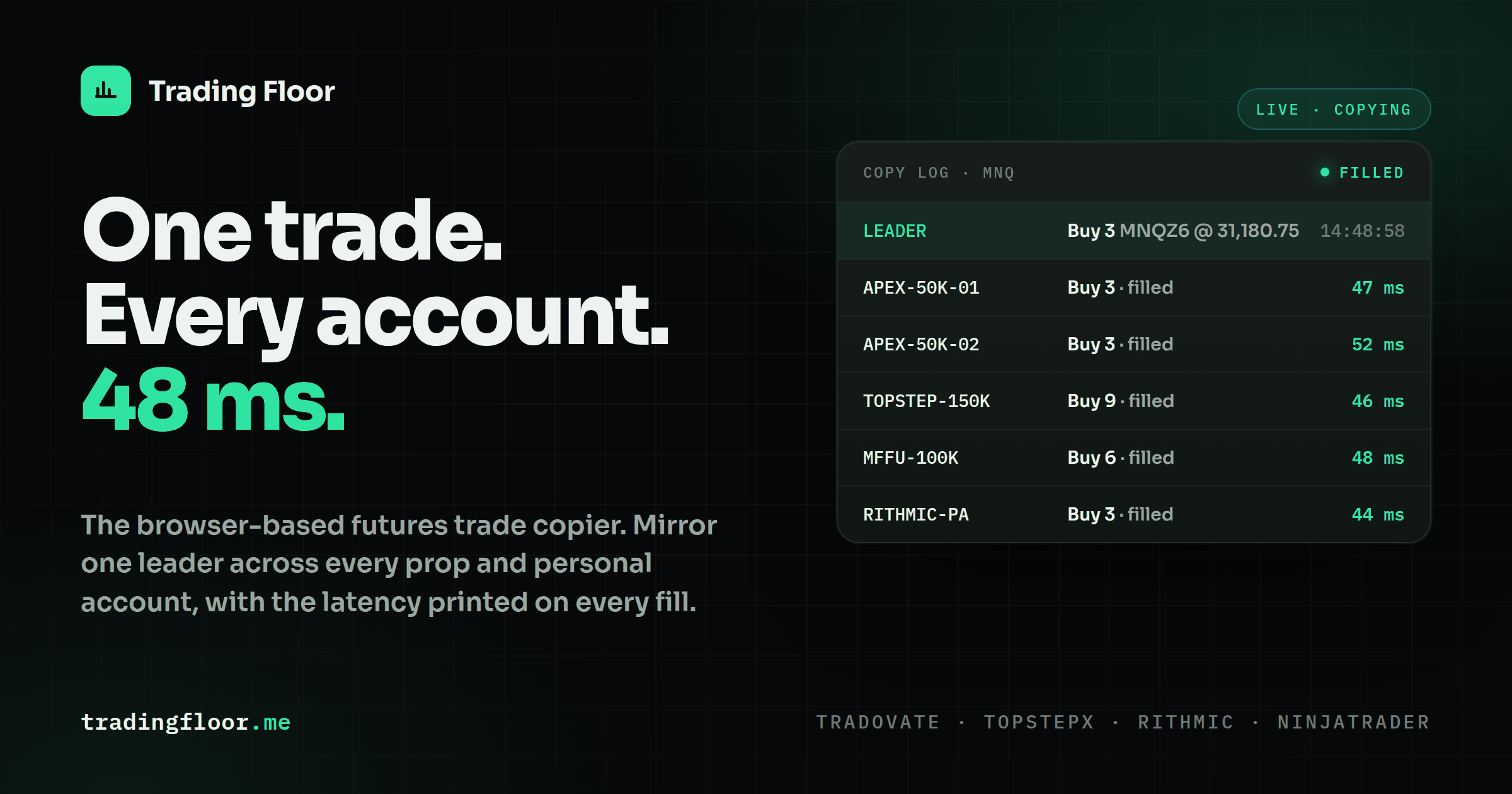
Tradingfloor runs in the cloud, which means no installation, no VPS dependency for the copying layer, and access from any device. It supports platforms including Tradovate and TopstepX, and includes trade limits and real-time notifications so you always know what each account is doing. For traders who want to manage multiple prop accounts without manually replicating every position, Tradingfloor handles the execution layer while you focus on the strategy. Check current platform status before your next evaluation session to confirm everything is running as expected.
FAQ
Is automated trading allowed during prop firm evaluations?
Most prop firms allow automated trading, but each firm’s terms of service define specific restrictions. Always confirm that your firm permits algorithmic systems and check for banned strategies like martingale or grid trading before deploying.
How long should I forward-test before using automation in an evaluation?
Experts recommend a minimum of 30 days of forward-testing on a demo account before using any automated system in a live evaluation. This period reveals real-world execution issues that backtesting cannot replicate.
What daily loss limit should my automated system enforce?
Set your automated halt at 4.5% of account balance to create a safety buffer below the typical 5% evaluation hard limit. This gap protects you from a single volatile trade breaching the firm’s rule before the system can react.
Can automation help me pass multiple evaluations at the same time?
Automation combined with a position-copying tool makes passing multiple evaluations simultaneously realistic. The key is ensuring each account has its own risk controls so a loss on one account does not cascade across the others.
What is the biggest mistake traders make when automating evaluation trades?
Skipping forward-testing is the most costly mistake. Traders who move directly from backtesting to live evaluation consistently encounter slippage, latency, and execution errors that a 30-day demo period would have caught and corrected.
Recommended
- Pass Multiple Prop Firm Evals at Once With One Strategy — Trading Floor
- Prop Trader Performance Optimization Explained — Trading Floor
- Types of Trading Evaluation Account Rules Explained — Trading Floor
- Multi-Account Trade Execution Explained for Prop Traders — Trading Floor
Trading Floor mirrors every trade across your Tradovate, TopstepX & Rithmic accounts in real time, from $25/mo.
Start copying →