OCO Copying That Survives a 30 Second Disconnect for Prop Traders

OCO order copying generally works one of two ways: the copier either builds a brand-new, broker-native bracket on each follower account, or it manages both legs itself and cancels them synthetically when one fills. Most platforms wait until the leader’s entry actually fills before pushing the take-profit and stop-loss legs to followers, which avoids orphaned exit orders sitting on an account with no position behind them. The real risk isn’t the copy logic itself. It’s the gap between leader and follower execution, where latency or a broker that doesn’t support native OCO can leave a follower half-protected for a few critical seconds.
TL;DR:
- Native OCO provides more reliable cancellation since the broker enforces order behavior server-side, but it requires broker support for native OCO APIs.
- Synthetic OCO works across brokers without native support but is more fragile, risking stale orders if connection drops before cancelation.
- Proper sequencing ensures TP and SL legs only attach after follower entries are confirmed filled to prevent orphaned orders and quantity mismatches.
- Monitoring round-trip latency, order type support, and partial fills helps identify issues early, avoiding unnoticed risk or order drifts.
- Verifying copies with receipts including timestamps, order IDs, and fill data enables transparent reconciliation and dispute resolution.
Table of Contents
- What Is OCO Order Copying in a Trade Copier?
- How Does OCO Replication Actually Work?
- Native OCO vs Synthetic OCO: Which Holds Up Better?
- When Do TP and SL Legs Actually Get Copied?
- What Goes Wrong, and How Do You Catch It Early?
- Setting Copy Ratios and Per-Account Risk Caps
- What API Features Do You Need to Support OCO Copying?
- How Do You Verify That an OCO Was Actually Copied Correctly?
- How Trading Floor Handles OCO Replication and Audit Trails
- A Practical Checklist Before You Trust Any Copier With Live Accounts
- Get OCO Copying That Holds Up on Funded Accounts
- Sources
What Is OCO Order Copying in a Trade Copier?
An OCO (one-cancels-the-other) order pairs two conditional orders so that filling one automatically cancels the other. Traders use it to combine a stop-loss and a take-profit on the same position, so the trade exits cleanly whether price moves in their favor or against them. That’s the standard definition. OCO order copying is a narrower, more operational problem: how does a trade-copying platform recreate that same paired-order behavior on ten, fifty, or two hundred follower accounts, in real time, without any of them ending up with a stop that never got a matching take-profit, or vice versa?
It matters more in futures and prop trading than almost anywhere else. A retail trader running one account can eyeball their bracket order and adjust manually if something looks off. A prop firm account manager running the same strategy across fifteen funded accounts on Tradovate, TopstepX, and Rithmic cannot watch fifteen screens at once. The copier has to get the OCO replication right on every account, every time, or someone ends up holding uncovered risk without realizing it until the drawdown shows up.
Coinbase’s explanation of OCO orders frames the tool around managing volatility, entering on a breakout while protecting against a retracement in the same order structure. That’s useful context, but copying multiplies the complexity: now the platform has to interpret the leader’s OCO event correctly and translate it into a matching structure on every connected account, each of which might sit on a different broker with different order-type support.
How Does OCO Replication Actually Work?
Trade copiers use one of two architectures to reproduce an OCO on follower accounts, and the choice shapes everything downstream, from latency exposure to how the system behaves if it briefly loses connectivity.
Native OCO replication sends an actual OCO order to the follower’s broker through the API. The broker itself enforces the cancel behavior. If the take-profit leg fills, the broker cancels the stop-loss leg server-side, with no dependency on the copier staying connected.
Synthetic OCO replication works differently. The copier places two separate orders on the follower account and tracks both legs itself. When one fills, the copier sends a cancel request for the other. This is the only route available when a broker’s API doesn’t expose native OCO support, which is more common than most traders assume, particularly among prop firm platforms still building out their order-routing infrastructure.
Sizing is a separate decision layered on top of replication. Copiers generally support two models:
- Proportional (ratio-based) copying, where a follower account trades a fixed percentage of the leader’s size, useful when accounts have different balances or evaluation stages.
- Absolute sizing, where every follower account copies the exact same contract quantity regardless of account size, common when managing multiple accounts at the same funding tier.
The timing decision matters as much as the architecture. Many copiers deliberately delay copying the TP/SL legs until the leader’s entry order actually fills, rather than copying the full bracket the instant it’s submitted. The logic is straightforward: if the leader’s entry order for the OCO gets rejected, cancelled, or never fills, a follower shouldn’t be sitting there with a stop-loss or take-profit attached to a position it never actually opened. That’s an orphaned order, and it’s one of the more common bugs in cheaper copier implementations.
Native OCO vs Synthetic OCO: Which Holds Up Better?
Neither approach is universally better. Each has a specific failure point, and knowing which one you’re exposed to changes how you monitor your accounts.
Native OCO’s advantage is durability. Because the broker enforces the cancel behavior server-side, the bracket survives a dropped connection between the copier and the follower account. If the copier’s server hiccups for thirty seconds, the OCO on that follower account keeps functioning exactly as the broker built it to. The tradeoff is dependency: the broker has to actually support native OCO through its API, and not every futures broker or prop firm platform does. For more insights, see Market vs Limit Futures: When Futures Traders Should Use Each.
Synthetic OCO gives the copier more control. It can layer in features a broker’s native order type doesn’t support, like trailing adjustments or conditional logic tied to account-level rules. The cost is fragility. If the copier’s connection drops at the exact moment one leg fills, the cancel instruction for the other leg might never get sent, leaving a follower account with a stale order resting in the market.
- Native OCO tends to perform better on brokers with mature, well-documented order APIs where uptime and cancel-guarantee matter more than custom logic.
- Synthetic OCO tends to perform better when a copier needs to support brokers with limited native order types, or when advanced per-account rules need to override standard bracket behavior.
Pro Tip: Ask any copier vendor directly whether OCO replication on your specific broker is native or synthetic. Many won’t volunteer this distinction unprompted, and it’s the single biggest predictor of what happens to your accounts during a disconnect.
When Do TP and SL Legs Actually Get Copied?
The sequence of events between a leader’s order and a follower’s fill determines how much exposure a follower carries during the gap. Here’s the typical event chain:
- The leader submits an entry order, often as part of a bracket that includes the OCO exit legs.
- The leader’s broker fills the entry order and reports the fill back through the broker’s API.
- The copier receives that fill event, usually through a webhook or a polling check depending on platform architecture.
- The copier translates the fill into follower-side entry orders, scaled by whatever copy ratio or absolute size rule is active on each account.
- Once follower entries are confirmed filled, the copier attaches the TP/SL legs, either as a native OCO on the follower’s broker or as two tracked synthetic orders.
That sequencing exists specifically to avoid step five happening before step four resolves. If a follower’s entry order is still pending, or partially filled, attaching a full-size exit bracket too early creates a mismatch between position size and protection size.
Partial fills complicate this further. If a follower’s entry only fills 60% of the target quantity, the OCO legs need to scale to that actual filled amount, not the intended amount. Time-in-force mismatches add another layer. Fidelity’s documentation on conditional orders notes that OCO legs generally need matching time-in-force settings, and a follower broker that defaults differently than the leader’s broker can create legs that expire out of sync with each other. Broker-to-broker latency differences, meanwhile, mean a follower on a slower API might see its entry confirmed several hundred milliseconds after a follower on a faster one, a gap that matters more than it sounds like in fast-moving futures contracts.
What Goes Wrong, and How Do You Catch It Early?
Copying bracket orders across multiple accounts is widely considered the hardest problem trade copiers solve, precisely because timing, partial fills, and broker API differences compound on top of each other rather than showing up as one clean failure. Here’s what actually breaks in practice.
Latency and race conditions. If the gap between leader fill and follower order placement grows too wide, a follower can end up entering at a materially worse price, or missing the fill window entirely on a fast-moving contract. Monitoring round-trip time between leader event and follower confirmation catches this before it becomes a pattern.
Broker feature mismatches. Not every broker supports every order type a leader account might use. A copier needs to detect this ahead of time, not discover it mid-trade, and fall back to a synthetic approach or reject the copy with a clear alert rather than silently failing.
Partial fills and rounding. When proportional sizing produces a fractional contract count, rounding decisions need consistent rules, and the OCO legs need to reconcile against the actual filled quantity, not the requested one.
MaxQty conflicts. A follower account with a hard maximum position cap can reject a copied order outright if the sized trade exceeds it, which needs to trigger a visible alert rather than a quiet failure.
- Set slippage caps so a follower doesn’t chase a fast market far past the leader’s fill price.
- Apply hard per-trade quantity limits independent of the copy ratio calculation.
- Build in auto-unlink logic that disconnects a follower from the leader if abnormal behavior, like repeated rejected orders, gets detected.
Pro Tip: If your copier doesn’t surface a visible alert the moment a copied order gets rejected, you’re relying on noticing a missing position in your account list. That’s not a monitoring strategy, that’s luck.
Setting Copy Ratios and Per-Account Risk Caps
Getting the sizing rules right is what keeps a leader’s strategy from turning into an uncontrolled multiplier across a fleet of follower accounts. Copy trading platforms generally structure this around a ratio, with per-trade filters and drawdown-based unlinking layered on top as safety nets.
For prop trading account managers, a few practical patterns hold up well:
- Proportional sizing works best when follower accounts sit at different balance tiers, since a fixed ratio scales the position to what each account can actually absorb.
- Absolute sizing works better when managing several accounts at the same funding stage, where uniform contract counts make performance easier to compare account to account.
- Per-account caps should sit independent of the ratio calculation. A cap of, say, three contracts per account regardless of what the ratio math produces gives you a hard ceiling that survives a leader sizing mistake.
- Maximum concurrent position limits prevent a copier from stacking multiple OCO brackets on the same follower account faster than the account can reasonably manage.
Net-position mirroring, where the copier tracks the leader’s aggregate position and adjusts followers to match that net exposure, tends to suit single-strategy accounts well. Per-account clones, where each follower runs an independent copy of every individual leader trade, suit setups where account managers want granular, trade-by-trade visibility across a group rather than a blended net view. Which model fits depends less on preference and more on how the accounts are actually structured and audited.
What API Features Do You Need to Support OCO Copying?
Supporting reliable OCO copying isn’t primarily a strategy problem, it’s an integration problem, and the API surface a copier depends on determines how much of this article’s failure modes actually show up in production.
At minimum, a copier needs order create, replace, and cancel endpoints for every connected broker, along with real-time order-state webhooks rather than slow polling loops, and accurate fill reports that include partial-fill quantities. Platform-level documentation like Trading Technologies’ OCO order specs is a useful reference point for how mature order-routing systems structure stop-child behavior and triggering logic.
- Detect whether a broker supports native OCO before attempting to place one, and fall back to synthetic tracking automatically rather than failing silently.
- Map each broker’s order-type vocabulary to a common internal schema, since “OCO,” “bracket,” and “conditional order” don’t always mean the exact same API behavior across platforms.
- Run sandbox tests that specifically reproduce race conditions: delayed fill confirmations, dropped webhook events, and simulated network partitions between the leader feed and follower execution.
- Test partial-fill scenarios explicitly, since this is where rounding and quantity-mismatch bugs surface most often before they reach live accounts.
Skipping sandbox testing on these specific scenarios is how bugs end up discovered by a live funded account instead of a QA environment.
How Do You Verify That an OCO Was Actually Copied Correctly?
Auditability is what separates a copier you can trust with a funded account from one you’re just hoping works. At minimum, every copied OCO needs a receipt that captures the leader’s original timestamp and order ID, the resulting follower order IDs, fill timestamps on both sides, and cancel confirmations for whichever leg didn’t execute.
Receipts matter most when a dispute happens, whether that’s an evaluation account flagged for a rule violation or a manager reviewing why a follower account’s exit didn’t match the leader’s. A receipt with hard timestamps and order IDs resolves that conversation in minutes instead of becoming a back-and-forth guessing exercise.
| Reconciliation check | What it catches |
|---|---|
| Order count parity | A follower missing an OCO leg the leader placed |
| Fill parity | A follower filled at a materially different time than the leader |
| Quantity parity | Rounding or proportional sizing errors between leader and follower |
| Alert threshold breach | Any parity check failing beyond a set tolerance window |
Running these checks hourly, rather than only after something looks wrong, catches drift before it compounds across a full trading session.
How Trading Floor Handles OCO Replication and Audit Trails
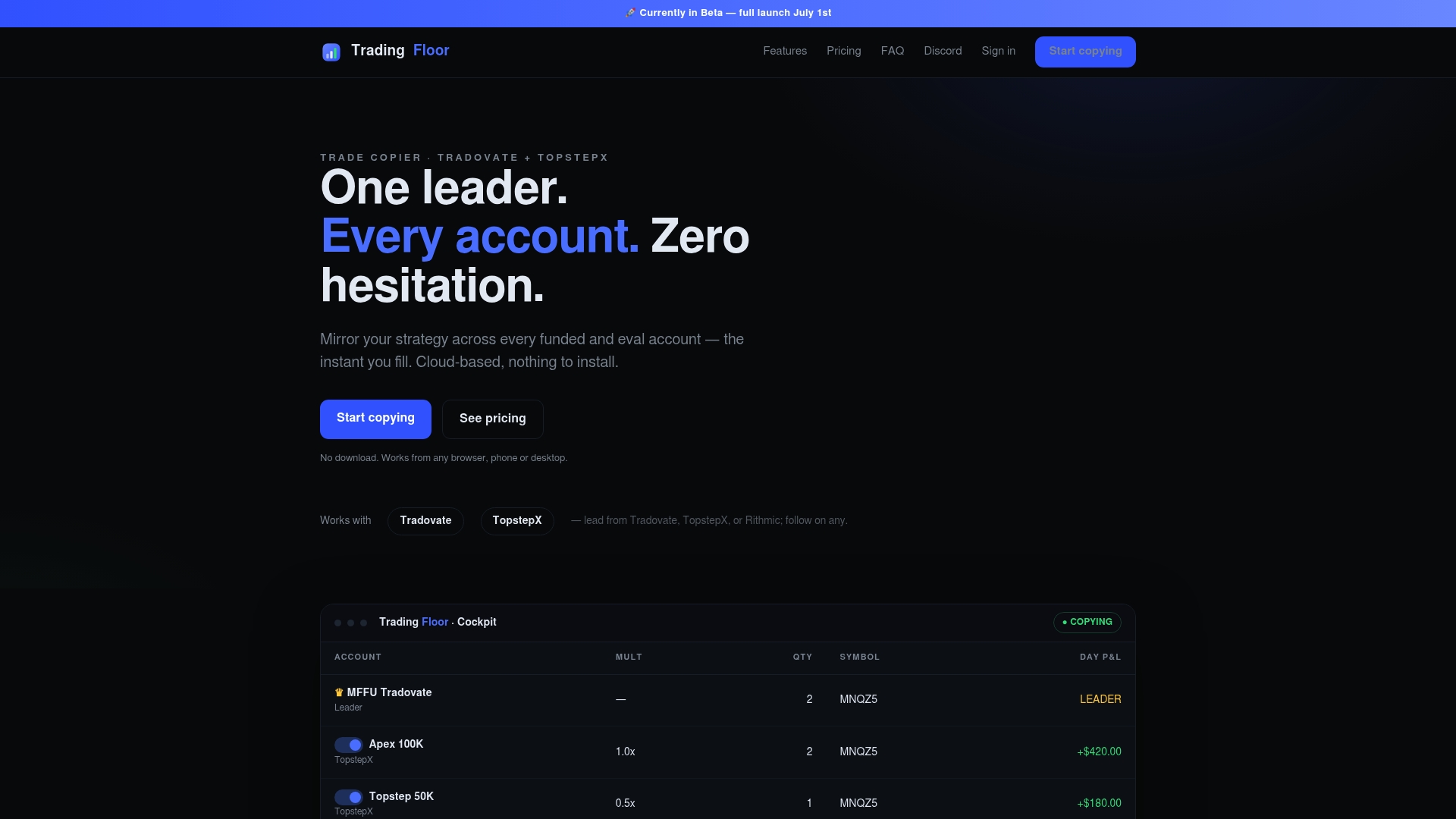
Trading Floor mirrors a leader’s net position across every connected funded and evaluation account, rather than just relaying signals, which keeps OCO legs tied to actual filled positions instead of speculative copies. Every account carries its own per-account risk controls, including hard quantity caps that address the MaxQty conflicts covered earlier, and every copy generates a receipt with timestamps and order IDs, which is exactly the reconciliation data funded account disputes require.
The platform runs across Tradovate, TopstepX, and Rithmic without requiring separate installations per broker, addressing the feature-mismatch problem directly by handling broker-specific order routing behind a single interface. For account managers running the same strategy across multiple Take Profit Trader accounts or a group of Earn2Trade evaluations, that consistency is what turns OCO copying from a manual monitoring job into something a receipt log can verify on its own.
A Practical Checklist Before You Trust Any Copier With Live Accounts
Test native OCO behavior in a sandbox environment before funding a single live account. If the copier can’t show you what happens when a broker connection drops mid-trade, that’s a gap you’ll discover the expensive way instead.
Enable follower protection settings wherever the platform offers them, set hard per-account caps independent of your ratio math, and check receipts against your own fill records at least once an hour rather than trusting the dashboard blindly. Run a stress test that simulates a delayed cancel confirmation and watch how the system responds. Most vendors haven’t been asked to demonstrate this, which tells you something on its own.
None of this replaces understanding your own strategy’s risk profile. It just makes sure the copier isn’t quietly introducing new risk you never signed up for.
— KennyTrades
Get OCO Copying That Holds Up on Funded Accounts
Most copiers treat OCO replication as an afterthought bolted onto simple entry copying, which is exactly where the failure modes covered above tend to surface. Trading Floor was built around position mirroring first, so TP/SL legs stay tied to a follower’s actual filled quantity rather than a guess, and every copy generates a receipt you can reconcile against your own broker statements instead of taking the dashboard’s word for it.
Per-account risk controls, including hard quantity caps and slippage limits, run independently on every connected account, whether that’s a group of TopstepX accounts or a mix of funded and evaluation accounts across different prop firms. If you’re currently piecing together OCO behavior manually or outgrowing a copier that doesn’t support native brackets on your broker, start with the TradeSyncer alternative page, where plans start at $25/month and every plan includes receipts on every single copy.
Sources
Investopedia’s breakdown of the OCO order structure remains the clearest starting point for the base mechanics before layering on copying complexity. Coinbase’s trader-facing explanation covers practical use cases like breakout and retracement setups, while TrendSpider’s learning center entry walks through common OCO variations traders build in practice. Fidelity’s conditional order documentation is worth reading for the time-in-force rules that trip up cross-broker copying setups more often than most traders expect.
- Forex Copy Trading Explained: How It Works | SignalBots Blog
- What Is A Conditional Order? - Fidelity
Recommended
- Trades Copied Right: Real-Time Mirroring for Prop Traders
- How to Automate Position Copying in Prop Trading
- Trading Account Delegation Best Practices for Prop Traders
- How to Copy Trades Across Multiple Prop Firm Accounts Like TopstepX
Trading Floor mirrors every trade across your Tradovate, TopstepX & Rithmic accounts in real time, from $25/mo.
Start copying →