Trading Account Delegation Best Practices for Prop Traders
The safest way to delegate trading across accounts is to run a leader/follower copier that enforces per-account risk caps, resolves symbol and lot differences automatically, and produces a receipt for every copied trade. Before connecting anything live, confirm three things: your prop firms allow copy trading in writing, each follower account has its own drawdown guard rather than inheriting the leader’s, and the system (whether that’s a setup on Trading Floor, running through Rithmic, TopstepX, or Tradovate) generates per-copy receipts you can audit later. A common working rule caps combined exposure at a low percentage of your total funded capital across accounts, and pairing that with JournalX-style trade journaling gives you a paper trail if a firm ever questions a fill.
Key Takeaways
Safe trading account delegation depends on per-slave risk caps, verified symbol and lot mapping, and a documented audit trail confirmed on demo before any live deployment.
| Point | Details |
|---|---|
| Confirm copy-trading clauses | Get written confirmation from every prop firm before mirroring trades across their accounts. |
| Enforce risk at the slave level | Never rely on the leader account’s drawdown settings to protect a follower’s different structure. |
| Test mismatched conditions | Run the full trade lifecycle on demo using deliberately different brokers and account sizes. |
| Cap portfolio exposure | Treat all accounts as one portfolio and set an aggregate risk ceiling rather than sizing accounts independently. |
| Use Trading Floor’s built-in controls | Per-copy receipts, per-slave drawdown caps, and multi-broker mapping are configured directly in the platform. |
Where to go for further documentation
- JP Trading Capital’s copier mechanics guide for mapping and reconciliation detail.
- Prop firm support channels for written copy-trading confirmations before going live.
Table of Contents
- What Should You Confirm Before Connecting Live Accounts?
- What Technical Pitfalls Break Naive Trade Copying?
- How Do You Protect Each Funded Account From Correlated Risk?
- How Do You Test a Copier Before Going Live?
- What Should You Monitor Once Copying Is Live?
- How Trading Floor Maps to This Checklist
- Frequently Asked Questions
- Sources
What Should You Confirm Before Connecting Live Accounts?
Run through this list before you flip any account from demo to live copying. Skipping even one item here is how traders end up with a flattened account and no record of why.
- Get the copy-trading clause in writing. Email support at every prop firm you use and ask directly whether mirrored positions across evaluation and funded accounts are permitted, then save the reply.
- Validate symbol mapping for every broker pair. Tradovate and Rithmic often name the same futures contract differently, and a naive string match will silently skip trades.
- Choose one sizing mode and document it. Balance-proportional, fixed multiplier, and fixed lot each behave differently when account sizes don’t match, so pick one and write down your rounding policy.
- Set drawdown caps on the follower side, not just the leader side. A follower with a trailing drawdown needs its own guard regardless of what the leader account allows.
- Confirm receipts and reconciliation logs are actually being generated. If you can’t produce a log of every copied trade after the fact, you don’t have an audit trail, you have a hope.
What Technical Pitfalls Break Naive Trade Copying?
Most copier failures aren’t dramatic. They’re small mismatches that compound over a session until a follower account looks nothing like the leader’s actual exposure.
Symbol mapping is the first place things break. A leader trading “ES” on one platform needs that mapped correctly to whatever suffix or contract code the follower’s broker uses. A copier that matches strings instead of resolving broker-specific symbol tables will simply drop the trade, and you won’t notice until you reconcile at day’s end. The JP Trading Capital breakdown of copier mechanics covers this resolution step in detail, including how lot sizes need to convert to each follower’s lot step and clamp to that broker’s allowed increments.
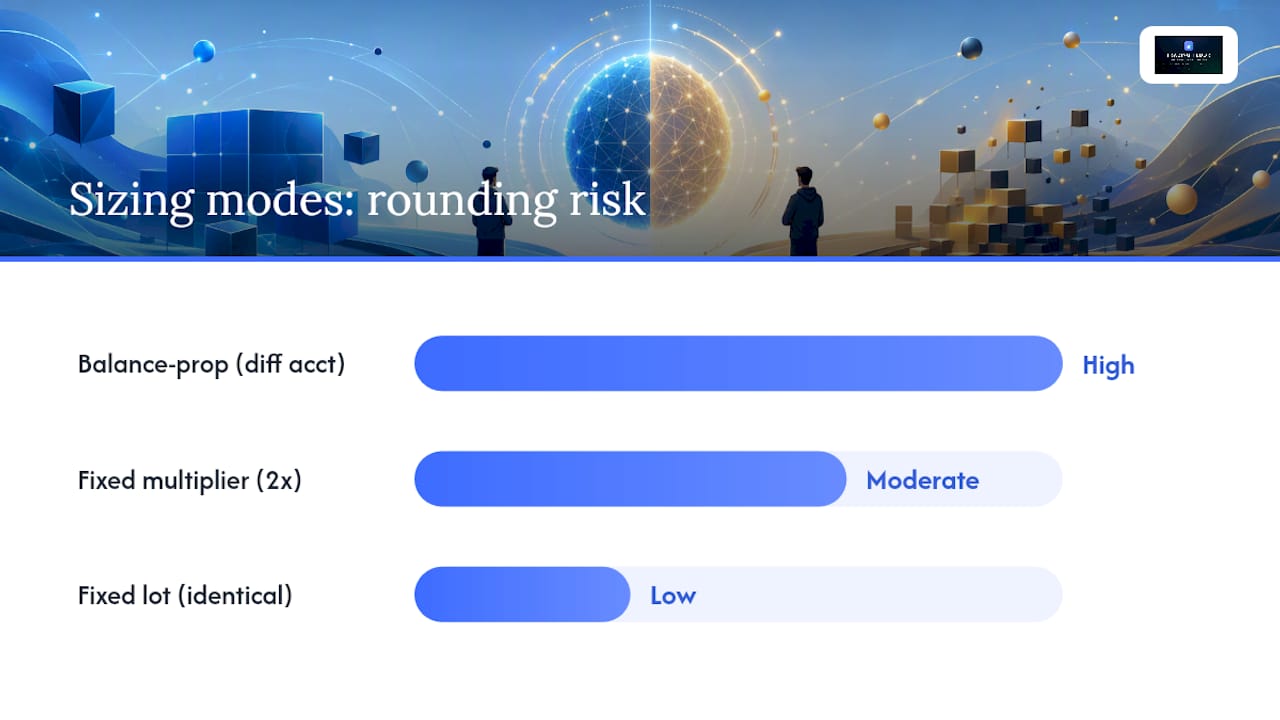
Lot sizing is where the rounding problem shows up. If your master account risks 3 contracts and a follower is sized at one-tenth the capital, the proportional calculation might compute 0.3 contracts, which rounds to zero. That’s not a bug, it’s a policy decision, and you need to decide in advance whether a zero-lot trade gets skipped silently or flagged for your attention. Supported sizing modes generally fall into three camps, and each behaves differently at the edges:
| Sizing mode | Best fit | Rounding risk |
|---|---|---|
| Balance-proportional | Accounts of different sizes tracking the same risk percentage | High when the ratio between accounts is large |
| Fixed multiplier | Accounts you want scaled by a set factor (2x) | Moderate, predictable but can still hit zero on small accounts |
| Fixed lot | Accounts where you want identical contract counts regardless of size | Low, but ignores actual risk parity between accounts |
Beyond sizing, every stop and target needs translating to the follower broker’s minimum stop distance, and any adjustment the copier makes should land in the audit trail. This matters even more once a trade is already open. Partial closes, stop-to-breakeven moves, and trailing stop updates all need to propagate as modify events, not just the initial entry. A copier that only mirrors opens and closes but ignores modifications will leave your followers holding stale stops while the leader has already moved to breakeven.
Reconciliation after a disconnect is the last piece. If a follower drops connection mid-session, the copier needs to compare current positions against the leader’s state on reconnect and fill only the gap, never re-copying trades that already filled. That reconciliation is a core behavior worth testing described in the JP Trading Capital guide, and it’s one of the four things practical testing tends to focus on: zero-lot handling, symbol mapping accuracy, disconnect reconciliation, and whether each slave can enforce its own risk cap independently.
Pro Tip: Force a disconnect mid trade on a demo follower, then reconnect and check whether the position matches the leader exactly. If it double-fills or misses the close, you’ve found the bug before it costs you a real account.
How Do You Protect Each Funded Account From Correlated Risk?
Copying the same trade to five funded accounts doesn’t diversify anything. It multiplies your exposure to the exact same market move five times over, which is the single most common way multi-account traders blow past a firm’s daily loss limit without realizing it until the numbers are in.
Per-slave drawdown caps have to be enforced on the follower account itself, not inherited from the leader’s settings. This matters because follower accounts frequently run different drawdown structures. One evaluation account might use a trailing drawdown while a funded account on the same setup uses a fixed one, and treating them identically because they’re copying the same leader is a mistake copier reliability testing specifically flags as essential to check.
A working aggregate ceiling that many multi-account traders start with is capping total open risk across all accounts at a low percentage of combined funded capital, then adjusting from there based on how correlated your instruments actually are.
Treating your accounts as a single portfolio rather than independent silos is the mindset shift that matters most here, and the portfolio approach outlined by NexusFi Academy walks through the exposure math and a staged plan for adding accounts only after consistent payouts.
Before going live, get these items confirmed in writing from every prop firm:
- Whether copy trading across your own accounts is explicitly permitted.
- Any cap on how many accounts one household or trader can hold simultaneously.
- Hedging restrictions that might conflict with mirrored positions across accounts.
- How identical fills across accounts are treated during payout review.
Your audit trail needs to cover per-copy receipts, reconciliation logs, and visible order rejections, including exactly what happens on a margin call. Define the policy now: does the copier flatten the position, pause copying to that account, or just notify you? Waiting until it happens live to decide is how a small rejection turns into an account breach.
How Do You Test a Copier Before Going Live?
Run this protocol on demo accounts with a broker mismatch intentionally built in, not on accounts that happen to match perfectly. A copier that only works when conditions are identical hasn’t been tested at all.
- Open a trade on the leader and confirm the follower opens with correctly mapped symbol and translated lot size.
- Partially close the leader position and verify the follower’s partial close matches proportionally.
- Move the leader’s stop to breakeven and confirm the modify event propagates without delay.
- Add a trailing stop on the leader and watch whether the follower’s stop tracks it correctly.
- Close the leader position fully and check that the follower closes with no residual contracts left open.
- Disconnect the follower mid-sequence, reconnect, and confirm no duplicate fills or missed fills occurred.
- Size the follower at a deliberate mismatch, something like a 1:10 ratio against the leader, and confirm rounding behaves per your documented policy rather than silently vanishing.
Testing on genuinely mismatched demo accounts, as the JP Trading Capital protocol recommends, is what surfaces bugs a same-broker test never will. Any step that produces a duplicate fill, a missed modify, or a silent zero-lot trade counts as a failure, and the remediation is the same every time: stop, fix the mapping or rounding rule, and rerun the full sequence before touching a live account.
Pro Tip: Run one leg of your test through Rithmic and the other through Tradovate on a VPS close to your broker’s servers. Latency differences between platforms are where reconciliation bugs actually surface, not on your home connection.
What Should You Monitor Once Copying Is Live?
Going live isn’t the finish line. It’s when monitoring becomes the job.
Watch per-account P&L, drawdown against each account’s specific threshold, aggregate open-position exposure across your whole portfolio, and any rejected or unfilled orders in real time. Independent connectivity checks matter here too. Monitoring your Rithmic or Tradovate connection separately from the copier itself is what the PropFolio guide to managing multiple accounts recommends, since a stuck order can look fine on your screen while the underlying connection has already dropped.
Automate the response, don’t rely on catching it manually:
- Auto-flatten and lock any follower account that breaches its drawdown cap.
- Apply a portfolio-level daily loss kill switch across all connected accounts.
- Randomize submission order slightly across followers to avoid systematic queue bias favoring one account every time.
In fast markets, partial fills and latency-driven desync between leader and follower are common enough that they deserve their own watch list, not just an occasional glance. Reconcile every session against your per-copy receipts and keep those reconciliation reports for payout review later.
Why do the fundamentals matter more than the feature list?
Correlated risk, not bad strategy, is what actually blows up multi-account traders. Discipline in reconciliation and drawdown enforcement beats chasing another feature every time.
How Trading Floor Maps to This Checklist
You don’t need to build this infrastructure from scratch. Trading Floor is the copier built specifically for prop traders juggling funded and evaluation accounts across different brokers, and its whole feature set exists to answer the checklist above without you writing a line of code.
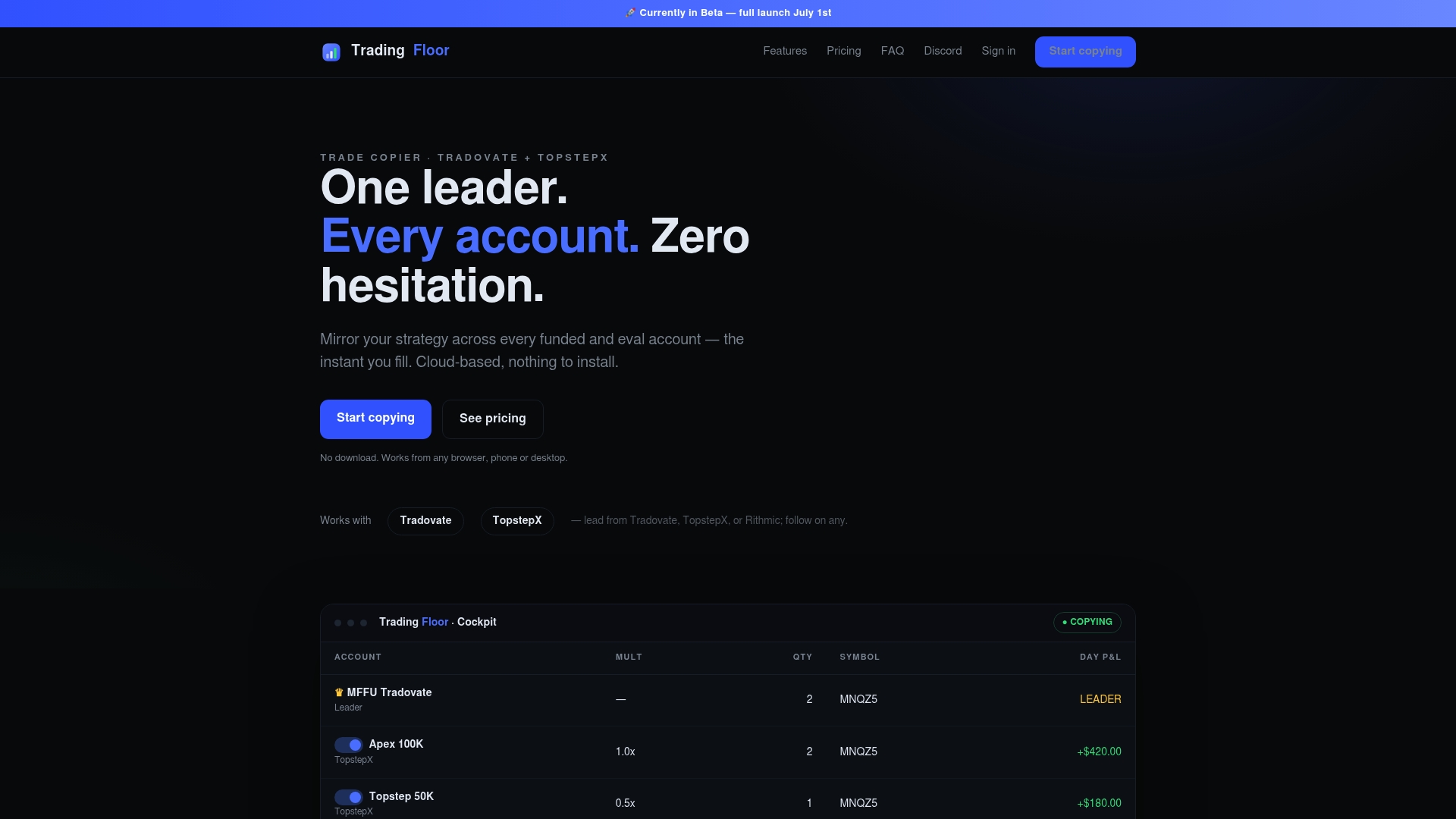
Every copied trade generates a per-copy receipt, which means your audit trail exists automatically instead of something you have to reconstruct after the fact. Per-slave drawdown caps sit on each follower account independently, so a trailing-drawdown evaluation account and a fixed-drawdown funded account never share risk logic they shouldn’t. Symbol mapping and auto-reconciliation are built in for supported platforms including Tradovate and Rithmic, so the mismatches that break naive copiers get resolved before they ever hit your followers. Push notifications flag rejections and margin events as they happen, not after you’ve already lost the window to react.
If you’re ready to see how it holds up under the exact mismatched-broker test protocol described above, the TradeSyncer alternative on Trading Floor starts at $25 per month and gives you a demo environment to run those disconnect, rounding, and modify-propagation tests yourself before connecting a single live account.
Frequently Asked Questions
What is the single most important rule for trading account delegation best practices? Enforce risk limits on each follower account independently rather than trusting that the leader account’s settings will protect every connected account equally.

Can I copy trades between a funded account and an evaluation account? Only if the specific prop firm permits it in writing. Policies vary by firm, and some restrict identical fills across accounts during payout review.
What happens when a copier’s calculated lot size rounds to zero? That depends on your documented policy. Some setups skip the trade silently, others flag it for manual review. Decide this before going live, not after it happens.
How do I prevent duplicate fills after a follower disconnects? Test reconciliation on demo by disconnecting mid-trade and reconnecting to confirm the copier fills only the gap rather than re-copying trades that already executed.
Does Trading Floor support both Tradovate and Rithmic accounts? Yes. Trading Floor supports multi-broker connections including Tradovate and Rithmic, with symbol mapping and auto-reconciliation built in for supported platforms.
Sources
- Trade copier (how it works) — JP Trading Capital blog
- Managing Multiple Funded Accounts: The Portfolio Approach to Prop Firm Trading - NexusFi Academy
Recommended
- Multi-Platform Trading Best Practices for Prop Traders — Trading Floor
- Prop Trading Leader Accounts: What Funded Traders Need to Know — Trading Floor
- Multi-Account Trade Execution Explained for Prop Traders — Trading Floor
- Best prop.tradovate.com Alternatives for Multi-Account Prop Traders — Trading Floor
Trading Floor mirrors every trade across your Tradovate, TopstepX & Rithmic accounts in real time, from $25/mo.
Start copying →