Why Prop Traders Need Error Reduction to Pass Challenges

Error reduction is what separates traders who pass prop-firm challenges from traders who fund the industry. Most evaluation failures trace back to rule breaches and behavioral mistakes, not bad strategy. A trader with a mediocre edge and tight error control clears a challenge more often than a trader with a great edge and loose discipline, because a single oversized position or one revenge trade against a daily loss limit ends the attempt regardless of how sound the underlying system is.
The rules doing the damage are almost always the same three: maximum drawdown, daily loss limits, and position-sizing caps. Break any one of them once, and the account is done. That is why error budgets work better than vague resolutions to “trade better.” An error budget treats mistakes as a countable resource, the same way an engineer treats system downtime, and it forces a shutdown before a bad session turns into a blown account.
Here are five moves you can put in place before your next session:
- Cap yourself at a small number of process errors per day, such as missed checklist items, late stop adjustments, or sizing miscalculations, and stop trading when that limit is hit.
- Run a pre-trade checklist on every single entry, no exceptions, even on the trades that feel obvious.
- Log every trade within 10 minutes of the close, including your emotional state and whether you followed your rules.
- Automate multi-account sizing so a manual sizing mistake on one account cannot happen on your others.
- Set a hard daily-loss alert at 50% of the firm’s limit, not the limit itself, so you have room to react.
Key Takeaways
Error reduction determines prop-challenge outcomes more than strategy quality does, because rule breaches and behavioral mistakes, not weak edges, cause most failed evaluations.
| Point | Details |
|---|---|
| Cap daily process errors | Enforce a three-error limit per day and stop trading immediately once you hit it. |
| Log trades within 10 minutes | Immediate logging with reason codes prevents recurring violations from going unnoticed. |
| Watch discipline score daily | Trigger a cooldown if checklist compliance drops below 90% across recent trades. |
| Fix one error type at a time | Apply the rule of three, then confirm the fix with 30 clean days before moving on. |
| Automate multi-account sizing | Trading Floor mirrors positions with per-account risk controls and auto-reconciliation, closing the manual-entry gap that causes sizing breaches across funded accounts. |
Table of Contents
- Why Prop Traders Need Error Reduction More Than a Better Strategy
- Common Reasons Traders Fail Prop-Firm Challenges
- Key Prop-Firm Rules and How Specific Errors Break Them
- Behavioral Errors That Wreck Otherwise Solid Trading
- Preparation Checklist Before Your Prop-Firm Challenge Starts
- In-Challenge Tactics That Cut Execution and Process Errors
- How Trade Syncing Cuts Errors Across Multiple Funded Accounts
- Warning Signs to Watch During Your Evaluation
- Post-Failure Analysis: The Review Most Traders Skip
- Choosing a Strategy That Fits Prop-Firm Rules
- Cut Multi-Account Errors With Automated Trade Syncing
- Sources
Why Prop Traders Need Error Reduction More Than a Better Strategy
Prop-firm challenges are pass/fail systems built around risk rules, not profit contests. That structure rewards consistency and punishes variance harder than any retail account ever would. A retail trader who blows through a stop and takes a bad loss just has a bad day. A challenge trader who does the same thing on the wrong day fails the evaluation outright, often with weeks of solid trading erased by one lapse.
This is the part most new challenge traders miss. Your strategy’s win rate matters less than your error rate, because the firm is not grading your best trades. It is watching for the one moment you break a rule. A pre-trade checklist run consistently can prevent roughly 90% of avoidable manual errors, according to one detailed breakdown of checklist mechanics, but only when it is applied without exception. The traders who skip it occasionally are often the ones explaining a failed evaluation later.
Common Reasons Traders Fail Prop-Firm Challenges
The failure patterns repeat across firms and platforms because the underlying causes are human, not technical. Here is the priority order, from most to least common:
- Rule breaches on drawdown or daily loss. A trader gets close to the daily limit, takes one more trade to “get back to even,” and crosses it.
- Oversizing and over-leveraging. Confidence after a winning streak leads to a position two or three times the normal size, and one adverse move erases days of gains.
- Revenge trading. A loss triggers an immediate re-entry meant to recover the loss fast, usually with worse setup quality and larger size.
- Overtrading. Boredom or impatience during slow markets produces trades that would never pass a normal filter, each one chipping away at the daily limit.
- Mistaken stop placement. A stop set at the wrong tick, on the wrong side, or left off entirely during a fast market.
- Platform and execution errors. Clicking the wrong contract, entering the wrong quantity, or trading the wrong account when managing several at once.
A single sizing mistake illustrates how fast this compounds. Say a trader normally risks one contract per trade on a $50,000 evaluation account with a $2,000 daily loss limit. A momentary lapse, maybe fatigue, maybe overconfidence, and they enter three contracts instead of one. The market moves two points against them. What would have been a $100 loss is now a $300 loss, and if it happens twice in the same session, the daily limit is gone before lunch.
Recurring account-killers, by the numbers: A breakdown of the most common mistakes that damage funded accounts found that over-leveraging, moving stop losses, and ignoring the higher timeframe show up more often than any other error category. Tagging losing trades with a single reason code and fixing the two or three most frequent tags first produces the fastest measurable improvement, following a basic Pareto pattern: a small number of error types cause most of the damage.
Key Prop-Firm Rules and How Specific Errors Break Them
Understanding the mechanism connecting a mistake to a rule breach is what makes error reduction actionable instead of abstract. Each firm has its own numbers, but the structure of the rules is nearly universal.
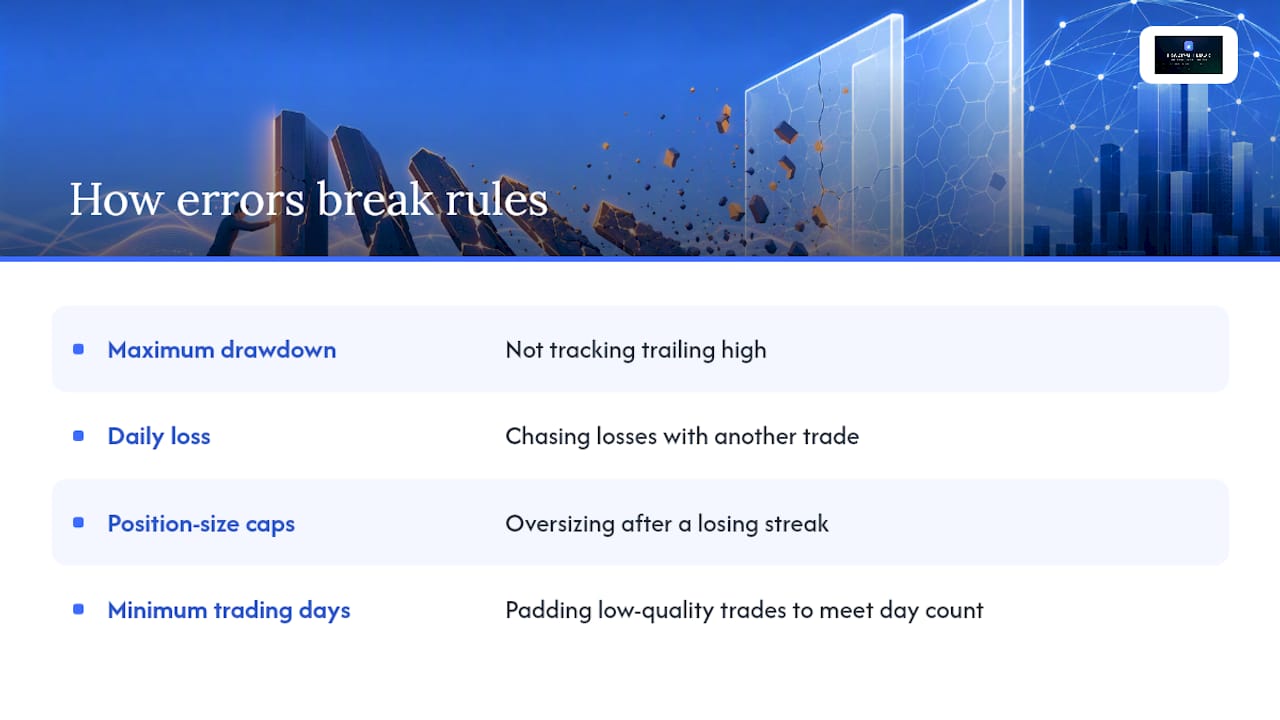
Maximum drawdown sets a floor the account equity can never touch, calculated either from the starting balance or from the highest equity point reached (a “trailing” drawdown). A trader who does not track their trailing high in real time can misjudge how much room they actually have left, and a normal-sized loss becomes the one that breaches the floor.
Daily loss limits cap how much the account can lose in a single session. The classic breach scenario: a trader down $1,400 on a $1,500 daily limit takes one more trade to “make it back,” loses again, and the account is flagged before the closing bell.
Position-size caps restrict how many contracts or lots can be open at once. Oversizing after a losing streak, often an unconscious attempt to recover faster, is the single fastest way to turn a rule cap into a violation.
Minimum trading day requirements force traders to be active across a set number of sessions rather than hitting the profit target in one lucky day. This rule causes fewer outright breaches but drives a different error: traders pad out low-quality trades on quiet days just to satisfy the day count, and those low-quality trades create their own drawdown risk.
Each of these rules gets broken the same way: a small process error, unmanaged, compounds under time pressure into something the account cannot absorb.
Pro Tip: Track your error budget separately from your P&L. Two columns, one spreadsheet: dollars lost to the market, and dollars lost to mistakes. When the mistake column grows faster than the market column, that is the signal to stop trading for the day, regardless of what your equity curve says.
Behavioral Errors That Wreck Otherwise Solid Trading
Most rule breaches start as emotional decisions, not technical ones. The technical mistake, the oversized position or the moved stop, is just the symptom. The cause is almost always one of four psychological patterns.
- Revenge trading. A loss feels unfinished, so the trader re-enters immediately to “fix” it, usually with a worse setup and bigger size than the original plan called for.
- FOMO entries. A move happens without the trader in it, and they chase the price with no clear invalidation level, which is how misplaced stops happen in the first place.
- Confirmation bias. A trader convinced they are right holds a losing position past their stop, hunting for any signal that confirms the trade instead of the ones that contradict it.
- Fatigue-driven errors. Hour six of screen time produces the same sloppy clicks and skipped checklist steps as hour one of a bad mood, just slower to notice.
All four accelerate account failure because they compound. One emotional trade rarely breaks a rule by itself. It is the second and third trade, stacked on top of the first while adrenaline is still elevated, that usually does the damage.
The fix is a repeatable in-session flow rather than willpower. When you notice the emotional spike (shaky hands, racing thoughts, the urge to “just get back in”): stop clicking, log what just happened and how you feel, take a mandatory five-minute break away from the screen, and only restart after re-reading your one-page ruleset out loud. It sounds almost too simple to matter, and that is exactly why most traders skip it under pressure.
Pro Tip: Pair every rule violation with an automatic size freeze for the rest of the session, no exceptions negotiated in the moment. Awareness alone rarely changes behavior fast enough during a live challenge. A hard consequence tied directly to the trigger does.
Preparation Checklist Before Your Prop-Firm Challenge Starts
The traders who pass challenges consistently treat preparation as a system with a timeline, not a vague intention to “trade carefully.” Build the following habits in the two to three weeks before your challenge begins.
| Checklist item | Why it matters | How to verify it’s done |
|---|---|---|
| Read the full rulebook, including fine print | Most breaches come from rules traders never actually read (news restrictions, overnight holds) | Write a one-page summary of every numeric rule and re-check it against the firm’s page |
| Run a two-week demo with real challenge sizing | Builds sizing habits before real money pressure exists | Compare demo position sizes against your written ruleset for consistency |
| Record your trading sessions | Reveals hesitation, hasty clicks, and skipped checklist steps you don’t notice live | Review one recorded session per week and note every deviation |
| Complete 50 checklist-compliant trades | Confirms the checklist is a habit, not a hope | Track compliance rate; target 100% before day one |
| Build a one-page trading ruleset | Gives you something to read aloud during an emotional spike | Print it or pin it where you can see it during every session |
| Set automated size limits on your platform | Removes the manual step where oversizing happens | Confirm hard caps are active, not just a mental note |
Non-negotiables from that list: reading the rules in full, setting automated size limits, and writing the one-page ruleset. Everything else improves your odds. Those three protect you from disqualifying yourself on a technicality you never even knew existed. Trading Floor’s evaluation-phase checklist breaks these items down further by firm-specific constraint, which is worth a read before you lock in your own list.
In-Challenge Tactics That Cut Execution and Process Errors
Preparation gets you to day one. Staying disciplined for the full challenge window requires process controls that run whether or not you are having a good day emotionally.
- Pre-commit your rules in writing before the market opens, not while a position is already open.
- Run a session-start checklist every single day, even on days that feel routine.
- Cap yourself to one new position size decision per day rather than re-litigating size on every trade.
- Set a hard shutdown trigger tied to a specific number, not a feeling. Three losses, one rule violation, or your daily loss floor.
- Use platform alerts for approaching drawdown thresholds instead of relying on mental math mid-session.
Tools do a lot of this work better than memory does. Trade-sync and copier software removes the manual re-entry step that causes size mismatches across multiple funded accounts, one of the more common and preventable execution errors among traders running several evaluations at once. Platform-native alerts for position size and daily P&L catch the moment you drift from plan before it becomes a violation, and pre-trade checklists run inside a structured template close the gap that a purely mental checklist leaves open.
Pro Tip: Set a slippage cap and an auto-reconcile check that fires immediately after every fill, not at the end of the day. Catching a fill discrepancy within seconds means you fix a sizing error before your next trade compounds it, instead of discovering it during a Sunday-night review when the account is already flagged.
How Trade Syncing Cuts Errors Across Multiple Funded Accounts
Manual entry across several accounts is one of the most preventable error sources in prop trading, and it rarely gets the attention it deserves. A trader managing three evaluation accounts on three different platforms has to place the same trade three separate times, by hand, under time pressure, and get every contract count and stop level identical across all three. One slip, and one account is now running a different risk profile than the other two without the trader realizing it until the damage shows up on a statement.

That is the exact class of error trade-copying software is built to solve: manual entry mistakes, inconsistent sizing across accounts, missed exits when one account gets closed manually but another doesn’t, and platform mismatch errors when accounts live on different brokers entirely.
Trading Floor addresses this directly by mirroring net positions in real time rather than just relaying signals, across funded and evaluation accounts on platforms including Tradovate and TopstepX. The features that matter most for error reduction specifically:
- Per-account risk controls, so one account’s sizing rule never leaks into another.
- Slippage caps that reject a copy if execution drifts too far from the master trade.
- Push notifications the moment a copy fires or fails, so you know instantly rather than discovering a gap later.
- Auto-reconciliation that flags any mismatch between the master position and a copied account.
- Trade journaling built into the same workflow, so your error log and your execution log are not two separate systems you forget to keep in sync.
A simple setup workflow looks like this:
- Connect your master account, the one whose trades you want mirrored.
- Verify per-account contract multipliers so a one-lot move on the master scales correctly on every connected account.
- Enable the slippage cap appropriate to your instrument’s typical spread.
- Turn on auto-reconcile and push notifications before your first live session.
- Run one demo session across all connected accounts to confirm every copy fires correctly before you rely on it during a real challenge.
Picture a trader running two Take Profit Trader accounts and one TradeDay account simultaneously during an evaluation window. Without a copier, that is three manual entries per trade, three chances to fat-finger a contract count, and three separate places a missed exit can happen. With sync in place, one decision executes correctly across all three, and the auto-reconcile step confirms it happened. Trading Floor’s guide on safe position-copying automation walks through the setup in more technical detail for traders running this across brokers.
Warning Signs to Watch During Your Evaluation
Small errors give off signals before they become account-ending breaches. The traders who pass challenges tend to be the ones who watch a short list of metrics daily rather than only checking equity at the end of the week.
- Discipline score (rule-compliance rate). If your checklist-compliant trade percentage drops below 90%, that is an early warning, not a footnote.
- Recent violation count. Two soft violations (not full breaches, just close calls) in one week means your process is drifting.
- Consecutive loss count. Three losses in a row is the natural trigger point for a mandatory cooldown, before a fourth loss turns emotional.
- Intraday drawdown versus your daily limit. Watch this as a percentage, not a dollar figure, so it stays consistent across account sizes.
- Execution slippage. Repeated slippage beyond your normal range often signals a platform issue or a sizing error, not just market noise.
- Platform error flags. A missed fill confirmation or a delayed order status is worth stopping for, not clicking past.
For each of these, the action plan should already be written down before you need it. If you hit three consecutive losses, size drops to half for the rest of the session. The value of deciding this in advance is that you are not negotiating with yourself in the moment you are least equipped to negotiate fairly.
The “rule of three” pattern, treating three related deviations as a forced trigger for structural change rather than a coincidence, is one of the more reliable heuristics for catching a bad pattern before it becomes a bad month, and it comes up repeatedly in structured mistake-tracking frameworks.
Post-Failure Analysis: The Review Most Traders Skip
Failing a challenge is not the expensive part. Failing it without learning anything is. A structured post-mortem turns one bad evaluation into a permanent fix, and most traders never do it properly because it requires looking closely at something that already feels bad enough.
- Tag every failed trade with a single reason code. Not a paragraph of excuses, one code: oversized, moved stop, revenge entry, platform error, and so on.
- Calculate frequency and financial cost per tag. Which single error code cost you the most money across the challenge, not which one happened the most times. Those are often different answers.
- Apply the rule of three. If the same tag shows up three or more times, that is not bad luck. That is a structural gap in your process that needs a specific fix, not general resolve to “be more careful.”
- Write the one fix, and only one. Pick the single highest-cost tag and design one concrete change: a hard size cap, an alert, a checklist addition.
- Set a 30-day clean-trading target. Thirty consecutive days without that specific violation before you consider the fix confirmed.
A useful journal entry for this process captures more than just entry and exit price. Record the timestamp, whether you completed your pre-trade checklist, your emotional state on a simple 1 to 5 scale, and the dollar cost specifically attributable to the error, separate from normal market risk. Trading Floor’s guide on structuring a trading error log covers the exact fields worth tracking if you want a repeatable template rather than building one from scratch.
Improvement compounds fastest when you change one rule at a time. Traders who try to fix five habits simultaneously after a failed challenge usually cannot tell which change actually worked, and they often abandon all five under the next stretch of pressure.
Choosing a Strategy That Fits Prop-Firm Rules
Not every strategy that works on your own capital survives a challenge’s rule structure unmodified. Before you commit real evaluation attempts to a strategy, run it through a short compatibility check.
- Trading frequency. A strategy needing 15 trades a day is harder to keep error-free under a daily loss limit than one taking two or three high-quality setups.
- Drawdown profile. A strategy with deep, infrequent drawdowns on your personal account can breach a firm’s trailing drawdown even while remaining profitable long term.
- Average R (reward relative to risk). Low average R strategies leave less room for the sizing mistakes that inevitably happen under pressure.
- Correlation exposure. Multiple positions in correlated instruments (two energy futures, for example) can multiply drawdown risk in a way a single-position view won’t show you.
- Minimum trading days required. A strategy built to hit targets in one or two sessions may force you to sit on your hands for the remaining required days, inviting the boredom trades that cause overtrading.
From there, the decision usually comes down to one of three paths. Adapt the strategy by tightening stops and cutting size if the core edge is sound but the volatility profile is too aggressive for the rule set. Reduce frequency if the strategy fires too often for you to maintain checklist discipline on every single trade. Postpone and train if backtesting reveals a drawdown pattern that would have breached the firm’s limit on more than one occasion historically.
A trend-following strategy with wide stops and few trades per week tends to be evaluation-friendly, since it naturally respects daily loss limits. A high-frequency scalping approach with tight, closely-spaced entries creates more rule-risk, simply because there are more opportunities per session for a sizing or execution mistake to slip through. Trading Floor’s guide on capital allocation across accounts is worth reading if you are managing this compatibility question across more than one account at a time.
A trading-floor practitioner’s view on what actually fixes this
The most common failure pattern isn’t a bad strategy. It’s a trader who passes the technical portion of a challenge with room to spare, then loses the account in the final week to a single oversized position taken out of frustration. I’ve watched this exact story repeat across enough evaluations to stop believing it’s about talent. It’s about whether the trader had a hard, automated stop between the emotional impulse and the order ticket. The traders who fix this permanently almost never do it through more willpower. They do it by removing the decision entirely, capping size at the platform level so the “just this once” trade physically cannot exceed the limit, regardless of how the trader feels in that moment.
If there’s one line worth remembering from all of this: discipline that depends on how you feel in the moment will fail eventually, but discipline built into your platform settings doesn’t get tired, angry, or overconfident.
Cut Multi-Account Errors With Automated Trade Syncing
If you’re running more than one evaluation or funded account at once, the manual entry step is where most operational errors actually happen, not your strategy. Every trade you have to place by hand, three or four times across different platforms, is another chance for a mismatched contract count or a missed exit that quietly breaches a rule you never intended to break.
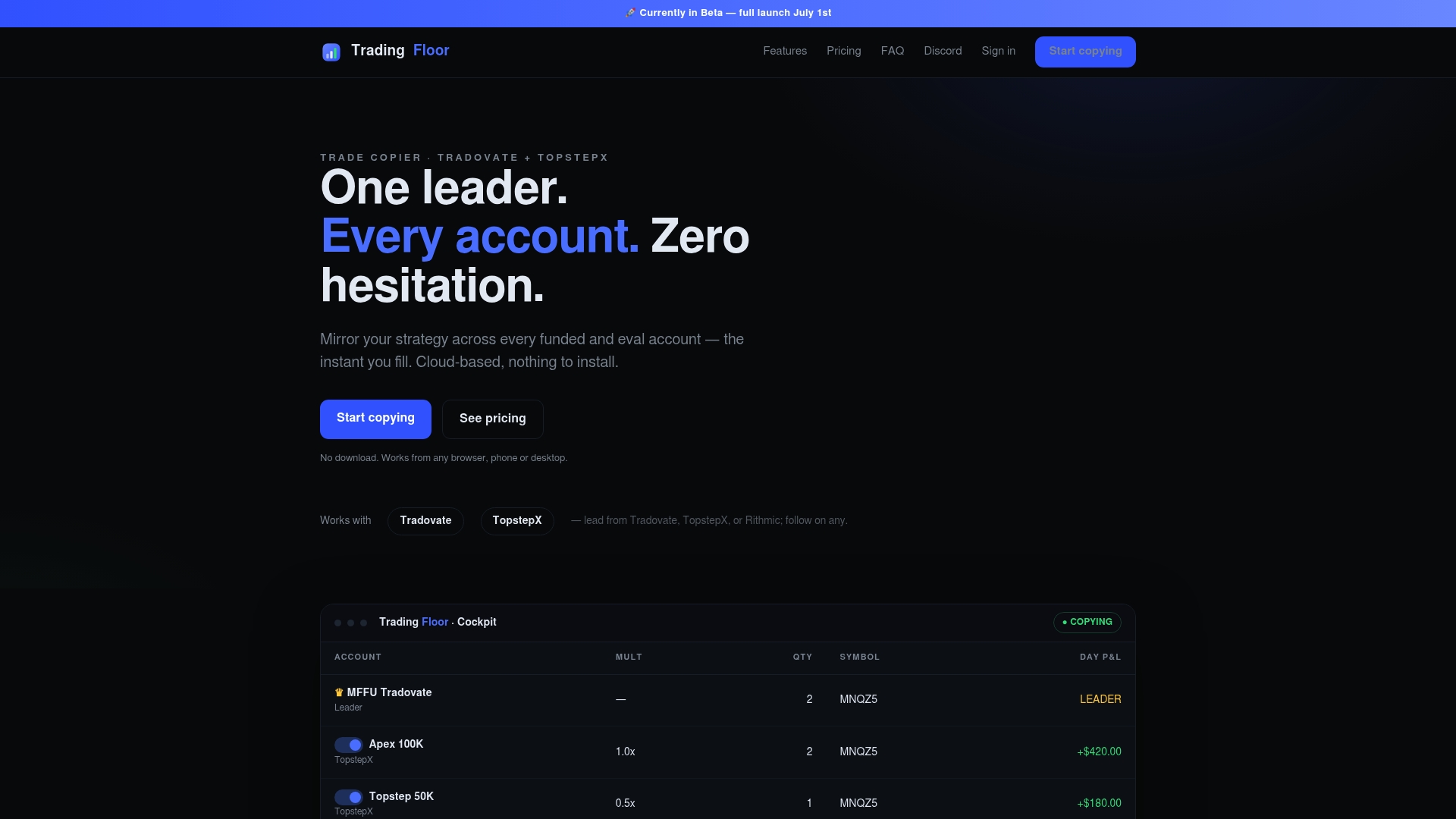
Trading Floor mirrors your net position in real time across every connected account instead of just relaying a signal, which closes the exact gap that causes size mismatches and missed exits between copies. Per-account risk controls stop one account’s sizing settings from bleeding into another. Slippage caps reject a copy that drifts too far from your master fill. Auto-reconciliation flags any discrepancy before it becomes a drawdown surprise, and push notifications tell you the moment something fires or fails instead of leaving you to find out at the end of the day. Built-in trade journaling means your execution record and your error log live in the same place, so post-failure review doesn’t require reconstructing what happened from memory.
For traders running challenges on Take Profit Trader, the Take Profit Trader trade copier mirrors one decision across every connected account automatically. TradeDay traders have the equivalent TradeDay trade copier integration. If you’re not sure which firms currently permit copy trading under their rules, check the current list of prop firms that allow copy trading before you connect anything. Start a trial and run one demo session across your accounts before your next challenge attempt.
Sources
- How to Track Trading Mistakes: A Complete Guide
- Futures Trading Error Budget (ES, NQ, CL) & Shutdown Logic
- The Complete Trading Checklist Guide: Pre-Trade, In-Trade, and Post-Trade | GrandAlgo Blog
- 15 Mistakes That Kill Trading Accounts (& Fixes)
This article is general information, not a substitute for advice from a qualified financial advisor. Consult a qualified financial professional about your own circumstances before acting on anything here.
Recommended
- The Consistency Rule in Prop Trading Evaluations: Pass the Math — Trading Floor
- Prop Trader Performance Optimization Explained — Trading Floor
- Trading Error Logs for Prop Traders: A Complete Guide — Trading Floor
- Evaluation Phase Trading Checklist for Prop Traders — Trading Floor
Trading Floor mirrors every trade across your Tradovate, TopstepX & Rithmic accounts in real time, from $25/mo.
Start copying →