The Consistency Rule in Prop Trading Evaluations: Pass the Math

The consistency rule is a single calculation that determines whether your profits are distributed evenly enough to satisfy a prop firm’s payout criteria. Compute it now: take your best single-day profit, divide it by your total cumulative profit, and multiply by 100. That percentage is your consistency score. Most prop firms that enforce this rule set the threshold at 30–40%, meaning no single day can account for more than 30–40% of your total profits.
- The formula: (best single-day profit ÷ total profit) × 100 = consistency %
- Typical thresholds: 20%–50% depending on the firm, with 30% being a common benchmark
- Pass condition: your consistency % must fall at or below the threshold
- Breach condition: one outsized day pushes the percentage above the limit, triggering a payout pause or a requirement to earn more profit before you qualify
Check this number before you request a payout. Many traders hit their profit target and still get blocked because they never ran this calculation.
Key Takeaways
The consistency rule is a best-single-day share-of-total-profit limit, and breaching it pauses payouts rather than failing your account in most cases.
| Point | Details |
|---|---|
| Core formula | (Best single-day profit ÷ total profit) × 100; most firms set the threshold at 30–40%. |
| Breach consequence | Typically pauses payouts or raises the effective profit target; rarely an instant account failure. |
| Fix calculation | Divide your best-day profit by the threshold to find the total profit you need, then earn the difference in small sessions. |
| Daily ceiling rule | Multiply your profit target by the threshold and stop trading for the day when you approach that number. |
| Tradingfloor | Mirrors consistent position sizing across multiple evaluation and funded accounts, reducing the human error that creates single-day spikes. |
Table of Contents
- How the consistency rule formula actually works
- Why prop firms enforce a consistency rule at all
- Which accounts and phases the rule applies to
- What happens when you breach the consistency rule
- Three pass vs breach scenarios you can reuse
- Policy gotchas that catch traders off guard
- Execution habits that keep your consistency score clean
- Why consistency matters beyond the pass/fail calculation
- Consistent execution across every account you run
- Sources
How the consistency rule formula actually works
The math is straightforward, but the inputs matter more than most traders realize.
1. State the formula
(Best single-day net profit ÷ Total net profit for the evaluation period) × 100 = Consistency %
2. Clarify the numerator and denominator
The numerator is your best single trading day measured in net profit, meaning after commissions and fees are deducted if your firm uses net P&L. The denominator is your total net profit accumulated across the entire evaluation period. Unrealized P&L is almost never counted; most firms measure realized closes only. Confirm this in your firm’s rule text because a few firms do include open positions at the time of a payout request.
3. Work through a concrete example
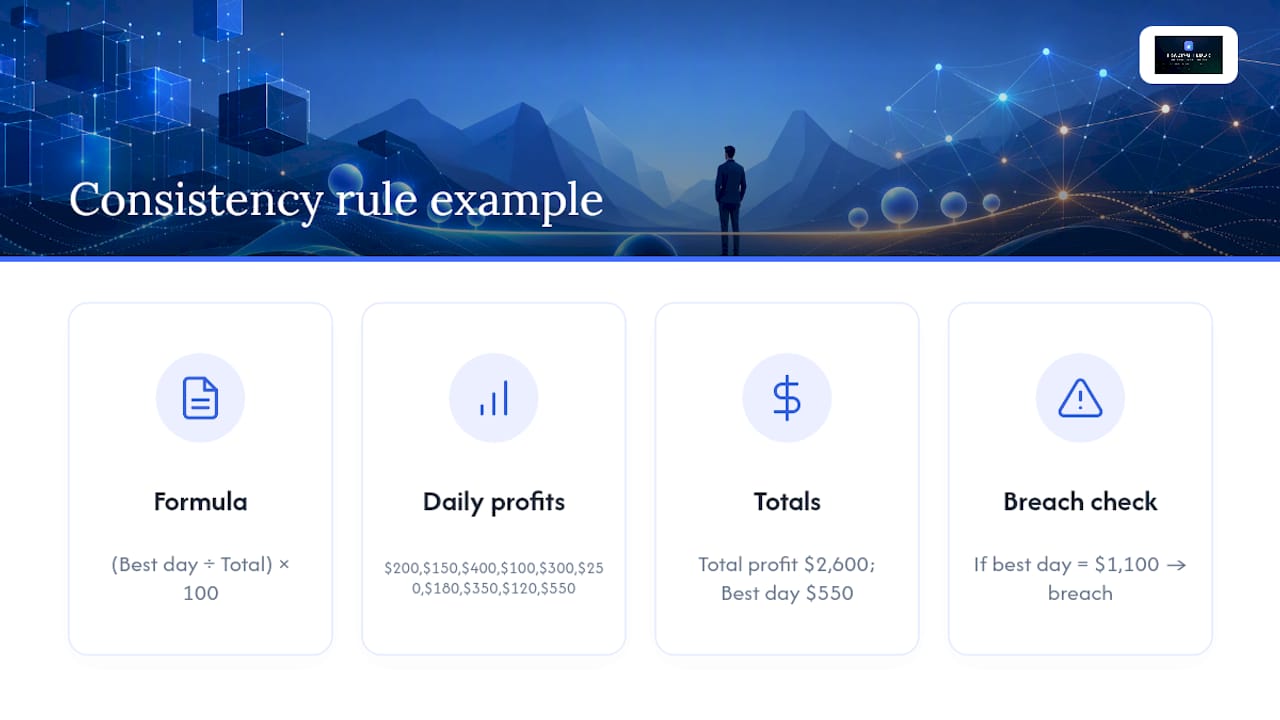
Say you are in a 10-day evaluation. Your daily net profits are: $200, $150, $400, $100, $300, $250, $180, $350, $120, and $550. Total profit = $2,600. Best day = $550.
Now imagine that $550 day was actually $1,100. Breach.
4. Convert the threshold into a daily ceiling
Multiply your profit target by the threshold percentage to get the maximum any single day can contribute. Stop adding size once you approach that number on a good day. A consistency calculator automates this conversion and flags your current best-day share in real time.
Stop trading for the day when you hit it.*
Why prop firms enforce a consistency rule at all
The rule exists because a single lucky trade tells a firm almost nothing about whether you can repeat the performance.
- Payout protection: a firm paying out a trader who made 90% of their profit on one news spike is effectively rewarding a gamble, not a skill set.
- Concentration risk: one oversized day usually means one oversized position. The rule forces sensible position sizing across the entire evaluation, not just on average.
- Behavioral signal: traders who spike on a single day and then give back profits over the following sessions are a liability. The consistency rule is an intentionally blunt instrument to detect that pattern, as Zentrade notes in their analysis of why evaluations fail despite hitting profit targets.
- Repeatability test: firms and allocators want to see a process that can be run again next month. A smooth equity curve with distributed daily gains is evidence of that process.
Habit formation research from IG supports the same logic from the trader’s side: written rules and repetitive rituals turn deliberate decisions into automatic responses, reducing the impulsive position-sizing that creates single-day spikes.
Pro Tip: Treat the consistency rule as a prompt to design your daily sizing and session exit rules before the evaluation starts, not as a number to game after the fact. A trader who builds a daily profit cap into their plan never has to worry about breaching it.
Which accounts and phases the rule applies to
The consistency rule does not apply uniformly across every stage or every firm. Knowing exactly when it kicks in saves you from managing it unnecessarily early or ignoring it at the wrong moment.
Common application points:
- Evaluation/challenge phases (Phase 1 and Phase 2): most firms apply the rule here, measuring your best day against total profit over the challenge window. Funded Futures Family’s help-center documentation shows how this wording appears in a live firm policy for both evaluation and funded-account contexts.
- Funded-account payout requests: some firms re-check consistency at the moment you request a withdrawal, not continuously. Others run a rolling check.
- Per-payout thresholds: a subset of firms apply the rule only to the profit earned since your last payout, not to your all-time funded-account total. This resets the denominator with each payout cycle, which is either helpful or dangerous depending on your trading pattern.
Typical firm-to-firm variations to look for:
- Threshold percentage (anywhere from 20% to 50%)
- Whether the rule applies during Phase 1 only, Phase 2 only, or both
- Whether funded accounts use a cumulative or per-payout window
- Whether a breach fails the account outright or simply pauses the payout
The table below shows the dimensions you should extract from any firm’s policy document before you start trading.
| Dimension | What to look for |
|---|---|
| Threshold % | The maximum share one day can represent (e.g., 30%) |
| Applies during | Phase 1, Phase 2, funded payout, or all three |
| Consequence of breach | Payout pause, raised effective target, or account failure |
| Fix method | Dilute ratio with more profitable days or earn additional profit |
| Special variations | Per-payout reset, graduated thresholds, per-instrument exceptions |
What happens when you breach the consistency rule
Breaching the rule rarely means instant account failure. Most firms pause the payout or require additional profit to dilute the ratio rather than rejecting the account outright. A minority of firms do treat a breach as an automatic evaluation failure, so confirm your firm’s policy before assuming you have a recovery path.
The hidden math risk most traders miss: losing days lower the denominator without changing the best-day numerator. This is why continuing to trade normally after a near-breach can push you over the limit without any single large day.
The fix formula: to push your consistency % below the threshold, you need your total profit to reach (best single-day profit ÷ threshold). If your best day is $900 and the threshold is 30%, your total profit must reach $900 ÷ 0.30 = $3,000. If you currently have $2,400 in total profit, you need $600 more in small, consistent days before requesting a payout.
Step-by-step recovery plan after a breach:
- Stop trading full size immediately. No new large positions until the ratio is back inside the threshold.
- Run the fix calculation. Divide your best-day profit by the threshold to find the total profit target you need. Subtract your current total to get the additional profit required.
- Trade micro-size sessions. Small, consistent gains dilute the ratio without risking a second large day that worsens it.
- Track the ratio daily. Recalculate after every session so you know exactly when you cross back below the threshold.
- Request the payout only after the ratio clears. Submitting while still in breach just delays the process further.
Three pass vs breach scenarios you can reuse
These three examples cover the most common situations traders face. Plug your own numbers into the same structure.
-
Scenario 1 — Borderline pass ($900 best day, $3,000 total, 30% rule): This is exactly at the threshold. Whether it passes depends on whether the firm uses a strict less-than rule (fail) or a less-than-or-equal rule (pass). Behavioral note: stop trading for the day the moment you reach $900 profit. One more winning trade pushes you over.
-
Scenario 2 — Clear breach ($1,200 best day, $3,200 total, 30% rule): Breach. Fix target: $1,200 ÷ 0.30 = $4,000 total profit required. Additional profit needed: $4,000 minus $3,200 = $800. Trade small, consistent sessions targeting $100–$150 per day. See account evaluation strategy examples for how to structure those recovery sessions.
-
Scenario 3 — Funded-account payout paused ($600 best day since last payout, $1,800 profit since last payout, 35% per-payout rule): Now imagine one session adds $400 in profit but the next session gives back $300, dropping the total to $1,900 while the best day stays at $600. Still fine. Payout paused. Recovery path: earn $1,714 total ($600 ÷ 0.35) before requesting. Additional profit needed: $214 in controlled sessions.
Policy gotchas that catch traders off guard
The rule text is where most surprises hide. Before you start any evaluation, audit the firm’s policy against this checklist.
- Net vs gross P&L: some firms calculate the consistency rule on gross profit (before commissions), others on net. On a high-frequency futures account, the difference can shift your best-day percentage by several points.
- Realized vs unrealized P&L: confirm whether open positions at payout time are included. Most firms use realized-only, but a few snapshot open equity.
- Fee and commission treatment: commissions paid to the broker are sometimes excluded from the P&L calculation entirely, meaning your “best day” figure in the firm’s system may differ from what your platform shows.
- Copied or mirrored trades: if you copy trades from a leader account, check whether the firm counts each copied account’s P&L independently or aggregates them. Avoiding consistency violations when copying trades across accounts requires a specific approach; the Tradingfloor guide on this topic covers the adjustments needed.
- Per-payout vs cumulative windows: a per-payout rule resets the denominator after each withdrawal, which sounds helpful but can trap you if your first session after a payout is unusually large.
- Graduated payout thresholds: some firms tighten the threshold as your account grows or as you progress through funding tiers. A 40% threshold in Phase 1 may become 30% on a funded account.
- Lookback windows: a handful of firms apply the rule only to the most recent 30 or 60 days rather than the full evaluation period. This can work in your favor after a distant large day ages out of the window.
The phrases to search for in any help-center document: “single trading day,” “best day,” “daily profit limit,” “payout eligibility,” and “consistency percentage.” If those terms do not appear in the rule text, ask support directly before trading.
Execution habits that keep your consistency score clean
Behavioral discipline is what separates traders who pass consistently from those who breach on their best day. The six-pillar framework from Complete Traders Edge — tested strategy, written rules, consistent risk, routine, trading journal, and self-awareness — maps directly onto the practical steps below.
- Fix your contract size before the session starts. Decide your maximum contracts per trade based on your daily profit ceiling, not on how the market feels that morning. Changing size mid-session after a winning trade is the most common path to a single-day spike.
- Set a hard daily profit target and a hard stop. When you hit the daily ceiling (profit target × threshold, minus your buffer), close the platform. A second session on the same day is not worth the consistency risk.
- Distribute profits deliberately. If you are ahead of pace, trade smaller the next day. A smooth equity curve is not just aesthetically pleasing; it is structurally safer under any consistency rule.
- Track your best-day share in your journal every session. Log: today’s net profit, cumulative net profit, current best day, and current consistency %. Spotting a creeping ratio on day six is far better than discovering a breach on day nine.
- Use a pre-session checklist. Before entering any trade, confirm your position size is within the day’s ceiling, your setup matches your written criteria, and your current consistency % has room to absorb a full winning day. An evaluation phase checklist gives you a ready-made template for this routine.
- After a large winning day, reduce size the next session by at least 50%. The day after a big win is statistically the highest-risk session for a consistency breach because traders feel confident and size up.
Pro Tip: Build a ritualized decision trigger for the session after a large win: before placing any trade, write down your current consistency % and your daily ceiling for that session. The act of writing it forces a pause and prevents the impulsive oversizing that IG’s habit-formation research identifies as the primary driver of revenge trading and post-win overconfidence.
Why consistency matters beyond the pass/fail calculation
The consistency rule gets treated as an obstacle. It is actually a mirror.

Traders who struggle with it almost always have the same underlying problem: their position sizing is reactive rather than planned. They trade small when uncertain and large when confident, which means their equity curve is driven by emotional state rather than edge. The rule forces a structural fix by capping the reward for any single emotional surge.
What prop firms are really measuring is whether you have a process. That is the longer-term value here. Passing the consistency rule is not just about clearing an evaluation; it is about building the kind of track record that gets you access to bigger accounts and better terms.
Process consistency precedes results consistency, as howtotrade.com’s analysis of trader development patterns makes clear. Traders who track process-adherence metrics alongside P&L metrics tend to develop more durable performance curves.
The traders who build careers in funded trading are not the ones who had the biggest single day. They are the ones who showed up with the same rules, the same sizing, and the same discipline across hundreds of sessions.
Consistent execution across every account you run
Managing the consistency rule across a single account is hard enough. Across two, three, or four evaluation accounts simultaneously, the risk of a sizing error on one account creating a breach compounds with every session.

Tradingfloor mirrors your leader account’s net position in real time across every funded and evaluation account you run, with per-account risk controls that let you cap contracts, set slippage limits, and receive push notifications the moment a position opens. The result is identical sizing across every account on every trade, which is exactly what the consistency rule rewards. No installations, no manual entry, no “I forgot to size down on account three.” One decision, executed everywhere, with the controls to keep each account within its own daily ceiling.
The 30-day free trial at Tradingfloor gives you enough time to run a full evaluation cycle and see whether mirrored execution changes your consistency score. Read your firm’s copy-trading rules first; a list of prop firms that allow copy trading is available on the site to help you confirm eligibility before you start.
This article is general information, not a substitute for advice from a qualified financial advisor. Consult a qualified financial professional about your own circumstances before acting on anything here.
Sources
The links below point to the primary help pages, calculators, and explainer guides that cover the consistency rule in firm-specific language or give tools to compute it.
- Funded
- Consistency Rule Prop Firm: What It Is and How to Pass It | Zentrade
- Consistency Calculator for Funded Traders
- Prop Firm Consistency Rule Explained: Formula, Examples & Tips
- How to Achieve Consistency in Trading: The Six Pillars
Recommended
- Prop Trader Performance Optimization Explained — Trading Floor
- Pass Multiple Prop Firm Evals at Once With One Strategy — Trading Floor
- Evaluation Phase Trading Checklist for Prop Traders — Trading Floor
- Consistent Trade Sizing Across Accounts: A Prop Trader’s Guide — Trading Floor
Trading Floor mirrors every trade across your Tradovate, TopstepX & Rithmic accounts in real time, from $25/mo.
Start copying →