Emotional Trading Bias Explained: How to Spot and Stop It

Emotional trading bias is when feelings drive your execution instead of your rules, and it systematically reduces returns by turning rare mistakes into recurring losses. It shows up in two familiar ways:
- You cut a winning trade the moment it turns green, terrified it will reverse.
- You hold a losing trade for hours past your stop, hoping it comes back.
Both moves feel protective in the moment. Both quietly wreck your edge.
Key Takeaways
Emotional trading bias reduces returns by replacing planned rules with fear- and greed-driven decisions, and structural controls fix it more reliably than willpower.
| Point | Details |
|---|---|
| Definition | Emotional trading bias occurs when feelings override your written trading rules during execution. |
| Most common patterns | Loss aversion, overconfidence, FOMO, and revenge trading each leave measurable fingerprints in your trade log. |
| Evidence base | Studies on day-traders show emotional reactivity, not personality, predicts poor performance outcomes. |
| Best detection method | Compare planned versus actual exits and track position-size changes after wins and losses weekly. |
| Structural fix | Trading Floor automates per-account risk caps and slippage limits across multiple funded accounts, enforcing rules you can’t override in the moment. |
Table of Contents
- What Is Emotional Trading Bias, Exactly?
- The Six Emotional Biases That Wreck Trading Accounts
- Auditing Your Own Trades for Emotional Bias
- What the Research Actually Shows About Emotion and Performance
- A Prioritized Plan to Reduce Emotional Trading Bias
- How Multi-Account Automation Enforces These Rules for You
- Treat Bias as a Process Problem, Not a Character Flaw
- Put Automation Between You and Your Worst Impulses
- Sources
What Is Emotional Trading Bias, Exactly?
Emotional trading bias differs from a purely cognitive bias, though the two overlap constantly. A cognitive bias is a mental shortcut, like anchoring to the price you paid for something. An emotional bias is a feeling state, fear, greed, hope, that hijacks the decision before logic gets a vote.
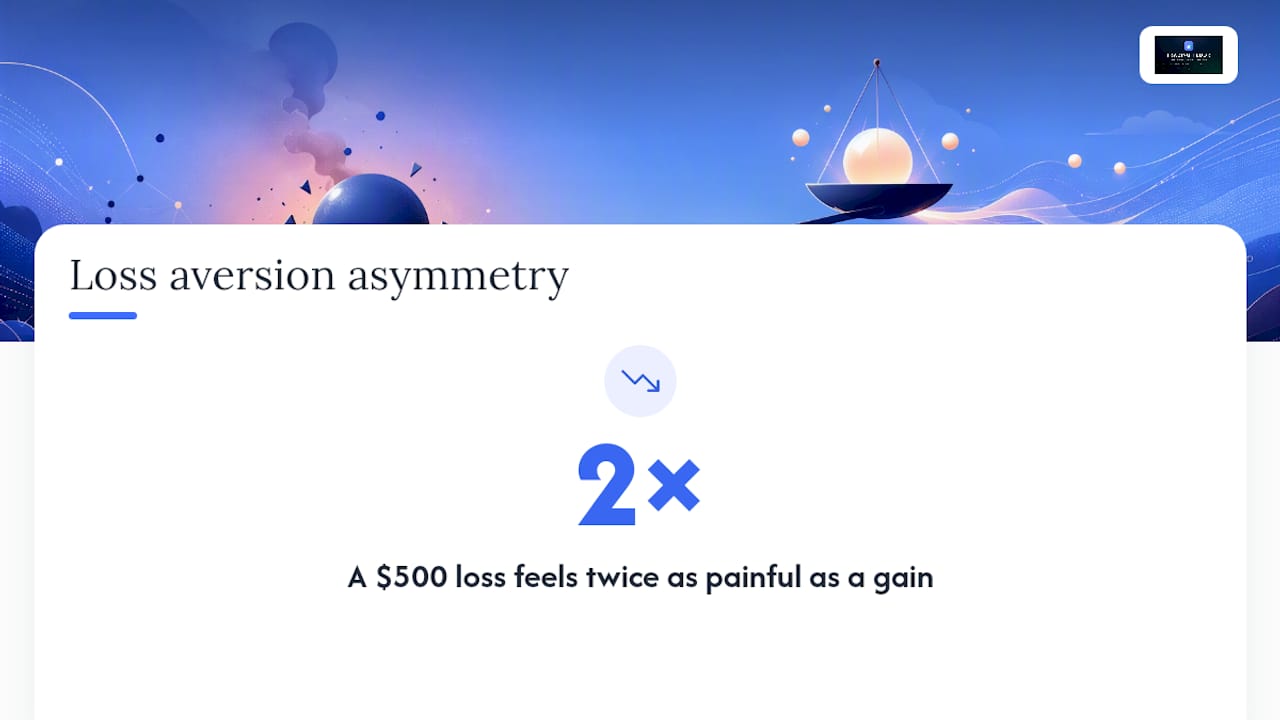
The mechanism underneath most of this is loss aversion, a core idea from prospect theory: a $500 loss feels roughly twice as painful as a $500 gain feels good. That asymmetry explains why traders will take a small, safe profit but let an ugly loss run, hoping to avoid the pain of admitting the trade failed.
Picture two traders in the identical setup. One takes profit at the first sign of resistance because the gain feels fragile. The other, down on the same trade, moves the stop further away, reclassifying a loser as “not realized yet.” Same market, same information, opposite emotional trap.
The Six Emotional Biases That Wreck Trading Accounts
Most damage traces back to a small set of repeat offenders. Each one leaves fingerprints you can actually measure.
- Loss aversion and the disposition effect: you sell winners fast and hold losers long, a pattern documented across thousands of brokerage accounts, where investors consistently exit profitable positions sooner than losing ones. Detection cue: compare average holding time on winners versus losers over your last 50 trades.
- Overconfidence: after two or three wins, you start sizing up without a corresponding edge increase. Detection cue: track position size against your last five outcomes.
- FOMO: you chase a move already in progress, entering late with a worse risk-reward ratio than your plan allows. Detection cue: flag any entry made more than a few ticks past your planned trigger.
- Revenge trading: a loss triggers an immediate re-entry, often larger, and often against a setup that wouldn’t otherwise qualify. Detection cue: count trades placed within 15 minutes of a stop-out.
- Hope and euphoria: you widen a stop mid-trade or skip your own exit rule because “this one feels different.” Detection cue: log every manual stop adjustment and why you made it.
Statistic worth sitting with: analysis of professional day traders found that moderate levels of emotional activation tend to correlate with more optimal trading outcomes than either very low or very high emotional activation, according to research published in PLOS One. The goal isn’t zero emotion. It’s regulation.
Auditing Your Own Trades for Emotional Bias
You don’t need a psychologist to find this in your account. You need your trade log and about twenty minutes.
- Compare planned exits to actual exits. Pull your last 30 to 50 trades and note the exit price you intended versus where you actually closed. A consistent gap in one direction, early on winners, late on losers, is the disposition effect in raw numbers.
- Track position size after wins and losses. Chart your contract or share size for the trade immediately following a win and immediately following a loss. Size creep after either outcome signals overconfidence or revenge behavior, not strategy.
- Flag the timing of impulse entries. Note how many trades happened within minutes of a stop-out or how many chased a breakout already three bars old.
- Add three fields to your journal: a mood tag before the trade, the trigger for entry, and a simple yes/no on whether you followed your own rule.
Pro Tip: Run the post-loss size check first. It’s the single fastest way to catch revenge trading before it becomes a pattern instead of an incident.
Practitioner-side tools built for this kind of pattern detection, including behavioral decision intelligence platforms, can automate a lot of this cross-referencing so you’re not doing it by hand every Sunday night.
What the Research Actually Shows About Emotion and Performance
A clinical study of 80 day-traders tracked daily emotional-state surveys against five weeks of trading results. The finding: emotional reactivity, not personality type, predicted who lost money. Even-keeled traders with dull personalities outperformed dramatic ones simply by reacting less intensely to swings, according to the study on fear and greed in financial markets.
The traders who lost the most weren’t defined by who they were. They were defined by how sharply their mood swung after a win or a loss, and how quickly that swing bled into the next order.
Separate analysis of 886,000 trades and over a million instant messages from professional traders confirmed the U-shaped pattern mentioned earlier: extreme emotional language, in either direction, correlated with worse trading decisions than moderate expressed emotion.
Neuroscience research backs this up mechanically. Studies on decision-making under risk show extreme emotional activation can bypass the brain’s deliberative control circuits entirely, pushing a trader straight into reflexive action. Moderate activation, by contrast, often supports faster, timely decisions rather than undermining them.

A Prioritized Plan to Reduce Emotional Trading Bias
Willpower loses to a bad mood nine times out of ten. Structure doesn’t. Here’s the order that actually works, starting with what to fix today.
- Write non-negotiable pre-trade rules. Entry trigger, stop price, target, and position size, decided before you’re in the trade, not while your heart rate is up.
- Set hard risk caps. A per-trade maximum loss, a daily loss limit, and a session stop that shuts you down for the day once hit. If you can override it manually, it isn’t a real cap.
- Automate what you can. Conditional orders that lock in a stop at entry, slippage caps that block fills beyond your set price, and platform-level daily loss limits that disable trading once you’re over. These are antecedent-focused controls, meaning they intervene before the emotional impulse can act, not after.
- Journal every trade with three fields: mood before entry, the actual trigger, and whether you followed your own rule. Review it weekly, not monthly.
- Build in a cooldown. After any stop-out beyond your normal loss size, step away for a fixed period, no exceptions, no “just one more.”
- Get a second set of eyes. A trading partner or mentor reviewing your log catches patterns you’re too close to see.
Pro Tip: If you only implement one rule this month, make it the daily loss limit paired with a mandatory stop on trading. It’s the single control that ends the worst revenge-trading spirals before they compound.
Structural fixes outperform willpower because they don’t ask you to be strong in the exact moment you’re least equipped to be. For a deeper walkthrough on setting these limits across accounts, see this guide to multi-account risk controls.

How Multi-Account Automation Enforces These Rules for You
Rules only work if something enforces them when you don’t want to follow them. A cloud-based trade copier that mirrors your net position across every funded and evaluation account applies the same discipline everywhere at once, instead of hoping you replicate it manually under pressure.
- Per-account risk controls and slippage caps prevent one emotional override from cascading across every connected account.
- Real-time notifications catch drift before it becomes a full-blown revenge cycle.
- No-install, browser-based access across platforms like Tradovate and TopstepX means the same guardrails travel with you, not just on your main terminal.
For setup specifics, this automated risk controls checklist walks through the technical side.
Treat Bias as a Process Problem, Not a Character Flaw
Emotional trading bias isn’t a personal failing you fix by trying harder. It’s an execution problem, and execution problems get solved with process design, not motivation. Blaming yourself for the fortieth revenge trade misses the point. The rule that would’ve stopped it didn’t exist yet.
My honest recommendation: set a daily loss cap this week and start mood-tagging your next 50 trades. Don’t overhaul everything at once. That single habit surfaces more about your actual pattern than a month of good intentions.
— KennyTrades
Put Automation Between You and Your Worst Impulses
Manual enforcement asks you to police your own emotions in real time, across every account, every session, forever. That’s a losing bet even for disciplined traders. Trading Floor mirrors your net position across every funded and evaluation account simultaneously, with per-account risk controls that don’t bend just because you’re having a bad afternoon.
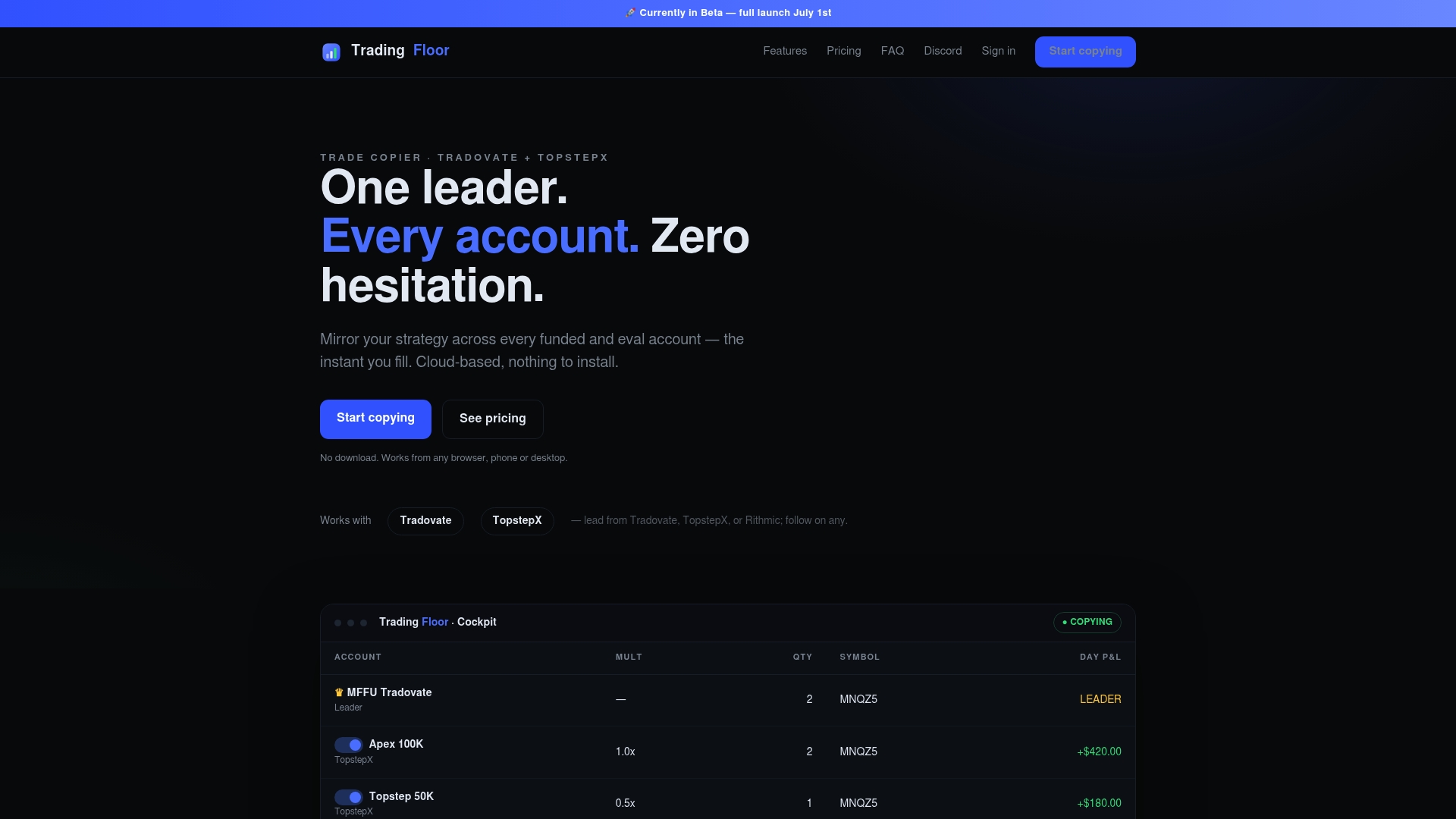
Trade limits, slippage caps, and real-time notifications apply automatically, whether you’re managing two accounts or a dozen across Tradovate, TopstepX, and beyond. If revenge trading or size creep after a loss has cost you accounts before, this is the structural fix that removes the moment of temptation entirely. Compare the setup against manual copying on the Trading Floor alternative page and start your trial today.
Sources
- Fear and Greed in Financial Markets: A Clinical Study of Day-Traders
- Do emotions expressed online correlate with actual changes in decision-making? The case of stock day traders (PLOS One)
- Neurobiological foundations of decision-making under risk (PMC)
Recommended
- Human Error in Trading Explained: Cut Losses With Rules — Trading Floor
- Over-Trading Risk Factors: How to Spot and Stop Them — Trading Floor
- Trading Execution Best Practices: A 2026 Trader’s Guide — Trading Floor
- Pass Multiple Prop Firm Evals at Once With One Strategy — Trading Floor
Trading Floor mirrors every trade across your Tradovate, TopstepX & Rithmic accounts in real time, from $25/mo.
Start copying →