Over-Trading Risk Factors: How to Spot and Stop Them

Over-trading is what happens when activity outpaces the capital or edge that supports it. In a business, that means expanding faster than working capital allows. For a trader, it means placing more trades, or larger ones, than your strategy and account can absorb. The core risk factors are the same in both worlds: cash strain, excessive leverage, and behavioral impulses that override judgment.
The highest-impact risk factors, at a glance:
- Cash and working capital shortfall — turnover grows but cash reserves fall
- Excessive leverage or margin use — positions sized beyond what the account can sustain
- Rapid growth without financing — new orders or trades taken on before prior ones settle
- Long receivables and inventory build — cash locked up, unable to fund the next cycle
- Revenge trading and action bias — emotional responses that multiply position frequency after losses
- Platform-induced incentives — notifications, gamification, and zero-commission interfaces that reward activity over quality
- Lack of a written plan or hard limits — no pre-committed rules means no circuit breaker
If you are watching your overdraft creep up while sales climb, or if you are placing trades within minutes of a loss, the rest of this article is written for you.
Table of Contents
- What does over-trading actually mean in business vs. trading?
- What are the over-trading risk factors you need to check?
- How do you identify over-trading before it becomes critical?
- What happens when over-trading goes unchecked?
- How do you prevent over-trading? A prioritized action plan
- Why does over-trading happen? What the research actually shows
- High activity vs. harmful over-trading: how to tell the difference
- Which industries face the highest overtrading risk?
- How do economic conditions make overtrading risk worse?
- What tools and systems help you detect overtrading early?
- How to run an overtrading risk audit
- What psychological factors drive overtrading in traders?
- Key Takeaways
- The structural fix is the only fix that lasts
- Tradingfloor gives prop traders a structural edge against overtrading
- Useful sources and when to get professional help
What does over-trading actually mean in business vs. trading?
The word gets used in two very different conversations, and conflating them leads to the wrong diagnosis.
In a business context, overtrading means a company is growing its revenue faster than its working capital can support. Sales are rising, but cash is not keeping pace. The symptoms are predictable: the overdraft is almost always drawn, suppliers are being paid late, and the business is constantly borrowing short-term to fund long-term commitments. Turnover looks healthy on paper; the bank account tells a different story.
In a trading context, overtrading describes two related problems. The first is a broker churning a client’s account to generate commissions. The second, far more common for self-directed traders, is a trader placing more trades, or larger ones, than their strategy and risk framework actually support. The driver is almost always behavioral, not analytical.
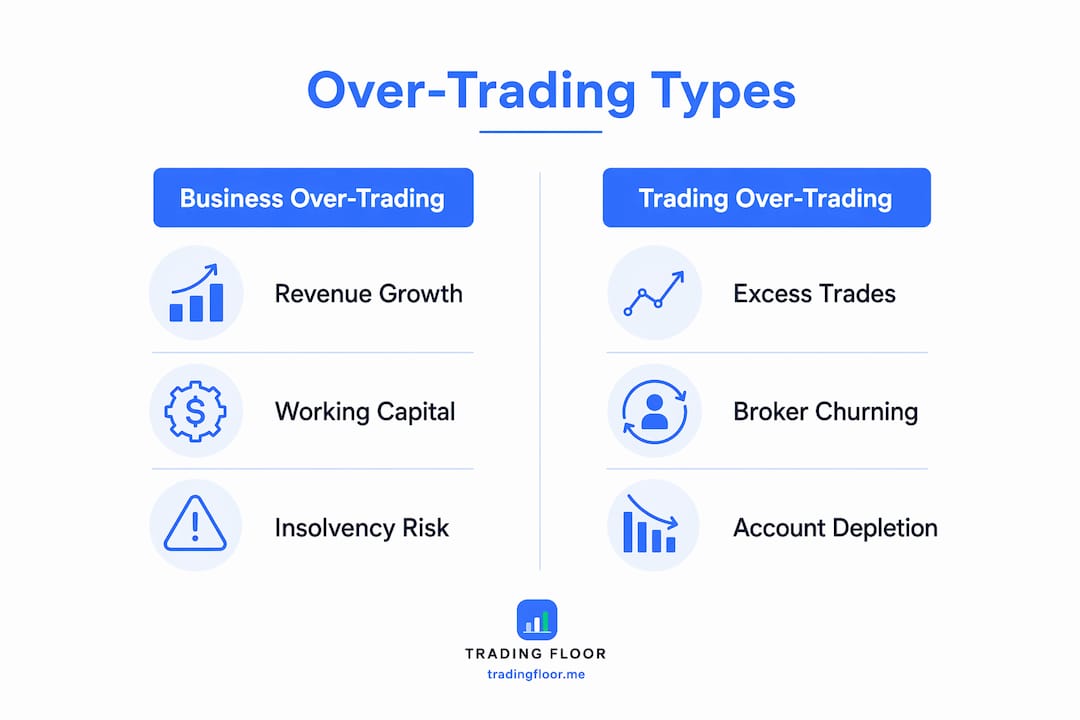
The outcomes differ, too. A business that overtrades risks insolvency because it cannot pay its creditors even while profitable. A trader who overtrades erodes capital through fees, slippage, and poor-quality entries until the account is too small to trade effectively. One is a structural cash problem; the other is a behavioral execution problem. Both are preventable with the right controls.
What are the over-trading risk factors you need to check?
Business risk factors
- Poor working capital — the gap between current assets and current liabilities shrinks as sales grow, leaving no buffer for delays or cost spikes.
- Rapid revenue growth without financing — new contracts require upfront costs (materials, labor, delivery) before payment arrives.
- Long receivables (high DSO) — customers taking 60–90 days to pay while suppliers demand 30 days creates a structural cash gap.
- Inventory build — stock sitting in a warehouse is cash that cannot pay wages or suppliers.
- Falling margins — rising input costs and seasonal peaks increase turnover without improving cash reserves.
- Overdraft and short-term credit dependence — using revolving credit to fund operating costs is a warning sign, not a solution.
- Supplier pushback — when suppliers shorten terms or demand prepayment, the business has already lost credibility in the supply chain.
A concrete example: a small manufacturer wins a large retail contract and ramps production immediately. The retailer pays on 90-day terms. The manufacturer’s suppliers want payment in 30 days. Within two months, the overdraft is maxed and payroll is at risk, despite record revenue.
Trader risk factors
- Revenge trading — after a loss, the impulse to win it back immediately drives larger or more frequent positions, accelerating account erosion.
- Action bias — the psychological discomfort of sitting out a move pushes traders into low-quality setups.
- Boredom trading — slow sessions generate trades with no edge simply to stay engaged.
- No written plan or hard limits — without pre-committed rules, every decision is made in real time under emotional pressure.
- Excessive leverage and margin use — overtrading is often driven by impatience and overconfidence that inflates position size beyond what the account can absorb.
- Platform gamification and notifications — push alerts, streak counters, and zero-commission interfaces reward activity, not quality.
- Misreading volatility as opportunity — high-volatility sessions feel like more chances to profit; statistically, they are more chances to lose.
- Insufficient risk limits — no daily loss cap, no max-trades rule, no position-size ceiling.
A trader example: after two consecutive losing days, a futures trader doubles position size on the third morning to “get back to even.” The market moves against them. The account drops below the minimum required for their prop firm evaluation, and the evaluation is voided.
Pro Tip: The single most effective triage step for both contexts is a hard pause. For traders: stop placing new orders until you have reviewed the last five trades. For businesses: freeze new sales that require credit until you have run a 30-day cash-flow projection. Speed is the enemy of diagnosis.

How do you identify over-trading before it becomes critical?
Objective metrics matter here because activity feels productive even when it is destructive. The goal is to measure cash behavior and trade behavior, not just revenue or trade count.
| Signal | What to measure | Warning level |
|---|---|---|
| Current ratio | Current assets ÷ current liabilities | Below 1.2 for most businesses |
| Days Sales Outstanding (DSO) | (Accounts receivable ÷ revenue) × days | Rising trend or above 60 days |
| Days Inventory Outstanding (DIO) | (Inventory ÷ COGS) × days | Rising trend; cash locked in stock |
| Overdraft utilization | % of facility drawn on average | Consistently high |
| Trades per day (trader) | Raw count vs. plan maximum | Exceeds your written plan limit |
| % losing trades after a loss | Frequency of losses following a loss | Spike indicates revenge trading |
| PDT threshold | Account equity in margin account | Below $25,000 triggers PDT rules |
| Midday session activity | Trades placed 11:30 AM–2:00 PM ET | Elevated vs. morning session |
For small businesses, track the current ratio and DSO monthly at minimum. A DSO climbing from 45 to 65 days over a quarter is a clearer early signal than any revenue figure. For traders, a portfolio risk calculator can quantify position-size exposure before you place a trade, not after.
Pro Tip: Set a calendar reminder for the first Monday of every month to pull your DSO, current ratio, and overdraft utilization. Three minutes of math beats three months of denial.
What happens when over-trading goes unchecked?
Business consequences
- Cash insolvency — the business cannot meet payroll or supplier invoices despite being profitable on paper.
- Supplier withdrawal — key suppliers stop extending credit or shorten terms, forcing prepayment and worsening the cash gap.
- Lost early-payment discounts — chronic late payment eliminates the 1–2% discounts that improve margins.
- Higher borrowing costs — emergency credit lines carry higher rates than planned facilities.
- Formal insolvency risk — if the cash gap cannot be bridged, the business enters administration or bankruptcy even with a full order book.
Trading consequences
- Account depletion — each low-quality trade chips away at capital; the account shrinks faster than any single loss would suggest.
- Margin calls and forced exits — overleveraged positions get closed at the worst possible moment.
- Tax and fee drag — even zero-commission platforms carry hidden costs: wider bid-ask spreads, slippage, and short-term capital gains taxes that compound with frequency.
- Behavioral burnout — the stress of constant monitoring and repeated losses degrades decision quality over time.
- Prop firm disqualification — exceeding daily loss limits or drawdown thresholds ends an evaluation account, often permanently.
The escalation pattern is consistent: one unchecked factor (a single bad day, a single overextended supplier) triggers a response (more trades, more orders) that makes the underlying problem worse. The compounding is fast.
How do you prevent over-trading? A prioritized action plan
Immediate triage (do this first)
- Pause new commitments. Stop accepting new orders requiring credit (business) or placing new trades (trader) until you have a clear picture of current exposure.
- Run the numbers. Calculate your current ratio, DSO, and overdraft utilization (business) or your trades-per-day count and daily P&L (trader).
- Notify key stakeholders. Alert your bank or key suppliers early if cash is tight; alert your trading coach or accountability partner if you have breached your daily loss limit.
- Reduce frequency or set hard locks. For traders: set a maximum of two or three trades per session and log out after hitting it. For businesses: freeze new credit sales until receivables improve.
Operational controls for businesses
- Renegotiate payment terms with suppliers to extend to 45–60 days where possible.
- Explore invoice factoring to convert receivables to immediate cash without new debt.
- Revise your credit policy: require deposits or shorter payment terms from new customers.
- Triage inventory: identify slow-moving stock and liquidate it to free working capital.
Risk controls for traders
- Set fixed session rules: no trading during the 11:30 AM–2:00 PM ET window, where decision fatigue and thin institutional volume combine to produce the most erratic price action.
- Cap trades per day in writing, before the session starts.
- Use position-size caps: never risk more than 1–2% of account equity on a single trade.
- Keep a trade journal and review it weekly, not daily, to spot frequency patterns rather than individual outcomes.
- Consider passive trading approaches that reduce discretionary decision-making and the temptation to overtrade.
Pro Tip: Willpower is the worst tool for stopping overtrading. Structure the environment instead: log out of your trading platform after your daily limit is hit, set an automatic calendar block for the midday window, and keep your trading journal somewhere you have to open before you can place a trade.
Why does over-trading happen? What the research actually shows
The behavioral evidence is clear and uncomfortable. Barber and Odean’s research found that the most active retail traders underperformed the market by more than 6% annually after costs, while less active traders nearly matched market returns. The activity itself was the problem, not the strategy.
The mechanism is neurological. The dopamine anticipation loop rewards scanning and entering trades independent of whether those trades have positive expected value. Near-misses and novelty reinforce the behavior. Decision fatigue compounds it: the more decisions a trader makes, the worse each subsequent one tends to be. The midday window (approximately 11:30 AM–2:00 PM ET) is particularly dangerous because institutional volume drops, price action becomes choppier, and cognitive resources are already depleted from the morning session.
Attempting to stop overtrading with willpower usually fails. The brain’s reward system treats trade entry as intrinsically satisfying, regardless of outcome. Structural changes — enforced breaks, environmental controls, pre-commitment rules — work because they remove the decision from the moment of temptation entirely.
Regulatory frameworks reflect this reality. The Pattern Day Trading rule requires a minimum equity balance for accounts flagged as pattern day traders (four or more day trades in five business days in a margin account). The rule is partly a consumer protection measure: it forces a capital threshold that filters out undercapitalized traders who are most vulnerable to the compounding losses of overtrading.
Structural fixes that actually work:
- Scheduled screen breaks every 90 minutes during active sessions
- Enforced max-trades rules set in writing before the session opens
- Automated risk locks that prevent new orders after a daily loss threshold is hit
- Cash-flow stress tests for businesses that model a 90-day runway assuming slower receivables and higher costs
- Early-warning dashboards that surface DSO, current ratio, and overdraft utilization weekly
For multi-platform prop traders, the structural risk is amplified: managing several accounts simultaneously increases the probability of execution errors and frequency spikes. Centralized controls matter more, not less, in that environment.
High activity vs. harmful over-trading: how to tell the difference
Not every busy period is overtrading. A retailer processing three times normal order volume during the holiday season is not overtrading if it has the working capital and supplier relationships to support it. A trader placing ten trades in a day is not overtrading if each one fits the written plan, the position sizes are appropriate, and the account has the equity to absorb normal drawdown.
The distinction comes down to whether the activity is supported by the underlying resources. High activity backed by adequate capital, clear rules, and a positive expected edge is normal operations. High activity that outstrips capital, violates the plan, or is driven by emotion rather than signal is overtrading.
Three diagnostic questions cut through the noise:
- Is cash (or account equity) declining despite rising activity?
- Are trades or orders being placed outside the written plan or normal parameters?
- Is the frequency increasing after a loss or a stressful period?
A “yes” to any one of these is a flag. A “yes” to all three is a crisis.
Which industries face the highest overtrading risk?
The structural cash dynamics of an industry determine baseline overtrading risk, independent of management quality.
Retail carries high risk during growth phases because inventory must be purchased before it is sold, and payment terms from large retail buyers are often 60–90 days. A small supplier winning a major retail account can find itself cash-negative within weeks of its best-ever revenue quarter.
Construction and contracting face similar dynamics: materials and subcontractor costs are paid upfront or on short cycles, while project payments arrive in stages or at completion. A single delayed payment from a general contractor can cascade into payroll and supplier defaults.
Manufacturing is exposed through raw material costs and production lead times. When input prices spike, manufacturers absorb the cost before they can pass it through to customers, compressing margins and cash simultaneously.
Professional services (consulting, legal, accounting) have lower inventory risk but high DSO exposure. Firms that grow headcount to service new clients before those clients pay face a working capital squeeze that looks identical to overtrading even without physical inventory.
For traders, the equivalent of industry risk is asset class. Futures and leveraged products amplify overtrading consequences because margin requirements mean a small account move can trigger forced liquidation. Equity traders face a slower erosion; futures traders can blow an account in a single session.
How do economic conditions make overtrading risk worse?
Rising interest rates increase the cost of the short-term credit that overtrading businesses depend on. A company running on an overdraft at 3% can absorb the cost; the same company at 8% faces a materially different math. The Federal Reserve’s rate cycles directly affect how expensive it is to fund a working capital gap.
Market downturns create a double hit for traders. Volatility spikes feel like opportunity, which triggers more trades. At the same time, the quality of signals degrades in choppy, directionless markets. The result is higher frequency and lower win rates simultaneously, which is the worst possible combination for account equity.
For businesses, a recession compresses margins (customers push back on price) while simultaneously extending receivables (customers pay slower). Both effects increase overtrading risk without any change in management behavior. A business that was operating safely in a stable environment can tip into overtrading within a single quarter of economic deterioration.
The practical implication: overtrading risk assessments should be stress-tested against adverse economic scenarios, not just current conditions. A 90-day cash runway that assumes current receivable collection rates and current input costs is not a stress test.
What tools and systems help you detect overtrading early?
For businesses, the most practical early-warning setup combines accounting software with a simple dashboard. QuickBooks, Xero, and FreshBooks all surface DSO, accounts receivable aging, and cash-flow projections natively. The key is reviewing them on a fixed schedule, not reactively. Set a weekly alert for any receivable aging beyond 45 days and a monthly review of the current ratio trend.

For traders, trade journaling platforms like Tradervue and Edgewonk track frequency, holding time, and performance by session and time of day. They surface patterns that are invisible in a raw trade log: a trader who consistently loses during the midday window, or whose win rate drops sharply after three trades in a session, can see that in a structured journal but not in a brokerage statement.
FINRA’s BrokerCheck at brokercheck.finra.org lets traders verify whether their broker has a history of churning complaints, which is the broker-side version of overtrading. The NFA’s BASIC database at nfa.futures.org serves the same function for futures brokers.
For a quick position-size check before entering a trade, a free risk calculator can quantify how much of your account equity is at risk on any given setup, which is the fastest way to catch an oversized position before it becomes a problem.
How to run an overtrading risk audit
An overtrading audit is a structured review of whether current activity is supported by current resources. Run it quarterly for businesses, monthly for active traders.
For businesses:
- Pull the last three months of bank statements and calculate average overdraft utilization.
- Calculate current DSO and compare it to your payment terms. A DSO of 65 days against 30-day terms means customers are paying more than a month late on average.
- Calculate the current ratio. Below 1.2 warrants immediate attention.
- Run a 90-day cash runway scenario: assume receivables take 20% longer to collect and input costs rise 10%. If the runway drops below 30 days, the business is at materially increased overtrading risk.
- Review supplier payment history. Any suppliers moved to prepayment terms are a direct signal.
For traders:
- Pull your trade log for the last 30 days and count trades per session.
- Calculate your average holding time. A sharp drop indicates shorter, more reactive trades.
- Identify your win rate on trades placed after a losing trade. A significant drop signals revenge trading.
- Review your maximum position size over the period. Any position exceeding your written plan limit is a breach.
- Check your account evaluation strategy against your actual behavior. If your plan says two trades per day and your log shows six, the plan is not being followed.
Document the findings and set a specific remediation target for each metric that is out of range. An audit without a written follow-up action is just a list of problems.
What psychological factors drive overtrading in traders?
Overconfidence is the most studied. Traders who have had a recent winning streak consistently overestimate the quality of their edge and increase position size or frequency beyond what the strategy supports. The winning streak feels like skill; statistically, it often includes a significant luck component.
Impulse control failures are distinct from overconfidence. Some traders know a setup is poor but place the trade anyway because the discomfort of inaction is greater than the discomfort of a small loss. This is action bias: the brain treats doing something as inherently better than doing nothing, even when the evidence says otherwise.
Loss aversion compounds both. After a loss, the emotional weight of that loss is disproportionate to its financial size. Traders chase recovery not because the math supports it but because the psychological pain of accepting a loss is acute. Revenge trading is loss aversion in action: larger positions, faster entries, and less selectivity, all in the service of emotional relief rather than expected value.
The fix is not more discipline. It is removing the decision from the moment of temptation. Pre-commitment rules (written before the session, enforced by platform settings or a trading partner) work because they transfer the decision to a moment when the trader is calm. Reviewing trading execution best practices before each session, rather than after a loss, keeps the rational framework active when it is most needed.
Key Takeaways
Over-trading is a capital and behavioral problem simultaneously: the most reliable prevention combines hard financial metrics with structural environmental controls that remove the decision from the moment of temptation.
| Point | Details |
|---|---|
| Cash metrics are the first signal | Calculate DSO, current ratio, and overdraft utilization monthly; a DSO above 60 days or a current ratio below 1.2 warrants immediate review. |
| Behavioral drivers require structural fixes | Willpower alone fails; pre-commitment rules, session locks, and enforced breaks outperform discipline every time. |
| Active traders pay a steep performance penalty | Barber and Odean’s research shows the most active retail traders underperformed the market by more than 6% annually after costs. |
| Run a 90-day stress test | Model slower receivables and higher costs; if the cash runway drops below 30 days, overtrading risk is materially elevated. |
| Tradingfloor enforces cross-account controls | For prop traders managing multiple accounts, Tradingfloor mirrors positions and enforces individual risk limits in real time, reducing execution errors and frequency spikes. |
The structural fix is the only fix that lasts
Most traders and business owners who overtrade know they are doing it. The problem is not awareness. The moment you are in a losing position or staring at a slow sales week, the rational case for restraint competes with a very loud emotional case for action. Awareness loses that fight more often than not.
What actually works is changing the conditions under which the decision gets made. A trader who has already logged out of their platform cannot place a revenge trade. A business that has a written policy requiring a cash-flow review before accepting any new credit order cannot impulsively take on a contract it cannot finance. The rule was made when the person was calm; it holds when they are not.
The research on this is consistent, and the practitioners who work with traders and business owners say the same thing: structure beats intention. Build the guardrails before you need them, not after.
Tradingfloor gives prop traders a structural edge against overtrading
Managing multiple prop firm accounts is one of the fastest ways to overtrade without realizing it. Each account feels like a separate decision, but the aggregate exposure adds up fast, and execution errors compound across platforms.
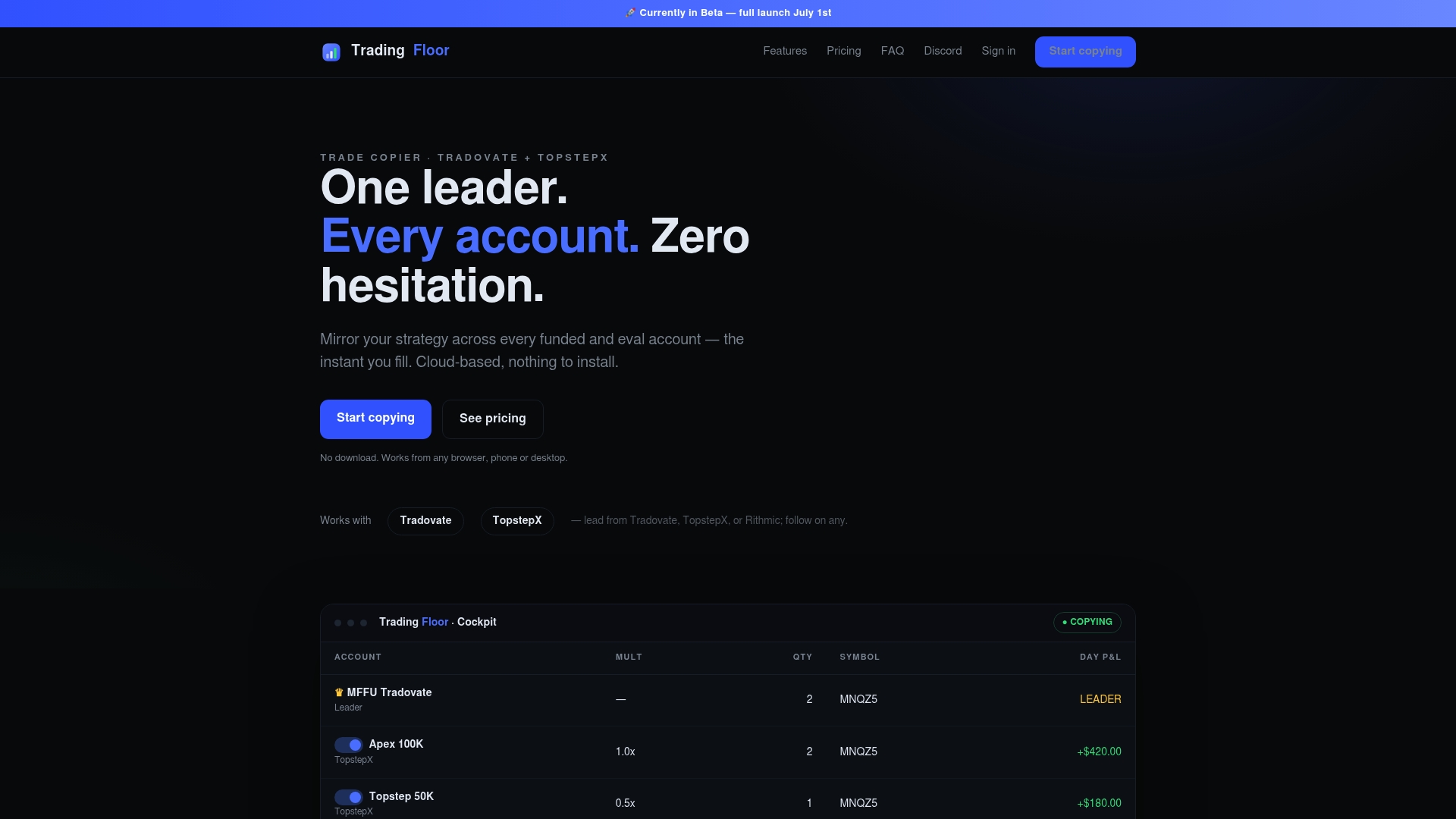
Tradingfloor solves this by mirroring the leader account’s net position across all funded and evaluation accounts in real time, with individual risk controls applied per account. You are not copying signals; you are synchronizing actual positions while keeping each account’s limits intact. Real-time notifications flag when any account approaches a risk threshold, so you catch the problem before it becomes a breach. The platform runs in the cloud, works across Tradovate, TopstepX, and other supported brokers, and requires no installation.
If you are managing more than one account and want a concrete check on whether your current setup is operating cleanly, check system status and explore how Tradingfloor’s cross-account controls work for your situation.
Useful sources and when to get professional help
- CFTC — Commodity Futures Trading Commission — regulatory guidance on futures trading, leverage, and broker conduct
- FINRA BrokerCheck — verify broker history and churning complaints
- FINRA — investor protection rules, pattern day trading regulations
- NFA BASIC Database — background on futures brokers and NFA members
- Investopedia: Overtrading — definitions, PDT rules, and prevention overview
- CMC Markets: What is overtrading? — business overtrading definition and working capital guidance
- The Wall Street Coach: How to stop overtrading — behavioral research, Barber and Odean findings, structural fixes
- Stock market education and glossary — foundational concepts for traders building a structured approach
When to seek professional help: If your business is drawing on its overdraft to meet payroll, if a supplier has moved you to prepayment terms, or if your trading account has lost more than 20% in a month, consult a qualified accountant, insolvency practitioner, or trading coach before making further commitments. General information is a starting point; a professional who can review your specific numbers is the next step.
This article is general information, not financial or legal advice. Confirm current rules and thresholds with a qualified professional or the relevant regulatory authority for your specific situation.
Recommended
- Account-Level Risk Management: A Trader’s Complete Guide — Trading Floor
- Cross-Account Trade Management: A 2026 Trader’s Guide — Trading Floor
- Funded Account Risk Rules Explained for Prop Traders — Trading Floor
- Multi-Platform Trading Best Practices for Prop Traders — Trading Floor
Trading Floor mirrors every trade across your Tradovate, TopstepX & Rithmic accounts in real time, from $25/mo.
Start copying →