Human Error in Trading Explained: Cut Losses With Rules

Human error in trading covers every behavioral and execution mistake that predictably damages performance, from holding a losing futures position three times longer than planned to fat-fingering the wrong contract size. The fastest way to reduce its damage is not willpower but instead using transparent AI trading strategies which offer enforceable, rule-based controls backed by automation. It is enforceable, rule-based controls backed by automation. A Norges Bank analysis of professional day traders found that algorithmic systems systematically avoid the disposition effect that human traders fall into repeatedly. Investopedia’s trading psychology research confirms that software-enforced limits outperform discipline alone under stress. Tradingfloor is one platform built specifically around that principle for multi-account traders.
Key facts to hold onto:
- Behavioral errors (bias-driven decisions) alter your expectancy on every trade.
- Execution errors (slips, misclicks, wrong order types) produce direct, avoidable P&L hits.
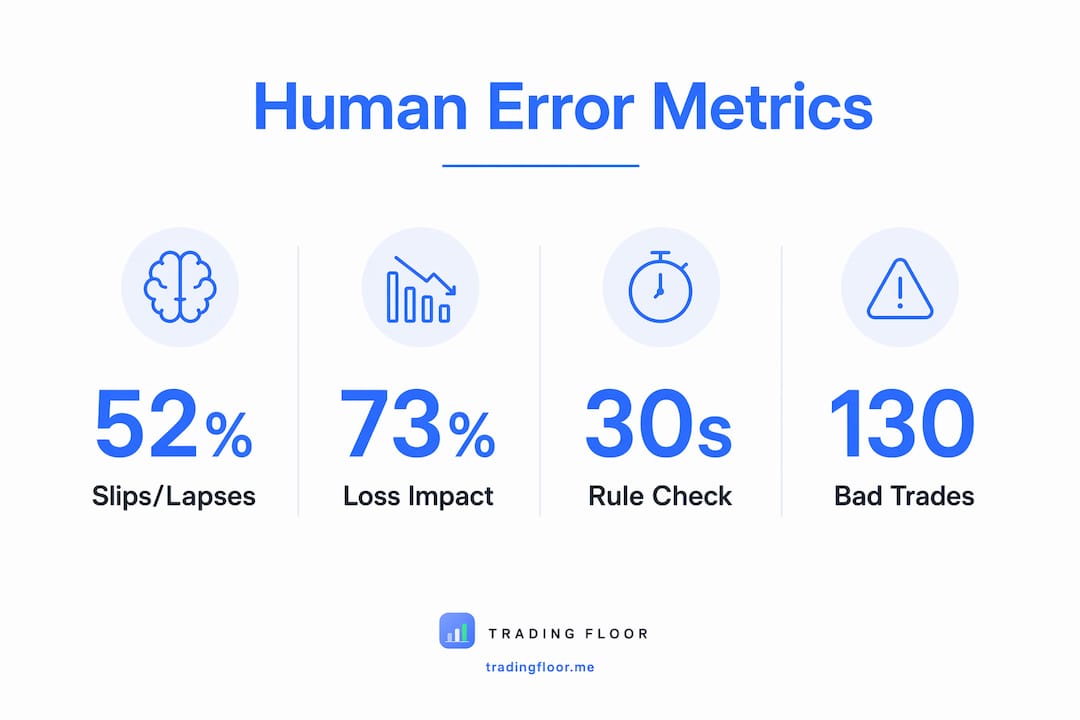
- LSE near-miss research found that 52% of trading incidents are slips and lapses, not strategy failures.
- Automation removes the human decision at the highest-risk moments.
Table of Contents
- What does “human error in trading” actually mean?
- Which cognitive biases cause the most trading errors?
- What are the most common execution and decision errors?
- How does human error show up in your track record?
- Structural vs. psychological defenses: which comes first?
- What structural controls should you implement first?
- What behavioral routines actually reduce mistakes?
- Your 30/60/90-day plan to reduce human error
- A before-and-after: the tilt cascade that automation would have stopped
- Key Takeaways
- The case for automation-first, not automation-only
- How Tradingfloor helps multi-account traders cut execution errors
- Useful sources
What does “human error in trading” actually mean?
Human error in trading splits into two distinct categories, and conflating them leads to the wrong fix.
Behavioral errors are bias-driven decisions: selling a winning ES trade at the first sign of a pullback while holding a losing NQ position because “it’ll come back.” These errors are invisible in the moment. They feel like judgment.
Execution errors are mechanical slips: entering 10 contracts instead of 1, clicking the wrong side of the market, or leaving a stop order unplaced because the entry happened too fast. These feel like accidents, but human factors research shows roughly 1% of all trades contain an error of this type, and they cluster predictably around high-volatility windows.
Both types matter for different reasons. Behavioral errors quietly erode expectancy across hundreds of trades. Execution errors produce sudden, outsized hits that can breach a funded account’s daily loss limit in a single session.
Which cognitive biases cause the most trading errors?
Six biases account for the bulk of trading decision-making flaws, and each one has a recognizable signature mid-session.
- Disposition effect: You exit winners early and hold losers too long. The Norges Bank finding is direct: this pattern is driven by emotional regulation failures, not rational calculation, and rule-based algorithms do not exhibit it.
- Loss aversion: Losses feel roughly twice as painful as equivalent gains feel good. That asymmetry pushes traders to avoid realizing losses, which is the disposition effect’s engine.
- Confirmation bias: You seek out signals that agree with your open position and discount the ones that don’t. A trader long crude oil will read every headline as bullish.
- Overconfidence: A three-day winning streak creates a subconscious sense of immunity. One trader described it precisely: going 3-for-3 the day before “created a subconscious sense of immunity. My brain filed it as: I can bend the rules and win.”
- Anchoring: You fixate on your entry price or a recent high as a reference point, making exit decisions relative to that anchor rather than current market structure.
- Recency bias: Whatever happened in the last session feels like the new normal. After a volatile open, every subsequent move looks like a continuation.
One underappreciated finding: academic research shows that non-financial factors like weather can causally shift the intensity of trader biases. Your bias level on any given day is not fixed. That variability is exactly why automated controls need to hold even when you feel sharp.
What are the most common execution and decision errors?
The errors below appear in post-mortems repeatedly. Most cluster in two windows: the first 30 minutes of a session and the 20 minutes after a significant loss.
- Overtrading: Taking setups that don’t meet plan criteria because the screen is moving and inaction feels wrong.
- Revenge trading: Immediately re-entering after a stop-out to “get it back.” FXStreet analysis identifies the 20 minutes after a loss as the single most expensive window in a trading session.
- Position-size creep: Gradually increasing size after wins until one loss wipes the streak’s gains.
- Moved or removed stops: Writing a stop level on a sticky note and then not honoring it. This is the most common single error in trader post-mortems.
- Multi-account mismatch: Manually managing three funded accounts and entering different sizes on each because the order tickets don’t sync.
- Fat-finger misorders: Wrong contract, wrong direction, wrong quantity. These are pure execution errors with no behavioral component.
The 22-trade spiral autopsy is the clearest case study of how these errors compound. Compressed timestamps between entries, unchanged position sizes, no hard stops, and sunk-cost escalation combined to turn a manageable loss into an account-threatening cascade. No single error caused it. The structural gaps enabled all of them.
How does human error show up in your track record?
The metrics below are the earliest warning signals of human-error-driven deterioration. Track them in your trade log and tag every entry that violated a plan rule.
| Metric | What it reveals |
|---|---|
| Expectancy per trade | Drops when behavioral errors skew your average loser larger than your average winner |
| Win rate vs. avg gain/loss ratio | A rising win rate with shrinking profit factor signals overtrading or early exits |
| Max drawdown clustering | Drawdowns that arrive in tight time clusters point to tilt cascades, not market conditions |
| Profit factor | Falls below breakeven when revenge trades and oversized losers dominate the log |
| Rule-violation frequency | Direct count of plan breaches; the single most useful audit metric |
A forensic review of 500 trades found that 130 “bad-habit” trades accounted for 73% of total dollar losses. The implication is clear: you don’t need to fix everything. You need to find and eliminate the small set of recurring mistakes that are doing most of the damage. Tagging rule breaches in your log is how you find them.
Pro Tip: Add a single “rule breach” column to your trade log. A yes/no entry per trade takes 10 seconds and, after 30 sessions, shows you exactly which setup or emotional state is costing you the most.
Structural vs. psychological defenses: which comes first?
Two tracks exist for mitigating trading mistakes, and they are not equally reliable under pressure.
Structural defenses are automated or rule-enforced controls: hard stops placed at order entry, per-account daily-loss limits enforced by software, cooling-off lockouts triggered automatically after a threshold loss. They work whether you are calm or tilting.

Psychological defenses are habits and routines: a written trading plan, a pre-trade checklist, journaling, an accountability partner. They work when you are calm. Under stress, the Investopedia evidence is unambiguous: traders’ ability to follow self-imposed rules degrades sharply in high-stress moments.
The priority order follows from that. Build structural defenses first. Use psychological practices to reinforce them and to catch the gaps automation cannot reach, like the decision to take a setup in the first place. For single-account discretionary traders, start with immovable stops and a daily-loss limit. For multi-account managers, add synchronization and per-account controls before anything else.
What structural controls should you implement first?
Systematic risk management starts with a prioritized sequence, not a simultaneous overhaul.
- Hard stops on every trade, placed at entry. No exceptions. This single rule eliminates the most common and most expensive error in trader post-mortems.
- Per-trade percentage risk enforced by position-sizing logic. Fixed-dollar or fixed-contract sizing is not the same thing. Size to risk, not to feel.
- Daily-loss circuit breakers. When the account hits a preset drawdown threshold, trading stops for the day. Automated, not discretionary.
- Enforced cooling-off timers. After a loss exceeding a set threshold, a lockout prevents new entries for a defined period. This directly addresses the post-loss danger window.
- Per-account slippage caps and contract multipliers. For multi-account traders on platforms like Tradovate, TopstepX, or Rithmic, these controls prevent one account’s execution from drifting out of sync with the leader position.
- Auto-reconciliation and alerting. Any mismatch between the leader account and a follower account triggers an immediate notification rather than a silent discrepancy.
For multi-account traders, execution consistency across platforms is the structural layer that single-account traders don’t need to think about. Tradingfloor mirrors the leader’s net position in real time across funded and evaluation accounts, with per-account risk controls enforced independently. That architecture removes the manual reconciliation step where most multi-account errors originate.
Pro Tip: Avoid automating recovery trades. Automation should enforce rules and prevent bad decisions, not execute new ones. A circuit breaker that stops trading after a loss threshold is correct. A bot that automatically re-enters to “recover” is a different kind of human error baked into code.
What behavioral routines actually reduce mistakes?
Structural controls handle the high-stress moments. These habits handle everything else.
- Write your trading plan before the session opens, including the specific setups you will take and the ones you will skip.
- Run a pre-trade checklist: direction bias confirmed, stop level identified, position size calculated, daily-loss limit checked.
- After any loss exceeding your threshold, enforce a 15–60 minute cooling-off period. The FXStreet post-loss window research makes this non-optional.
- End each session with a rule-adherence review, not a P&L review. Did you follow the plan? Where did you deviate?
- Journal rule breaches specifically. “I moved my stop because I was sure it would reverse” is more useful than “bad trade.”
- Use an accountability partner or trading coach for weekly log reviews.
Pro Tip: Start with one immutable rule and automate its enforcement before adding a second. “I never move a stop” is a complete rule. Trying to install six new habits simultaneously means none of them stick.
Your 30/60/90-day plan to reduce human error
- Days 1–30: Audit your last 60 trade logs. Tag every rule breach. Identify your top three recurring errors. Define three immutable rules. Set up hard stops and position-size enforcement on every new trade.
- Days 31–60: If you manage multiple accounts, integrate synchronization. Set daily-loss circuit breakers and cooling-off timers. Run simulated stress tests using historical volatile sessions to confirm the controls hold.
- Days 61–90: Review expectancy, drawdown clustering, and rule-violation frequency. Refine rules based on what the data shows. Add reconciliation alerts and notification layers. Assign an accountability partner for monthly log reviews.
Cost considerations are minimal at the structural level: most execution platforms support native stop orders and daily-loss limits at no additional cost. Multi-account synchronization via a cloud-based trade copier adds a subscription cost but replaces the manual reconciliation time and the error cost it was generating.
A before-and-after: the tilt cascade that automation would have stopped
Before: A trader takes a loss on the open. No hard stop was placed. They re-enter immediately at a larger size to recover. That trade also loses. Over the next 90 minutes, they execute 22 trades with compressed timestamps, unchanged sizing, and no stops. The 22-trade spiral autopsy identifies exactly this pattern: sunk-cost escalation, no structural interruption, and a cascade that a single circuit breaker would have ended after trade three.
After: The same trader, same emotional state, same bad first trade. The difference:
- Hard stop placed at entry: loss capped at 1% of account.
- Daily-loss circuit breaker at 3%: trading halted automatically after the third loss.
- 30-minute cooling-off lockout: no new entries possible during the highest-danger window.
- Result: three losing trades instead of twenty-two. The account survives the session.
The mechanism matters here. Automation did not make the trader calmer. It removed the decision-making link between the emotional state and the order ticket.
Key Takeaways
Human error in trading is predictable and measurable, and structural automation is the most reliable way to stop it before it compounds.
| Point | Details |
|---|---|
| Slips dominate incidents | 52% of trading incidents are slips and lapses, not strategy failures. |
| Bad habits drive most losses | 130 bad-habit trades out of 500 accounted for 73% of total dollar losses in one forensic review. |
| Post-loss window is highest risk | The 20 minutes after a loss are the most expensive; enforced cooling-off rules directly cut that exposure. |
| Structural controls beat willpower | Software-enforced limits hold under stress; self-imposed rules degrade when it matters most. |
| Tradingfloor enforces multi-account controls | Per-account risk limits, slippage caps, and auto-reconciliation remove the manual steps where most multi-account errors originate. |
The case for automation-first, not automation-only
The conventional wisdom on trading psychology puts journaling and mindset work at the center. That framing is backwards. Journaling is a diagnostic tool. It tells you what went wrong after the fact. It does not stop the 22nd trade in a cascade.
The traders who reduce human error durably are the ones who build the structural layer first and use behavioral work to understand what their rules need to cover. The disposition effect is not a character flaw. Norges Bank’s finding is that professional traders, people paid to be rational, exhibit it systematically. The fix is not to be more disciplined. The fix is to build a system where the biased decision cannot be executed.
That said, automation has a ceiling. It cannot decide which setups are worth taking. It cannot replace the judgment that comes from reading a session correctly. The traders who get this right use automation to handle the moments when judgment fails, and they use behavioral routines to sharpen judgment for the moments when it counts.
How Tradingfloor helps multi-account traders cut execution errors
Prop traders running three or four funded accounts face a version of human error that single-account traders don’t: the manual reconciliation gap. Every time you enter a position on one account and forget to mirror it on another, or size it differently because you were watching the wrong screen, that is a structural error with a structural fix.
Tradingfloor mirrors the leader’s net position across Tradovate, TopstepX, and Rithmic-connected accounts in real time, with per-account risk limits, slippage caps, contract multipliers, and auto-reconciliation enforced independently on each account. Push notifications flag any mismatch before it becomes a loss. No installation, no manual reconciliation, and the 30-day free trial means you can confirm it fits your setup before committing.

Check system availability before your next session and see whether your current setup has the structural controls this article describes.
Useful sources
- Near misses in financial trading — LSE: Near-miss incident analysis quantifying slip/lapse rates and the role of non-technical skills in prevention.
- Human factors in financial trading — Leaver PhD thesis, LSE: Comprehensive human-factors framework for trading; source of the 1% erroneous-trade estimate.
- When machines beat bias — Norges Bank (2025): Professional day-trader disposition-effect analysis contrasting human and algorithmic performance.
- Trading Psychology: Why Traders Lose — Investopedia: Overview of cognitive biases and the case for structural defenses over discipline alone.
- Behavioral biases and external factors — Paris-December 2022: Academic evidence that non-financial factors causally modulate trader bias intensity.
- The 22-Trade Spiral — Complete Trader’s Edge: Forensic autopsy of a tilt cascade identifying the structural gaps that enabled it.
- The most expensive 20 minutes in trading — FXStreet: Analysis of post-loss danger window and the case for enforced cooling-off rules.
- 500-trade data analysis — Thrive: Forensic trade-log review showing a minority of bad-habit trades drive the majority of dollar losses.
Recommended
- Types of Trading Evaluation Account Rules Explained — Trading Floor
- Avoid Consistency Rule Violations When Copying Trades — Trading Floor
- Trading Execution Best Practices: A 2026 Trader’s Guide — Trading Floor
- Prop Trader Performance Optimization Explained — Trading Floor
Trading Floor mirrors every trade across your Tradovate, TopstepX & Rithmic accounts in real time, from $25/mo.
Start copying →