Passive Trading Strategy Types Explained for Traders

Passive trading strategies are systematic, rule-based methods that automate position management and reduce trading errors by following predefined rules rather than frequent active decisions. The industry standard term for this approach is “systematic trading,” though traders commonly use “passive trading” to describe any method that removes moment-to-moment human judgment from execution. Passive trading strategy types explained clearly show that these methods span a wide range: from index funds and ETFs that mirror market benchmarks, to grid trading bots, factor ETFs, managed futures ETFs, and options income systems. Each type balances automation, risk, and monitoring differently. Choosing the right one depends on your capital, risk tolerance, and how much oversight you can realistically commit to.
## Passive trading strategy types explained: the major categories
The five core types of passive trading strategies each operate on a distinct mechanism. Understanding how each one generates returns, and where it can break down, is the foundation of effective automated position management.
Grid trading bots
Grid trading bots place buy and sell orders at fixed price intervals above and below a set price. The bot profits from price oscillation within that range, capturing the spread repeatedly without any manual input. Grid bots can generate monthly returns of 1%–5% in range-bound markets by automating entry, exit, and risk management with predefined rules. That performance depends entirely on the asset staying within the grid’s range. A directional breakout can exhaust the bot’s capital quickly, which is why asset selection matters as much as the bot’s configuration.

Pro Tip: Run grid bots on high-liquidity assets with historically range-bound price action. Avoid assets with strong trending behavior or low daily volume, since both conditions can deplete bot capital faster than the grid can recover.
Factor ETFs
Factor ETFs use systematic screening for quality or value to provide passive exposure to specific return drivers. Instead of picking individual stocks, the ETF rebalances automatically based on factor criteria such as low volatility, momentum, or dividend yield. Traders use factor ETFs to capture systematic return premiums without building or maintaining a custom algorithm. The trade-off is that factor ETFs are packaged products with less customization than a DIY systematic strategy, but they require far less setup time and technical expertise.
Managed futures ETFs
Managed futures ETFs deliver trend-following exposure without requiring traders to manage futures contracts directly. The fund’s algorithm identifies and holds trends across asset classes including commodities, currencies, and bonds. Trend following has shown stability across decades, making managed futures a lower-maintenance option for traders who want systematic exposure to momentum without manual trading. The main limitation is that these funds underperform in choppy, directionless markets where no clear trend exists.
Systematic options income
Systematic options income strategies use fixed rules to sell covered calls or cash-secured puts on a recurring schedule. Automated options premium selling yields approximately 1%–3% monthly income under favorable conditions. The rules govern strike selection, expiration dates, and position sizing, removing discretion from the process. Assignment risk is the primary concern: if the underlying asset moves sharply against the position, the trader may be forced to buy or sell shares at an unfavorable price.
Dollar-cost averaging bots
Dollar-cost averaging (DCA) bots purchase a fixed dollar amount of an asset at regular intervals regardless of price. This approach removes the temptation to time the market and builds positions gradually over time. DCA bots are the most accessible entry point into passive trading because they require minimal configuration and carry straightforward risk. The strategy works best in assets with long-term upward bias, since averaging into a declining asset without a recovery thesis can produce sustained losses.
Risk profiles and monitoring requirements
Passive strategies are not equal in the oversight they demand. Understanding each strategy’s risk profile prevents the most common mistake: treating automation as a substitute for judgment.
-
Grid bots: high monitoring requirement. Grid bots require monitoring for liquidity and asset behavior to avoid losses from directional crashes. A market regime shift from range-bound to trending can exhaust bot capital within days. Weekly reviews of price action and grid parameters are the minimum standard.
-
Mean reversion systems: tight monitoring required. Mean reversion requires tighter monitoring than trend following due to range-bound risks. When a market breaks its historical range, mean reversion positions accumulate losses rapidly. Traders must set hard stop-loss limits at the system level, not just at the trade level.
-
Systematic options income: assignment risk. Options income strategies carry assignment risk that can force large capital commitments at the worst possible time. Traders must size positions so that assignment does not exceed available capital or margin limits.
-
Factor ETFs and managed futures: lower active risk. These packaged strategies carry lower active monitoring requirements because the fund itself handles rebalancing. The risk is structural: passive approaches cannot react quickly to sudden market shocks. Traders must accept that drawdowns during extreme events will be larger than in actively managed positions.
-
DCA bots: lowest monitoring, highest patience requirement. DCA bots need the least active oversight but require the longest time horizon to show results. The risk is behavioral: traders often abandon DCA strategies during drawdowns, which eliminates the averaging benefit entirely.
Pro Tip: Schedule a monthly “sanity check” for every automated strategy you run. Review whether the market conditions that justified the strategy’s setup still exist. A strategy that worked in a low-volatility regime may need reconfiguration after a volatility spike.
Automation tools and technology for passive strategies
The right technology stack determines whether a passive strategy runs as designed or drifts into uncontrolled risk. Choosing platforms and tools that match your strategy type is not optional.
- Broker API integration. Broker-level controls such as bracket orders and risk limits enforce discipline and reduce human error in automated systems. Any platform you use should support direct API connectivity to your broker so that risk parameters execute at the order level, not just at the strategy level.
- Signal automation vs. fully managed systems. Signal automation sends trade alerts that require manual confirmation. Fully managed systems execute without human input. For passive trading, fully managed systems deliver the error-reduction benefit that signal automation cannot.
- Phased deployment. Test every automated strategy in a paper trading environment before committing live capital. Run the live version at reduced size for the first 30 days to confirm that execution matches the backtest.
- Bracket orders, stop-loss, and take-profit automation. These three order types are the minimum feature set for any passive strategy platform. Without them, a bot can hold losing positions indefinitely.
| Feature | Why it matters for passive strategies |
|---|---|
| Bracket orders | Automatically cap loss and lock in profit on every trade |
| Stop-loss automation | Prevents capital exhaustion during regime shifts |
| Take-profit rules | Removes discretion from exit decisions |
| API connectivity | Ensures execution matches strategy parameters at the broker level |
| Multi-account support | Allows the same strategy to run across funded and evaluation accounts |
Tradingfloor supports multi-account trade execution by mirroring a leader account’s net position across multiple funded and evaluation accounts in real time. That architecture is particularly useful for prop traders running the same passive strategy across several accounts simultaneously.
How to choose the best passive trading strategy for your goals
Matching a passive strategy to your situation requires honest answers to three questions: How much capital do you have? How much drawdown can you tolerate? How much time can you spend on monitoring?
Capital size directly limits your options. Systematic options income requires enough capital to cover potential assignment, which typically means at least $5,000–$10,000 per position. Grid bots and DCA bots can operate with smaller accounts. Factor ETFs and managed futures ETFs have no practical minimum beyond the ETF share price.
Market conditions should drive strategy selection. Grid bots and mean reversion systems work in range-bound markets. Managed futures ETFs and trend-following systems work in trending markets. Running a grid bot in a strong trend, or a trend-following system in a choppy market, produces consistent losses regardless of how well the system is configured. Traders who want to cover both regimes should combine a grid bot with a managed futures ETF, using each to offset the other’s weakness. For a practical look at hands-off trading systems that apply these principles, Tradingfloor’s blog covers real configurations across multiple market types.
Monitoring availability is the most underestimated factor. Successful passive trading shifts decision-making to reliable algorithms with periodic checks rather than full hands-off operation. Traders who cannot commit to weekly reviews should stick to factor ETFs or managed futures ETFs, which require the least active oversight. Traders with more time available can run grid bots or options income systems, which offer higher return potential but demand more frequent attention.
Combining multiple strategies across different market regimes is the most effective way to reduce overall portfolio risk. A DCA bot provides a stable base. A grid bot adds income in sideways markets. A managed futures ETF captures trending periods. Together, they cover more market conditions than any single approach.
Key Takeaways
Passive trading strategies reduce errors and automate position management by following predefined rules, but each type demands a different level of monitoring and carries a distinct risk profile.
| Point | Details |
|---|---|
| Grid bots need active oversight | Monitor asset behavior weekly to avoid capital exhaustion during trend breakouts. |
| Match strategy to market regime | Use grid bots in range-bound markets and managed futures ETFs in trending conditions. |
| Options income carries assignment risk | Size positions so that assignment does not exceed available capital or margin. |
| Automation does not replace oversight | Schedule monthly reviews to confirm market conditions still match strategy parameters. |
| Combine strategies for resilience | Running DCA, grid, and trend-following systems together covers more market conditions. |
Why passive trading is more active than traders expect
The biggest misconception I see among traders new to automation is the belief that “passive” means “hands-off forever.” That framing causes real financial damage. Every passive strategy I have worked with, from grid bots to factor ETFs, has a set of conditions under which it performs and a set of conditions under which it bleeds capital. The strategy does not know when those conditions have changed. You do.
The traders who succeed with passive systems treat them like employees, not machines. They check in regularly, review performance against expectations, and make configuration changes when the market environment shifts. The automation handles execution discipline, which is genuinely valuable. It removes the emotional decisions that cost most traders money. But the strategic judgment, knowing when a grid bot’s range is no longer valid or when a trend-following system is whipsawing in a choppy market, still requires a human.
The technology is improving fast. Platforms that support account-level risk management and real-time position mirroring are making it easier to enforce discipline across multiple accounts without manual intervention. That is a genuine advance. But the traders who use these tools best are the ones who understand what the tools cannot do, not just what they can.
— KennyTrades
Tradingfloor and automated passive strategy management
Passive strategies deliver their full benefit only when execution is consistent across every account you run. Tradingfloor is built for exactly that situation.
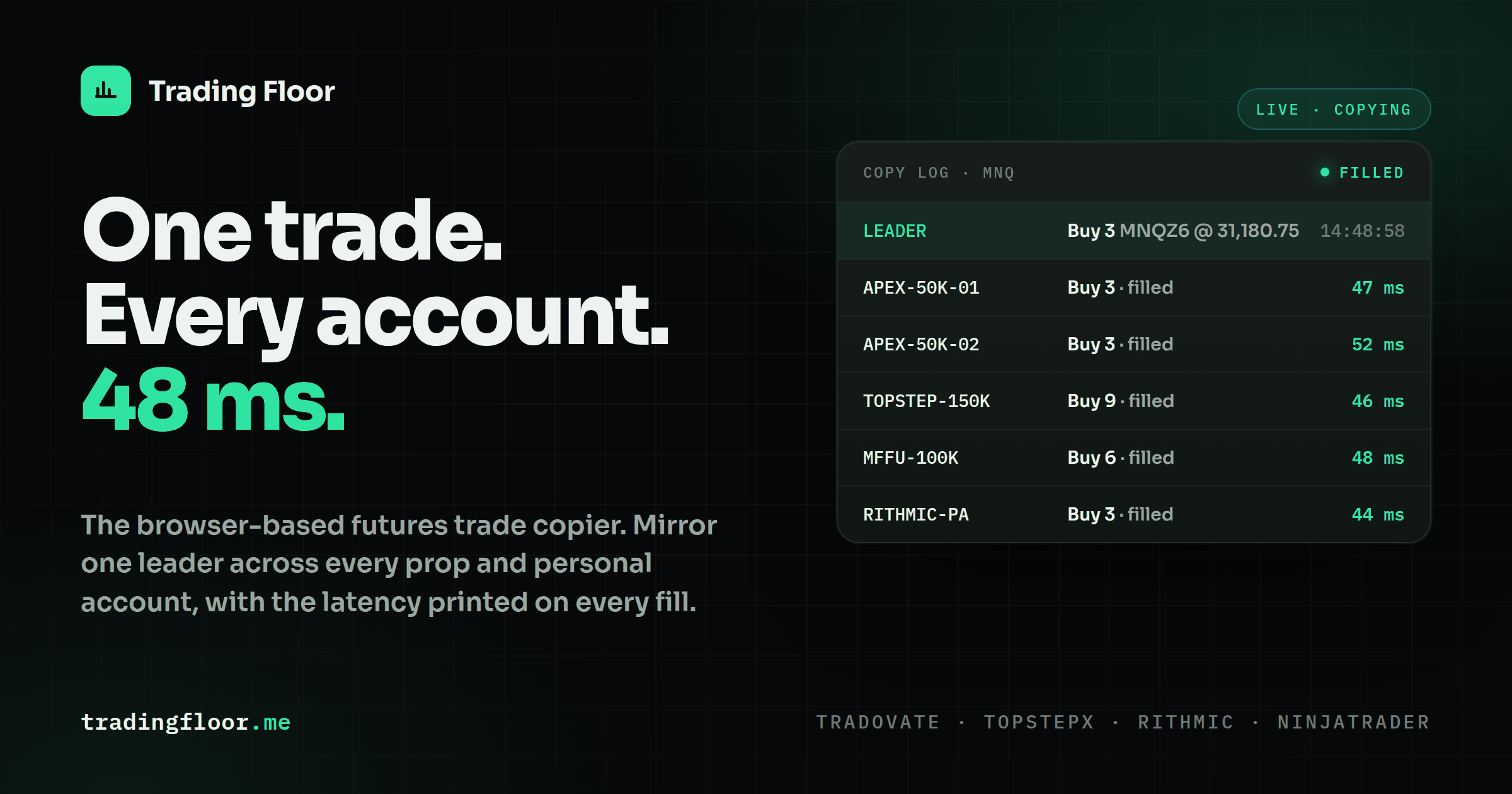
Tradingfloor mirrors a leader account’s net position in real time across any number of funded and evaluation accounts, including those on Tradovate and TopstepX. Every account follows the same passive strategy simultaneously, with individual risk controls applied at the account level. Bracket orders, trade limits, and real-time notifications keep each account within its defined parameters without requiring manual input. Traders managing multiple prop firm accounts can run the same passive strategy everywhere without logging into each account separately. See how Tradingfloor works and review the available plans to find the setup that fits your account structure.
FAQ
What is a passive trading strategy?
A passive trading strategy is a rule-based system that automates trade entry, exit, and risk management without requiring frequent active decisions. Common examples include grid trading bots, factor ETFs, managed futures ETFs, and dollar-cost averaging bots.
How do grid trading bots generate returns?
Grid bots place buy and sell orders at fixed price intervals and profit from repeated price oscillation within that range. They generate monthly returns of 1%–5% in range-bound markets under favorable conditions.
What is the biggest risk in passive trading strategies?
The biggest risk is a market regime shift that invalidates the strategy’s core assumption. Grid bots lose capital in trending markets, and trend-following systems underperform in choppy conditions. Periodic reviews are the primary defense against this risk.
How often should I review an automated passive strategy?
Monthly reviews are the minimum standard for most passive strategies. Grid bots and options income systems benefit from weekly checks due to their sensitivity to short-term market behavior.
Can I run multiple passive strategies at the same time?
Running multiple passive strategies across different market regimes reduces overall portfolio risk. Combining a DCA bot, a grid bot, and a managed futures ETF covers range-bound, trending, and long-term accumulation conditions simultaneously.
Recommended
- Examples of Hands-Off Trading Systems That Work — Trading Floor
- Types of Trade Copying Strategies: 2026 Guide — Trading Floor
- Trade the Same Strategy Across Multiple Brokers — Trading Floor
- Pass Multiple Prop Firm Evals at Once With One Strategy — Trading Floor
Trading Floor mirrors every trade across your Tradovate, TopstepX & Rithmic accounts in real time, from $25/mo.
Start copying →