Protect Funded Accounts: Trade Copier Safety Meets FCA and SEC Tests

Trade copier safety comes down to five non-negotiable controls: per-account drawdown caps, daily loss limits, stop and take-profit propagation to every follower, reconciliation that shows rejected orders instead of hiding them, and encrypted, authenticated connections between master and follower accounts. Before connecting any funded or evaluation account, run the full setup in a demo environment and get written confirmation of your prop firm’s copying rules. A trade copier should build its architecture around exactly this checklist.
TL;DR:
- Using per-account risk caps and daily loss limits is essential to prevent a single bad trade from draining a follower’s entire account.
- Stop-loss and take-profit orders should be set independently on each follower account to avoid silent failures during fast market conditions.
- Reconciliation, logging, and rejection alerts are crucial for detecting and managing order skips, duplicates, or mismatches after reconnects or execution delays.
- Before connecting funded accounts, traders must review firm policies, get written approval, strip order metadata, and route through dedicated IPs to reduce detection risks.
- Testing the system thoroughly through demo runs, simulated disconnects, and load scenarios is vital to identify safety gaps before live trading with real money.
Table of Contents
- What Makes a Trade Copier Actually Safe?
- Execution Timing, Reconciliation, and Symbol Mapping Risks
- Compliance Risks Before Connecting Funded Accounts
- How to Test a Trade Copier Before Going Live
- How Tradingfloor Applies These Safety Principles
- Updating Your Trade Copier Without Breaking It
- Handling Network Interruptions Without Losing Control
- Author Perspective: Practical Tradeoffs and Lessons Learned
- Getting Started With a Trade Copier
- Sources
- FAQ
What Makes a Trade Copier Actually Safe?
A trade copier is only as safe as its weakest guardrail, and most of the damage traders report comes from a handful of predictable gaps: no per-account risk ceiling, no stop enforcement on the follower side, and silent failures when an order gets rejected. Copy trading security isn’t a single feature. It’s a layered system where each control catches what the one before it missed.

Per-follower risk caps and daily loss limits
Every follower account needs its own static and trailing drawdown limit, set independently of the master account’s risk profile. A master trader running a $150,000 account and a follower on a $50,000 evaluation account cannot share the same dollar-based stop. If the copier applies a flat dollar risk instead of scaling to account size, one bad trade on the master can blow through a follower’s entire daily loss limit in seconds. Daily loss limits need to sit below whatever ceiling the funding firm or broker enforces, not equal to it, so there’s a buffer before an automated flatten kicks in.
Position sizing and rounding
Balance-proportional sizing and per-account multipliers solve the size mismatch, but rounding is where things quietly break. If a master trade calls for 2.3 contracts scaled to a smaller account, the copier has to round down, never up, and log the adjustment. Undocumented rounding is how followers end up over-leveraged without anyone noticing until the drawdown hits.
Stop propagation, not master-only settings
Stop-loss and take-profit levels should exist independently on each follower account rather than relying on the master’s exit to close everyone out. If the master’s stop order fails to fill during a fast market, follower accounts with their own enforced stops still get out. Followers dependent on the master’s exit alone are exposed the entire time that order is stuck.
- Automatic halting after a defined loss threshold, no manual restart required
- “Flatten all” capability that closes every open position across every connected account instantly
- Visible rejections logged in real time, not swallowed silently
- Per-order audit logs showing timestamp, size, fill price, and account ID
- Real-time push alerts the moment a follower’s cap is breached
That gap is your buffer against slippage on the flatten order itself.*
Execution Timing, Reconciliation, and Symbol Mapping Risks
The gap between when the master trade fires and when the follower’s order lands is where a lot of safety in trade copying quietly falls apart. Latency and slippage between master and follower accounts are unavoidable, but they’re manageable with the right settings.
- Set a slippage cap on every follower account. If the fill price moves beyond a defined tick threshold, the order should reject rather than execute at a worse price.
- Reconcile symbol mapping before connecting a new broker. Contract suffixes, minimum tick sizes, and lot steps differ across platforms like Tradovate, TopstepX, and Rithmic, and a mismatched symbol will either fail silently or trade the wrong instrument entirely.
- Define a clear reconnection policy. After a dropped connection, the copier needs to either skip the missed event, open late with a flagged note, or queue the trade for manual review. Silence about what happened during a disconnect is the actual failure, not the disconnect itself.
- Watch for duplicate fills. A follower reconnecting mid-trade should never re-execute an order it already filled before the drop.
- Test order rejection paths. Margin shortfalls and stop-distance violations should trigger an alert, not a quiet skip.
- Measure master-to-follower delay under simulated load, not just in a quiet market. Delay that looks fine with one follower can stretch noticeably once five or six accounts are copying simultaneously.
Compliance Risks Before Connecting Funded Accounts
Prop firms watch for patterns that scream “this account is being copied,” and getting flagged can mean a forfeited payout, not just a warning email. Detection systems commonly look at shared IP addresses or VPS fingerprints across accounts, near-identical order timestamps, leftover metadata like magic numbers or comments in order tags, and correlation scores between accounts that spike well above normal trading variance.
Regulators are watching a related but separate concern: whether copying crosses into unlicensed portfolio management. The FCA has stated that copy trading becomes a form of investment management once trades execute automatically without the follower’s manual input, which carries suitability and conduct obligations. In the US, the SEC is the relevant authority to consult if you’re unsure whether an automated copying arrangement triggers registration requirements.
Before you connect a funded or evaluation account:
- Read the firm’s copy trading clause line by line, not the summary someone posted in a forum
- Get written approval, even if the contract seems to allow it
- Set follower caps meaningfully below the firm’s stated limits
- Strip magic numbers and comment tags from copied orders
- Route follower accounts through dedicated IPs or separate VPS instances
Randomizing execution timing across followers and keeping per-account limits tight reduces detection risk while keeping you inside the spirit of the firm’s rules, not just the letter of them.
How to Test a Trade Copier Before Going Live
Skipping demo testing is the single most common way traders discover a safety gap after it costs them money instead of before.
- Connect one follower on a different broker first. Confirm symbol mapping and suffix handling resolve correctly before adding a second account.
- Run a full trade lifecycle. Open a position, take a partial exit, move the stop to break even, trail it, then close. Every step should mirror correctly on the follower.
- Kill the connection mid-trade and reconnect. Check that the follower reconciles without duplicating the fill or losing track of the open position.
- Force a rejection deliberately. Set a follower’s margin too low or push a stop distance that violates a broker rule, then confirm the alert fires and the log records it.
- Validate caps and rounding. Confirm the per-account drawdown limit actually halts trading, and check that contract rounding never rounds up.
- Load test with multiple followers running at once. Measure the master-to-follower delay and slippage under that load, since a copier that performs fine with one account can lag badly with six.
Pro Tip: Run the reconnection test on purpose, mid-week, during a normal trading session — not just once during setup. Reconciliation bugs tend to show up under real market noise, not in a quiet test window.
How Tradingfloor Applies These Safety Principles
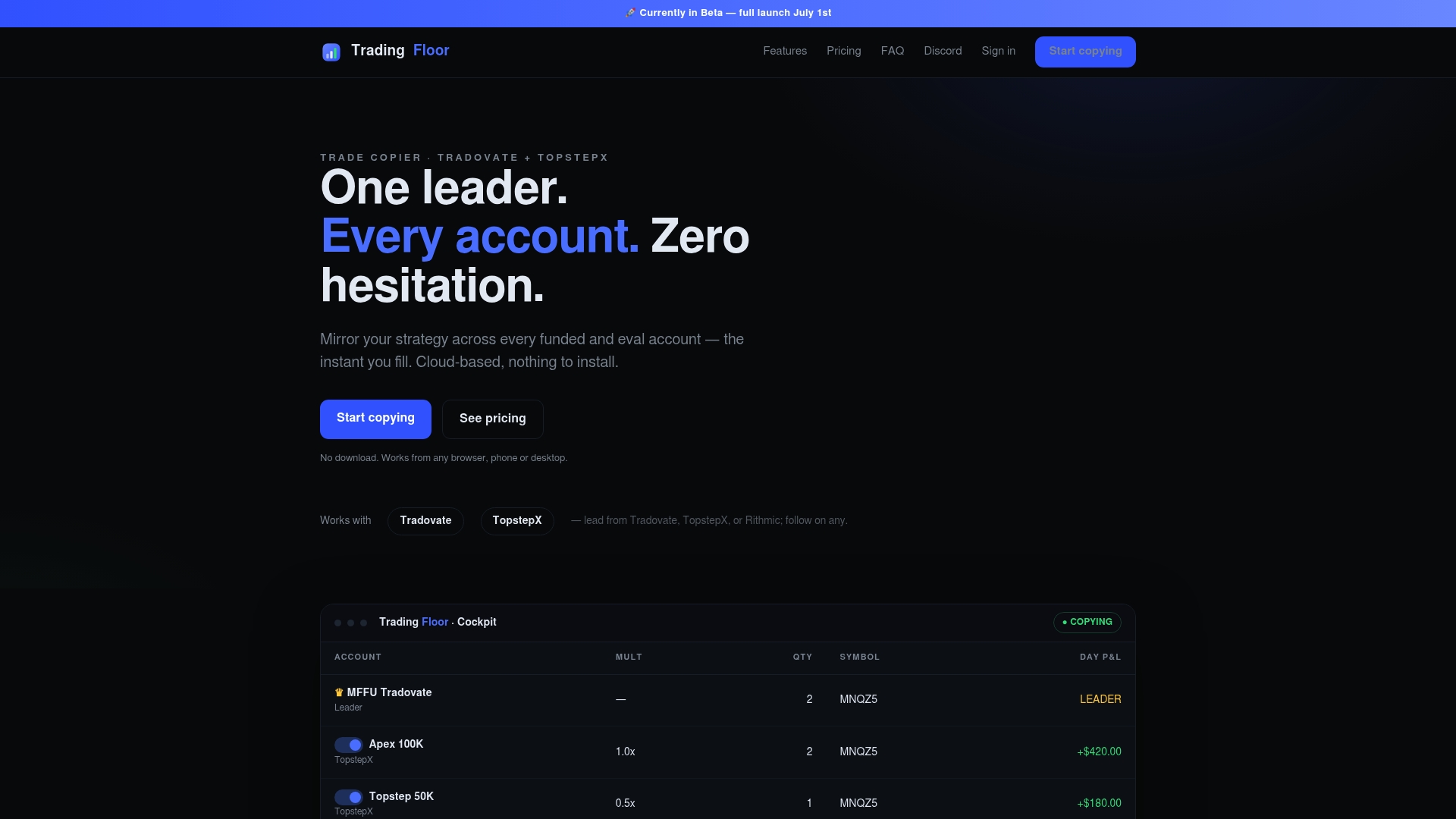
Tradingfloor’s architecture maps directly onto the controls above rather than treating them as add-ons. Real-time position mirroring copies the master’s net position, not just a signal, which removes an entire category of interpretation error between accounts. Per-account drawdown and daily loss caps, slippage limits, and contract multipliers all sit at the individual follower level, so one account’s settings never bleed into another’s.
- Real-time position mirroring across funded and evaluation accounts on Tradovate, TopstepX, and other supported brokers
- Per-account drawdown caps, daily loss limits, and slippage caps configured independently
- Contract multipliers for scaling position size across accounts of different sizes
- Auto-reconciliation to catch mismatches after disconnects
- Push notifications the moment a cap or rejection triggers
Because the platform is cloud-based, every copied trade generates a receipt and a per-copy log accessible from any device, which matters as much for compliance audits as it does for spotting your own configuration mistakes early. Real-time mirroring and a documented risk-control checklist give account managers something concrete to point to when a firm asks how copying is being monitored.
Updating Your Trade Copier Without Breaking It
Software patches are one of the quietest ways a safe setup turns unsafe overnight. A copier update can change how it handles symbol mapping, adjust default slippage tolerances, or alter reconnection behavior, and none of that is obvious until a trade behaves differently than expected.
Never apply an update to every connected account at once. Push it to a single demo or low-stakes account first, run the full trade lifecycle test again, and only then roll it out further. This matters even more during earnings weeks or high-volatility sessions, when a subtle change in slippage handling can compound quickly across several live accounts.
Read the changelog before updating, even a short one. Look specifically for changes to risk-cap defaults, reconnection logic, or symbol handling, since those are the three areas most likely to shift silently between versions. If a patch note doesn’t mention them, don’t assume they were untouched.
Keep one account on the previous version until the new one has run cleanly for at least a few sessions, following best practices from Smishalert to maintain overall account security. That gives you a fallback if the update introduces a bug that only shows up under live market conditions rather than in testing. Schedule updates during low-volume periods, weekends or after-hours when futures markets are thin, so a bad rollout doesn’t collide with your busiest trading window. Document every update with the date, version, and any behavior change you noticed, because that log becomes the first thing you check when something goes wrong three weeks later and you’re trying to remember what changed.
Handling Network Interruptions Without Losing Control
A dropped connection between master and follower accounts is not rare. It’s routine, and the safety of the whole system depends on what happens in the seconds after it occurs, not on preventing it entirely.
The copier’s reconnection behavior should follow one of three documented paths: skip the missed event entirely, open the position late with a flagged note explaining the gap, or queue it for manual review. What it should never do is stay silent about which of those three happened, because that silence is what leads to duplicate fills or missed exits later.

Before a disconnect happens in live trading, know your own fallback plan. Keep the broker’s native platform open as a secondary way to flatten positions manually if the copier’s connection drops during an open trade. Set a personal rule: if you haven’t confirmed reconciliation within a defined window after reconnecting, say five minutes, check every affected account manually rather than assuming the system caught up correctly on its own.
Test disconnects on purpose during demo verification, not just in theory. Pull the connection mid-trade, then confirm the follower account shows the correct position, the correct fill price, and no duplicate order once it reconnects. If your setup includes multiple followers, stagger the reconnection test so you can see whether one account’s recovery affects another’s timing. Network interruptions are the scenario most traders skip testing, and it’s the one most likely to cost real money when it happens live instead of in a demo.
Author Perspective: Practical Tradeoffs and Lessons Learned
A tight per-account drawdown cap looks like overcaution right up until the day it isn’t. The value of a strict limit isn’t visible on a normal trading day. It shows up on the one day the master account has a bad run, and the follower’s cap stops the bleeding three trades before it would have without one.
Automation earns its place in this workflow, but it doesn’t earn unsupervised trust. Check reconciliation logs at least weekly, not just after something looks wrong, and treat every software update as a reason to rerun your demo checklist rather than assume nothing changed. If you’re copying into a funded or evaluation account, get the firm’s approval in writing before you connect anything, and log every setting change you make. The traders who get burned aren’t usually careless. They’re just confident that this week will look like last week.
— KennyTrades
Getting Started With a Trade Copier
Most of the safety controls in this guide take real engineering effort to build correctly, and most traders shouldn’t have to build them from scratch. Some platforms mirror your master account’s net position across every connected follower in real time, with per-account drawdown caps, daily loss limits, slippage caps, and contract multipliers built into the setup rather than bolted on afterward.
If you’re running a funded account on Take Profit Trader, the Take Profit Trader trade copier mirrors a single trade across every account you manage on that platform, with the same per-account caps and auto-reconciliation covered above. Traders on other firms should check the current prop firms that allow copy trading before connecting anything live, since rules vary firm by firm. Start with a demo connection, confirm your caps and reconciliation behave the way this guide describes, and move to a funded account only once you’ve watched it hold up under a forced disconnect and a forced rejection.
Sources
Verify these claims directly: the IOSCO final report on imitative trading covers copy trading risks and Good Practices, the SEC and FCA guidance on copy trading outline regulatory expectations, and security best practices for copy trading platforms detail encryption and access-control standards.
This article is general information, not a substitute for advice from a qualified financial advisor. Consult a qualified financial professional about your own circumstances before acting on anything here.
FAQ
How Safe Is Copy Trading?
Copy trading is as safe as its weakest control. Per-account drawdown caps, stop propagation, and reconciliation logic determine whether a bad trade on one account stays contained or spreads across every connected follower.
Is Copy Trading Illegal in the US?
Copy trading itself isn’t illegal, but automated arrangements can trigger SEC registration or advisory obligations depending on how much discretion the follower retains. Check your specific setup against SEC guidance rather than assuming any copier is automatically exempt.
Does NinjaTrader Have a Built-in Trade Copier?
NinjaTrader does not include a native multi-account trade copier for mirroring positions across separate funded or evaluation accounts. Traders typically use dedicated copier software like Tradingfloor alongside NinjaTrader for that functionality.
Can I Just Copy Someone’s Trade?
Manually replicating a trade you see someone else place is legal, but automating that copy across multiple accounts introduces the operational and regulatory risks covered above, including detection risk on funded accounts and potential suitability obligations under FCA guidance.
Recommended
- Trading Account Delegation Best Practices for Prop Traders
- Prop Traders: Audit Proof Entry Only Copying Across 5 Funded Accounts
- Stop Accidental Copies: 5 Steps to Exclude Accounts for Prop Traders
- Protect Funded Accounts: Practical Per Account Risk Limits Workflow
Trading Floor mirrors every trade across your Tradovate, TopstepX & Rithmic accounts in real time, from $25/mo.
Start copying →