Prop Traders: Audit Proof Entry Only Copying Across 5 Funded Accounts

Entry-only copying mirrors a leader’s opened positions across follower accounts while leaving exits, stop management, and account-level risk controls local to each account. It’s the right choice when you’re scaling one proven entry logic across accounts you legally own, not when you want a fully hands-off mirror of someone else’s trade management. Done correctly, it runs on per-account multipliers, daily-loss limits, and a kill switch that shuts everything down the moment something looks wrong.
TL;DR:
- Entry-only copying is suitable when scaling a proven entry strategy across accounts owned by the same person, using local exits and risk controls for each account.
- Prop firms typically prohibit copying trades into accounts owned by others or sharing signals across unrelated accounts, making prior support confirmation essential.
- Cloud-based copiers offer quick setup and reasonable latency for most strategies, while VPS setups may reduce milliseconds of latency but increase management complexity.
- Configuring individual risk limits, position multipliers, and exit controls per account is vital to prevent losses from escalations or failed stops.
- Regular testing, clear symbol mapping, and strict account registration are essential to maintain compliance and operational safety during daily trading.
Table of Contents
- When Entry-Only Copying Makes Sense (And When It Doesn’t)
- Prop-Firm Compliance and Account-Permission Checklist
- Cloud Copiers vs. VPS: Choosing Your Setup
- Setting Per-Account Risk Controls That Actually Hold
- Verification Checklist Before You Go Live
- Running It Day to Day Without Getting Flagged
- Regulatory Considerations Around Order Transmission
- Why Real-Time Entry Mirroring With Local Controls Wins Out
- Start a Trial and See Entry Mirroring in Action
- Sources
When Entry-Only Copying Makes Sense (And When It Doesn’t)
Entry-only copying differs from full trade mirroring in one key way: exits stay local. Full copiers replicate the leader’s stop moves, trailing adjustments, and partial exits in real time. Entry-only setups fire the same entry signal across accounts, then let each account’s own stop-loss, target, or discretionary exit run independently. That’s also different from third-party signal copying, where you’re following someone else’s account entirely, often across ownership lines that prop firms explicitly ban.
The appeal is speed and reproducibility. If your edge lives in the entry, not the trade management, entry-only copying lets you scale that edge across five funded accounts without rebuilding logic five times. It also keeps the leader’s code simple since it only has to fire one signal, not manage a dozen conditional exits per account.
The trade-offs are real:
- Losses compound across every account simultaneously if the entry logic is wrong.
- Scalpers relying on sub-second timing feel latency more acutely than swing traders.
- Every follower account carries correlated exposure to the same market move at the same time.
Prop-Firm Compliance and Account-Permission Checklist
Most prop firms permit copying only between accounts you personally own, and they explicitly prohibit group or third-party signal copying, according to guidance from JP Trading Capital’s setup guide. Violating that rule is one of the fastest ways to lose a funded account. Before you enable copying anywhere, work through this:
- Read your prop firm’s terms of service specifically for language on “copy trading,” “group trading,” or “shared strategies.”
- Contact support directly and get their answer on entry-only copying in writing, not just a forum post from another trader.
- Document proof of ownership for every account you plan to link, including funding source and account registration details.
- Confirm there’s no cap on the number of accounts you can run simultaneously under one strategy.
- Watch for red flags: identical trade timestamps across unrelated accounts, shared IP addresses tied to accounts under different names, or position sizes that don’t match each account’s own equity curve.
Our guide to prop firms that allow copy trading breaks down which firms are explicit about their rules and which ones leave it ambiguous, which is its own warning sign.
Cloud Copiers vs. VPS: Choosing Your Setup
Two architectures dominate entry-only copying: cloud-based copiers and local or VPS-hosted copiers. Neither is universally better. The right one depends on how much latency actually matters to your strategy.
Cloud copiers run on the provider’s infrastructure. You don’t maintain a terminal, you don’t worry about your home internet dropping mid-session, and you get cross-broker support without juggling multiple platform installs. High-quality cloud copiers can replicate a trade in under 100 milliseconds, which is fast enough for the vast majority of entry-only strategies, including many futures scalping approaches that do not rely on microsecond timing.
Local or VPS-hosted copiers trade convenience for speed. According to TTT Markets’ comparison of copier setups, VPS setups can shave a few milliseconds off execution compared to cloud alternatives. That advantage matters if you’re running a strategy where fills a few milliseconds apart change your outcome. It comes at a cost: you’re now responsible for terminal uptime, software updates, and a single point of failure if that VPS goes down mid-session.
Whichever architecture you pick, a handful of features are non-negotiable:
- Symbol mapping that correctly translates contracts across brokers (ES to MES, for instance).
- Contract multipliers that scale position size to each account’s equity.
- Reliable API or broker integration rather than screen-scraping workarounds.
- Order-type fidelity, so a market order doesn’t accidentally propagate as a limit order on a follower account.
Setting Per-Account Risk Controls That Actually Hold
The entire point of entry-only copying is that each account keeps its own risk profile, and that only works if you configure it that way instead of assuming the copier handles it by default.
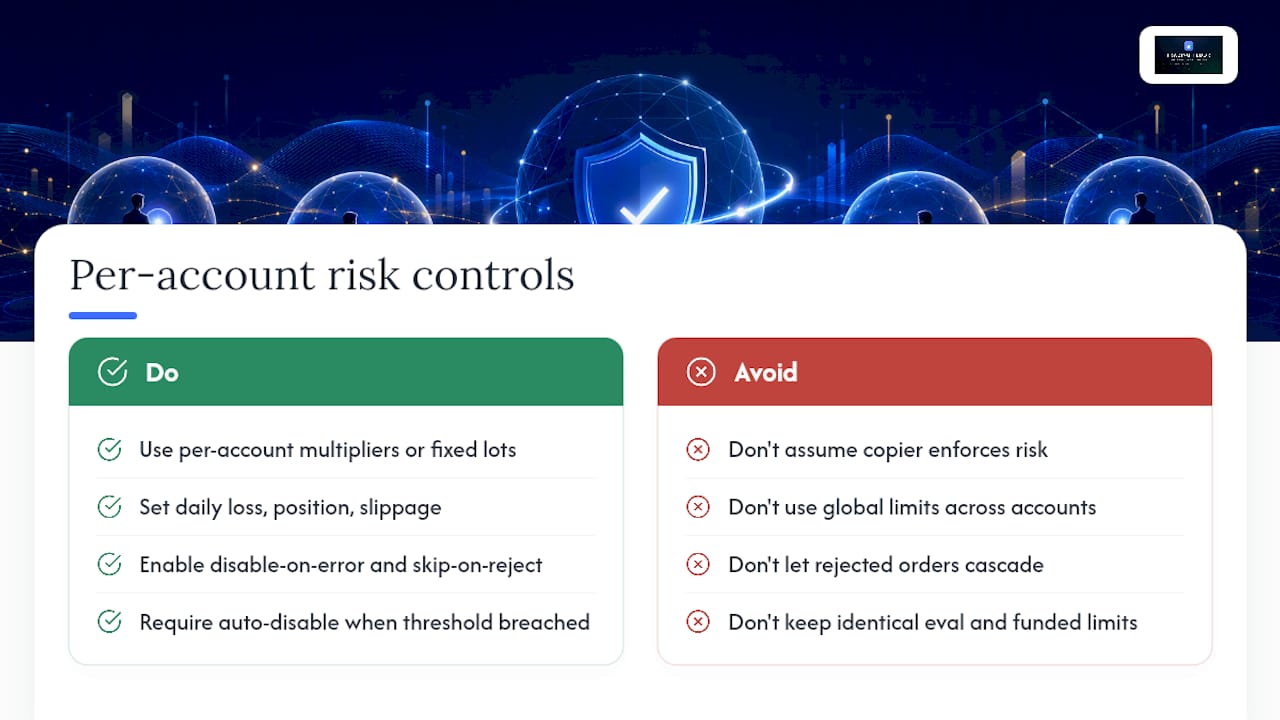
Start with per-account multipliers and fixed-lot overrides so a $50,000 evaluation account and a $150,000 funded account never take identical position sizes off the same signal. Layer daily loss limits, max position limits, and slippage caps on top, set individually for each follower, not globally across the group. Enable disable-on-error and skip-on-reject so a rejected order on one account doesn’t cascade into a stuck queue or a mismatched position elsewhere. Most copier platforms also offer automatic follower-disable once a threshold is breached, a feature worth treating as mandatory rather than optional, since these follower-guard features are what actually stop a bad morning from becoming a terminated account.
Keeping exits local is what makes entry-only copying more forgiving than full mirroring. If one account’s stop gets hit early because of a fill difference, that account exits on its own terms instead of forcing every other account to exit at the same moment.
Pro Tip: Set your daily loss limit slightly tighter on evaluation accounts than on funded ones. Evaluation accounts are where a single bad copy event ends your shot at getting funded at all.
Verification Checklist Before You Go Live
Nobody should link a strategy across five accounts and trust it worked. Confirm it did:
- Run minimum-size test trades across every broker and account in the group, then confirm the fill landed correctly on each one.
- Check symbol mapping manually. A mismapped contract is invisible until it fires the wrong instrument entirely.
- Verify partial fill handling and confirm stop and limit orders propagate the way you expect, not just market entries.
- Simulate a disconnection. Watch whether your kill switch and disable-on-error settings behave as configured, and check that logging captures the event.
- Save every test result. Written test records and reconciliation logs become your evidence if a prop firm ever questions activity across your accounts during a payout review.
This isn’t a one-time task, according to Plutus Trade Base’s copy trading safety guide either. Re-run the checklist after any broker update, platform migration, or new account addition.
Running It Day to Day Without Getting Flagged
The daily discipline matters as much as the initial setup. Never copy across accounts owned by different people, even if it’s a friend or a fellow trader you trust. Every account in your copy group needs to be registered under your legal name with documentation to prove it.
A few operational habits keep you out of trouble:
- Pause or reduce size around major news releases, since volatility spikes are when copier lag and slippage do the most damage.
- Track your combined exposure across all accounts, not just each account in isolation. Five accounts holding the identical position multiplies your real market risk even if each account looks fine on its own.
- Run kill-switch drills monthly so you’re not learning how it works during an actual emergency.
- Watch for trade fingerprints: identical entry timestamps to the millisecond, matching lot sizes across unrelated-looking accounts, or shared login IPs. These are exactly what prop firm compliance teams scan for.
For deeper detail on running the same logic across different broker rails, our piece on trading the same strategy across multiple brokers covers the platform-specific quirks worth knowing before you scale.
Regulatory Considerations Around Order Transmission
Order transmission compliance for entry-only copying in the United States centers on who is legally initiating the trade and whether that activity resembles unregistered money management. If you’re copying entries only across accounts you personally own and fund, you’re generally transmitting your own orders, not managing someone else’s money, which keeps you outside the registration requirements that apply to investment advisers or commodity trading advisors.
That changes the moment you copy trades into accounts owned by other people, even with their permission. At that point you may be acting in a capacity that regulators and exchanges scrutinize differently, regardless of whether money changes hands. Prop firms layer their own contractual rules on top of this, and those rules are frequently stricter than what regulation technically requires, since firms are managing their own capital risk, not just legal exposure.
The safest position is straightforward: keep every account in the copy group under your own name, keep records of that ownership, and treat any group or shared-signal arrangement as a compliance question to resolve with the firm and, if needed, a securities attorney, before you ever route an order. Our breakdown of how US prop traders keep copy trading compliant walks through the distinction between personal order transmission and third-party trade management in more detail. For a broader look at detection patterns regulators and firms watch for, this primer on copy-trading risks is a useful outside reference.
Why Real-Time Entry Mirroring With Local Controls Wins Out
A good entry mirroring approach should stay simple: copy the position, not the leader’s entire trade management. That design keeps each account’s risk local and auditable, which matters more to funded traders than raw speed alone. Before trialing any copier, check its documented uptime and system status, and look for a provider whose architecture matches the compliance realities covered above, not just its latency numbers.
— KennyTrades
Start a Trial and See Entry Mirroring in Action
Some copiers implement features like real-time entry mirroring, per-account multipliers, daily-loss and position limits, and push notifications when a follower account needs attention. If you’re running strategies through TradingView into Tradovate, the TradingView to Tradovate integration fires alerts into every linked account in roughly 42 milliseconds, no VPS required. If you’re already inside the Tradovate ecosystem across multiple funded accounts, the Tradovate trade copier handles the mapping and multiplier work covered earlier in this guide automatically.
Before committing to any provider, check current system status and uptime history. Tradingfloor offers a free trial, so you can run the exact verification checklist from this article, minimum-size test trades, symbol mapping checks, kill-switch drills, before you ever risk live capital across your accounts.
Sources
- Ultimate Guide to Trade Copying for Funded Accounts | Damn Prop Firms
- Trade Copier for Multiple Prop Firm Accounts: Setup Guide
- How to Manage Multiple Funded Accounts with a Trade Copier
- How to Copy Trade Funded Accounts Safely | Plutus Trade Base
Recommended
- Trade Audit Trails for Prop Traders: A Practical Guide
- How to Copy Trades Across Multiple Prop Firm Accounts Like TopstepX
- Elite Trader Funding Trade Copier — mirror one trade across every Elite Trader Funding account
- Multi-Account Discipline for Freelance Prop Traders — Trading Floor
Trading Floor mirrors every trade across your Tradovate, TopstepX & Rithmic accounts in real time, from $25/mo.
Start copying →