Best Cloud-Based Trading Assistants for Prop Traders 2026

For multi-account prop and futures traders in 2026, Tradingfloor is the recommended cloud trade copier. It mirrors your real-time net position across funded and evaluation accounts simultaneously, enforces per-account risk overlays, and requires zero installation.
- Real-time position mirroring copies entries, exits, and modifications in order, not just signals
- Per-account risk overlays (position size caps, stop-loss rules, contract multipliers) prevent rule breaches on individual accounts
- Auto-reconciliation and audit logs give you a defensible record if a firm questions a fill
- A 30-day free trial lets you run the full vendor test plan before committing to a subscription
Pro Tip: Before your trial goes live, check Tradingfloor’s system status page. A quick uptime review before you wire any accounts tells you more about reliability than any sales call.
Table of Contents
- What does “cloud-based trading assistant” mean for this guide?
- What features must a cloud trade copier have in 2026?
- How do you choose a cloud trade copier vendor quickly?
- How do you implement a cloud trade copier safely?
- How do you protect a multi-account portfolio from correlated drawdowns?
- Which platforms and brokers does a cloud copier need to support?
- What security and compliance controls should you require?
- What does a cloud trade copier cost, and does it pay for itself?
- What is the final verdict and your 30-day trial plan?
- Key Takeaways
- The part most traders skip until it’s too late
- Tradingfloor: what the 30-day trial actually gives you
- Useful sources
What does “cloud-based trading assistant” mean for this guide?
This article covers one specific product category: cloud-based trade copier software that mirrors real-time positions across multiple funded or evaluation futures accounts with per-account risk overlays, slippage caps, contract multipliers, and reconciliation. That is the job-to-be-done.
What this guide does NOT cover:
- AI signal services or strategy-generation bots
- Analytics-only dashboards with no execution layer
- Standalone journaling tools
The platforms discussed here, Tradovate, TopstepX, and Rithmic, are the dominant U.S. futures execution venues where prop traders run funded and evaluation accounts. A cloud copier in this context connects to those APIs and replicates your master account’s position state across every follower account in real time.
What features must a cloud trade copier have in 2026?
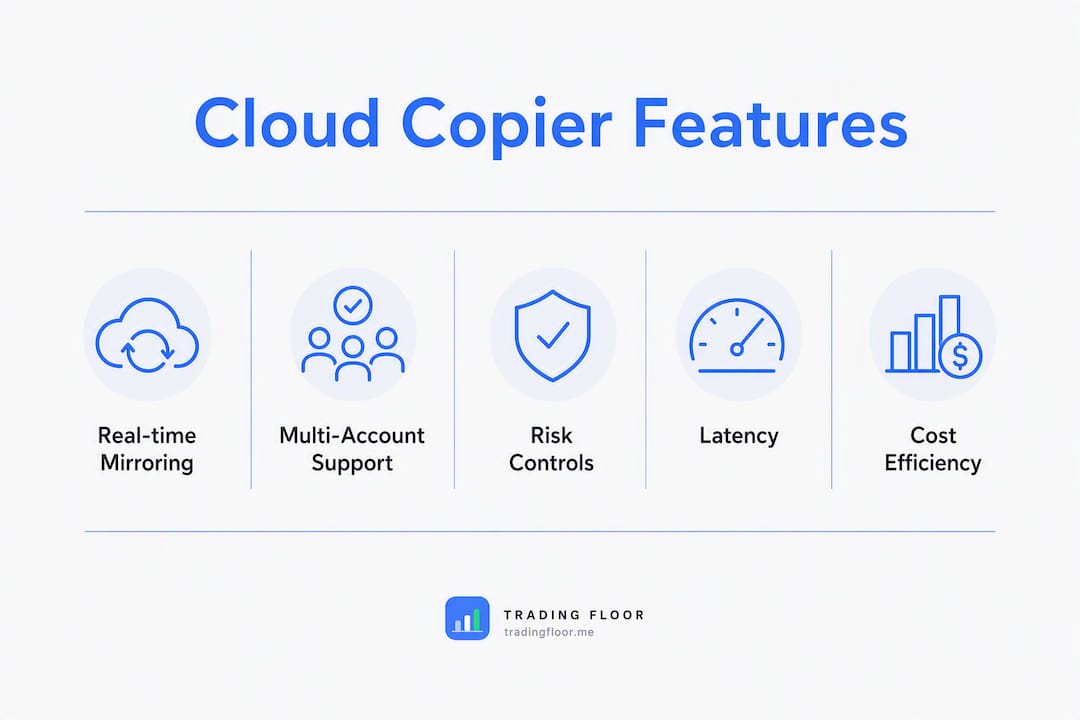
Per-account risk overlays and centralized monitoring are considered essential for long-term survival when managing multiple funded accounts. Here is the full checklist:
- Real-time position mirroring with ordering guarantees. Entry, modification, and exit must replicate in sequence. Out-of-order fills cause position mismatches that trigger compliance events.
- Per-account risk overlays. Each follower account needs its own max position size, daily loss cap, and contract multiplier. A single global setting is a liability when accounts have different drawdown rules.
- Slippage caps and fill handling. Define the maximum acceptable slippage per instrument. If a fill exceeds the cap, the copier should reject or flatten rather than accept a bad fill silently.
- Auto-reconciliation. After every session reset, the copier should compare master and follower positions and correct any drift automatically.
- Audit logs and alerts. Trade-level logs with timestamps, latency readings, and rule-trigger notifications give you evidence when a firm audits a session.
- Latency profile. Cloud copiers typically deliver around 100 ms sync latency; optimized local VPS setups can reach 1–3 ms. For most prop traders, 100 ms is acceptable. For scalping strategies, it may not be.
- Symbol mapping and contract multipliers. ES on Tradovate and ES on Rithmic are the same instrument but different API symbols. The copier must translate cleanly and apply the correct tick rules.
You can read more about multi-account trade execution and why ordering semantics matter at the execution layer.
How do you choose a cloud trade copier vendor quickly?
Start with this numbered checklist, then use the red flags below to disqualify vendors before you waste trial time.
- Feature fit. Does it support your exact broker APIs (Tradovate, Rithmic, TopstepX)?
- Per-account overrides. Can you set different position limits and loss caps per follower account?
- Reconciliation cadence. Does it reconcile automatically after session resets, or manually?
- SLA and uptime. What is the guaranteed uptime, and what is the support response time during market hours?
- Audit log retention. How long are trade-level logs retained, and can you export them?
- Trial availability. Is there a free trial with full feature access, not a crippled demo?
Red flags that disqualify a vendor immediately:
- No per-account stop-loss or position-size override
- No audit logs or only aggregate-level logging
- Vague latency claims with no architecture explanation
- No trial or sandbox environment
- Firm policy conflict: some prop firms forbid cloud copiers entirely; confirm your firm permits the tool before signing up
Questions to ask vendors: What is your order-routing architecture? How do you handle a partial fill on the master account? What happens if a follower account hits its daily loss cap mid-trade?
How do you implement a cloud trade copier safely?
A staged rollout over roughly two weeks eliminates most compliance risk.
- Account mapping (Day 1, ~2 hours). List every funded and evaluation account, its broker, drawdown method (balance vs. equity), and reset time. Note which accounts share a platform.
- Demo environment test (Days 1–3). Connect master and two follower accounts in sandbox mode. Confirm symbol mapping, contract multipliers, and timezone handling.
- Per-account risk overlay setup (Day 3, ~1 hour). Configure individual position caps, daily loss limits, and slippage caps for each follower. Do not use global defaults.
- Simulated stress tests (Days 4–5). Run test cases: high-latency fill simulation, partial fill on master, concurrent modify/cancel race, and a session-reset reconciliation. These are the failure modes that cause compliance events.
- Small live pilot (Days 6–10). Go live with 2–3 accounts only. Batching accounts into clusters of 2–3 limits the blast radius of any single error.
- Reconciliation review (Day 10). Compare master and follower P&L, position counts, and fill timestamps. Investigate any drift before scaling.
- Full go-live (Day 14+). Add remaining accounts only after the pilot passes reconciliation review with zero unexplained discrepancies.
Evaluation account management best practices covers the specific timing rules for running funded and eval accounts side by side.
How do you protect a multi-account portfolio from correlated drawdowns?
Diversifying strategies across accounts so a single market event does not create correlated drawdown across the portfolio is the core principle. Practically, that means:
- Cluster accounts, not a single master. Keep clusters at 2–3 accounts. Hold some accounts independent as a firewall.
- Set aggregate loss limits. Define a portfolio-wide daily loss threshold. When it is hit, all copying stops automatically.
- Distinguish balance vs. equity drawdown. Different firms calculate drawdown differently. An overlay that uses equity-based rules on a balance-based account will misfire.
- Master tilt control. Traders managing multiple accounts face higher temptation to revenge-trade when accounts draw down simultaneously. A master tilt control rule, an automated kill switch that locks all accounts after a defined aggregate loss, removes the decision from your hands.
Pro Tip: Set your master tilt threshold at 50% of your worst single-day loss ever. When the kill switch fires, enforce a mandatory 24-hour cooldown before re-enabling copying. Soft rules get overridden under pressure; automated lockouts do not.
For deeper guidance on aggregate loss control and portfolio-level rules, the cross-account management guide covers template policies you can adapt directly.

Which platforms and brokers does a cloud copier need to support?
Selecting prop firms that share common platforms reduces symbol mapping work and per-account integration overhead. Before connecting any account:
- Tradovate: Confirm API key permissions, symbol format (e.g., ESM5 vs. ES), and session reset time (5 PM CT).
- TopstepX: Verify that the copier is on the firm’s approved tools list. TopstepX has specific rules on third-party integrations.
- Rithmic: Check the R | API+ connection type and confirm the copier handles Rithmic’s order-routing protocol correctly.
Connectivity verification steps:
- Run a latency test from the copier’s cloud node to each broker’s API endpoint.
- Submit a test order on each follower account and compare fill timestamps against the master.
- Simulate a partial fill and confirm the copier handles the remainder correctly.
- Verify session-reset reconciliation fires at the correct time for each broker’s timezone.
Platform compatibility notes for Tradovate and symbol mapping across brokers are covered in detail in Tradingfloor’s broker-specific guides.
What security and compliance controls should you require?
- Encryption in transit and at rest. TLS 1.2 or higher for all API traffic; encrypted storage for credentials and logs.
- Role-based access control. Separate permissions for read-only monitoring, risk-overlay editing, and master account control.
- API key management. Keys scoped to the minimum required permissions; rotation policy documented.
- Trade-level audit logs. Timestamped records of every order, modification, and cancellation, retained for at least the length of your longest active funded account agreement.
- SLA and uptime. Require a documented uptime commitment and a defined support response time during U.S. market hours (9:30 AM–4:00 PM ET for equities; 6:00 PM–5:00 PM CT for CME futures).
- Vendor security verification. Ask for SOC 2 Type II reports or equivalent third-party audit documentation before production use.
What does a cloud trade copier cost, and does it pay for itself?
Pricing in 2026 follows three common shapes:
| Pricing Model | Typical Structure | Best For |
|---|---|---|
| Per-account subscription | Fixed monthly fee per follower account | Traders with 2–5 accounts |
| Tiered seat pricing | Flat monthly fee up to N accounts, then per-seat above | Firms scaling to 10–20 accounts |
| Enterprise / custom | Annual contract, volume discounts, dedicated support | Trading firms with 20+ accounts |
Insist on a 30-day free trial with full feature access, including sandbox/demo mode and at least one live pilot account. A trial without per-account risk overlays enabled is not a real trial.
The ROI math is straightforward. A 20-account portfolio can carry $3,000–$8,000+ in upfront fees, subscriptions, and resets. A copier that prevents a single account reset by enforcing a daily loss cap pays for several months of subscription in one event. At that scale, the subscription cost is not the variable to optimize; the reset prevention rate is.
What is the final verdict and your 30-day trial plan?
Tradingfloor is the recommended cloud trade copier for U.S. prop and futures traders managing multiple funded or evaluation accounts. Real-time position mirroring, per-account risk overlays, auto-reconciliation, and audit logs cover every mandatory feature in this guide.
30-day trial plan:
- Week 1: Map all accounts, configure demo environment, verify symbol mapping and contract multipliers
- Week 2: Run stress tests (partial fills, latency spikes, reset reconciliation), set per-account overlays
- Week 3: Live pilot with 2–3 accounts, daily reconciliation review
- Week 4: Go/no-go decision based on reconciliation accuracy and latency consistency; scale to full account set if passed
Immediate actions:
- Check Tradingfloor’s system status before starting your trial
- Start the 30-day free trial at tradingfloor.me
- Map your broker accounts against the connectivity checklist in Section 7 before Day 1
Key Takeaways
Tradingfloor is the recommended cloud trade copier for multi-account prop and futures traders in 2026, covering real-time mirroring, per-account risk overlays, and auto-reconciliation in a single no-install subscription.
| Point | Details |
|---|---|
| Real-time mirroring is non-negotiable | Entry, exit, and modification must replicate in order; out-of-sequence fills cause compliance events. |
| Per-account overlays protect each account | Set individual position caps and daily loss limits; global defaults are a liability across mixed drawdown rules. |
| Cluster accounts in groups of 2–3 | Batching limits blast radius; keep some accounts independent as a firewall against a single bad session. |
| Verify firm policy before connecting | Some prop firms forbid cloud copiers; confirm approval before trial to avoid disqualification. |
| Tradingfloor covers the full checklist | Real-time mirroring, per-account overlays, slippage caps, reconciliation, and audit logs; 30-day free trial available. |
The part most traders skip until it’s too late
Most of the conversation around cloud trade copiers focuses on latency and feature lists. Those matter. But the failure mode I see most often in multi-account prop setups is not a technology problem. It is a policy problem.
Traders configure a copier, run a quick demo test, and go live across every account at once. No cluster strategy, no aggregate loss limit, no tilt control rule. The copier works exactly as advertised. Then a volatile session hits, three accounts draw down simultaneously, and the trader overrides the system manually to “manage” the situation. That override is where accounts get blown.
The technology is only as good as the rules you enforce around it. A master tilt control that fires automatically at a defined threshold is not a nice feature. It is the only thing standing between a bad morning and a portfolio reset. Set it before you go live, not after.
The same logic applies to cluster sizing. Two or three accounts per cluster is not a conservative suggestion. It is the structural limit that keeps one error from becoming a portfolio event. Traders who skip this step because they want maximum copying efficiency are optimizing the wrong variable.
Tradingfloor: what the 30-day trial actually gives you
Prop traders managing multiple funded accounts need one thing most platforms cannot deliver: real-time position mirroring with per-account guardrails, not just a signal relay. Tradingfloor is built specifically for that gap.
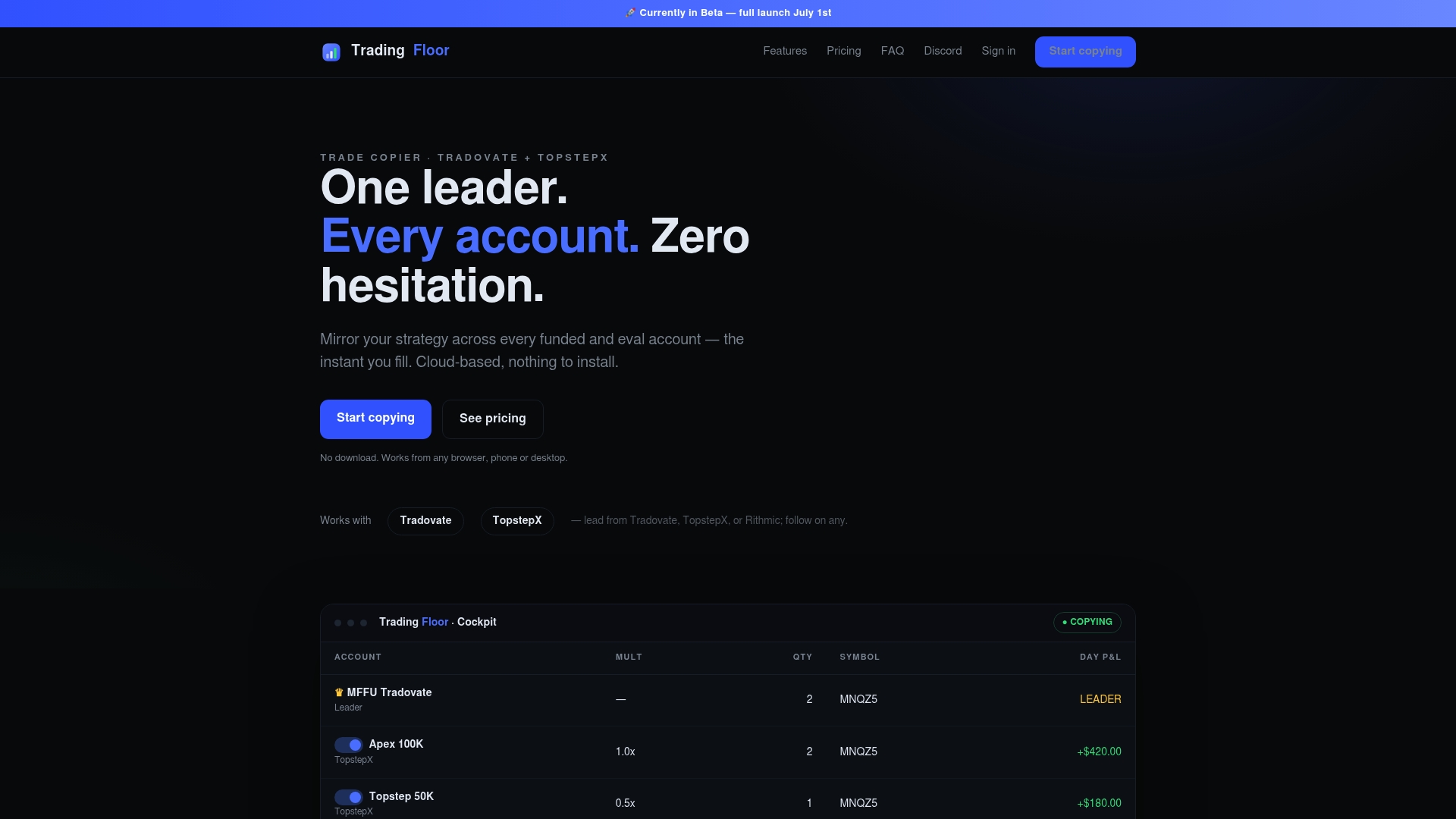
The 30-day free trial includes full access to real-time position mirroring, per-account risk overlays, slippage caps, contract multipliers, auto-reconciliation, and trade-level audit logs. No installation. Works across Tradovate, TopstepX, and Rithmic from any device. You can run the complete vendor test plan from the implementation checklist above during the trial period, including stress tests and pilot reconciliation, before spending a dollar on a subscription.
Check system status first, then start your free trial at tradingfloor.me and run the 30-day plan outlined in this guide.
Useful sources
- The Prop Firm Guide — Running multiple prop firm accounts: Practical guidance on cluster strategies, tilt control, and scaling costs for large multi-account portfolios.
This article is general information for educational purposes. Confirm current platform policies, firm rules, and subscription terms directly with each provider before making any trading or financial decisions.
Recommended
- Tradecopia.com Alternatives for Prop Traders in 2026 — Trading Floor
- Best prop.tradovate.com Alternatives for Multi-Account Prop Traders — Trading Floor
- Why Cloud Trading Apps Outperform Desktop Platforms — Trading Floor
- Multi-Platform Trading Best Practices for Prop Traders — Trading Floor
Trading Floor mirrors every trade across your Tradovate, TopstepX & Rithmic accounts in real time, from $25/mo.
Start copying →