Why Cloud Trading Apps Outperform Desktop Platforms

Cloud trading apps outperform desktop platforms on every dimension that matters for professional multi-account trading: uptime, scalability, synchronization, and cost. Desktop setups depend on local hardware, a single internet connection, and manual maintenance. Cloud platforms distribute all of that across redundant infrastructure, update automatically, and let you trade from any device without reinstalling anything. For prop traders running multiple funded accounts simultaneously, that difference is not academic. It determines whether your strategy executes cleanly or falls apart during a volatility spike.
The core advantages stack up fast. Cloud-based platforms let you access accounts from any browser without installation or manual updates. Elastic scaling provisions additional server capacity during market surges, preventing the lag that local hardware cannot avoid. Modern web platforms using WebSocket streaming deliver market data in 50–100ms, with UI updates under 16ms, performance that is functionally indistinguishable from a native desktop app. Security is centralized: SOC 2 compliant data centers, automatic audit logs, and multifactor authentication replace the patchwork of local device security. And real-time multi-account synchronization, the feature prop traders need most, only works reliably when account state lives in the cloud rather than on a single workstation.
Table of Contents
- Why cloud trading apps outperform desktop: the technical case
- How multi-account synchronization works in the cloud
- Why professional traders should move fully to cloud platforms now
- Tradingfloor: cloud-native multi-account trading built for prop traders
- Key Takeaways
Why cloud trading apps outperform desktop: the technical case
Desktop platforms are thick clients. The platform state lives on your machine. Lose power, lose your connection, or hit a silent crash, and your working orders are orphaned until you reconnect and manually verify your position. Local setups are vulnerable to power outages, overheating, and silent crashes, risks that cloud redundancy and automatic failover are specifically designed to eliminate.
Cloud infrastructure inverts that model. The authoritative system lives server-side: your positions, working orders, account context, and saved layouts. Every connected device is just a display layer. If your laptop dies mid-session, you log in on your phone, and the platform rehydrates your full session state from the cloud. No manual re-entry, no guessing where your orders stand.
The performance gap that once favored desktop has closed. WebGL-accelerated charting renders at 60fps. WebAssembly enables near-native client-side processing for filtering and backtesting. The dominant latency factor for retail futures traders is ISP routing quality, not whether the platform is cloud or desktop-based. Cloud middleware co-located near exchange infrastructure actually shortens the round-trip for most traders compared to a home desktop routing through a consumer ISP.
Security is another area where cloud architecture wins structurally. Sensitive financial data stays in secured data centers rather than on a laptop that could be lost or compromised. Updates deploy instantly to all users. Audit logs are centralized and queryable from any device, which matters for compliance and dispute resolution.
Pro Tip: Use cloud execution for all live order placement and always-on strategies. Reserve a desktop with multiple monitors for intensive discretionary analysis where you need every chart open simultaneously. That hybrid trading approach gives you the reliability of cloud infrastructure without sacrificing the screen real estate that manual analysis demands.
How multi-account synchronization works in the cloud
Multi-account synchronization is where cloud architecture separates itself from desktop setups entirely. A desktop platform manages one session on one machine. Replicating that across five funded accounts means running five separate instances, manually coordinating entries, and accepting that any lag or crash on one machine creates a mismatch across your book.
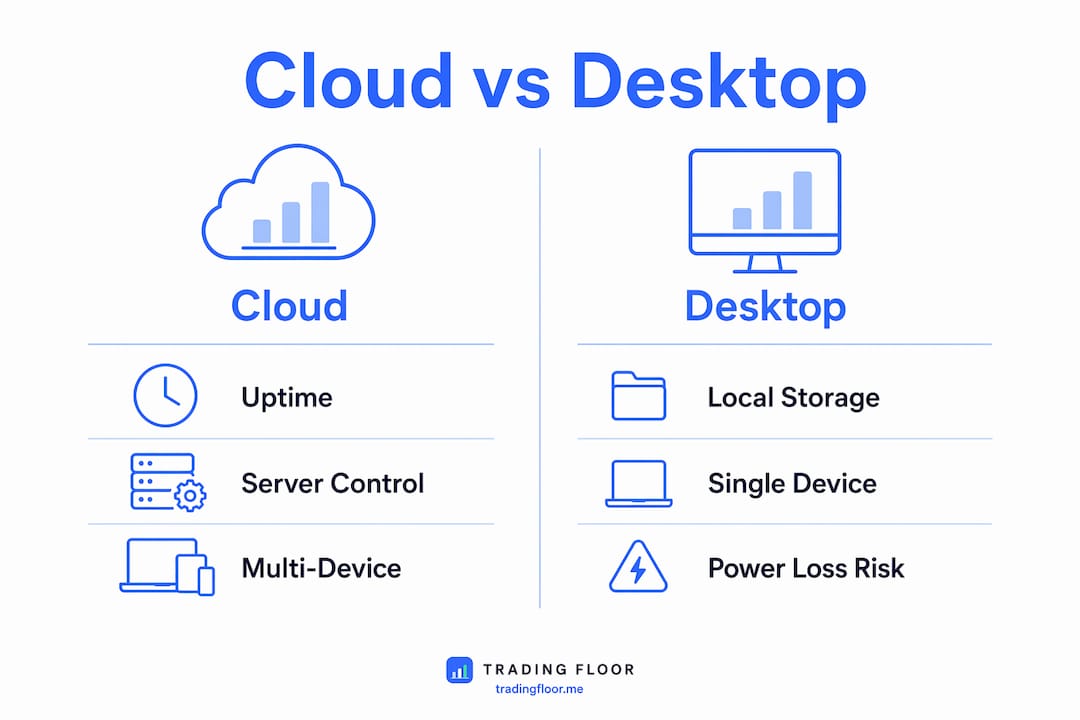
Cloud platforms solve this at the architecture level. Account state is server-authoritative. When the leader account executes an order, the system propagates that position update to every linked account simultaneously, not sequentially. The result is consistent strategy execution across all accounts without manual intervention.

Tradingfloor is built specifically around this problem. The platform synchronizes net positions across multiple funded and evaluation accounts in real time, copying the leader’s actual net position rather than just a signal. That distinction matters: copying a signal still requires each account to execute independently, which introduces timing differences. Copying the net position means every account reflects the same state at the same moment.
Tradingfloor also enforces individual risk controls per account, so the synchronization does not override position limits or trade caps set for each funded account. Real-time notifications flag any execution issue immediately. For prop traders managing accounts across brokers like Tradovate and TopstepX, that combination of synchronized execution and per-account risk controls is what multi-account trade execution actually requires in practice.
API integrations extend this further. Cloud platforms connect to third-party analytics, risk dashboards, and monitoring tools without the compatibility friction that desktop installations create. You can build a monitoring workflow that spans brokers, accounts, and data sources without touching a local config file.
Why professional traders should move fully to cloud platforms now
Industry analysts note that cloud platforms’ cost efficiency, ease of updates, and elastic scaling make them increasingly preferred over desktop setups despite the hardware advantages desktops once held. The economics have shifted. Cloud providers achieve economies of scale that individual traders cannot replicate with local hardware, and those savings pass through to lower platform costs and better infrastructure than any home setup can match.
For prop traders specifically, the calculus is straightforward. Uptime during volatile markets is not optional. The GameStop short squeeze in 2021 exposed how traditional infrastructure fails precisely when traders need it most. Cloud platforms auto-scale during traffic surges, provisioning additional capacity without manual intervention. A home desktop cannot do that.
Consistent cross-device access changes how you work. You can monitor positions from your phone, adjust risk parameters from a tablet, and execute from your primary workstation, all reflecting the same live account state. That flexibility is not just convenient. It means you are never locked out of your own positions because you are away from one specific machine.
Automatic updates keep you current without disrupting active sessions. Security patches deploy without requiring you to download anything. Compliance features like centralized audit logs satisfy regulatory requirements that desktop setups handle poorly, if at all. For traders on copy trading platforms managing funded accounts, that audit trail is often a requirement, not a preference.
Pro Tip: When evaluating cloud trading platforms for volatile markets, check whether the platform uses elastic scaling for volatility spikes. A platform that cannot auto-scale during a major Fed announcement or earnings event is not built for serious prop trading.
Tradingfloor: cloud-native multi-account trading built for prop traders
Most cloud trading platforms give you accessibility. Tradingfloor gives you synchronized execution across every account you run, which is a different product entirely.
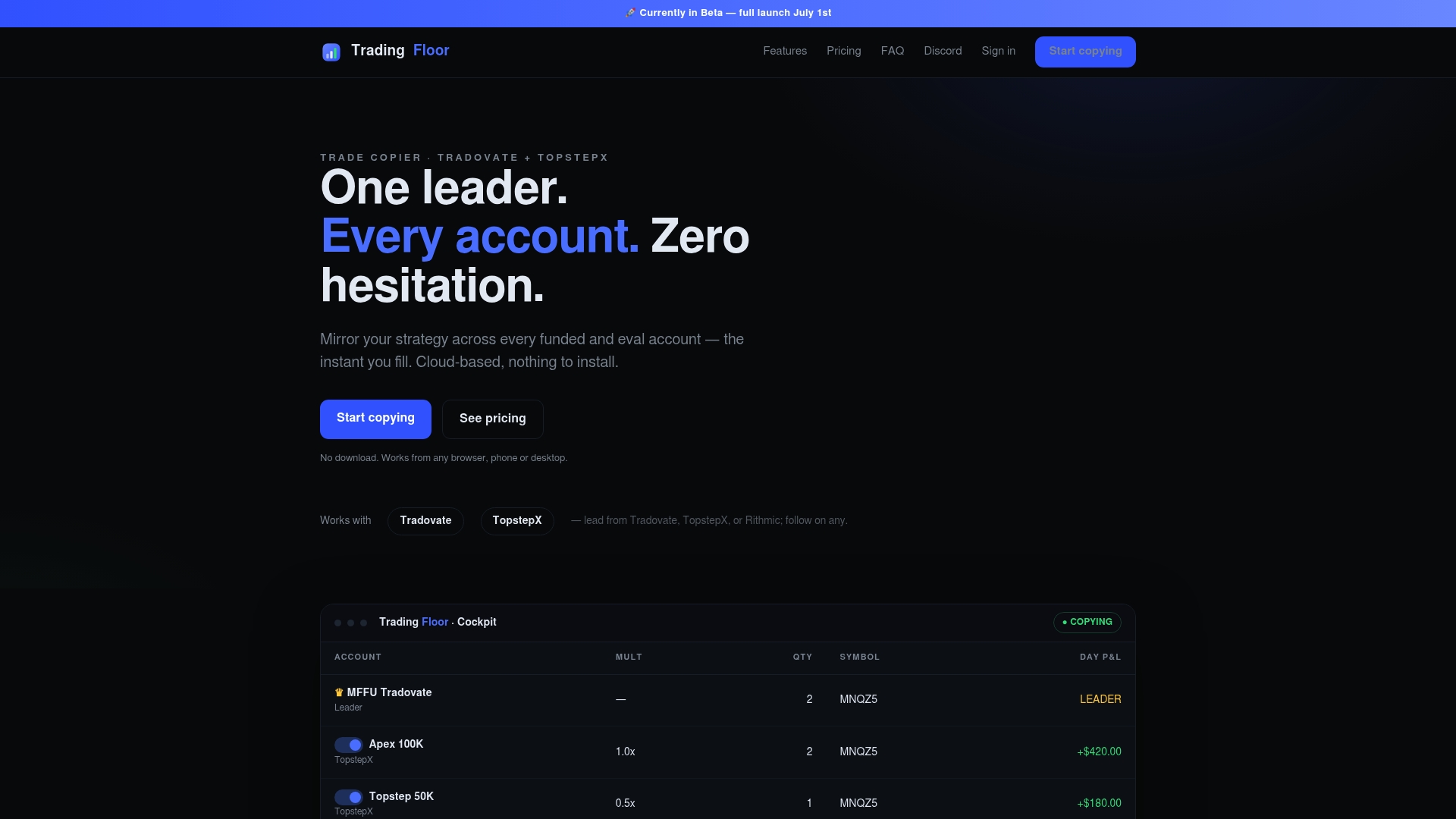
The platform copies the leader’s net position in real time across funded and evaluation accounts, with individual risk controls enforced per account. No manual replication, no timing mismatches, no duplicate order risk. It works across Tradovate and TopstepX without requiring separate installations or configurations for each broker. You open a browser, log in, and every account reflects your strategy simultaneously.
For prop traders who need to scale across multiple funded accounts without scaling their error rate, Tradingfloor is the direct answer. Check platform uptime and reliability in real time, then visit Tradingfloor to see current pricing and start synchronizing your accounts today.
Key Takeaways
Cloud trading apps outperform desktop platforms for professional traders because cloud infrastructure delivers uptime, synchronization, and scalability that no local hardware setup can match.
| Point | Details |
|---|---|
| Performance parity with desktop | Web platforms deliver market data in 50–100ms with UI updates under 16ms, matching native desktop apps. |
| Uptime and redundancy | Cloud failover eliminates silent crashes, power outages, and connection drops that strand desktop traders mid-session. |
| Multi-account synchronization | Server-authoritative account state enables real-time position copying across all linked accounts simultaneously. |
| Cost and IT efficiency | Cloud providers handle maintenance, security, and scaling, removing IT overhead from the trader’s plate entirely. |
| Tradingfloor for prop traders | Tradingfloor copies the leader’s net position across funded and evaluation accounts in real time, with per-account risk controls enforced automatically. |
Recommended
- Multi-Platform Trading Best Practices for Prop Traders — Trading Floor
- Best Tradease.io Alternatives for Multi-Account Traders — Trading Floor
- Top 3 technests.ai Alternatives 2026 — Trading Floor
- Best Copy Trading Platform for Futures Day Traders — Trading Floor
Trading Floor mirrors every trade across your Tradovate, TopstepX & Rithmic accounts in real time, from $25/mo.
Start copying →