Centralized Trade Management for Prop Traders: 2026 Guide

Centralized trade management, in the prop and futures trading context, is a cloud-based trade copier that mirrors live positions from a single leader account across multiple funded and evaluation accounts simultaneously, while enforcing per-account risk controls and delivering real-time notifications on every copy. If you’re running more than two accounts on platforms like Tradovate, TopstepX, or Rithmic, this is directly relevant to you. The primary benefit is eliminating manual execution errors across accounts. The immediate next step: verify that any solution you evaluate supports per-account sizing, receipts on every copy, and your specific broker connections before committing to a subscription.
Many traders accumulate funded and evaluation accounts over time to diversify payout caps and reduce provider risk. Without centralized tracking, that accumulation becomes operational chaos fast.
Key Takeaways
Centralized trade management is the operational infrastructure that separates traders who scale funded accounts from those who stay stuck managing chaos manually.
| Point | Details |
|---|---|
| Core definition | A cloud trade copier mirrors live positions across funded and evaluation accounts with per-account risk controls. |
| Most critical feature | Per-account risk limits prevent one account’s drawdown from breaching another’s rules during a volatile session. |
| Implementation timeline | Most traders complete account linking, mapping, simulation, and a live pilot in three to five days. |
| Vendor red flags | No simulation mode, missing per-copy receipts, and vague credential handling are disqualifying. |
| Tradingfloor trial | Tradingfloor offers a 30-day free trial with Tradovate, TopstepX, and Rithmic integrations from $25/month. |
Table of Contents
- What is centralized trade management and how does it work technically?
- Core features every prop trader needs from a centralized trading system
- Which brokers and connectors does a centralized trade solution need to support?
- How to implement a centralized trading system: steps and timeline
- Security and operational controls to require from any CTM vendor
- How to evaluate a CTM vendor: questions, tests, and red flags
- How Tradingfloor implements centralized trade management
- Pricing expectations and ROI for a centralized trade solution
- Practical use cases for prop traders deploying a centralized system
- When centralized trade management is actually the right move
- Tradingfloor’s 30-day free trial: what to test first
- Sources
What is centralized trade management and how does it work technically?
The signal flow is straightforward: one chart or strategy fires an alert, a webhook or API call carries that signal to the CTM cloud layer, the router fans it out to each connected broker account, per-account adapters apply sizing and contract mapping, and the broker executes. A receipt and reconciliation record generate on every copy.
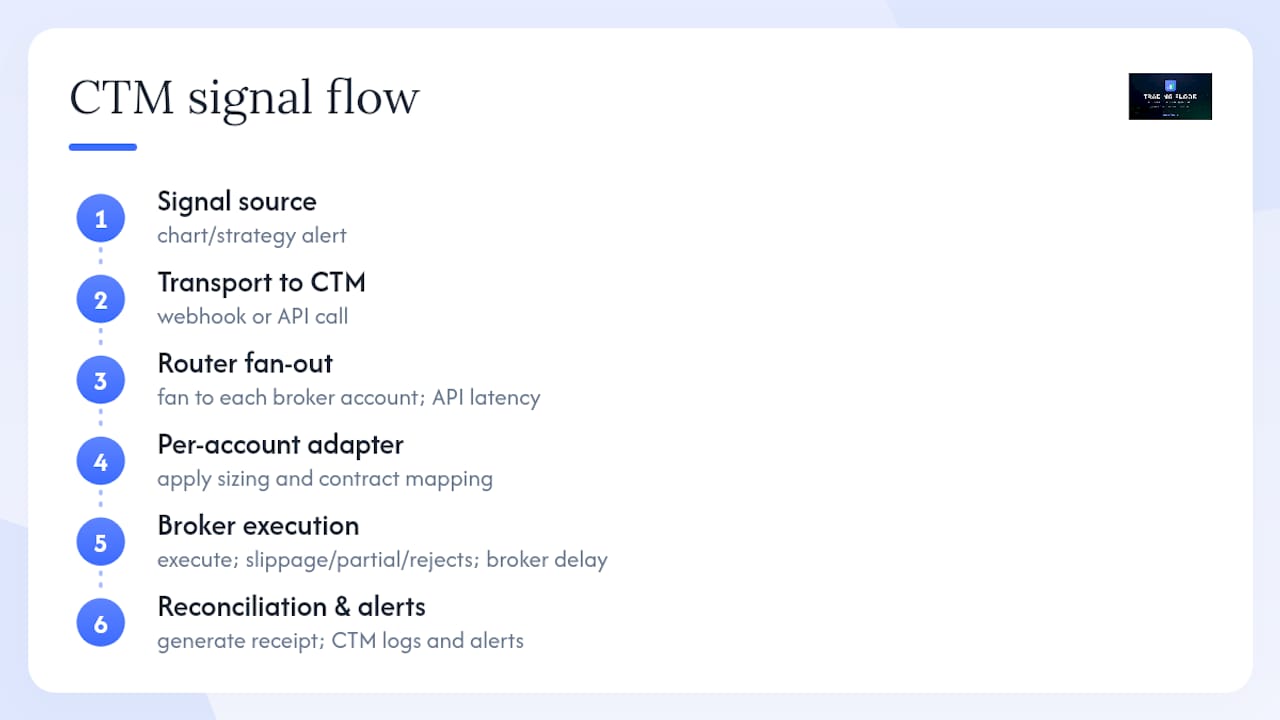
Latency lives at two points: the API round-trip between the CTM and each broker, and the broker’s own order processing speed. Most cloud CTM platforms randomize submission order across follower accounts to avoid systematic fill advantages or disadvantages on any single account. Slippage, partial fills, and rejections are broker-side events. The CTM’s job is to detect them, log them, and alert you immediately.
Core features every prop trader needs from a centralized trading system
A futures trade copier must cover more than basic signal replication. The features below map directly to operational outcomes:
- Real-time position mirroring: copies the leader’s net position, not just entry signals, so follower accounts stay synchronized even after partial fills or manual adjustments
- Per-account risk limits: daily loss caps and trailing drawdown thresholds enforced independently per account, preventing one account’s bad session from cascading into another
- Contract multipliers: maps ES contracts to MES equivalents (or any ratio) so smaller accounts trade proportionally without manual recalculation
- Slippage caps: rejects or flags copies that would execute beyond a defined price tolerance
- Auto-reconciliation: detects and corrects position mismatches between leader and followers without manual intervention
- Trade journaling and receipts: generates a timestamped receipt for every copy, giving you audit-ready records across all accounts
- Push notifications: real-time alerts on fills, rejections, and mismatch events so you catch problems before they compound
- Audit logs: full history of every copy action, useful for tax records and prop firm compliance
Centralized trackers and trade copiers replace the manual spreadsheet-and-multiple-dashboards workflow with a single consolidated view of P&L, drawdown status, and account health.
Pro Tip: Per-account risk limits are the single highest-leverage feature for multi-account prop traders. Configure trailing drawdown thresholds on each follower account independently before going live. A single misconfigured account can breach a funded account’s rules in minutes during a volatile session.
Which brokers and connectors does a centralized trade solution need to support?
For U.S. futures traders, the three primary integrations to verify are Tradovate, TopstepX, and Rithmic. Each uses a different connectivity model.
- Tradovate: REST and WebSocket API; supports sub-accounts natively, which simplifies multi-account fan-out
- TopstepX: broker-level account structure with its own API layer; verify that the CTM supports the current TopstepX API version and handles evaluation-to-funded account transitions
- Rithmic: RPC-based protocol; requires a dedicated gateway adapter rather than a simple REST call, so confirm the vendor maintains an active Rithmic connector
- Webhook endpoints: for alert fan-out from charting platforms like TradingView; verify payload format compatibility and retry logic on failed deliveries
- Sub-account support: confirm the CTM can address individual sub-accounts within a single broker login, not just top-level accounts
- Instrument mapping: ES to MES, NQ to MNQ, and similar micro/full contract pairs must be configurable per follower account
- Reconnection behavior: the connector should auto-reconnect and reconcile positions after a dropped session without requiring manual intervention
For a deeper look at operating across multiple platforms, multi-platform trading best practices covers the tradeoffs between centralized and decentralized execution in more detail.
How to implement a centralized trading system: steps and timeline
The typical path runs from trial and account linking through mapping and simulation to a limited live pilot, then full deployment. Most traders complete this in three to five days when documentation is clear.
- Account linking and authentication (Day 1, 2–4 hours): connect each broker account using API keys or gateway credentials; verify read and order permissions without enabling copying yet
- Instrument mapping and sizing (Day 1–2, 1–3 hours): configure contract multipliers, per-account position limits, and slippage caps for each follower account
- Simulated dry run (Day 2–3, 4–8 hours): run the copier in simulation mode; fire test signals and confirm receipts generate correctly for every follower account
- Live pilot with one account (Day 3–4): enable copying on a single low-stakes account; verify fill quality, receipt detail, and mismatch detection under real market conditions
- Full rollout (Day 4–5): expand to remaining accounts after the pilot passes acceptance tests
Pre-go-live acceptance checklist:
- Rejection handling: confirm the CTM logs and alerts on a rejected order without halting other followers
- Partial fill reconciliation: verify the system correctly updates net position across all accounts after a partial fill on the leader
- Stop propagation: confirm stop orders replicate correctly and trigger on follower accounts as expected
- Emergency halt: test the global stop feature to confirm it pauses all copying without closing existing positions
Account evaluation strategy examples can help you map specific strategies to the right accounts before you configure the copier.
Security and operational controls to require from any CTM vendor
Require strong encryption, least-privilege credentials, and clear audit logs before permitting live copying with funded capital. This is not optional due diligence.
Security checklist:
- Transport encryption on all API connections and at-rest encryption for stored credentials
- API key handling: the vendor should never custody your broker credentials unless you explicitly consent and understand the implications
- Multi-factor authentication on the admin account
- Role-based permissions if you share access with a team member or coach
- Uptime SLA and a public status page you can monitor independently
- Failover behavior: confirm what happens to open positions if the CTM service goes offline mid-session
- Per-copy receipts retained for a defined period (verify this matches your prop firm’s record-keeping expectations)
- Emergency stop/halt-for-all that pauses new copies without touching existing positions
Check account-level risk management for a detailed breakdown of per-account drawdown models and how they interact with CTM controls.
How to evaluate a CTM vendor: questions, tests, and red flags
Prioritize reliability, broker coverage, per-account control, clear receipts, and documentation quality. A vendor that checks all five is worth paying for.
Vendor evaluation checklist:
- Which brokers and connector versions are supported today (not “coming soon”)?
- Does per-account sizing support ratio, fixed-contract, and account-value modes?
- What does a receipt look like? Can you export audit logs in a format your accountant can use?
- What is the documented uptime history, and is there a public status page?
- Does the platform offer a test/simulation mode before live copying?
- What does the pricing structure look like at your account count, and does it scale linearly?
- Are API docs and sample payloads publicly available?
Red flags:
- No simulation mode or test environment
- Opaque or missing per-copy receipts
- Single-point-of-failure architecture with no documented failover
- Vague credential handling (“we store your keys securely” with no specifics)
- No emergency halt feature
Running multiple prop firms in parallel increases bookkeeping and tax complexity; a vendor without exportable audit logs makes that problem significantly worse.
How Tradingfloor implements centralized trade management
Tradingfloor is a cloud trade copier built to mirror live positions across funded and evaluation accounts with per-account risk controls, real-time receipts, and native integrations for Tradovate, TopstepX, and Rithmic. No installation required; it runs from any browser.
Core capabilities:
- Per-account daily loss limits and trailing drawdown thresholds configured independently
- Contract multipliers for ES/MES and other micro/full pairs
- Slippage caps per follower account
- Timestamped receipt on every copy
- Push notifications on fills, rejections, and mismatches
- Auto-reconciliation for position drift
- Trade journaling across all accounts in one view
- 30-day free trial, with paid plans starting from $25/month
During the trial, test receipt detail first (confirm every copy generates a timestamped log), then verify per-account risk limit enforcement, then stress-test the contract multiplier behavior with a simulated ES-to-MES mapping.
Pro Tip: Use the first 48 hours of the Tradingfloor trial exclusively in simulation mode. Fire at least 20 test signals across all connected accounts and review every receipt before enabling live copying. This single step catches the majority of configuration errors before they cost you real capital.
Pricing expectations and ROI for a centralized trade solution
CTM pricing is subscription-based, and ROI comes from three sources: reduced execution errors, time saved on manual reconciliation, and faster scaling across funded accounts.
A simple breakeven example: if a $49/month subscription prevents one execution error per month that would have cost a $500 funded account reset fee, the subscription pays for itself roughly ten times over in that single month. Faster payout attainment across multiple funded accounts compounds that return further.
Practical use cases for prop traders deploying a centralized system
- Evaluation parallelization: run the same strategy across three to five evaluation accounts simultaneously; one passing evaluation covers the cost of the others and the subscription
- Funded account stacking: mirror a proven strategy across multiple funded accounts to multiply payout capture without multiplying screen time
- Strategy separation: route uncorrelated strategies to different accounts from the same CTM, keeping risk profiles distinct while maintaining a single operational view
- Group and coaching management: a head trader or coach mirrors positions to student or group accounts with per-account sizing, letting each participant trade proportionally
- Broker failover: if one broker connection drops mid-session, the CTM detects the mismatch and alerts immediately, allowing rapid manual intervention or automatic reconciliation on reconnect
Experienced traders typically find that managing more than four to six funded accounts without software infrastructure creates overhead that outweighs the incremental upside. A CTM removes that ceiling.
When centralized trade management is actually the right move
Adopt a CTM once you consistently run more than two funded or evaluation accounts, understanding that without software infrastructure, most traders cap active funded accounts at four to six. If manual reconciliation takes more than 15 minutes per session, that’s the practical threshold where the operational drag becomes a real cost.
Readiness signals worth checking before you commit:
- You have a consistent positive edge documented across at least 30 sessions
- At least one account is within range of a payout
- Your entry, exit, and sizing process is fully documented and repeatable
- You’ve completed a simulation test on your chosen CTM with zero unresolved mismatches
One caution: running identical strategies across multiple firms simultaneously increases correlated exposure. A single bad macro event can breach drawdown limits on every account at once. Verify that each firm’s rules permit the strategy you’re copying, and consider routing uncorrelated strategies to separate account groups rather than mirroring everything everywhere.
Tradingfloor’s 30-day free trial: what to test first
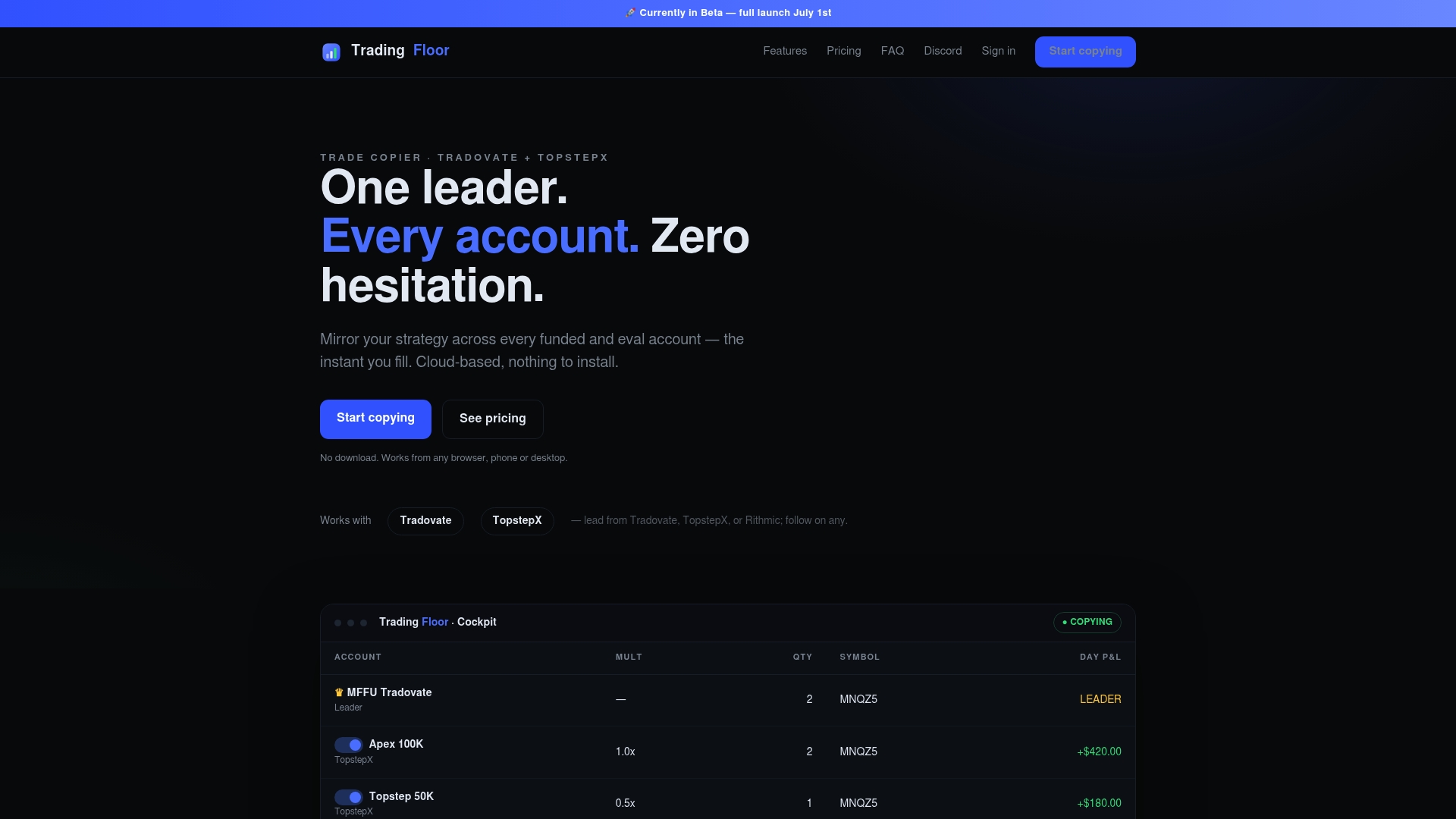
Tradingfloor gives you 30 days to verify everything before paying. The platform connects to Tradovate, TopstepX, and Rithmic, generates a receipt on every copy, and enforces per-account risk limits independently across all follower accounts. Plans start from $25/month with no long-term contract required.
Trial test plan (first 24–72 hours):
- Connect all broker accounts and confirm authentication in simulation mode
- Fire 10–15 test signals and verify a timestamped receipt appears for every follower account
- Configure per-account risk limits and confirm they trigger correctly on a simulated breach
- Test contract multiplier behavior with an ES-to-MES mapping
- Trigger the emergency halt and confirm it pauses copying without closing open positions
Check the Tradingfloor status page for live uptime during your trial. Start your free trial at Tradingfloor.
Sources
- Futures Trade Copier — How to Copy Trades Across Multiple Futures Accounts
- Running Multiple Prop Firms in Parallel — A Practical Guide | PROP NAVI
Recommended
- Multi-Platform Trading Best Practices for Prop Traders — Trading Floor
- Tradecopia.com Alternatives for Prop Traders in 2026 — Trading Floor
- Prop Trading Capital Allocation: A Practical Guide — Trading Floor
- Multi-Account Trade Execution Explained for Prop Traders — Trading Floor
Trading Floor mirrors every trade across your Tradovate, TopstepX & Rithmic accounts in real time, from $25/mo.
Start copying →