What Causes Missed Trade Entries: Fixes That Work

Missed trade entries fall into four categories: psychology, process, practical constraints, and platform/execution. The fastest fixes are:
- Start a missed-trade journal — log every valid setup you didn’t take and why. Journaling missed trades exposes hesitation triggers and is the single highest-leverage diagnostic tool you have.
- Set alerts and pre-place limit orders before each session so the market does the triggering, not your reflexes.
- Cut position size on any instrument where you hesitate repeatedly. Smaller size removes the emotional weight that freezes execution.
Those three moves address the majority of avoidable misses. The sections below give you the diagnostics, the categorized checklist, and a 30-day plan to measure progress.
Key Takeaways
Missed trade entries are a measurable, fixable execution problem — the dominant cause is almost always psychology or process, and a journal plus pre-placed orders resolves most of it within 30 days.
| Point | Details |
|---|---|
| Four cause categories | Psychology, process, practical constraints, and platform/execution each require a different fix. |
| Journal every miss | Log timestamp, reason, emotional state, and expected R:R to identify your dominant cause category. |
| Pre-place orders and alerts | Set limit orders and multi-device alerts before each session so the market triggers entries, not your reflexes. |
| Reduce size to reduce hesitation | Cutting position size on instruments where you freeze is the fastest behavioral fix. |
| Tradingfloor for multi-account traders | Real-time mirroring with per-account risk controls stops missed fills on secondary funded and evaluation accounts. |
Table of Contents
- Why missed entries cost more than you think
- What actually causes missed trade entries
- How to measure and diagnose missed entries
- Actionable process fixes you can apply today
- Tools and automation that prevent missed entries
- A 30-day plan to cut your missed-entry rate
- The fix is simpler than most traders expect
- Tradingfloor cuts missed entries across every account you manage
- Sources
Why missed entries cost more than you think
A missed entry looks like a neutral event. You didn’t lose anything. But the cumulative cost is real and it compounds in three ways.
First, there’s opportunity cost. The trades you skip often include winners, and repeated missed valid setups erode the match between backtest and live performance. If your system expects a moderate win rate and you’re missing a significant number of valid setups, your realized edge will be lower than your tested edge, potentially enough to turn a profitable system into a losing one.
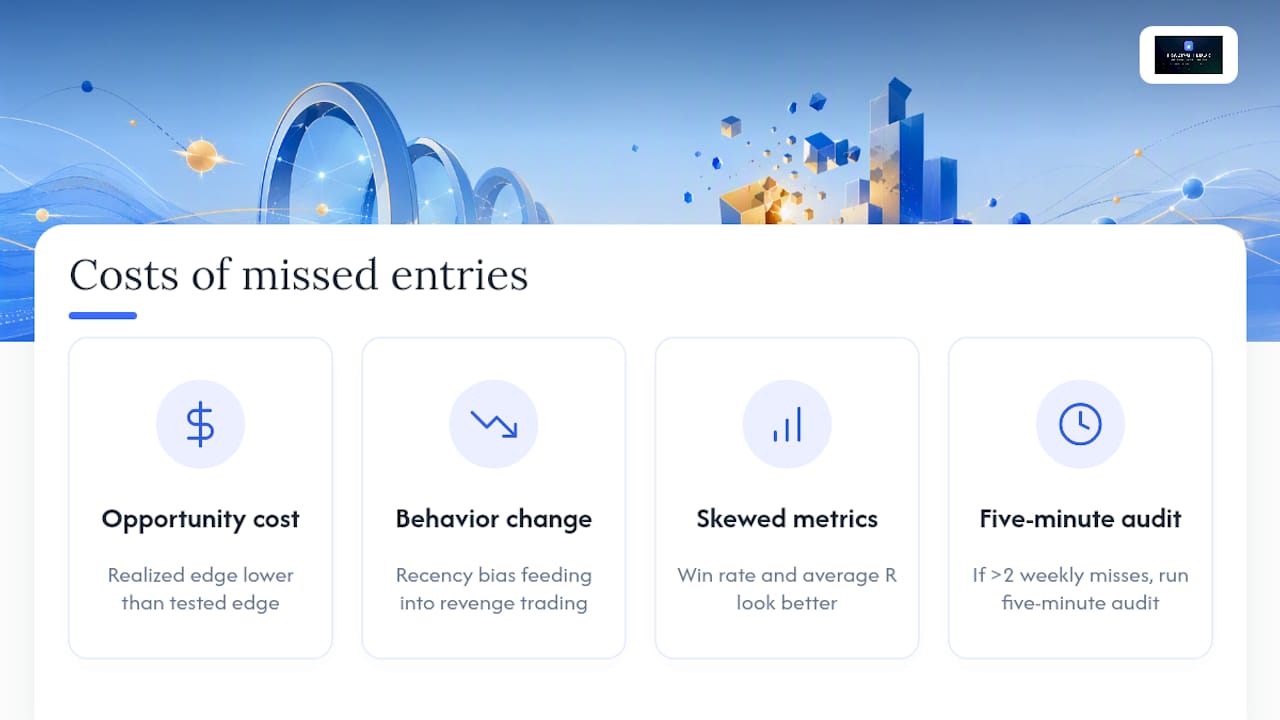
Second, missing trades changes your behavior. A trader named Steve ran a futures system with a solid backtest. After missing three consecutive winners, he started second-guessing every entry. Within two weeks, he was taking marginal setups to compensate — classic recency bias feeding into revenge trading. The missed trades weren’t the problem. The unexamined pattern was.
Third, skewed metrics mislead you. If you’re not logging misses, your win rate and average R looks better than it should. You’re measuring only the trades you took, not the full opportunity set.
A trading journal review that excludes missed trades is measuring your execution, not your system. Including missed trades reveals whether your misses are disciplined decisions or execution failures — and that distinction determines whether the fix is process, psychology, or automation.
Pro Tip: After any week where you missed more than two valid setups, run a five-minute audit before the next session. Ask one question: was each miss a rule-based rejection or a hesitation? The answer tells you where to focus.
What actually causes missed trade entries
The causes split cleanly into four buckets. Most traders have a dominant one.
Psychological causes
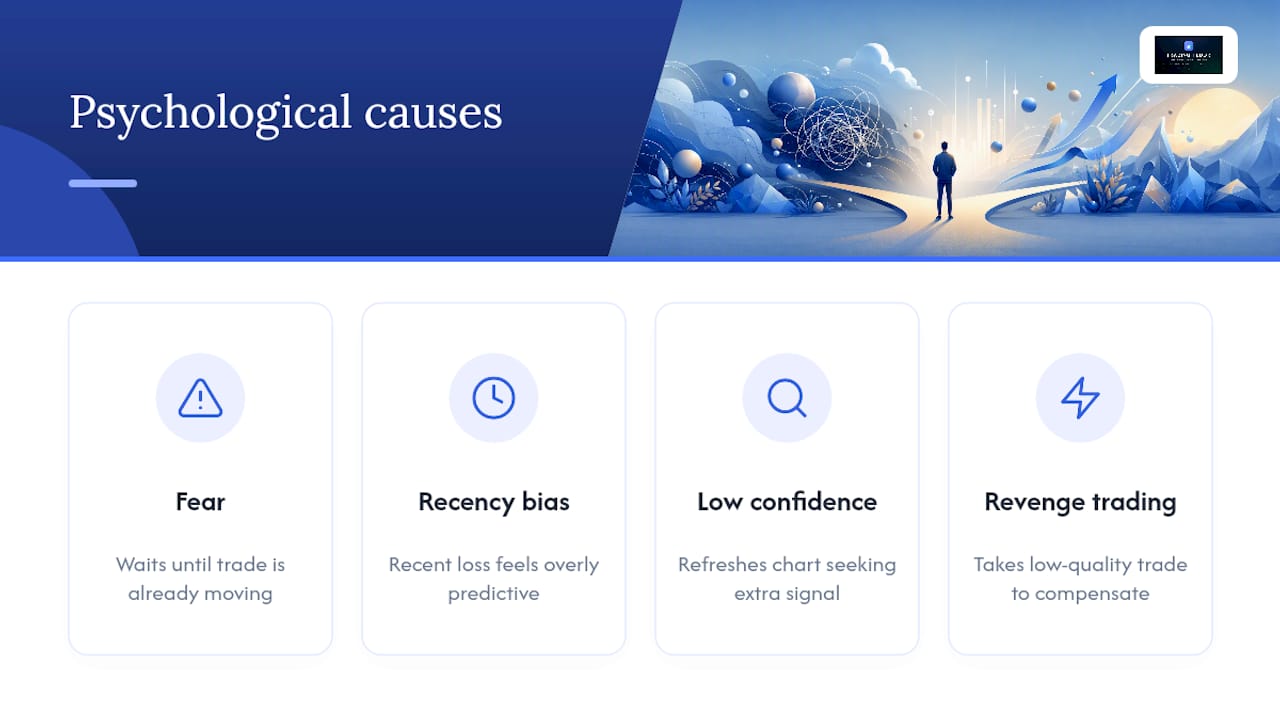
Fear after a loss is the most common. Tony had a string of three losers in NQ futures and started waiting for “more confirmation” on every setup — which meant he was actually waiting for the trade to already be working before he entered. That’s not confirmation; that’s chasing.
Recency bias makes recent outcomes feel more predictive than they are. One bad trade rewires your willingness to take the next valid setup. Lack of confidence often shows up as analysis paralysis: the setup is there, the criteria are met, but you keep refreshing the chart looking for one more signal. Revenge trading is the flip side — after missing a winner, Natasha took a low-quality setup to “make up” for it, which is a different kind of miss.
Process causes
Unclear entry rules are a process failure, not a psychological one. If your rule is “buy when it looks strong,” you’ll hesitate every time because “looks strong” is undefined. Traders miss valid setups when they’re unprepared, distracted, or when their filtering criteria are too vague. Discretionary overrides, poor watchlists, and inconsistent journaling all belong here too. Check your trading execution best practices if your rules feel fuzzy.
Practical constraints
Clint manages three funded accounts and misses entries simply because he’s away from the screen during the New York open. Insufficient balance for the required position size, daily loss limits already hit, and plain distraction (phone, meetings, family) are all legitimate practical causes. Prop firm evaluation rules — max open positions, consistency requirements — can also block entries that would otherwise be valid.
Platform and execution causes
Delayed price feeds, server latency, poor VPS location, and platform overload can all cause automated systems to miss entries. Manual traders face order-entry mistakes, wrong contract sizes, and conflicting open orders that block new fills. These are fixable with the right setup.
Pro Tip: Identify which category accounts for most of your missed entries over the last 20 sessions. That single category is your priority fix — don’t spread effort across all four at once.
How to measure and diagnose missed entries
You can’t fix what you don’t measure. Documenting context for missed trades — why you missed, which criteria matched, time of day, distraction level — is what separates a useful log from a vague note.
A complete, contemporaneous log with no missing fields is the difference between evidence you can act on and noise. Use this template for every missed-trade record:
| Field | What to log | Why it matters |
|---|---|---|
| Timestamp | Date, time, session | Reveals time-of-day patterns |
| Instrument | Ticker/contract | Spots instrument-specific hesitation |
| Setup criteria matched | Which rules triggered | Confirms it was a valid setup |
| Reason not taken | One-line honest answer | Identifies the cause category |
| Emotional state | Calm / anxious / frustrated | Links psychology to misses |
| Expected R:R | Estimated reward-to-risk | Quantifies opportunity cost |
| Potential size | Contracts/shares you’d have taken | Feeds opportunity-cost formula |
Two metrics to track weekly:
- Missed-trade rate = missed valid setups / total valid setups. A rate above 20% warrants investigation.
- Opportunity-cost estimate = sum of hypothetical profits on missed trades using conservative assumptions (entry at signal close, exit at first target).
Run a weekly micro-review (five minutes, same day each week) and a monthly statistical check against your backtest expectations. If your live win rate is consistently below your backtest win rate, missed entries are a likely culprit. See the trading error log guide for a full template.
When you need to correct a log entry after the fact, document what changed, who made the correction, and why — the same auditability standard that applies to any professional record.
Actionable process fixes you can apply today
- Write one-line entry scripts. “If price closes above X on the 5-minute chart and RSI is below 60, place a limit at X+2 ticks; size = 1% of equity.” Ambiguity is the enemy of execution.
- Pre-place limit and stop orders before the session. If the setup is already defined, the order should already be in the system. Let the market trigger it.
- Set multi-device alerts. Phone, desktop, and tablet. Missing an entry because you didn’t see the signal is a setup problem, not a discipline problem.
- Reduce position size on hesitation instruments. If you consistently freeze on a specific contract, cut size by half until the hesitation disappears. Smaller risk = faster trigger finger.
- Use hotkeys or order templates. Pre-fill tickets with your standard size and order type. One keypress, not five clicks.
- Build a pre-session checklist. Confirm watchlist, confirm alerts are live, confirm no conflicting open orders. Three minutes before the open.
After missing a trade, don’t chase it. Late entries carry worse stop placement and higher emotional pressure. Look for a structured second-chance setup at the next key level instead.
Pro Tip: Keep a “decision script” card next to your keyboard: “Setup met? Size correct? Order placed? Go.” Reading it aloud before each entry takes four seconds and eliminates most hesitation freezes.
Tools and automation that prevent missed entries
- Alert and scanning tools (TradingView, Thinkorswim scanner): notify you the moment criteria are met so you’re never caught off-guard.
- Conditional entry orders: pre-placed limit, stop-limit, or MIT orders that execute without you needing to be at the screen.
- Trade copiers and mirror tools: a single trigger distributes to multiple funded or evaluation accounts simultaneously. Tradingfloor mirrors real-time positions across accounts on Tradovate, TopstepX, and Rithmic, with per-account risk controls, slippage caps, and push notifications. One entry on the leader account fires to every follower account in real time — no manual re-entry, no missed fills on secondary accounts. The TradingView to Tradovate integration fires alerts into every account with minimal latency.
- VPS and latency monitoring: a VPS co-located near your broker’s servers cuts execution delay. Test latency on low-risk orders and monitor execution timestamps weekly.
- Multi-device notification systems: push alerts to phone and desktop so a missed screen moment doesn’t become a missed trade.
- Trade journaling software: automation that captures events automatically reduces manual data-entry errors and keeps logs complete without relying on memory.
Pro Tip: Run a latency check monthly: place a small test order and compare the timestamp on your order confirmation to the signal time. A gap above two seconds on a futures platform warrants a VPS upgrade or broker review.
A 30-day plan to cut your missed-entry rate
- Week 1 — Setup. Create your missed-trade journal using the template above. Set alerts on your top three instruments. Write entry scripts for every active setup. Add a pre-session checklist to your routine.
- Week 2 — Habits. Run a daily five-minute missed-setup review after the close. If hesitation appears on any instrument, cut size by 50% for the rest of the week. Test conditional orders on one low-risk setup. Check VPS latency.
- Week 3 — Automation. Implement a trade copier or conditional entry orders for your most repeatable setups. Automate alerts. Begin a weekly performance snapshot: entries taken vs. valid setups identified.
- Week 4 — Measure and adjust. Calculate your missed-trade rate for the month. Set a concrete target: reduce it by 50% from your Week 1 baseline. Review which cause category still dominates and adjust one rule to address it.
Success at 30 days: your missed-trade rate is documented, trending down, and you have at least one automated entry mechanism running. The prop trader performance optimization guide covers how to extend this into a longer-term execution review cycle.
The fix is simpler than most traders expect
Most traders treat missed entries as random bad luck. They’re not. They’re a pattern with a cause, and the cause is almost always in one of those four buckets. The traders who close the gap between backtest and live performance fastest are the ones who log every miss without judgment, identify the dominant cause, and make one targeted change at a time.
FOMO is a symptom. The underlying issue is usually an undefined rule or an alert that wasn’t set. Fix the process, and the psychology tends to follow. One journal, one alert system, one daily review — that’s the whole framework. Everything else is refinement.
Tradingfloor cuts missed entries across every account you manage
Managing multiple funded or evaluation accounts multiplies the missed-entry problem. One hesitation on the leader account means every follower account misses the same trade. Tradingfloor solves this with real-time position mirroring: a single entry on your primary account copies instantly to every connected account, with per-account risk controls, slippage caps, and auto-reconciliation built in.
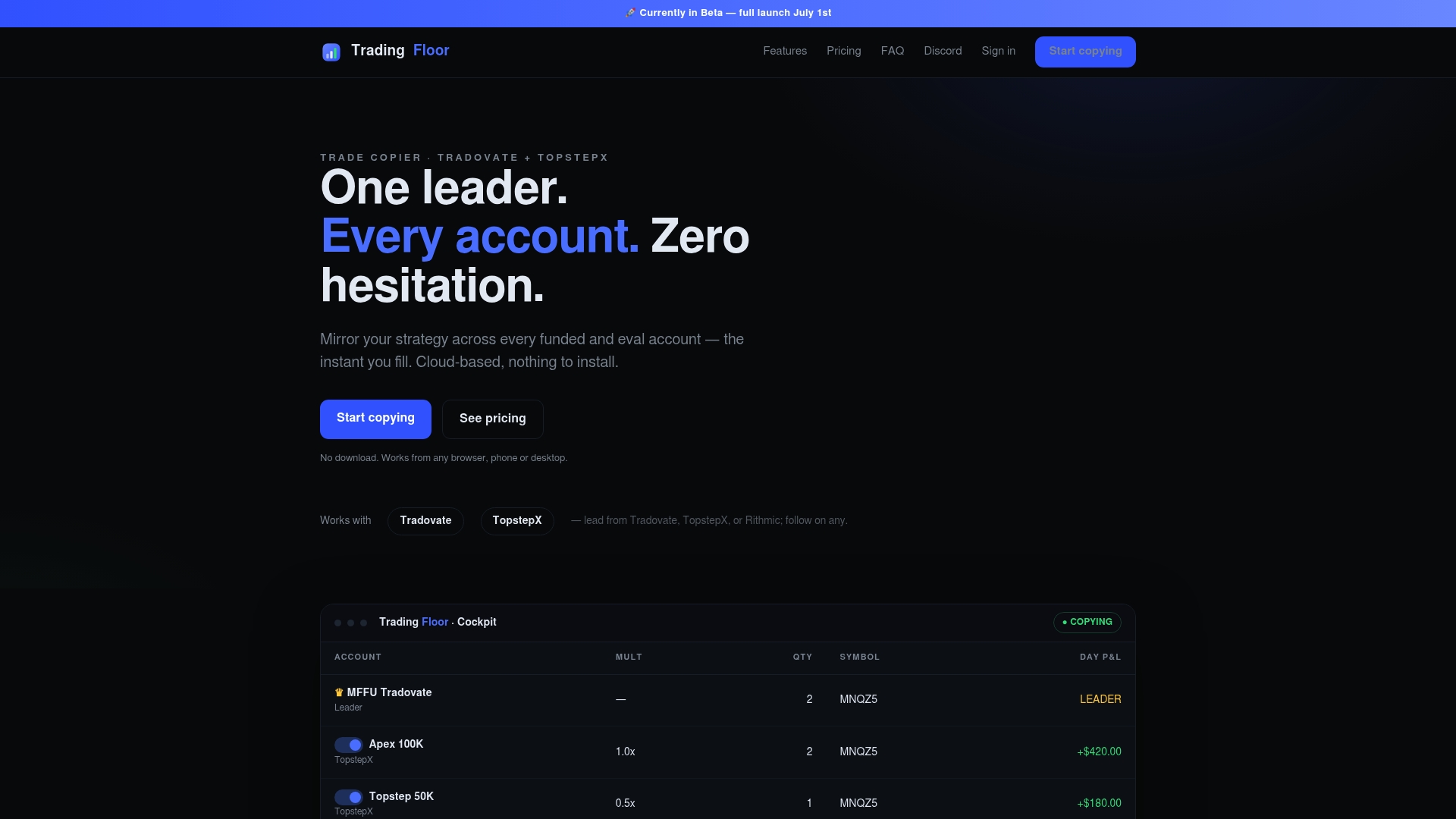
No installation. No manual re-entry. Push notifications confirm every copy so you know the fill landed. If a secondary account misses a fill, the auto-reconciliation feature re-syncs positions without manual intervention. For prop traders running evaluation and funded accounts simultaneously, Tradingfloor’s consistency rule protections keep every account within its firm’s parameters while you trade from a single interface.
Start a 30-day free trial at Tradingfloor and see how many entries your secondary accounts stop missing in the first week.
Sources
- Psychology: 4 ways to minimize missing good trades
- Your Trading Journal Review Is Incomplete Without Missed Trades | Trader+AI
- The Best Way to Track Missed Trades in Your Journal
- Site diary completion checklist
- How to handle missed punches before payroll
- CRM and sales: CRM data capture
This article is general information, not a substitute for advice from a qualified financial advisor. Consult a qualified financial professional about your own circumstances before acting on anything here.
Recommended
- Trading Error Logs for Prop Traders: A Complete Guide — Trading Floor
- Human Error in Trading Explained: Cut Losses With Rules — Trading Floor
- Common Automated Investing Mistakes for Multi-Account Copiers — Trading Floor
- Avoid Consistency Rule Violations When Copying Trades — Trading Floor
Trading Floor mirrors every trade across your Tradovate, TopstepX & Rithmic accounts in real time, from $25/mo.
Start copying →