Common Automated Investing Mistakes for Multi-Account Copiers
The most damaging automated investing mistakes for prop traders running multi-account trade copiers are not about diversification or fees. They are operational failures: instrument cache races that generate phantom positions, failed reconciliation that compounds state drift, wrong contract multipliers that blow per-account drawdown limits, and timing fingerprints that trigger prop-firm compliance flags. Fix them in this order: pause copying if anything looks wrong, run a reconciliation snapshot, and verify your instrument filter coverage before re-enabling.
Three checks to run right now (10 minutes):
- Pause copying on all follower accounts and compare open positions against your master account ledger.
- Confirm your instrument filter list covers every symbol the master is currently trading, including any recently rolled futures contracts.
- Check your per-account daily-loss caps and contract multipliers against each funded account’s current drawdown headroom.
Named failure modes to triage: WebSocket ORDER_TRADE_UPDATE cache-miss race (see nautilus_trader issue #3775), reconciliation guard rails, and Tradingfloor’s real-time monitoring layer.
Table of Contents
- The 10 most common automated copy mistakes and how to fix them
- Why the instrument cache race creates phantom positions
- How to configure copy settings safely before going live
- Testing and monitoring to catch replication errors early
- Incident response playbook for phantom positions
- Architecture patterns that prevent whole classes of failures
- Key Takeaways
- The real cost of getting state wrong in prop trading
- Tradingfloor gives you the guardrails this article describes
- Useful sources for deeper reading
The 10 most common automated copy mistakes and how to fix them
-
Slippage and latency failures. Delayed follower entries widen slippage beyond acceptable thresholds, and identical fill timestamps within 50–200 ms can trigger prop-firm compliance flags. Fix: add randomized execution delays and set explicit slippage caps per instrument.
-
Expired-contract handling. Automation that ignores contract lifespan silently holds through expiry or subscribes to a stale feed. The correct sequence is detect, close, re-subscribe, and reconcile using an explicit roll state machine.
Pro Tip: Mistakes 1, 2, and 7 are the most likely to cause immediate prop-firm rule violations because they create position-size or drawdown breaches that look intentional to a risk team. Prioritize those three.
Why the instrument cache race creates phantom positions
When a WebSocket ORDER_TRADE_UPDATE event arrives before the instrument provider cache has finished loading, the execution engine cannot resolve the instrument. The result is a ValueError, which triggers an inflight REST recovery routine. That routine infers a fill from incomplete data and emits a phantom PositionOpened event.
Testnet reproduction steps:
- Subscribe to multiple USDT-margined perpetual pairs simultaneously on testnet.
- Open a long position on
ETHUSDT-PERP. - Submit a
reduce_onlypartial close immediately after. - Observe the
ORDER_TRADE_UPDATEarriving before the cache lookup completes.
The logged traceback looks like this:
ValueError: Cannot process event for ETHUSDT-PERP: instrument not found in cache[WARN] Inflight check threshold exceeded (5000ms); generating inferred fill[ERROR] PositionOpened emitted for ETHUSDT-PERP — position not in strategy state
The key line is the second one. The inflight_check_threshold_ms=5000 recovery does not wait for confirmation; it guesses. That guess becomes a phantom open that your reconciliation engine then has to unwind. Full reproduction details and the original traceback are documented in nautilus_trader issue #3775.
Code-pattern mitigations:
- Retry with exponential backoff on cache-miss before processing any
ORDER_TRADE_UPDATE. - Queue unprocessable events in an ordered buffer and replay after cache population confirms.
- Delay user data stream subscription until the instrument cache reports fully loaded.
- Emit an
OrderStatusReportto the reconciliation path rather than inferring fill state.
Pro Tip: Add a multi-layer guard inside on_position_opened(): check tracked trades, detect the reduce_only flag, and verify the event side matches the strategy’s current capability. This catches phantom opens at the application layer even when the adapter misbehaves.
How to configure copy settings safely before going live
Always map contract multipliers and validate per-account risk limits before enabling live copying. A single misconfigured multiplier on a funded account is enough to breach drawdown rules on the first trade.
Configuration checklist:
- Instrument filter: confirm every symbol the master trades is explicitly listed; do not use wildcard filters on live funded accounts.
- Per-account contract multiplier table: example,
0.33xfor a $25K follower vs. a $75K master. - Per-account daily-loss cap: set independently, not shared across the group.
- Slippage cap: define in ticks per instrument (e.g., 2 ticks on ES, 1 tick on NQ).
- Execution delay and jitter: add randomized delay (50–200 ms range) to avoid identical timestamp fingerprints that prop firms actively monitor.
- Deduplication: use idempotent order IDs tied to master order reference plus account ID.
- Comment and tag removal: strip trade comments and metadata before submission to reduce detection surface.
Safe ramp procedure:
- Run master and all followers on a sim/demo environment for at least five trading sessions.
- Promote one follower to a micro-funded account and validate multipliers and stops.
- Enable full funded accounts only after two clean sessions with no reconciliation mismatches.
Pro Tip: Set conservative defaults for every new follower account: 0.25x multiplier, 50% of the account’s stated daily-loss limit, and a 100 ms minimum execution delay. Tighten only after confirmed clean runs.
Testing and monitoring to catch replication errors early
Test every execution path on sim before touching a funded account: normal fills, partial closes, order rejections, and the reconciliation recovery path. Vetted Prop Firms recommends starting with a single lead account and micro positions to validate sizing before scaling.
Test plan:
- Run master and follower on testnet; execute controlled partial closes and confirm
reduce_onlyhandling. - Inject a deliberate cache-miss and verify no inferred fills are created.
- Run high-frequency order sequences (10+ orders in 30 seconds) to stress-test deduplication.
- Simulate a network drop mid-fill and confirm reconciliation recovers cleanly.
Monitoring metrics and alert thresholds:
| Metric | Alert threshold | Action |
|---|---|---|
| Reconciliation mismatch rate | — | Pause copying, run snapshot |
| Inferred-fill events | — | Immediate investigation |
| Order rejection rate | > 2% per session | Check feed and multipliers |
| Instrument cache-miss rate | > 0 on live stream | Delay stream, retry cache |
| Inter-account fill-time delta | — | Review latency and routing |
Rejected orders that go unreconciled compound state drift — the internal ledger stays wrong and every subsequent order builds on a false baseline. Alert on rejections immediately, not in batch.
Incident response playbook for phantom positions
Stop new entries first. Then flatten affected accounts if the position size is outside acceptable bounds. Then collect logs. Do not attempt to reconcile while new orders are still flowing.
Step-by-step playbook:
- Activate kill-switch or pause copying across all follower accounts.
- Take synchronized snapshots: broker-reported positions vs. internal ledger for every account.
- Collect WebSocket logs, REST order reports, sequence numbers, and
ORDER_TRADE_UPDATEpayloads with timestamps. - Run the idempotent reconciliation routine against the snapshots; flag every mismatch.
- Apply manual or automated rollback: close phantom positions, cancel orphaned orders.
- Document the full timeline for postmortem and notify prop-firm risk teams if drawdown limits were touched.
Log collection template — capture these fields:
- Event timestamps (UTC, millisecond precision)
ORDER_TRADE_UPDATEpayload (symbol, side, quantity,reduce_onlyflag)- REST order report (order ID, fill price, fill quantity, status)
- Instrument cache hit/miss log at event receipt time
- Reconciliation delta per account (expected vs. actual position)
Track net position state across accounts throughout the incident window so the postmortem has a clean timeline.
Architecture patterns that prevent whole classes of failures
Deterministic event choreography beats fire-and-forget event webs. When fill state flows through an ordered queue with acknowledgment semantics, a single dropped message does not silently corrupt every downstream account.
Patterns to implement:
- Pre-populate the instrument cache at connect, before any stream subscription opens.
- Use ordered event queues with replay and acknowledgment; never process events out of sequence.
- Make every order handler idempotent: the same order ID processed twice produces the same result, not a duplicate.
- Run reconciliation-first workflows: confirm state before accepting the next signal, not after.
- Per-account sandboxing: each follower account runs in an isolated execution context with its own kill switch.
- Distributed tracing: tag every order with a trace ID that flows from master signal through every follower fill.
For ops teams, a three-tier diagram helps: ingestion layer (WS + REST feeds) feeds into an execution engine (queue + dedup + multiplier logic), which writes to a reconciliation store (ledger + snapshot + alert rules). Safety gates sit between each tier.
Pro Tip: If your prop firm monitors shared cloud IPs, a local native execution node reduces your detection footprint more than any timing tweak. Local copiers reduce shared-IP fingerprint risk in ways that cloud-only setups cannot fully mitigate.
Key Takeaways
Phantom positions, state drift, and compliance flags are the real risk for multi-account copiers — not market timing or diversification.
| Point | Details |
|---|---|
| Cache-miss race is the root cause | Pre-populate the instrument cache before subscribing to the user data stream to prevent phantom PositionOpened events. |
| Reconciliation must run continuously | Alert immediately on any reconciliation mismatch; do not wait for batch review. |
| Per-account config is non-negotiable | Set independent multipliers, daily-loss caps, and slippage limits for every funded and evaluation account. |
| Test every path on testnet first | Partial closes, cache-miss injection, and high-frequency deduplication stress tests must pass before live copying resumes. |
| Tradingfloor addresses these directly | Tradingfloor’s auto-reconciliation, per-account risk controls, and real-time notifications map to the mitigations in this article. |
The real cost of getting state wrong in prop trading
Most traders treat phantom positions as a software curiosity. They are not. A single inferred fill on a funded account can push net exposure past the daily-loss limit before the trader sees the alert, triggering an automatic account closure that no appeal process reverses.
The deeper problem is that state errors compound. One phantom open skews the reconciliation baseline. The next real trade is sized against a wrong position. By the time the mismatch surfaces in monitoring, two or three accounts may be affected. Human error compounds the problem when traders attempt manual fixes mid-session without pausing the copier first.
Prop accounts fail fast when state is wrong. The technical fixes in this article are not optional refinements; they are the minimum viable architecture for anyone running live funded accounts through a copier. The firms do not care whether the error was a race condition or a misconfigured multiplier. They see a rule violation and close the account.
Tradingfloor gives you the guardrails this article describes
Every mitigation in this article requires per-account controls, real-time reconciliation, and audit-grade logging. Tradingfloor builds those in by default: auto-reconciliation that compares broker state against the internal ledger on every fill, per-account contract multipliers and daily-loss caps set independently, slippage caps per instrument, and push notifications the moment something diverges.
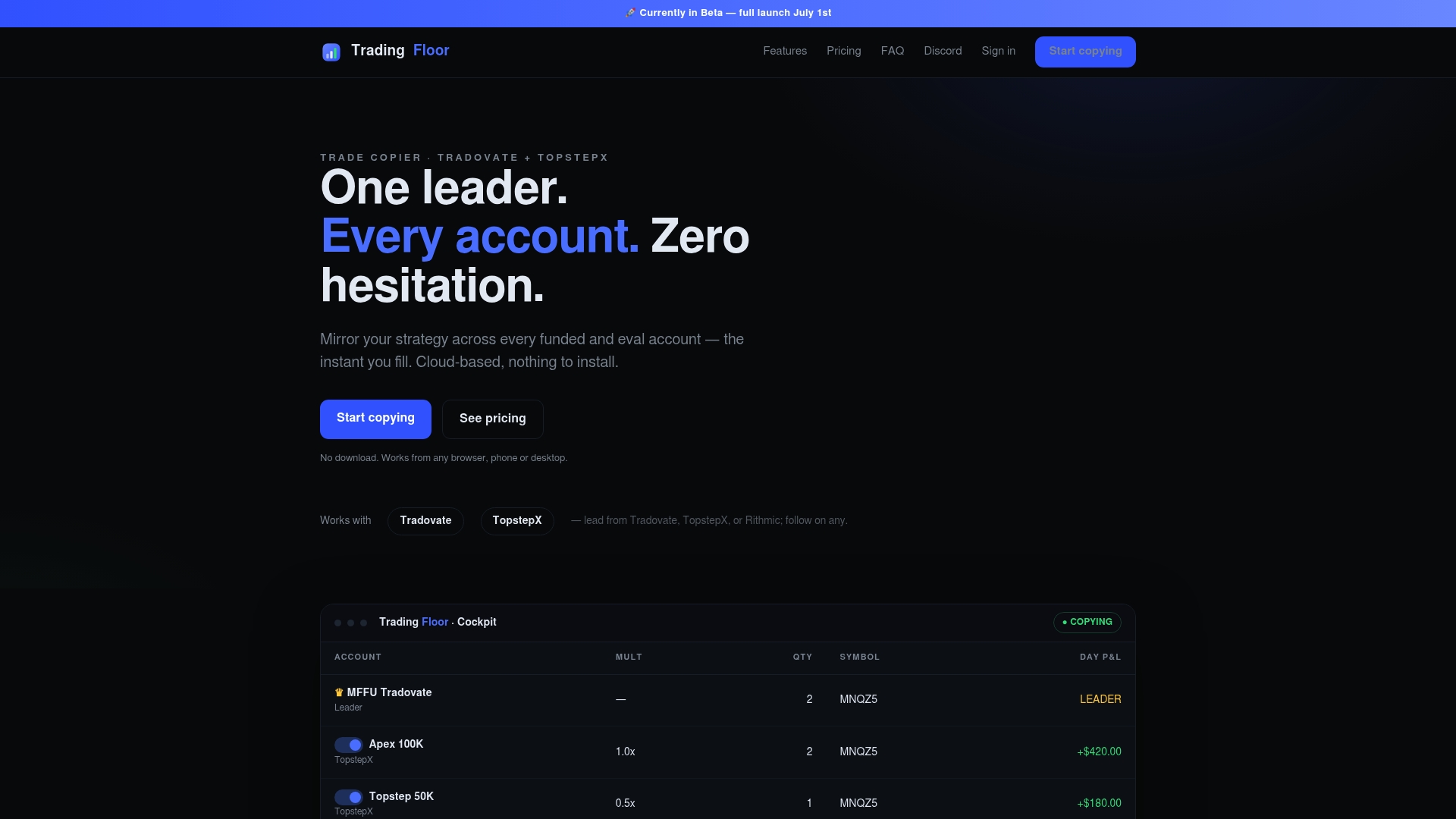
The instrument filter pre-populates before any stream opens. Order deduplication uses idempotent IDs. Every account gets its own kill switch. And because Tradingfloor runs in the cloud with no installation, you can monitor and intervene from any device the moment an alert fires. Platforms supported include Tradovate, TopstepX, and Rithmic.
Start with a 30-day free trial and run your first session on sim before touching a funded account. That is exactly the ramp procedure this article recommends.
Useful sources for deeper reading
- nautilus_trader issue #3775 — instrument not found in cache causes inferred fills
- Futures Contract Expiry: The Problem Automation Ignores
- Order Rejected Mid Strategy: The Hidden Cost of One Bad Fill
- Avoiding Rule Violations with Trade Copiers | Damn Prop Firms
- Prop Firm Trade Copier Rules: What’s Allowed in 2026
- How To Copy Trade Across Multiple Prop Firm Accounts Without Execution Errors — Vetted Prop Firms
- Multi-Account Automation Investing: A 2026 Trader’s Guide — Trading Floor
Recommended
- Avoid Consistency Rule Violations When Copying Trades — Trading Floor
- How to Automate Position Copying in Prop Trading — Trading Floor
- Multi-Account Automation Investing: A 2026 Trader’s Guide — Trading Floor
- Trades Copied Right: Real-Time Mirroring for Prop Traders — Trading Floor
Trading Floor mirrors every trade across your Tradovate, TopstepX & Rithmic accounts in real time, from $25/mo.
Start copying →