Prop Traders: Server Side Trailing Stop Sync with Slippage Caps

The most reliable way to handle trailing stop synchronization is to centralize SL/TP updates in a server-side trade copier or API manager, rather than trusting each broker terminal to trail independently. That single layer replicates every stop adjustment in real time and normalizes contract size per account. The payoff is fewer manual errors, consistent exits across every funded and evaluation account, and one set of risk rules instead of five conflicting ones.
TL;DR:
- Using a server-side trade copier or API manager ensures real-time, consistent trailing stop updates across multiple accounts, avoiding manual errors and conflicting risk rules.
- Client-side trailing stops can fail to protect positions if the terminal disconnects or stops updating, especially when managing several accounts or brokers.
- Normalizing contract sizes and applying volatility-aware trail distances are essential for accurate risk management when copying trailing stops across different instruments and accounts.
- Broker-native trailing is sufficient for single accounts on one platform, but centralized solutions are necessary for multi-account or cross-broker setups to prevent missed or outdated stop adjustments.
- Reconciliation and testing on demo modes before live deployment are critical to avoid costly mistakes caused by latency, slippage, or misconfigured risk controls.
Table of Contents
- How Trailing Stops Work and Why Copying Them Is Tricky
- Where Multi-Account Trailing Stop Sync Breaks Down
- Comparing Architectures for Real-Time Stop Synchronization
- Setting the Numbers: Trail Distance and Risk Controls
- A Checklist for Deploying Synchronized Trailing Stops
- How Tradingfloor Handles Trailing Stop Sync in Practice
- Choosing Between Native Trailing and Centralized Sync
- Get Synchronized Trailing Stops Without Building It Yourself
- Sources
- FAQ
How Trailing Stops Work and Why Copying Them Is Tricky
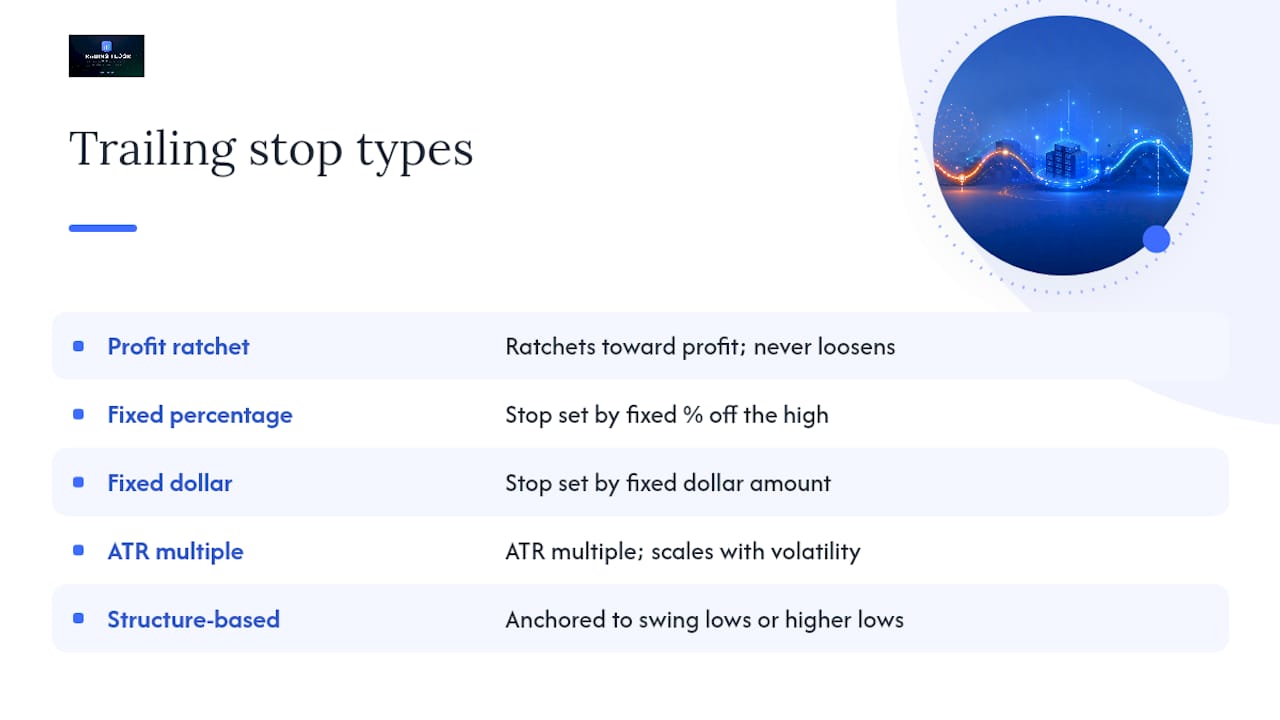
A trailing stop is a stop-loss order that moves with price to lock in gains while limiting downside, and it only ever ratchets in the direction of profit. It never loosens back toward your entry. Traders build trails four main ways: a fixed percentage off the high, a fixed dollar amount, an ATR multiple that scales with volatility, or a structure-based trail anchored to swing lows or higher lows.
Most trails also carry an activation threshold. The stop stays fixed until price moves a defined distance in your favor, then starts trailing. This matters enormously once you copy that behavior across accounts, because the mechanism generating the stop update lives in one of two places.
Client-side trailing runs inside your trading terminal. It only updates the stop while that terminal stays connected and running. Server-side trailing runs on the broker’s server itself, so it keeps adjusting even if your laptop crashes or your internet drops overnight. For anyone managing multiple accounts, that difference decides whether your protective stop actually protects you when you’re not watching the screen.
Where Multi-Account Trailing Stop Sync Breaks Down
Synchronization tends to fail in predictable ways, and almost all of them trace back to one broker terminal doing work that a centralized system should be doing instead.
- Client-side trailing on a disconnected terminal. If the leader’s terminal drops, the trail stops moving, but receiver accounts may have already copied the old stop and now sit unprotected against a fresh leg lower.
- Trails set too tight for the instrument’s volatility. A fixed 1% trail on a choppy futures contract gets stopped out on normal noise, not on an actual trend reversal.
- Latency and slippage between the signal and the fill. A trailing stop guarantees the order fires, not the price you get filled at, and that gap widens under fast markets or weekend gap risk.
- Mismatched contract multipliers across brokers. A one-contract position on one platform can represent a very different notional exposure than one contract on another, so a raw price-level stop copied verbatim distorts risk on the receiving account.
- Initial-only copying. Some copiers replicate the entry and the original stop but never propagate later adjustments, which defeats the entire point of a trailing strategy once the stop starts moving.
Pro Tip: Before trusting any copier with live capital, place one manual trailing-stop adjustment on the leader account and time how long it takes every receiver to reflect it. Anything beyond a couple of seconds is a red flag on a fast-moving instrument.
Comparing Architectures for Real-Time Stop Synchronization
Four practical architectures cover most setups, and each trades latency for flexibility differently.
- Server-side trade copier. A cloud service holds the leader’s position and stop state centrally, then pushes SL/TP changes to every linked account through broker APIs. This is the closest thing to true real-time sync because the state lives outside any single terminal, and per-account risk rules apply uniformly.
- Broker-native server-side trailing. Fast and reliable within one broker’s infrastructure, but inconsistent the moment you run accounts across different platforms. What one broker’s server enforces natively, another may only support client-side.
- Alert-to-webhook pipeline. A signal or indicator fires a webhook, a cloud manager interprets it, then calls broker APIs to adjust each account’s stop. Flexible and broker-agnostic, but every hop adds latency, and each added integration is another point of failure.
- Custom API-based manager. Maximum control over logic and risk normalization, built and run in-house. It also means owning API rate limits, error handling, and reconnection logic yourself.
Real-time SL/TP synchronization is the feature that separates a copier that merely mirrors entries from one that actually maintains a live trailing strategy, since later stop modifications have to propagate just as reliably as the original order.
Setting the Numbers: Trail Distance and Risk Controls
Configuration decisions matter more than architecture choice once the pipeline is built. A few starting points worth applying directly:
- Pick a volatility-aware distance. ATR multiples around 2x for day trades, 3x for swing positions, and 4x for longer-term holds scale naturally with instrument noise, while a flat 5% to 15% trail works reasonably for many liquid equities.
- Set an activation threshold. Don’t let the trail start moving until price has cleared a meaningful profit cushion, often one full risk unit (1R), so normal early volatility doesn’t trigger a premature trail.
- Normalize contract size per account. Convert the leader’s stop distance into an equivalent risk-based distance for each receiver, accounting for differing contract multipliers rather than copying raw price levels.
- Cap slippage per account. Define a maximum acceptable slippage in ticks or points and reject or flag fills outside that band.
- Reconcile positions on a fixed interval. Compare leader and receiver state regularly and alert on any mismatch instead of assuming the last sync succeeded.
Pro Tip: Run the same ATR multiplier across two accounts with different contract sizes before going live. If the resulting dollar risk isn’t roughly equal, your normalization math needs fixing before your stop logic does.
A Checklist for Deploying Synchronized Trailing Stops
- Map every symbol and contract multiplier across all brokers you’re connecting, so a stop distance means the same risk on every account.
- Confirm your API scopes or broker permissions actually allow SL/TP modify operations, not just order placement.
- Build listeners, whether webhook-based or polling, paired with a reconciler that matches trades between leader and receivers.
- Enforce per-account risk controls and slippage caps at the point of execution, not as an afterthought.
- Test the whole pipeline in replay or demo mode under stress scenarios, then roll out to a small account cohort with active monitoring before scaling further.
Skipping the demo stage is the single most common shortcut that turns into a costly production incident.
How Tradingfloor Handles Trailing Stop Sync in Practice
A cloud-based real-time position mirroring service copies the leader’s net position, not just an entry signal, across linked funded and evaluation accounts. Because the sync runs server-side, updates propagate whether you’re watching the screen or asleep.
The platform includes per-account risk controls, slippage caps, and push notifications, and it works across broker platforms including Tradovate and TopstepX. For a prop trader running one leader on a funded account and mirroring into several evaluation accounts, that means one trailing-stop adjustment reaches every account with contract-normalized sizing already applied.
- Cloud-based, no installation required
- Real-time SL/TP propagation across funded and evaluation accounts
- Per-account risk limits and slippage caps enforced automatically
Pro Tip: If you’re running both an evaluation account and a funded account on the same strategy, mirror the evaluation account rather than trading it manually. It removes the temptation to override your own trailing logic under pressure.
Choosing Between Native Trailing and Centralized Sync
Native, broker-native server-side trailing is genuinely enough if you trade one broker, one account, and don’t need cross-platform consistency. Building or buying a centralized copier for that setup is overengineering.
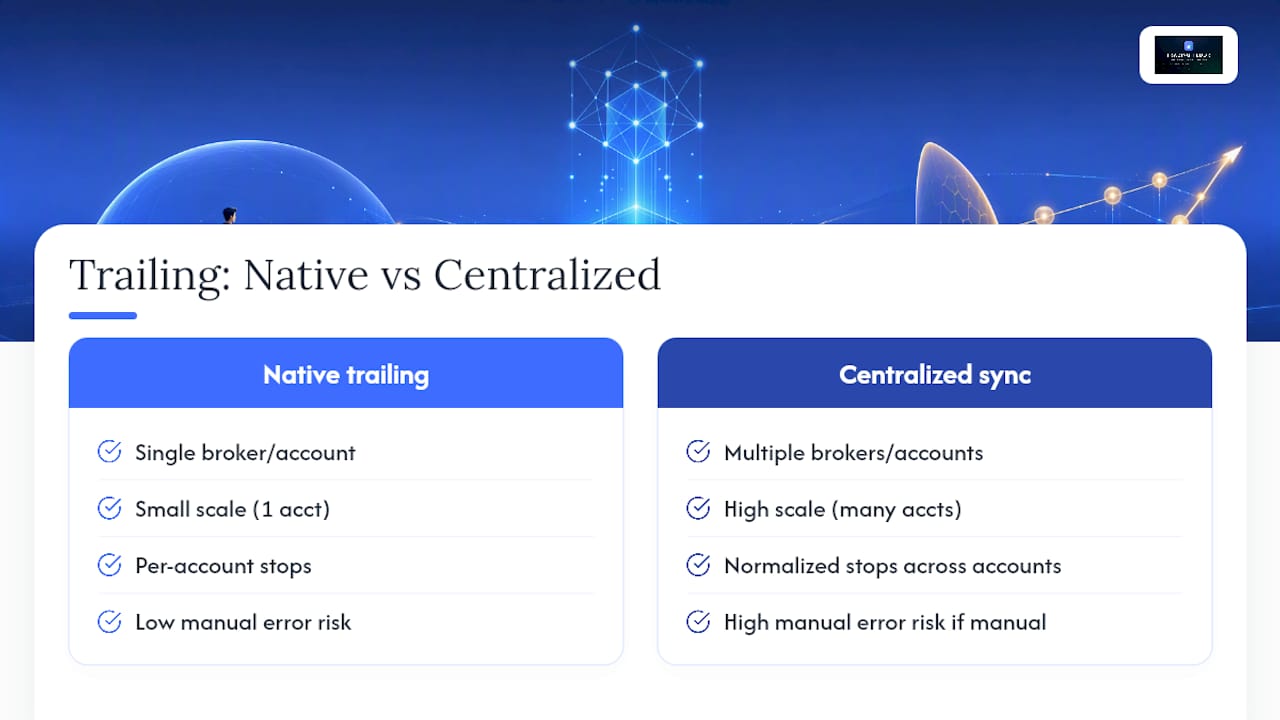
The math changes the moment you’re running multiple funded and evaluation accounts, especially across different brokers, because a manual approach to trailing stop synchronization means every stop adjustment is a chance for a typo or a missed account. My rule of thumb: if you’d need a spreadsheet to track which account has which stop, you’ve already outgrown client-side trailing.
The decision checklist is short. Single broker, single account, comfortable watching it: native trailing is fine. Multiple brokers, multiple accounts, or a prop firm structure where consistency isn’t optional: centralize it, normalize contract sizes, and let the reconciler catch what a tired trader would miss at 2 a.m.
— KennyTrades
Get Synchronized Trailing Stops Without Building It Yourself
Such services provide a practical shortcut for traders who don’t want to build an API manager from scratch just to keep stops aligned across accounts. They handle server-side replication, contract normalization, and slippage caps, so trailing-stop logic on one leader account applies consistently across multiple funded and evaluation accounts.
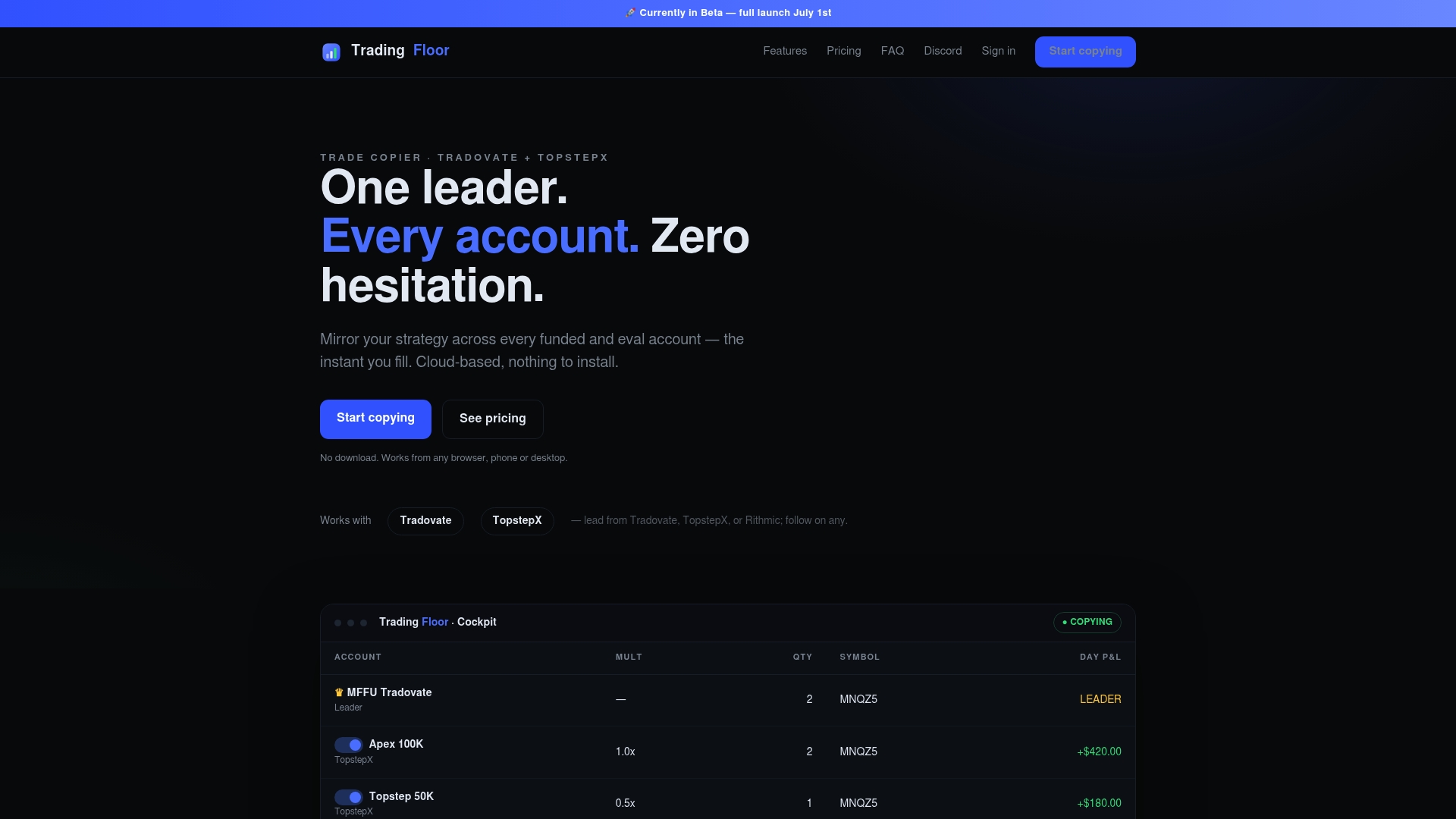
If you’re running a Take Profit Trader setup across multiple accounts, the Take Profit Trader Trade Copier mirrors one trade, and every stop adjustment that follows, across all of them automatically. Traders juggling TopstepX or Tradovate accounts get the same real-time mirroring, with per-account risk rules enforced from the same dashboard. Start a trial and connect your first two accounts to see the sync latency for yourself before you commit real size to it.
Sources
- Trailing Stops: What They Are, How to Use Them in Trading — Investopedia
- Trailing stop loss: How to set it — TradingSim
- How trailing stop works and when it kills your profit — Forex-basics
- MT5 Trade Copier Real-Time SL/TP Synchronization: Keeping Every Receiver in Sync — MQL5 blog
FAQ
What Are Common Mistakes When Using Trailing Stops?
The biggest ones are setting the trail too tight for the instrument’s volatility, relying on client-side trailing that stops updating when the terminal disconnects, and copying only the initial stop instead of every later adjustment.
Is a Trailing Stop-Loss a Good Idea?
Trailing stops are a solid risk-management tool for locking in gains on a trending position, but they guarantee that an order fires, not the price you’ll get filled at, so they don’t fully protect against gaps or heavy slippage.
How Do I Properly Use a Trailing Stop?
Set the distance to match volatility, ideally with an ATR multiple rather than a flat percentage, add an activation threshold so the trail doesn’t start too early, and confirm the mechanism is server-side if you need it to keep working while disconnected.
What Is the 7% Rule for Stop-Loss?
It’s a popular guideline from swing-trading circles suggesting you exit a losing stock position once it drops roughly 7% to 8% below your purchase price, though the right distance really depends on the instrument’s own volatility rather than one fixed number.
Can Trailing Stops Be Synchronized Across Multiple Brokers?
Yes, through a centralized server-side copier or API manager like Tradingfloor, which replicates SL/TP changes in real time and normalizes contract sizing so the same trailing logic applies consistently across every connected account.
Recommended
- Stop Sandwich Bots: Slippage Cap Settings for Multi Account Traders
- P99 Trade Copying Latency: 60ms Tails That Kill Prop Traders
- Prop Traders: Audit Proof Entry Only Copying Across 5 Funded Accounts
- Trades Copied Right: Real-Time Mirroring for Prop Traders
Trading Floor mirrors every trade across your Tradovate, TopstepX & Rithmic accounts in real time, from $25/mo.
Start copying →