P99 Trade Copying Latency: 60ms Tails That Kill Prop Traders

Trade-copying latency is the time between your leader account firing an order and your follower accounts actually filling it. For scalpers and prop traders working tight drawdown limits, that gap can decide whether a strategy survives. Measure end-to-end latency at the P99 level, cut unnecessary hops in your copy chain, and cap slippage before you touch anything else.
TL;DR:
- Reducing network latency through co-location or nearby VPS hosting can significantly lower copy delays and improve fill accuracy during volatile market conditions.
- Switching from polling to event-driven hooks can cut detection delays to near zero, especially important when copying multiple accounts simultaneously.
- Measuring the P99 latency during stress periods is crucial, as worst-case delays often exceed averages and directly impact profit and compliance thresholds.
- A one-millisecond delay can cause a follower to fill at a worse price, leading to tangible financial losses, especially during news or liquidity gaps.
- Optimizing architecture by removing bottlenecks and using parallel processing can lower tail latencies and better safeguard against drawdowns.
Table of Contents
- What Latency in Trade Copying Actually Measures
- Why Milliseconds Turn Into Real Money
- What Actually Causes Copier Latency
- How to Measure Latency the Right Way
- Cutting Latency: A Prioritized Action List
- How Trading Floor Approaches Low-Latency Copying
- The Measurement-First Take Most Traders Skip
- Copy Positions in Real Time With Per-Account Risk Controls
- Sources
- FAQ
What Latency in Trade Copying Actually Measures
Latency in trade copying is the delay between a master account’s order event and the moment a follower account gets a confirmed fill. That delay builds up across five distinct stages, and each one adds its own tax.
- Detection: the copier software notices the master’s position change
- Internal processing: the system calculates position size, contract multipliers, and risk limits for each follower
- Transmission: the order travels from the copier’s infrastructure to the broker’s servers
- Broker processing: the broker’s matching engine accepts and routes the order
- Fill confirmation: the exchange or liquidity provider returns a confirmed price
Internal processing latency and end-to-end latency are not the same number, and vendors that only publish one of them are hiding half the picture. A copier can process a signal internally in under a millisecond and still take 15 to 20 milliseconds to get a confirmed fill back from a broker three time zones away. A cloud-based trade copier’s real performance lives in that end-to-end number, not the internal one, because that’s the boundary that actually determines your entry price.
Why Milliseconds Turn Into Real Money
A single tick on the E-mini S&P 500 (ES) represents a fixed monetary value per contract. Even a small millisecond lag can cause a follower account to fill at a worse tick than the master, leading to direct financial losses. Multiply that across ten follower accounts running the same signal, and a routine lag turns into a real drag on the strategy’s edge.
The tail is the real cost, not the average. A copier that reports “5ms average latency” can still blow past 40ms during the worst-window bursts that happen during news releases or liquidity gaps, and P99 tracking rather than blended averages is the only way to catch that.
The risk goes beyond a bad fill. Delayed exits can push a follower account past a prop firm’s daily loss limit even when the master account closed clean, because the follower was still holding the position during the extra milliseconds it took to process the exit. That’s a compliance flag, not just a bad trade.
- Delayed entries increase adverse selection: the market has already moved by the time your fill confirms
- Delayed exits extend exposure during exactly the volatility spikes you were trying to avoid
- News events and thin liquidity windows widen the gap between master and follower fills, sometimes by an order of magnitude over normal conditions
- Prop firm drawdown rules don’t care why the follower lagged. A blown limit is a blown limit
Academic work on order book behavior backs this up directly: latency changes whether a marketable limit order reaches its intended queue position at all, which alters both fill probability and price quality, not just timing.
What Actually Causes Copier Latency
Some latency sources you control. Others you don’t. Knowing which is which changes how you spend your time fixing the problem.
- Polling versus event hooks. Polling checks the master account for changes on a fixed interval, say every 100 milliseconds, which means your worst-case detection delay is baked in regardless of how fast everything downstream runs. Event-driven hooks fire the instant a position changes, cutting that fixed cost to near zero.
- Fan-out and queueing. Copying to one follower is simple. Copying to twenty followers sequentially means account number twenty waits for nineteen orders to process ahead of it. Systems that queue sequentially instead of processing in parallel create latency that scales with account count.
- Database and CPU jitter. Shared infrastructure under load introduces inconsistent processing times. A copier that runs fine with five accounts can develop unpredictable spikes at fifty, especially on underprovisioned cloud instances.
- Cloud relay overhead. Every hop between the master signal and the broker’s matching engine adds a few milliseconds. A signal that bounces through a third-party relay server before reaching the broker’s API picks up delay that a direct connection wouldn’t.
- Network geography. Physical distance between your infrastructure and the broker’s servers matters. A copier hosted in one region serving a broker’s matching engine in another region pays a latency tax that no amount of software tuning fixes.
- Broker-side execution variability. Even a perfectly optimized copier is at the mercy of the broker’s own matching engine speed and order queue depth at the moment of the trade. This is the one variable you influence only through broker selection, not architecture.
Benchmarks across trade-copier tools show this variability in practice: desktop-local paths average around 1.6 milliseconds with tight, predictable tails, while cloud and VPS-mediated tools commonly run 5 to 15 milliseconds average with wider P99 spreads. Local architectures win on consistency; cloud architectures win on accessibility and multi-device flexibility. Which one matters more depends on how sensitive your strategy is to a single missed tick.
How to Measure Latency the Right Way
Most traders measure latency wrong, if they measure it at all. They look at an average, feel reassured, and move on. Averages hide the spikes that actually cost money.
A correct measurement setup captures six specific timestamps:
- Master event detection (when the copier notices the position change)
- Internal processing start
- Internal processing complete
- Outbound order send to broker
- Broker acceptance confirmation
- Follower fill confirmation
The gap between the first and last timestamp is your true end-to-end latency. Everything in between tells you which stage is actually the bottleneck.
Report median (P50), P95, and P99, and always isolate a worst-window P99 taken during a stress period rather than a calm one. A copier that looks great on a quiet Tuesday afternoon can fall apart during a Federal Reserve announcement, and averages without boundary and load-condition metadata are close to meaningless for that reason. Watch for coordinated omission too: if your test skips measurements during the exact moments the system is struggling, your data quietly excludes the worst behavior you’re trying to catch.
Pro Tip: Run your latency test during your broker’s known busy windows, not just during off-peak hours. A copier that posts a clean 5ms median at 2 AM can post a very different number during the opening range at 9:30 AM Eastern.
For context on how much latency even top-tier market infrastructure carries, exchange quote reporting through the SIP has historically averaged around 1.13 milliseconds for quotes and 22.84 milliseconds for trades, with long right tails. If institutional-grade reporting carries that much variability, a retail-facing copier chain has no excuse for skipping tail measurement.
Cutting Latency: A Prioritized Action List
Fixing latency isn’t about doing everything at once. Some changes move the needle far more than others.
- Co-locate or use a VPS near your broker’s matching engine. This is the single highest-leverage fix, because it attacks the network geography problem directly rather than trying to optimize around it.
- Replace polling with event-driven hooks. If your current setup checks for changes on a timer, switching to instant event detection removes a fixed delay that no other optimization can touch.
- Cut sequential per-account processing. If your copier processes followers one at a time, ask whether it can process them in parallel instead. This matters most once you’re running more than five or six follower accounts.
- Remove unnecessary API calls from the critical path. Every external lookup your copier makes before sending an order, a price check, a balance confirmation, a third-party validation, adds delay. Move anything non-essential outside the execution path.
- Enforce slippage caps and reject on excessive deviation. If a follower fill would land more than a defined tick or point threshold away from the master’s fill, the system should reject the trade rather than execute a bad one.
- Stagger fan-out during high-account-count copying. Sending twenty orders simultaneously to the same broker can trigger queue congestion on the broker’s side. A small, controlled stagger sometimes outperforms a naive “all at once” approach.
Test every change with an A/B comparison, not a gut feeling. Run the same signal through the old and new configuration side by side, compare fills, and track P99 specifically under a stress window, not a quiet one.
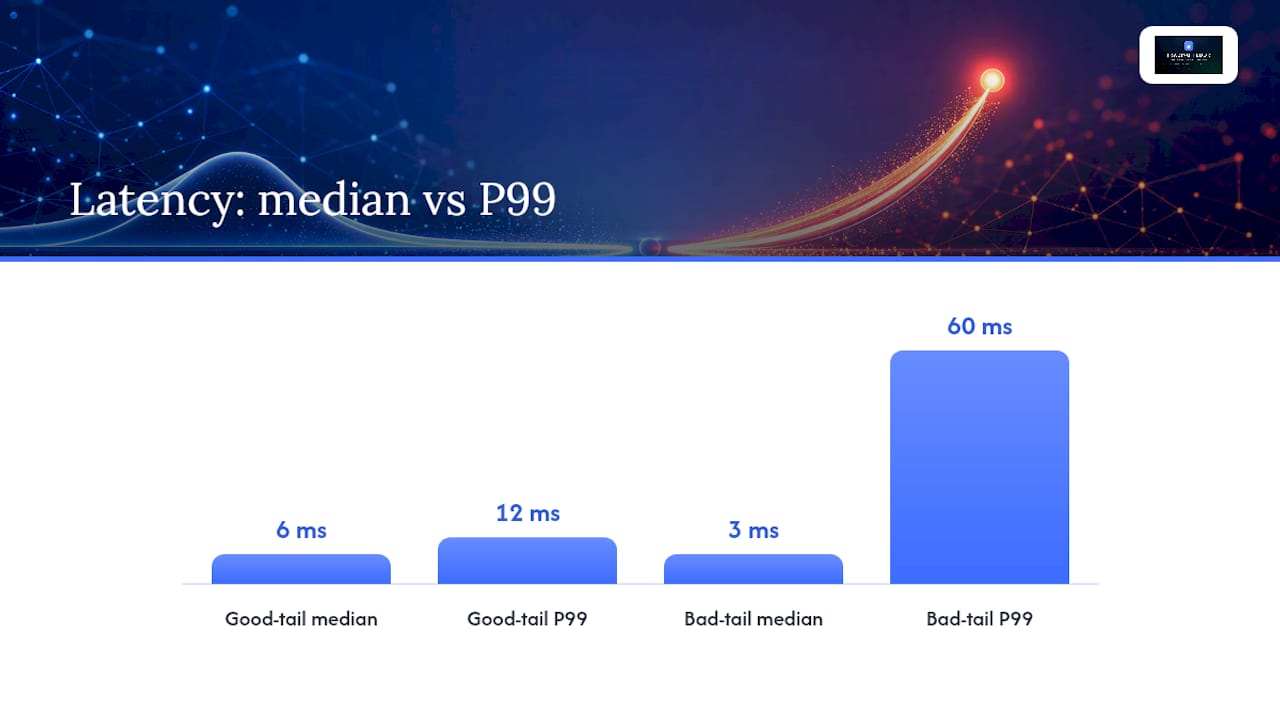
Pro Tip: Don’t chase a lower median latency number if your P99 is still wide. A strategy with a 3ms median and a 60ms P99 tail is riskier than one with a 6ms median and a 12ms P99, because the tail is where drawdown limits actually get hit.
How Trading Floor Approaches Low-Latency Copying
Real-time position mirroring, rather than signal-based copying, removes an entire layer of interpretation delay: the follower account mirrors the master’s net position directly instead of waiting for a separate signal to be generated and parsed. That distinction matters more than it sounds.
A trade copier’s approach can include mitigation steps such as:
- Implementing per-account risk controls that serve as slippage caps and rejection logic for each funded or evaluation account
- Providing push notifications to give traders visibility into fill timing without needing separate monitoring tools
- Offering cloud-based, no-installation access, trading some local-architecture latency advantage for the flexibility to manage accounts across various supported platforms from any device
For a deeper technical breakdown of where the milliseconds actually go inside a copier’s architecture, see how trade copiers actually work.
The Measurement-First Take Most Traders Skip
Most advice on trade-copying latency stops at “get a fast VPS,” which is true but incomplete. The bigger problem is that traders rarely measure the right thing in the first place. A vendor’s advertised average latency tells you almost nothing about how that system behaves during the ten minutes a day when it actually matters, a Fed announcement, a CPI print, a liquidity air pocket right before the close.
Conventional advice treats latency as a single number to shrink. The more useful frame treats it as a distribution with a dangerous tail, and the tail is what blows drawdown limits, not the median. A prop trader running five accounts through the same copier doesn’t get hurt by a 5ms average. They get hurt by the one trade during the one volatile session where the P99 spiked to 80ms and the follower account got filled three ticks worse than the master.
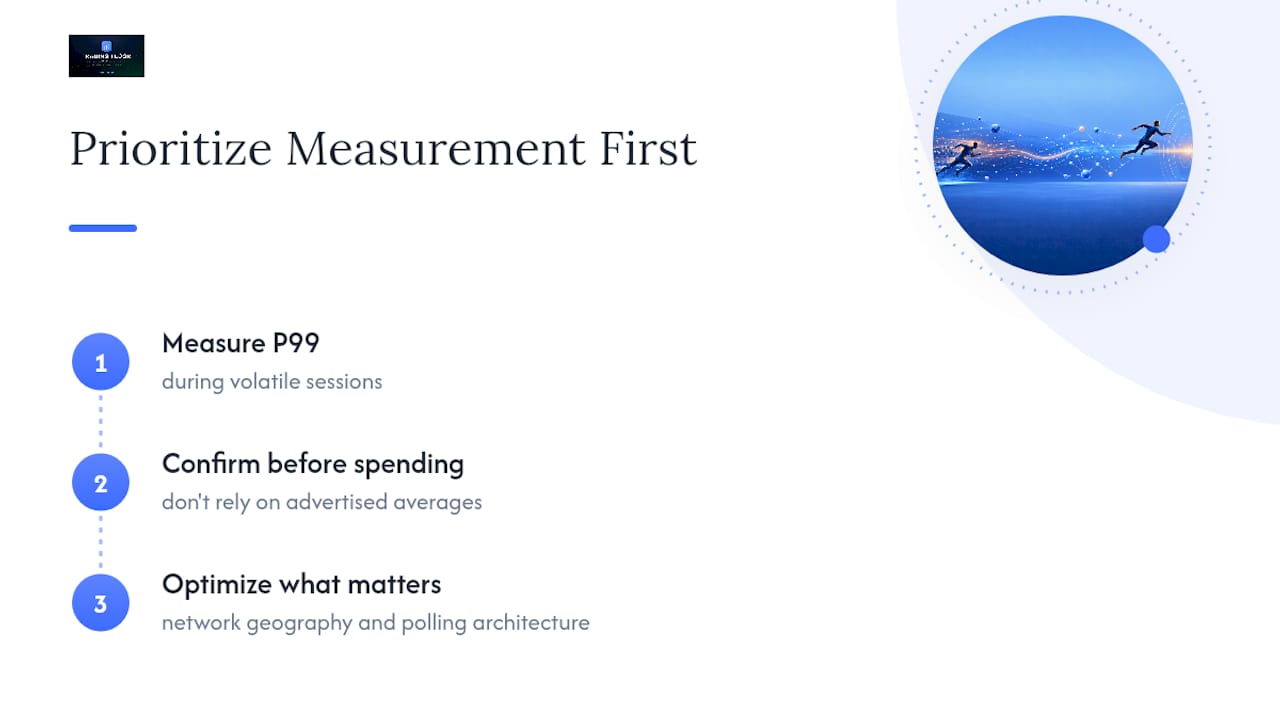
Prioritize measurement before optimization. Know your P99 before you spend money on infrastructure to fix a problem you haven’t confirmed exists. Then attack network geography and polling architecture first, because those two changes affect every single trade you copy, not just the occasional edge case.
— KennyTrades
Copy Positions in Real Time With Per-Account Risk Controls
Trading Floor mirrors your master account’s net position directly across every funded and evaluation account you run, instead of relaying signals that need to be reinterpreted on each follower. That distinction cuts out an entire layer of processing delay for traders managing multiple accounts across Tradovate, TopstepX, and other supported platforms.
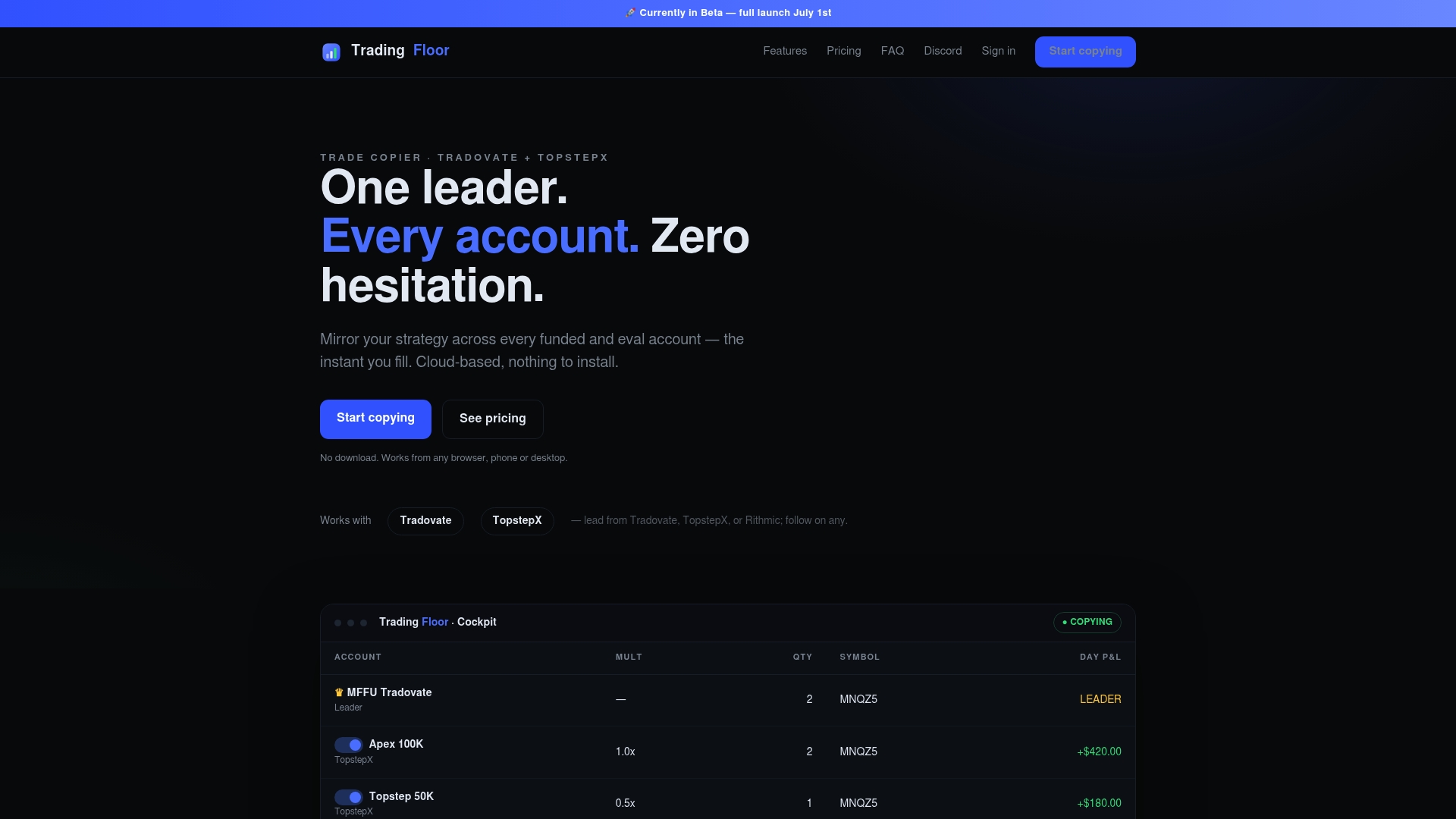
The platform runs in the cloud with no installation required, so you can manage account groups, set per-account trade limits, and get push notifications on fills from any device. That fits prop traders juggling several evaluation accounts who need consistent execution without babysitting each one manually. If you’re managing copy trading across a Take Profit Trader setup or checking whether your prop firm allows copy trading at all, start a trial and see how your fills compare across accounts before committing to a full subscription.
Sources
- Latency and Liquidity Risk (academic paper)
- SIP reporting latency analysis (NBER working paper)
- What and how to measure trading system latency: a P99 acceptance bar for low latency infrastructure
FAQ
What Counts as Good Latency for Trading?
For most futures scalping strategies, end-to-end copier latency under 20 milliseconds at the median is workable, but the more important number is your P99. A system with a clean median and a P99 above 50 to 60 milliseconds during volatile windows still carries real tail risk.
What Does Latency Actually Mean in Trading?
Latency in trading is the time delay between an event, like a price change or an order signal, and the system’s response to it, measured in milliseconds. In trade copying specifically, it’s the gap between the master account’s order and the follower account’s confirmed fill.
Is 40 Milliseconds of Latency Bad?
It depends entirely on the strategy. For a scalping or high-frequency approach, 40 milliseconds can mean a missed tick or a blown drawdown limit; for a swing strategy holding trades for hours or days, 40 milliseconds is functionally irrelevant.
Is Copy Trading Actually Profitable?
Copy trading can replicate a profitable strategy’s results across multiple accounts, but profitability still depends entirely on the underlying strategy’s edge. Latency and slippage during copying can erode that edge, which is why measuring and minimizing delay matters as much as choosing a good strategy to copy in the first place.
Recommended
- Trades Copied Right: Real-Time Mirroring for Prop Traders
- How to Automate Position Copying in Prop Trading
- How trade copiers actually work (and where the milliseconds go)
- How to Copy Trades Across Multiple Prop Firm Accounts Like TopstepX
Trading Floor mirrors every trade across your Tradovate, TopstepX & Rithmic accounts in real time, from $25/mo.
Start copying →