Per-Account Risk Controls: The Role They Play for Multi-Broker Traders

Per-account risk controls stop erroneous or outsized orders before they execute, capping losses at the account level so one account’s mistake never bleeds into another. That matters more the moment you’re running positions across three, five, or ten funded and evaluation accounts at once. Each account carries its own drawdown limit, its own contract cap, its own rules from its own prop firm or broker. A single control setting applied across all of them almost guarantees a violation somewhere.
The immediate payoff is simple:
- Loss containment — a bad fill or fat-finger order gets rejected or capped instead of wiping out an account
- Rule enforcement — each account’s specific limits (daily loss, position size, allowed instruments) stay intact even when you’re copying trades across all of them
- Regulatory alignment — brokers are required to maintain their own pre-trade controls, and your account-level discipline works alongside that framework rather than against it
Get this wrong, and you’re not just risking a blown account. You’re risking every account tied to the same trade.
Key Takeaways
Per-account risk controls work because they enforce each account’s own limits independently, preventing one account’s error or violation from spreading to every other account you trade.
| Point | Details |
|---|---|
| Controls act at two stages | Pre-trade filters stop bad orders before execution; post-trade checks catch what got through. |
| Regulation sets the baseline | SEC Rule 15c3-5 requires broker-dealers to maintain and annually review pre-trade controls under their direct control. |
| Templates need per-account overrides | Start conservative, then customize size limits, loss stops, and slippage caps for each account’s actual rules. |
| Testing beats configuration alone | Simulated erroneous orders and duplicate-order tests, logged and reviewed, prove a control actually works. |
| Tradingfloor enforces controls while mirroring | It copies net positions across funded and evaluation accounts while keeping each account’s individual trade limits and slippage caps active. |
Table of Contents
- The Role Of Risk Controls Per Broker Account In Compliance And Performance
- Essential Risk Controls To Set Up On Every Account
- How To Configure Controls Across Multiple Accounts, Step By Step
- Monitoring And Testing: How Often Should You Review Risk Controls?
- Common Mistakes And A Fast Pre-Launch Checklist
- What Traders Get Wrong About “Set It And Forget It” Controls
- Get Per-Account Controls Working Across Every Broker You Use
- Sources
The Role Of Risk Controls Per Broker Account In Compliance And Performance
Every broker-dealer with market access has to answer to SEC Rule 15c3-5, known as the Market Access Rule. It requires firms to maintain risk management controls and supervisory procedures that limit financial exposure and keep orders compliant with regulatory requirements, and those financial controls have to stay under the broker-dealer’s direct and exclusive control in nearly all cases. That single requirement is why “someone else is watching my risk” is never a safe assumption for a trader running multiple accounts.
The rule exists because regulators wanted to eliminate what the industry calls “naked” or unfiltered market access, letting orders reach an exchange without any check at all. The adopting release for Rule 15c3-5 is explicit that pre-trade controls need to catch erroneous orders and prevent one account’s exposure from becoming a systemic problem.
For you, that translates into two overlapping motivations for setting controls per account:
- Compliance: brokers must review their controls at least annually, and your own account-level settings need to hold up under that same scrutiny.
- Discipline: controls framed as boundaries, not restrictions, let you trade aggressively within a safe zone rather than second-guessing every entry.
Point to note: SEC guidance requires broker-dealers to conduct an annual review of their risk management controls to meet the “direct and exclusive control” standard, ensuring they retain core oversight without outsourcing key risk checks to third parties without proper diligence. The same logic should govern how you treat your own per-account settings when copying trades across platforms.
Researchers at Harvard Business School describe well-built risk controls as boundary systems that let people pursue performance without catastrophic downside. That’s the right mental model here. A tight per-account limit doesn’t slow you down. It just keeps one account’s mistake from becoming five accounts’ mistake.
Essential Risk Controls To Set Up On Every Account
Some controls stop a bad order before it’s placed. Others catch problems after execution. You need both layers, and they need to be configured per account, not applied as one blanket setting across your whole roster.
- Order size and price limits. Cap maximum contract size and set a price collar around the current market so a fat-finger entry or a stale quote can’t slip through.
- Position limits. Set a hard ceiling on open contracts per account, matched to that account’s actual capital and the prop firm’s rules, not your largest account’s rules.
- Daily loss and drawdown stops. Configure automated lockouts that halt new orders once an account hits its daily loss threshold, before a funded account gets flagged for a violation.
- Slippage caps. Reject or flag fills that land outside an acceptable range from the intended price, which matters most on fast-moving futures contracts.
- Duplicate-order prevention. Block repeat submissions caused by a lag, a refresh, or a copier hiccup, since duplicate fills are one of the fastest ways to double your intended exposure.
- Contract multiplier checks. Confirm the multiplier matches what that specific account and instrument require, since a mismatch here can turn a modest trade into an oversized one.
- Real-time alerting. Push notifications the moment an order is rejected, a limit is approached, or an account nears its stop, so you’re not finding out after the fact.
Preventive controls, like size limits and price collars, stop the error at the door. Detective controls, like reconciliation checks, catch what got through. Corrective controls, like automated lockouts, limit the damage once something’s already wrong. Investopedia’s breakdown of risk control types frames it this way, and mapping your own settings against those three categories is a fast way to spot gaps.
Pro Tip: Don’t set the same slippage cap on a thin-liquidity micro contract that you use on a heavily traded index future. The right cap depends on the instrument’s typical spread, not a round number that feels safe.
How To Configure Controls Across Multiple Accounts, Step By Step
Configuring controls one account at a time, from memory, is how gaps happen. A repeatable process closes that gap.
- Audit every account. List each account’s purpose (funded, evaluation, live), its capital, its allowed instruments, and the specific rules its broker or prop firm enforces.
- Build a baseline template. Start with your most conservative account’s settings as the default, since it’s easier to loosen a setting for a larger account than to catch a missed tightening on a smaller one.
- Customize per account. Adjust position size, daily loss stop, and slippage cap to match each account’s actual rules, and document every override in one place.
- Implement in the broker’s UI or middleware. Some platforms expose these settings directly; others require a third-party layer to enforce them consistently across your multiple broker connections.
- Test before full deployment. Run a small live order or a simulated fill through each account’s settings to confirm the limit actually triggers where you expect.
- Document and timestamp. Keep a record of what was set, when, and why, since this becomes your evidence trail if a broker or prop firm ever questions a trade.
A few things to check before you consider the setup finished:
- Are notification routes mapped to the right device or channel for each account?
- Does every account’s contract multiplier match its actual instrument specs?
- Has the emergency stop been tested on at least one account, not just configured?
Trading Floor’s guide to setting risk controls across multiple accounts walks through this exact sequence with screenshots from live account setups, which is worth a look if you’re doing this for the first time.
Monitoring And Testing: How Often Should You Review Risk Controls?
A control you set once and never test again is a control you’re trusting blindly. Real-time monitoring should flag three things immediately: rejected orders that hit a limit, accounts approaching their daily loss threshold, and any mismatch between expected and actual position size after a fill.
Testing effectiveness takes more than watching a dashboard. Simulated erroneous orders, duplicate-order scenarios, and edge-case market moves belong in a periodic test cycle, with results logged and reviewed by whoever owns that account’s controls.
A workable review cadence looks like this:
- Daily: scan alerts and rejected-order logs for anything unusual
- Weekly: spot-check that live settings still match your documented baseline
- Quarterly: run simulated tests against edge cases, including duplicate orders and stale-price scenarios
- Annually: a formal review of every account’s controls, matching the review frequency regulators expect from broker-dealers under Rule 15c3-5.
Important insight: the Market Access Rule’s adopting release emphasizes that the credibility of controls depends on documented and recent testing. Controls not verified periodically lack reliability regardless of their configuration status.
Assign one person, even if that’s just you, as the owner of each account’s control set. Ownership without documentation isn’t ownership.
Common Mistakes And A Fast Pre-Launch Checklist
Most control failures trace back to the same handful of habits. Relying on a broker’s default settings instead of configuring your own is the most common one, since defaults are built for the average account, not yours. Copying one account’s template onto every other account without adjusting for capital or instrument differences is a close second. Missing duplicate-order checks and unclear ownership, where nobody’s actually responsible for reviewing a given account, round out the list.
Before you consider any account live, confirm:
- A documented baseline template exists and every override is recorded
- Position size, slippage cap, and daily loss stop are set per account, not copied blindly
- Duplicate-order prevention is active and has been tested, not just enabled
- Alert routing goes to a channel you actually check
- The emergency stop has been fired at least once in testing
If a breach happens anyway, pause new orders on the affected account first, review the log to find where the control failed, then fix the setting before resuming, not after.
What Traders Get Wrong About “Set It And Forget It” Controls
Most traders treat risk controls as a one-time setup task, something you configure once when you open an account and never touch again. That’s backwards. The accounts that actually stay protected are the ones where someone revisits the settings every time the trading approach changes, a new instrument gets added, or a prop firm updates its rules.
The bigger blind spot is assuming that mirroring trades across accounts automatically means mirroring risk. It doesn’t. A copier that mirrors net position without letting you override limits per account is solving convenience while ignoring the actual risk problem. The tools that get this right treat each account’s constraints as fixed and the trade as the variable that adapts to them, not the other way around.
That distinction is where most of the real damage happens. It’s rarely the trade itself. It’s the assumption that one account’s rules apply everywhere.
Get Per-Account Controls Working Across Every Broker You Use
Manually rebuilding limits, slippage caps, and lockouts on every account every time you place a trade is where most multi-account traders lose time and make mistakes. Tradingfloor mirrors your net position across every funded and evaluation account in real time, on platforms including Tradovate and TopstepX, while keeping each account’s own trade limits, slippage caps, and contract multipliers intact.
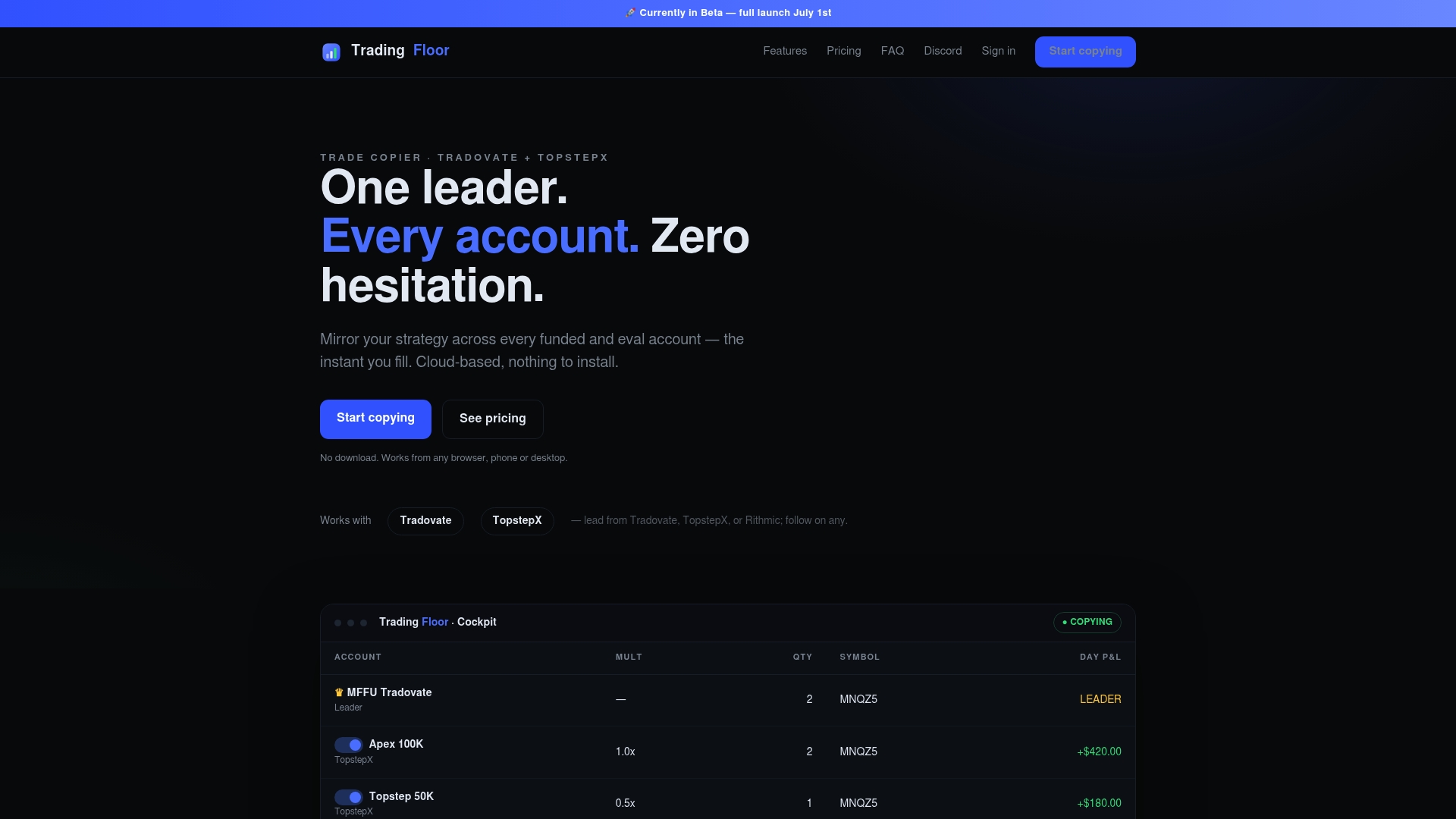
That means a size limit set on your smallest evaluation account never gets accidentally applied to your largest funded one, and a slippage cap tuned for one instrument doesn’t carry over where it doesn’t belong. Real-time notifications flag rejected orders and near-limit accounts the moment they happen, and auto-reconciliation catches mismatches before they compound across your roster. If you’re managing more than one broker connection right now, the Trading Floor trade copier is built specifically for that setup, with per-account controls as a core feature rather than an add-on. Start a free trial and follow the setup guide for multi-account risk controls to have your first accounts configured within the hour.
Sources
- SEC staff guidance — Market Access Rule FAQs
- Final Rule: Risk Management Controls for Brokers or Dealers with Market Access (Adopting release)
- What Is Risk Management & Why Is It Important? | HBS Online
- Risk control — Investopedia
Recommended
- Account-Level Risk Management: A Trader’s Complete Guide — Trading Floor
- Multi-Account Trade Execution Explained for Prop Traders — Trading Floor
- Evaluation Account Management Best Practices for Prop Traders — Trading Floor
Trading Floor mirrors every trade across your Tradovate, TopstepX & Rithmic accounts in real time, from $25/mo.
Start copying →