Cloud Storage's Role in Trading History for Prop Traders
Cloud-hosted trade history and durable event logging are the operational backbone that lets prop traders mirror net positions reliably across multiple funded and evaluation accounts. When your fills, journals, and position states live in a synchronized cloud layer instead of a single desktop terminal, you get consistent execution across accounts, audit-ready logs the moment a prop firm asks for them, and a recovery path when a connection drops mid-session.
The immediate operational wins are straightforward:
- Fills stay consistent across every funded and evaluation account you run.
- Every position change gets logged the instant it happens, ready for audit or dispute.
- Journals and trade notes live in one place instead of scattered across broker platforms.
Trading Floor is built around exactly this model. Rather than copying trade signals, it mirrors a leader’s net position across any connected funded or evaluation account, which means the follower account always reflects the actual position size and direction, not just a duplicated order.
Key Takeaways
Cloud-hosted, append-only trade history with real-time reconciliation is what lets prop traders run multiple funded accounts without manual drift or compliance gaps.
| Point | Details |
|---|---|
| Cloud sync beats local copiers | Off-device operation avoids single-machine failures that stall multi-account trading. |
| Durable logs enable recovery | Append-only write-ahead logs plus snapshot and replay prevent lost or ghost positions. |
| Retention has two rules | NFA requires five-year storage with the most recent two years readily accessible. |
| Reconciliation must be automatic | Continuous broker-state diffs catch mismatches before they compound across accounts. |
| Trading Floor mirrors net positions | It syncs real positions, not signals, across Tradovate, TopstepX, and other funded accounts with per-account risk controls. |
Table of Contents
- The Role of Cloud Storage in Trading History Management
- What Must the Cloud Layer Guarantee for Trade Data?
- How Do Regulatory Recordkeeping Rules Apply to Cloud Trading Data?
- Which Operational Controls Keep Multi-Account Trading Reliable?
- How Should You Evaluate a Cloud Trade-History Solution?
- How Does Cloud Storage Affect Data Accessibility and Latency?
- What Security Measures Protect Cloud-Stored Trading History?
- What Are the Cost and Scalability Benefits of Cloud Storage?
- How Does Cloud Storage Integrate With Algorithmic Trading Workflows?
- What Compliance Challenges Come With Cloud-Stored Trading History?
- What Do Real Cloud Trade-History Implementations Look Like?
- Mirror Trades Across Every Account Without the Manual Reconciliation
- Sources
The Role of Cloud Storage in Trading History Management
Cloud storage does more than back up your trade data. It becomes the shared source of truth that every connected account reads from and writes to, which is what makes multi-account trading manageable instead of chaotic.
Cloud synchronization reduces execution drift because every follower account pulls from the same event stream instead of relying on a local script polling in isolation. When one account’s fill lags behind another’s, you get slippage between what should be identical positions. Cloud-based trade copiers mirror orders or net positions in near real time, which keeps P&L comparisons across accounts meaningful rather than a coin flip on timing.
Uptime matters more than shaving milliseconds off latency for most prop strategies. A copier tied to one machine dies the moment that machine loses power, updates its operating system, or the trader closes the laptop lid. Cloud-hosted synchronization keeps running independent of any single device, which is the practical reason it beats desktop-only copiers for traders juggling multiple evaluation accounts at once.
Centralized journaling closes the loop. When every trade, note, and screenshot lands in one searchable history, reviewing a losing week takes minutes instead of cross-referencing three broker exports.
- Pull a week’s trades from the cloud journal instead of five separate platform exports.
- Tag entries by setup type to see which patterns actually make money.
- Export the same data directly for tax reporting or a prop firm dispute.
Pro Tip: Tag your journal entries by account and strategy the moment you place a trade, not at the end of the week. Retroactive tagging is where most traders lose the details that actually explain a losing streak.
What Must the Cloud Layer Guarantee for Trade Data?
Not all cloud sync is built the same, and the difference shows up exactly when you need it most: during a disconnect, a broker outage, or a compliance request. A few technical guarantees separate a system you can trust with real capital from one that quietly drifts out of sync.
Append-only write-ahead logs. Every order and position event needs to be written to a durable log before the system acts on it, not after. Production trading architecture should persist every critical event to a durable append-only log so a crash mid-trade doesn’t erase the record of what was supposed to happen.
Sequence numbers and trace IDs. Monotonic sequence numbers, paired exchange and receive timestamps, and a trace ID on every event let you reconstruct exactly what happened and in what order, even across multiple accounts on different brokers.
Snapshot and replay recovery. Full master-book snapshots with sequence numbers act as checkpoints. Declarative snapshots with guarded adoption rules prevent drift by making sure a follower account doesn’t accidentally close a position based on an incomplete message.
Reconciliation against broker state. The system should query each broker’s actual account state, diff it against the internal record, and alert automatically on any mismatch.
| Guarantee | What It Protects Against |
|---|---|
| Append-only event log | Lost or overwritten trade records after a crash |
| Sequence numbers + trace IDs | Out-of-order events causing false position reads |
| Snapshot + replay | Permanent drift after a missed message |
| Automated reconciliation | Silent mismatches between broker and internal state |
These aren’t nice-to-haves buried in engineering documentation. They’re the difference between a copier that recovers cleanly from a dropped connection and one that leaves you holding a ghost position you didn’t know existed.
How Do Regulatory Recordkeeping Rules Apply to Cloud Trading Data?
The National Futures Association sets the baseline every prop firm and futures trader operating in the US needs to know. NFA guidance allows required books and records to be stored electronically for the full five-year retention period, provided those records are indexed, date-stamped, convertible to hard copy on request, and readily accessible for the most recent two years.
That last part is where most casual setups fail. A trade journal scattered across screenshots and spreadsheet tabs isn’t “readily accessible” in any exam-ready sense. A cloud archive with searchable, timestamped entries is.
Practical checklist for staying exam-ready:
- Keep every fill and position change indexed by date and account, not just logged in raw order.
- Store confirmations in a format you can export to hard copy without reformatting.
- Maintain records in English with reporting in US dollars, consistent with NFA member expectations.
- Keep a designated compliance contact who can pull two years of records on short notice.
- Retain the underlying data for the full five-year window even after it ages out of daily use.
Cloud storage doesn’t just satisfy this requirement. It makes the difference between scrambling before an audit and pulling a clean export in under a minute.
Which Operational Controls Keep Multi-Account Trading Reliable?
Storage alone doesn’t protect your accounts. The controls built on top of it do the real work of catching problems before they become account-ending mistakes.
- Set per-account risk limits. Daily loss caps, maximum open positions, and slippage tolerances should be configured individually per account, not applied as one blanket setting across every funded account you run.
- Enable real-time alerts. The system should notify you the moment a reconciliation check finds a mismatch or a sequence gap appears in the event log, and auto-suspend copying to that account until resolved.
- Build off-site, geographically separate backups. Business continuity planning should include off-site backups and geographically separate systems with periodic testing, so a regional outage doesn’t take every account offline at once. A cloud disaster recovery strategy built around geographic separation is worth reviewing before you scale past a handful of accounts.
- Keep journals searchable and tagged. Investigations and performance reviews move fast when you can filter by account, strategy, or date range instead of reading raw logs line by line.
Pro Tip: Run a disconnect simulation once a month, even when everything is working fine. The first time you test recovery shouldn’t be during an actual outage with real capital on the line.
How Should You Evaluate a Cloud Trade-History Solution?
Vendor selection or an internal deployment review comes down to a short list of hard questions. Skip any of these and you’re trusting the system blind.
- Ask for the recovery mechanism. Durable logging plus snapshot and replay recovery isn’t optional, and you should get a straight answer on mean time to recovery, not a vague assurance.
- Confirm multi-broker support and account mapping. If you run accounts across Tradovate, TopstepX, and Rithmic, the system needs to map each one correctly without manual reconfiguration every time you add an account.
- Check for net-position mirroring, not just signal copying. Mirroring the leader’s actual position size protects you from a follower account drifting out of sync on partial fills.
- Verify audit and export tools exist for compliance. You should be able to pull an indexed, timestamped export without contacting support.
- Run a simulated disconnect and reconciliation drill before committing real capital across every account.
Pro Tip: Ask any vendor what happens to open positions during a reconnect, specifically. Their answer tells you more about the architecture than any feature list will.
How Does Cloud Storage Affect Data Accessibility and Latency?
The tradeoff is real, and worth being honest about: cloud sync introduces a small amount of latency compared to a copier running entirely on one local machine talking directly to a broker’s API. That latency is usually measured in milliseconds, not seconds.
What you get in exchange is accessibility that a local setup simply can’t match. Your trade history, journal, and live positions are reachable from any device, at any location, without needing the specific machine that originally ran the trade. Trade copiers tied to local terminals create single points of failure; a laptop crash, an update that reboots mid-session, or a lost internet connection at your desk shouldn’t be the reason a funded account misses a fill.
For most prop and futures trading strategies, especially those holding positions for minutes or hours rather than scalping on tick-level timing, the resilience trade is the right one. Uptime and consistency matter more than shaving off a few milliseconds when the alternative is a copier that goes dark the moment your machine has a problem.
The practical result is that you can check position status from a phone during a meeting, confirm a fill from a different city, or hand off monitoring to a partner without physically handing over a laptop. Accessibility, not raw speed, is the metric that actually protects your accounts day to day.
What Security Measures Protect Cloud-Stored Trading History?
Trading history is financial data with real consequences if it leaks or gets tampered with. It shows your positions, your account balances, your strategy patterns, and in a prop context, potentially the trading approach of multiple funded traders at once.
Encryption in transit and at rest is the baseline, protecting data as it moves between your trading platform and the cloud storage layer, and while it sits there afterward. Access controls matter just as much: only the accounts and services that need to read a specific data stream should be able to touch it, with authentication that doesn’t rely on a single shared password across your whole operation.
Append-only logging itself is a security feature, not just a durability one. If historical records can’t be edited after the fact, that removes an entire category of tampering risk, whether from an outside actor or an internal mistake. Combined with sequence numbers and trace IDs, an append-only design means any attempt to alter history leaves a visible gap that reconciliation checks will catch.
Financial data security standards give a useful framework for evaluating any cloud provider handling trading records, covering encryption practices, access logging, and incident response expectations that go beyond what a general-purpose backup service offers. Reviewing how a financial data security standard approaches these controls is a reasonable step before trusting a vendor with multi-account trading history.
What Are the Cost and Scalability Benefits of Cloud Storage?
Running your own storage infrastructure for trading history means paying for servers, maintenance, and redundancy whether you’re actively trading five accounts or fifty. Cloud storage flips that equation: you scale the resource to match the accounts you’re actually running.
For a prop trader moving from two evaluation accounts to eight funded accounts, the cost difference between self-hosted infrastructure and cloud storage is stark. Self-hosting means provisioning for peak load and redundancy from day one. Cloud-based systems let you add accounts incrementally, paying for the capacity you use as your operation grows rather than over-building upfront.
Scalability isn’t only about account count. It’s about data volume. A trader logging a year of tick-level fills, journal entries, and reconciliation records across a dozen accounts generates a meaningful amount of data, and cloud storage handles that growth without requiring a hardware upgrade or a migration project. The subscription model that most cloud trading tools use, Trading Floor included, reflects this: you pay based on your account tier, not based on guessing your future data needs and buying hardware for it.
The scalability benefit compounds when you’re adding broker platforms, not just accounts. A cloud layer that already handles Tradovate and TopstepX integration absorbs a new platform far more cheaply than a locally hosted system would, because the underlying storage and reconciliation logic doesn’t need to be rebuilt per platform.
How Does Cloud Storage Integrate With Algorithmic Trading Workflows?
Algorithmic strategies generate orders faster and more frequently than manual trading, which makes durable, low-latency data storage even more critical. An algo that can’t reliably log its own decisions and the resulting fills is flying without a black box, and reconstructing what happened after a bad session becomes guesswork.
Cloud-hosted trade history gives algorithmic systems a consistent source of truth across every account the strategy touches. When an algorithm runs across multiple funded accounts simultaneously, it needs to know the current position state on each one before deciding whether to open, add to, or close a position. Pulling that from a synchronized cloud layer rather than querying each broker individually reduces the chance that stale data drives a bad decision.
Reconciliation becomes especially important for algo-driven multi-account setups, because a mismatch between what the algorithm believes its position is and what the broker actually shows can compound quickly across dozens of trades per day. Automated reconciliation checks that run continuously, rather than at the end of a session, catch these mismatches before they turn into a meaningful loss.
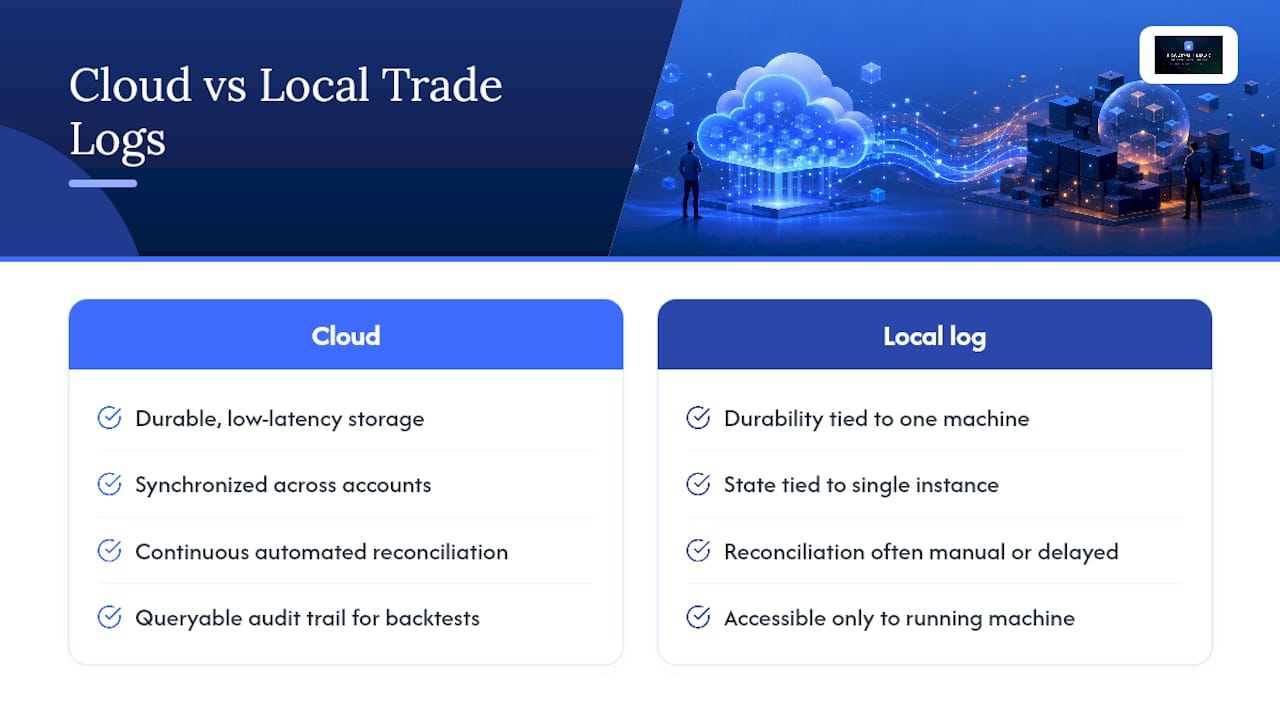
Cloud storage also gives algorithmic traders a practical audit trail for strategy refinement. Every signal, every fill, and every reconciliation event gets logged in a queryable format, which means backtesting against real execution history, not just simulated data, becomes possible. That’s a distinctly different value than a local log file that only the machine running the algorithm can access.
What Compliance Challenges Come With Cloud-Stored Trading History?
Storing trading history in the cloud doesn’t automatically satisfy regulatory requirements. The challenge most prop traders underestimate is that accessibility and retention are two separate obligations, and a cloud provider that handles one well doesn’t necessarily handle the other.
The NFA’s five-year retention rule requires records to remain readily accessible for the most recent two years, which means a cloud archive that only supports fast retrieval for the last thirty days creates a real gap. Verify retrieval speed for records approaching the two-year mark, not just recent ones.
A second challenge is data sovereignty and provider reliability. If your cloud storage provider experiences an outage or gets acquired and migrates infrastructure, your access to historical records during that transition period matters. Building in redundant export routines, pulling periodic backups into a format you control, is a reasonable hedge against relying entirely on one provider’s continuity.
The solution to both challenges is the same principle: treat compliance as an ongoing operational check, not a one-time setup. Schedule a quarterly review where you actually attempt to pull a record from eighteen months back and confirm the export process still works cleanly. Firms that only discover a retrieval gap during an actual NFA exam are firms that skipped this step.
What Do Real Cloud Trade-History Implementations Look Like?
A prop trader running multiple funded accounts across several different platforms, Tradovate, TopstepX, and a Rithmic-connected broker, represents the kind of setup where cloud storage stops being optional. Manually reconciling fills across three separate broker interfaces at the end of each trading day isn’t sustainable past two or three accounts, let alone six.
In that kind of setup, a cloud-based copier that mirrors net positions in real time replaces what would otherwise be a full-time reconciliation job. The trader places one trade, the system mirrors it proportionally across every connected account based on each account’s sizing rules, and the resulting fills land in a single searchable journal rather than three disconnected platform histories.

The failure mode this solves is a familiar one: a trader manually copying trades across accounts misses one entry on a busy morning, and by the time they notice, one evaluation account is out of sync with the rest. Cloud-based copying platforms with account-level sizing rules and detailed logs catch that kind of drift immediately through reconciliation checks, rather than the trader discovering it during a weekly review.
Why treat cloud history as part of execution, not just archiving
Most traders think of trade history as paperwork you deal with after the fact. It’s not. Ordering guarantees and reconciliation are execution infrastructure, on the same level as your broker connection. Stage any migration to a cloud copier gradually, and measure drift and recovery time on paper accounts before trusting it with funded capital.
— KennyTrades
Mirror Trades Across Every Account Without the Manual Reconciliation
Trading Floor is built to handle everything this guide just walked through: durable position mirroring, per-account risk controls, and audit-ready logs, without you managing the infrastructure yourself.
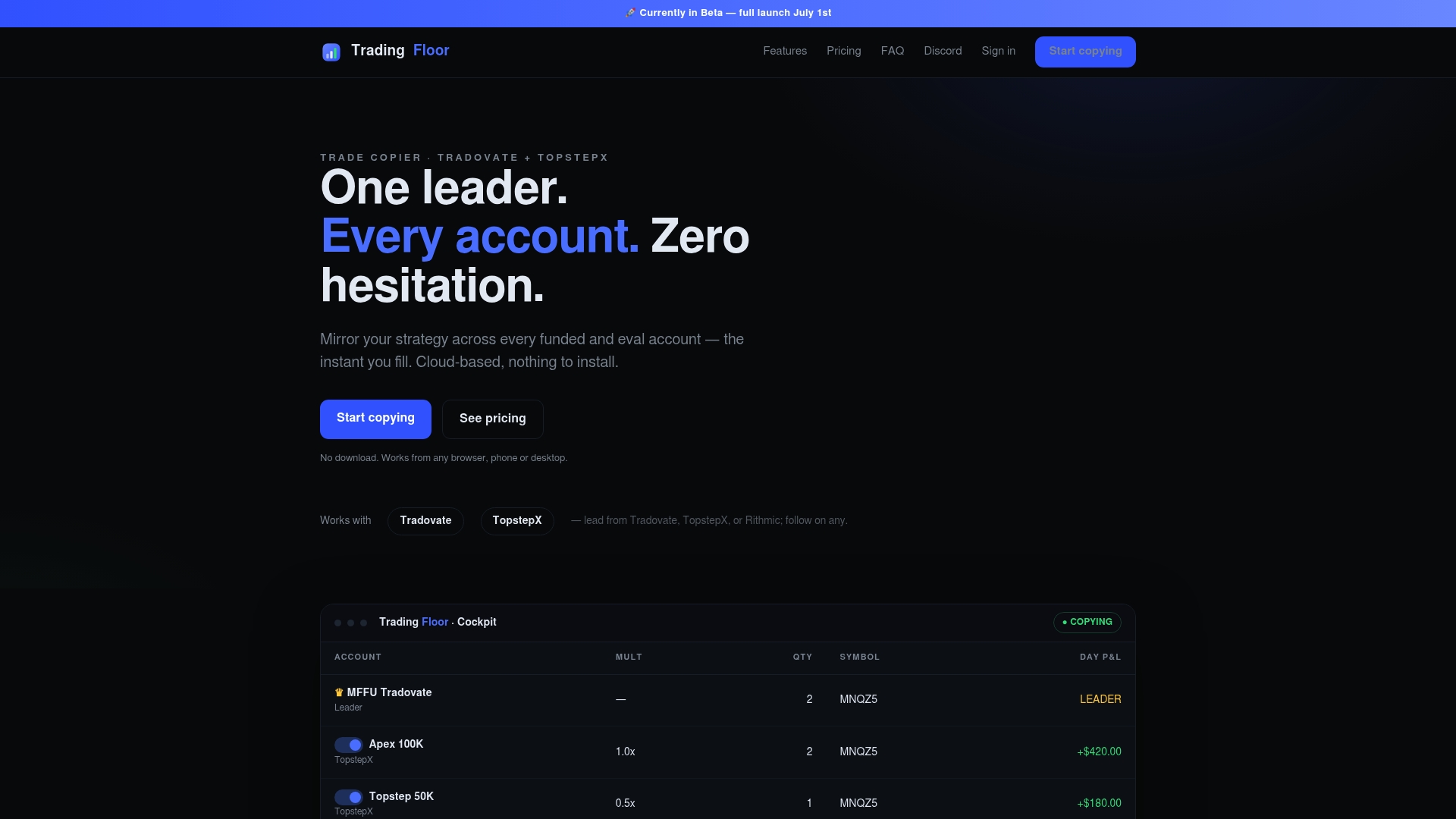
Instead of copying signals and hoping the sizing works out, Trading Floor mirrors the leader’s actual net position across every connected funded or evaluation account, on Tradovate, TopstepX, and other supported platforms. Each account keeps its own trade limits, slippage caps, and daily loss controls, so one aggressive account doesn’t drag down the rest. Real-time notifications flag a mismatch the moment it happens instead of leaving you to discover it during a weekly reconciliation.
If you’re running multiple accounts on Take Profit Trader or checking whether your prop firm allows copy trading, start with a 30-day trial to see how position mirroring and audit logs hold up against your actual trading volume before committing to a subscription.
Sources
- NFA regulatory requirements guide
- Cloud-Based Trade Copiers Are Changing Multi-Account Futures Trading
- Automated futures trading architecture: production system design for 7 decoupled layers
Recommended
- Tradecopia.com Alternatives for Prop Traders in 2026 — Trading Floor
- Why Cloud Trading Apps Outperform Desktop Platforms — Trading Floor
- Best Cloud-Based Trading Assistants for Prop Traders 2026 — Trading Floor
- Centralized Trade Management for Prop Traders: 2026 Guide — Trading Floor
Trading Floor mirrors every trade across your Tradovate, TopstepX & Rithmic accounts in real time, from $25/mo.
Start copying →